


Armenia Raises Peacekeeper 'Problems' with Putin, Fears Escalation

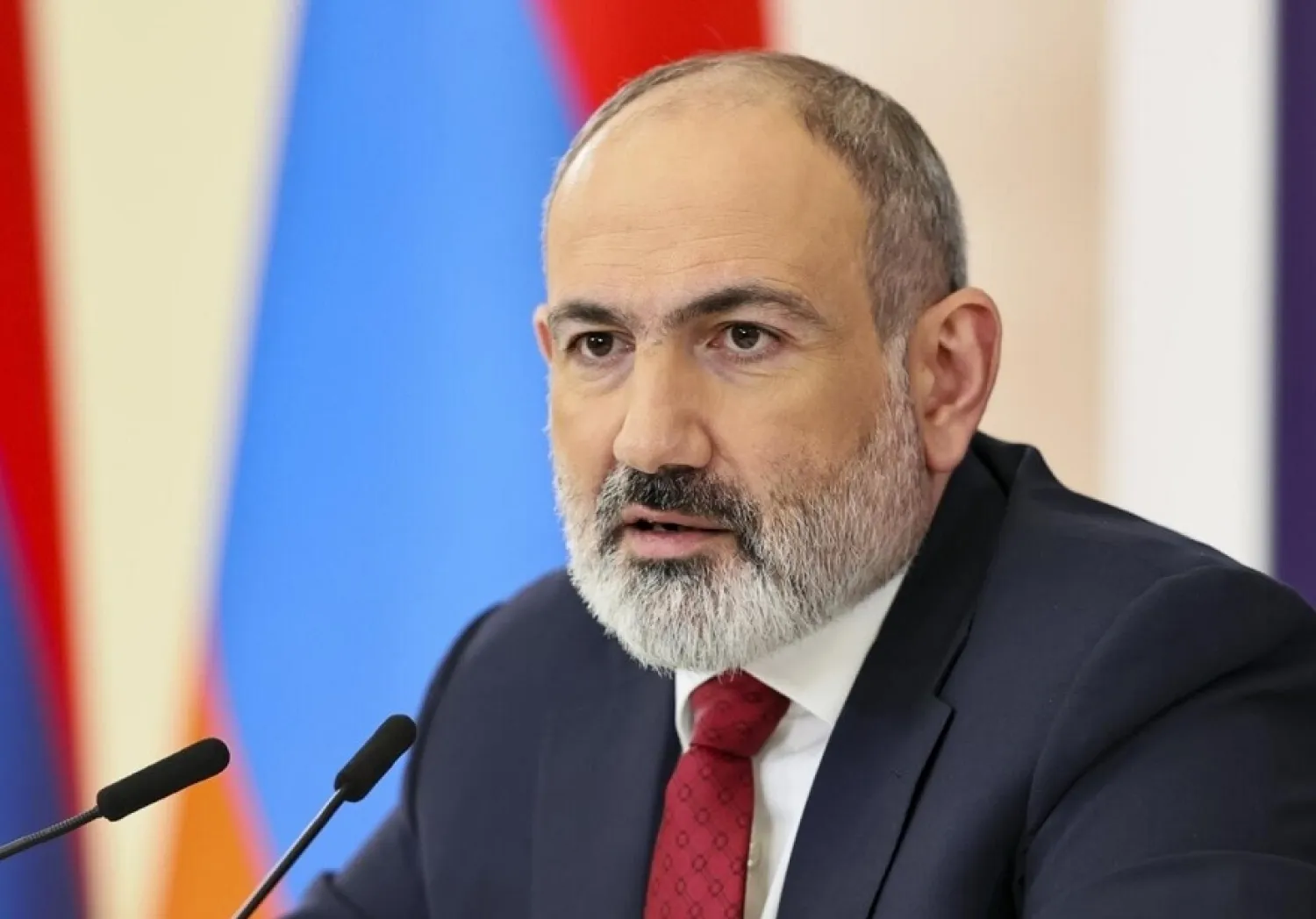
Armenian Prime Minister Nikol Pashinyan gestures during a news conference in Yerevan, Armenia, Tuesday, March 14, 2023. Tigran Mehrabyan, AP
TT

Armenia Raises Peacekeeper 'Problems' with Putin, Fears Escalation

Armenian Prime Minister Nikol Pashinyan gestures during a news conference in Yerevan, Armenia, Tuesday, March 14, 2023. Tigran Mehrabyan, AP

Armenian Prime Minister Nikol Pashinyan said Tuesday he had complained to President Vladimir Putin about "problems" with Russian peacekeepers in Nagorno-Karabakh, warning of an escalation in the restive Caucasus region.

Armenia and Azerbaijan have fought two wars for control of the Armenian-majority region and the latest conflict in 2020 ended with the deployment of Moscow's forces, said AFP.

Pashinyan's comments are the latest sign that Armenia, which relies on Russia as a security guarantor, is growing frustrated with the Kremlin whose attention is focused on Ukraine and confrontation with the West.

"In a phone conversation with Putin yesterday, I spoke of a possible escalation in Nagorno-Karabakh and said that there are problems in the zone where Russian peacekeepers are responsible," Pashinyan said during a press conference.

"Azerbaijan's rhetoric is becoming more and more aggressive every day," he said, denouncing a blockade of the so-called Lachin corridor, which is Karabakh's sole land link with Armenia.

Since mid-December, a group of self-styled Azerbaijani environmental activists has barred traffic in the Lachin corridor to protest what they say is illegal mining.

Pashinyan on Tuesday described the disruptions along the route as "preparation for ethnic cleansing of Armenians."

- Waning influence -

Yerevan has claimed that the blockade has led to a humanitarian crisis and was aimed at driving Armenians from Karabakh, which Baku has denied.

Armenia, which hosts a permanent Russian military base on its territory, is a member of the Collective Security Treaty Organisation (CSTO) that includes several pro-Moscow ex-Soviet republics -- but not Azerbaijan.

Last week Yerevan refused to assume the rotating top post in the security bloc -- partly in a show of frustration over the peacekeepers' failure to prevent Karabakh's blockade.

"It is not that Armenia is leaving the CSTO, the CSTO is leaving Armenia, which is of great concern to us, Pashinyan said.

Yerevan's distancing from the bloc marked another sign of Russia's waning authority in its traditional sphere of influence.

At least three Armenians died in the latest border clashes at the beginning of March.

"I want to underline that this happened in the zone of responsibility of Russian peacekeeping forces. This worries us," Pashinyan said Tuesday.

- Progress, problems, red lines -

Pashinyan also said that Armenia recently received Baku's response to proposals for a full peace treaty, which Yerevan submitted in mid-February.

He noted some progress in the peace process, but said "fundamental problems" remain because "Azerbaijan is trying to put forward territorial claims, which is a red line to Armenia."

Yerevan has accused Baku forces of occupying -- after the 2020 war -- some 150 square kilometers in Armenia, along the countries' shared border.

On February 20, the European Union deployed an expanded monitoring mission to Armenia's volatile border area as Western engagement grows in the region seen by the Kremlin as its geopolitical backyard.

When the Soviet Union collapsed in 1991, ethnic Armenian separatists in Karabakh broke away from Azerbaijan. The ensuing conflict claimed around 30,000 lives.

Another flare-up in violence in 2020 left more than 6,500 dead and ended with a Russian-brokered truce.

Under the deal Armenia ceded territories it had controlled for decades and Russia deployed its peacekeeping contingent to oversee the fragile ceasefire.



Iran Says Redirects US-sanctioned Oil Tanker to Its Shores

FILE PHOTO: An aerial view of the Iranian shores and the island of Qeshm in the strait of Hormuz, December 10, 2023. REUTERS/Stringer/File Photo
TT

Iran Says Redirects US-sanctioned Oil Tanker to Its Shores

FILE PHOTO: An aerial view of the Iranian shores and the island of Qeshm in the strait of Hormuz, December 10, 2023. REUTERS/Stringer/File Photo

Iran said on Friday it redirected a US-sanctioned oil tanker carrying Iranian oil back to its shores, though it was unclear from its statement why it would have returned it, reported AFP.

"The Islamic Republic of Iran's navy, through a specially planned operation in the Sea of Oman, seized the offending tanker Ocean Koi," the army said in a statement carried by state television, adding that the oil belonged to Iran.

It said the ship was redirected to Iran's southern shores after it sought "to damage and disrupt Iran's oil exports," without elaborating.


Meloni Meets Rubio as Iran War Strains Italy-US Ties

US Secretary of State Marco Rubio leaves the San Damaso courtyard after meeting Pope Leo XIV at the Vatican, May 7, 2026. REUTERS/Yara Nardi
TT

Meloni Meets Rubio as Iran War Strains Italy-US Ties

US Secretary of State Marco Rubio leaves the San Damaso courtyard after meeting Pope Leo XIV at the Vatican, May 7, 2026. REUTERS/Yara Nardi

Italian Prime Minister Giorgia Meloni met US Secretary of State Marco Rubio on Friday at a moment of unusual strain between her government and President Donald Trump's administration, driven largely by the war with Iran.

Rubio is in Italy for a two-day trip aimed at easing ties with Pope Leo after unprecedented attacks on the pontiff by Trump, while also addressing Washington's frustration over Italy's refusal to support the US-Israeli war on Iran.

Meloni had been one of Trump's firmest supporters in Europe, cultivating close ties with him and presenting herself as a natural ‌bridge between Washington ‌and other EU states that had no natural political ‌affinity ⁠with the Republican ⁠US leader.

But that alignment has come under increasing strain in recent months, as the Iran war has forced her to balance loyalty to the United States against Italian public animosity to the war and the growing economic cost of the conflict.

Before heading to the prime minister's office, Rubio met Italy's Foreign Minister Antonio Tajani, who said the talks had been positive.

"I am convinced ⁠that Europe needs America, Italy needs America, but the United ‌States also needs Europe and Italy," Tajani ‌told reporters.

Meloni and Rubio were expected to discuss the situation in the Gulf, as ‌well as Russia's war on Ukraine, US tariffs on European goods and ‌the outlook for Cuba, which Washington is seeking to isolate both diplomatically and economically.

TRUMP'S ATTACKS ON POPE

The Italians will also be keen for a readout on Rubio's meetings at the Vatican. Trump's recent attacks on Pope Leo crossed a sensitive ‌line in overwhelmingly Catholic Italy and prompted Meloni to call them "unacceptable."

Her criticism in turn drew a sharp rebuke ⁠from Trump, who said ⁠she lacked courage and had let Washington down. He subsequently threatened to withdraw US troops from Italy.

Meloni said on Monday she would not support such a move, but acknowledged that the decision "doesn't depend on me".

Italy last month refused to allow US aircraft to use the Sigonella air base in Sicily for combat operations linked to the Iran conflict. Italian officials have said Washington had not sought prior authorization from Rome for the use of the site.

Defense Minister Guido Crosetto, a close Meloni ally, later warned that the Iran war was putting US global leadership at risk and said he feared the "madness" of nuclear escalation.

Pollsters say Meloni's ties to Trump could prove a potential liability with voters ahead of national elections due next year.


Trump Says Ceasefire Still Holds after Fighting Between the US and Iran Flares

US President Donald Trump looks on as he speaks to reporters near the Lincoln Memorial Reflecting Pool as it undergoes renovations, in Washington, D.C., US, May 7, 2026. REUTERS/Kylie Cooper
TT

Trump Says Ceasefire Still Holds after Fighting Between the US and Iran Flares

US President Donald Trump looks on as he speaks to reporters near the Lincoln Memorial Reflecting Pool as it undergoes renovations, in Washington, D.C., US, May 7, 2026. REUTERS/Kylie Cooper

US and Iranian forces clashed in the Gulf, but President Donald Trump said a ceasefire was still holding despite the flare-up, which dented hopes for a swift diplomatic resolution to the crisis.

The escalation came as Washington awaited Tehran's response to a US proposal to end the war, which began on February 28 when the US and Israel launched airstrikes on Iran.

Trump said on Thursday three US Navy destroyers were attacked as they moved through the Strait of Hormuz, a conduit for around a fifth of the world's oil and liquefied natural gas flows that Iran has all but closed since the conflict began.

"Three World Class American Destroyers just transited, very successfully, out of the Strait of Hormuz, under fire. There was no damage done to the three Destroyers, but great damage done to the Iranian attackers," Trump wrote on Truth Social.

He later told reporters the ceasefire remained in effect and played down the exchange.

"They trifled with us today. We blew them away," Trump said in Washington.

Iran, however, accused the United ⁠States of breaching ⁠the ceasefire, an agreement that has been punctuated by intermittent clashes since it was announced on April 7.

Iran's top joint military command said US forces had targeted an Iranian oil tanker and another ship, and carried out air attacks on civilian areas on Qeshm Island in the Strait of Hormuz and nearby coastal areas. It said Iranian forces responded by attacking US military vessels east of the strait and south of the port of Chabahar.

A spokesperson for Iran's Khatam al-Anbiya Central Headquarters said the Iranian strikes inflicted "significant damage," but US Central Command said none of its assets were hit.

Iranian state media later signaled a de-escalation, with Press TV reporting that, after several hours of exchanges, "the situation on Iranian islands and coastal cities by the Strait of Hormuz is back to normal now."