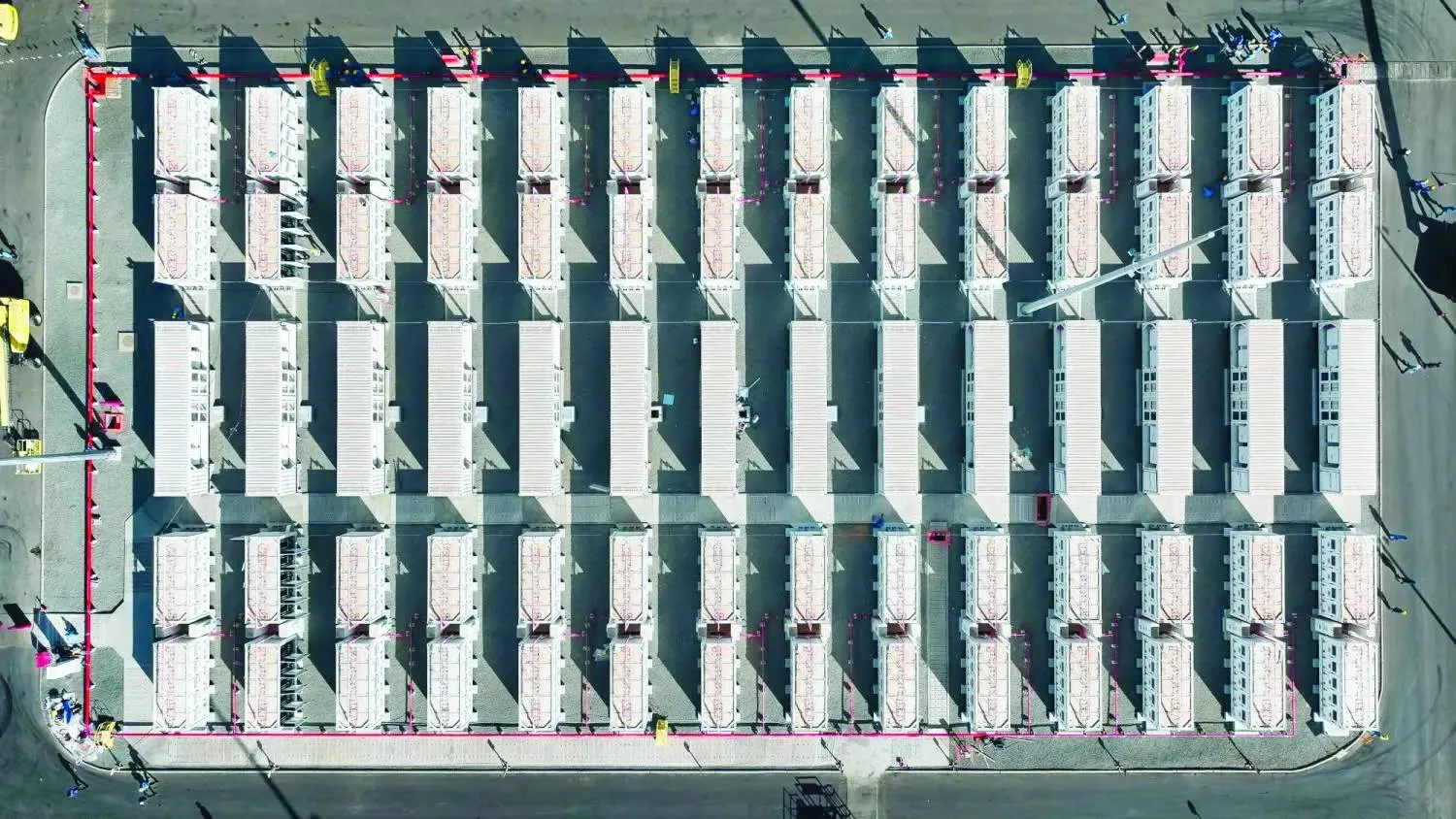
As solar and wind projects reshape Saudi Arabia's energy landscape, a new market is taking shape, focused on electricity storage. As reliance on renewable energy sources expands, batteries are emerging as a critical component of the system, storing electricity when it is available and feeding it back into the grid when demand rises.
This shift is not limited to adding a new technology to the power sector. It is gradually establishing a standalone investment activity in which batteries are evolving from a supporting solution for renewable energy projects into part of the infrastructure needed to manage electricity and enhance grid flexibility and reliability.
Saudi Arabia is taking another step in this direction with the Saudi Power Procurement Company signing four agreements for independent battery energy storage projects, with a total capacity of 2,000 megawatts for four hours and investments exceeding 4.35 billion riyals ($1.16 billion). The agreements were signed in the presence of Prince Abdulaziz bin Salman, Minister of Energy, Minister of Industry and Mineral Resources, and Chairman of the company's board of directors.
Four Projects Shaping the Storage Market
The first group includes three projects signed with a consortium comprising Saudi Energy Company, ACWA Power, and Al Sharif Contracting and Commercial Development. The projects are Al Muwayh and Hadn in Makkah Province, and Al Kahfa in Hail Province, each with a capacity of 500 megawatts for four hours.
The group also includes the Al Khashibi project in Qassim Province, with the same capacity. Its agreement was signed with a consortium comprising ENGIE and Alhaj Abdullah Ali Reda & Co. Ltd.
These projects are part of the first group of energy storage projects being developed under a build, own and operate model, as part of the energy sector's efforts to enhance the reliability and efficiency of electricity generation in Saudi Arabia.
"Storage" Strengthens Renewable Energy
In an analysis of the project, Dr. Mohammed Al-Sabban, a former senior adviser to the Saudi oil minister, told Asharq Al-Awsat that this approach addresses the energy sector's needs for the next phase, amid the rapid expansion of renewable energy sources.
He explained that battery energy storage is a key driver in strengthening the role of renewable energy sources, particularly solar and wind, within Saudi Arabia's electricity generation system.
Al-Sabban said the importance of storage stems from the nature of renewable energy sources, as the energy they generate is typically available within a limited period of no more than four hours. Storing this energy in batteries therefore plays an important role in extending the period during which it can be used and making it available to meet electricity sector needs at later times.
He noted that the current capacity, despite its importance, remains insufficient on its own given weather fluctuations and the limited period during which solar energy can be utilized, particularly after sunset. This further underscores the importance of these projects in the next phase to improve the efficiency of renewable energy utilization.
"Storage" Reshapes the Electricity System
Financial and economic adviser Dr. Hussein Al-Attas told Asharq Al-Awsat that signing these agreements simultaneously carries an important message: Saudi Arabia is no longer viewing renewable energy simply as an addition of new generation capacity. Instead, it is moving toward building an integrated electricity system encompassing generation, storage, load management, and improved grid reliability.
He explained that storage is the link that transforms solar and wind from intermittent sources into resources that can be managed and utilized when needed. He considers this a sign of greater maturity in the power sector, particularly given the targeted expansion of renewable energy sources.
These projects also contribute economically by improving the utilization efficiency of electricity assets and reducing the need to build conventional capacity that operates only during peak hours, while also enhancing grid stability. The value, he stressed, lies not only in the batteries themselves, but in the flexibility they add to the entire power system.
Billions Offer an Opportunity for Local Content
Al-Attas said the value of the contracts represents a good opportunity for local content, while emphasizing the need to distinguish between battery manufacturing itself and the rest of the value chain. He expects opportunities in the initial phase to focus on civil, electrical, construction, installation, operations, and maintenance work, in addition to some assembly and supporting systems, while cells and advanced battery technologies will initially remain more dependent on imports.
He stressed that the more important economic factor is the size of the future market. Saudi Arabia's emergence as a large and stable market for energy storage projects could create a genuine incentive to localize assembly plants, followed by some components and potentially broader manufacturing later. Industry does not move into a market simply because one or two projects exist, he noted, but when it sees sustained demand and clear economic scale. This highlights the importance of maintaining Saudi Arabia's storage program.
A Standalone Investment Asset
Al-Attas believes these projects represent an important step toward treating energy storage as an independent investment asset class rather than simply a component of a solar or wind power plant.
He explained that the presence of 15-year long-term contracts, a clear contractual structure, and predictable cash flows makes this type of asset more attractive to investors and project financiers.
He noted that storage's appeal compared with conventional generation plants lies in the different service it provides, namely flexibility and the ability to supply energy when it is needed. Compared with renewable energy projects, storage addresses one of their biggest challenges: the mismatch between the timing of generation and the timing of demand.
ACWA Expands Its Presence in Energy Infrastructure
ACWA Power stands out as one of the key parties in the three projects in Makkah Province and Hail, with a stake of approximately 35 percent. Al-Attas sees this as reflecting a move toward building a broader portfolio of energy infrastructure assets rather than focusing solely on electricity generation projects.
Through these projects, Saudi Arabia aims to increase the share of renewable energy and energy storage systems in its energy mix to around 50 percent by 2030, in line with growing electricity demand and in a way that contributes to enhancing the reliability, efficiency, and operational flexibility of the system.
The Saudi Power Procurement Company, in its capacity as the "principal buyer," is responsible for preparing preliminary studies and tendering electricity generation and energy storage projects, as well as signing power purchase agreements and energy storage service agreements with the developer consortia.
The reshaping of the electricity system is not limited to adding storage capacity. The move coincides with parallel efforts to strengthen the grid infrastructure itself to keep pace with the expected expansion of new generation sources. Saudi Energy Company has signed a cooperation agreement with Bpifrance to finance electricity grid development and expansion projects and provide financing solutions for the company's procurement and infrastructure projects.
The agreement was signed during the Saudi-French Investment Roundtable in Paris, coinciding with the official visit of Prince Mohammed bin Salman, Crown Prince and Prime Minister of Saudi Arabia, to France.
The agreement builds on a previous memorandum of understanding to establish a financing facility worth up to $3 billion, aimed at supporting the procurement program and electricity infrastructure projects, including equipment related to grid stability.
Ultimately, the picture taking shape today is not just about batteries. It is about what Saudi Arabia's electricity system could become in the coming years: solar and wind generating electricity, batteries storing it, and a grid better equipped to transmit and manage it when needed. Between these components, a new market is taking shape that could become one of the energy sector's most prominent investment stories in the next phase.