


Gaza Fisherman Tests Waters in Legal Fight Over Israeli Blockade

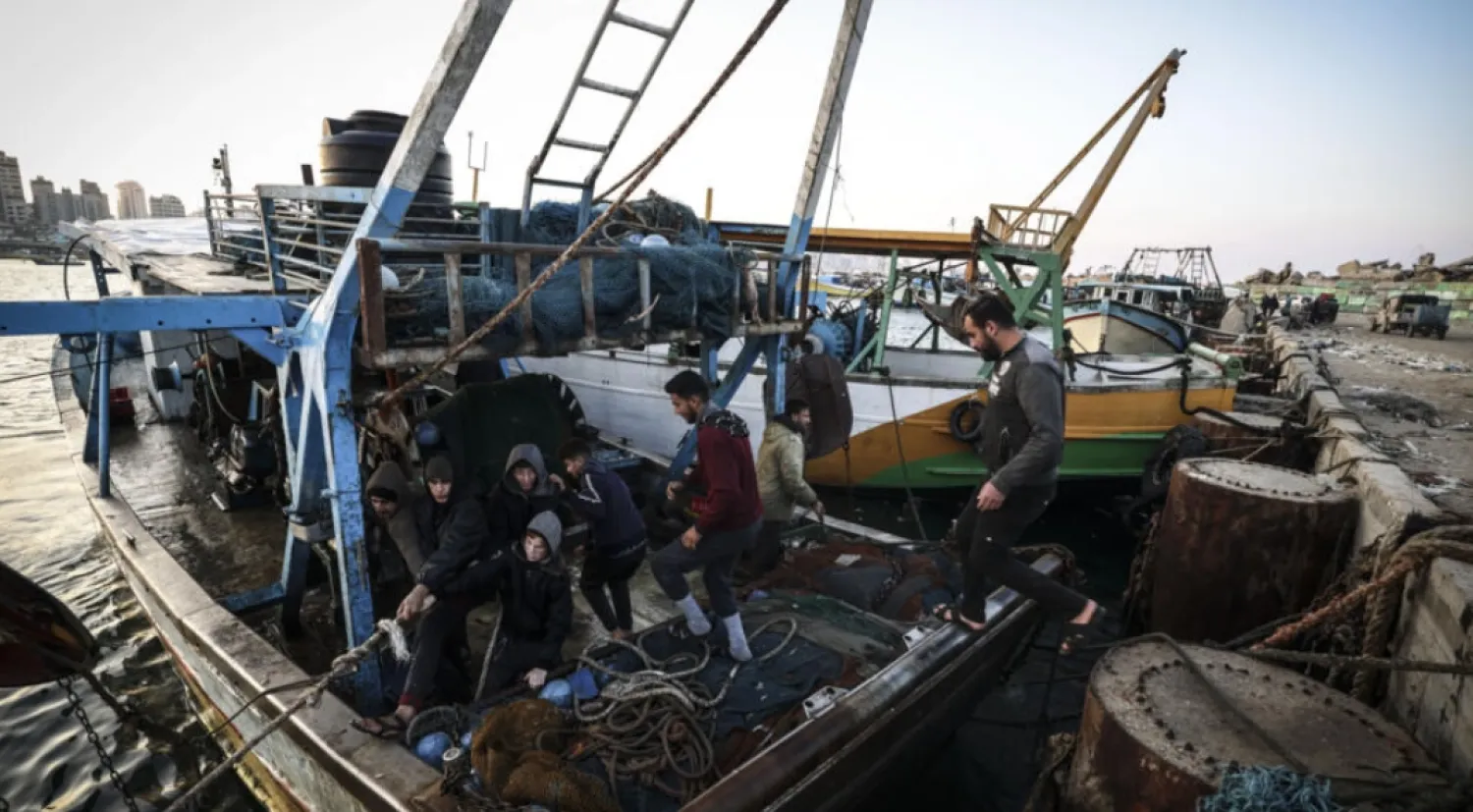
Palestinian fisherman Jihad al-Hissi and his sons aboard their boat at the seaport in Gaza City © MAHMUD HAMS / AFP
TT

Gaza Fisherman Tests Waters in Legal Fight Over Israeli Blockade

Palestinian fisherman Jihad al-Hissi and his sons aboard their boat at the seaport in Gaza City © MAHMUD HAMS / AFP

Gaza fisherman Jihad al-Hissi is used to rough waters but he now faces a new storm. An Israeli court may seize his boat after he breached the limits of the enclave's fishing zone.

The issue is crucial for thousands in the blockaded Palestinian territory of 2.3 million people, where fishing in the Mediterranean Sea remains one of the few economic lifelines.

Hissi, 55, with square shoulders and a scruffy beard, told his story at Gaza's dock early one morning as fishermen sold their overnight catch of sea bream, prawns and sardines.

For now he has his boat, but its fate is uncertain as Israeli authorities argue before a Haifa court that it should be permanently taken away.

The vessel, used to catch gamberi prawns off southern Gaza near Egypt, is named the "Hajj Rajab", but its owners have erased the name from its yellow hull.

"I don't want the Israelis to spot us and seize my boat," said Hissi, who had a violent encounter with an Israeli naval patrol boat more than a year ago, AFP reported.

Israel says its land, air and sea blockade of Gaza is needed to protect it from rocket and other attacks from Hamas and to prevent arms smuggling to the Islamist militant movement.

Palestinians argue it is an effective siege that has crippled Gaza's economy and further impoverished its people, while the fishing limits deny it crucial protein.

Last year's incident came on February 14 when Hissi's vessel ventured beyond the maritime zone that Israel declared in 2007, the year Hamas seized power in Gaza.

Jihad's brother Nihad, who was at sea that day, said that "100 meters beyond the area, we were surprised by three Israeli boats with commandos.

"They attacked our boat... tied us up and arrested us."

The boat's cabin is still damaged from the water cannon blasts and the rubber-encased bullets fired by the Israeli forces that day.

Israel, in documents presented to court, accuses Hissi of having "repeatedly violated the security restrictions imposed by the Israeli army in the maritime zone adjacent to Gaza".

The Israeli non-government group Gisha has helped defend Hissi and in September secured the boat's return, but Israeli authorities now demand the court "permanently confiscate" the vessel.

The fishing zone allowed by Israel currently extends only to the heavily fished areas between six and 15 nautical miles (about 11 to 28 kilometres) off the Gaza coast.

Hissi argues this is less than the maximum of 20 nautical miles agreed in the 1990s under the Israeli-Palestinian agreements in Oslo.

But he also admits to going even beyond that from time to time, in search of shrimp which nets around $21 per kilogram (2.2 pounds) and can make the difference between profit and loss.

The legal fight is closely watched by thousands of fishermen in Gaza.

If Hissi's boat is permanently confiscated, this would spell "a serious threat to the thousands of fishermen in Gaza, because it aims to put an end to fishing," charged Nizar Ayyash, president of the union representing the 4,000 fishermen in Gaza.

The court battle comes amid a rise in Israel's temporary seizures of fishing boats suspected of smuggling or breaching the fishing zone.

Last year saw 23 boat confiscations, the highest number since 2018, according to the Palestinian non-governmental group Al Mezan.

The group also recorded 474 security incidents involving Gaza fishermen last year, the most in five years.

Gisha lawyer Muna Haddad argued that the case was "outrageous" and came amid "an unprecedented escalation in targeting those fishermen".

Haddad accused Israel of misusing provisions of international law on armed conflict regarding the seizure of enemy ships by imposing them on civilians.

In the court documents seen by AFP, Israel claims Hissi "abused" legal protections and that his crew had "threatened" the safety of soldiers during the maritime seizure.

Israeli military officials assured AFP they wanted to support Gaza's economy -- but without compromising Israel's security.

"We fish to survive," said Hissi, whose family once lived in Jaffa, now part of Tel Aviv, before fleeing to Gaza during the 1948 war.

"And we will continue to fish even when our profits are low. I don't know how to do anything else in life anyway."



Israel Strikes Apartment Building in Central Beirut

 Smoke rises after an Israeli strike on Beirut's southern suburbs, following an escalation between Hezbollah and Israel amid the US-Israeli conflict with Iran, Lebanon, March 10, 2026. (Reuters)
Smoke rises after an Israeli strike on Beirut's southern suburbs, following an escalation between Hezbollah and Israel amid the US-Israeli conflict with Iran, Lebanon, March 10, 2026. (Reuters)
TT

Israel Strikes Apartment Building in Central Beirut

 Smoke rises after an Israeli strike on Beirut's southern suburbs, following an escalation between Hezbollah and Israel amid the US-Israeli conflict with Iran, Lebanon, March 10, 2026. (Reuters)
Smoke rises after an Israeli strike on Beirut's southern suburbs, following an escalation between Hezbollah and Israel amid the US-Israeli conflict with Iran, Lebanon, March 10, 2026. (Reuters)

Israeli strikes targeted an apartment building in central Beirut on Wednesday, Lebanese state media said, marking the second strike in the city in recent days.

Israeli media said the strike targeted an office used by the Jamaa Islamiya group that has ties with Hezbollah. They said four people were killed and four others wounded.

There ‌was no ‌immediate comment ‌from ⁠the Israeli military ⁠and no immediate reports of casualties.

A previous strike in Beirut killed five members of Iran's ⁠Revolutionary Guard Corps on ‌Sunday.

Lebanon ‌was drawn deeper into ‌the regional conflict ‌after Iran-backed Hezbollah opened fire on Israel, saying it was retaliating for the ‌killing of Iran's supreme leader.

Israel has since ⁠carried ⁠out air strikes across southern and eastern Lebanon and in Beirut’s southern suburbs, killing nearly 500 people, including more than 80 children, according to Lebanon’s health ministry.


Sudan Urges US to Designate RSF a Terrorist Group

RSF commander Mohamed Hamdan Daglo speaks during a press conference at RSF headquarters in Khartoum, Sudan February 19, 2023. (Reuters)
TT

Sudan Urges US to Designate RSF a Terrorist Group

RSF commander Mohamed Hamdan Daglo speaks during a press conference at RSF headquarters in Khartoum, Sudan February 19, 2023. (Reuters)

Sudan's foreign ministry said Tuesday that the United States should designate the paramilitary Rapid Support Forces a "terrorist organization", a day after Washington slapped the same designation on the local branch of the Muslim Brotherhood.

The US designation for the Brotherhood, which will come into effect next week, accused the Islamist group of receiving support from Iran.

Noting that decision, while stopping short of criticizing it, Sudan's foreign ministry said "all groups that violate international humanitarian law and commit terrorism, crimes against humanity, and war crimes in Sudan should be designated as terrorist groups".

The US, it added, should therefore "designate the RSF militia as a terrorist group, given its proven crimes and documented violations of international humanitarian law, including war crimes, crimes against humanity, genocide, and terrorism".

Since 2023, the RSF -- under paramilitary commander Mohamed Hamdan Daglo -- has been at war with the regular army, under Sudan's de facto leader Abdel Fattah al-Burhan.

Burhan has a complex relationship with Islamists, relying on them for political support and fighters, but facing pressure from the US and his allies to distance himself from them.

He has denied having Brotherhood members in his government.

The RSF has been widely accused of mass atrocities, and last month was found by a UN inquiry to have committed "acts of genocide" in Darfur.

Last year, the US issued a similar genocide determination.

The RSF has repeatedly characterized the war as a fight against Sudan's Islamists and the remnants of the ruling system of Islamist-military president Omar al-Bashir, whom Daglo and Burhan helped oust in 2019.


Israeli Strikes Hit Near Beirut as Envoy Says Disarming Hezbollah Could End War

Smoke billows following an Israeli airstrike on Dahieh, in the southern suburbs of Beirut, Lebanon, 10 March 2026. (EPA)
TT

Israeli Strikes Hit Near Beirut as Envoy Says Disarming Hezbollah Could End War

Smoke billows following an Israeli airstrike on Dahieh, in the southern suburbs of Beirut, Lebanon, 10 March 2026. (EPA)

Israel's military pounded the Lebanese capital's southern suburbs with air strikes on Tuesday and its troops pushed deeper into the country's south, as an Israeli envoy said the key to ending the war was disarming Lebanese group Hezbollah.

Lebanon was pulled deep into the war in the Middle East last week, when Iran-backed Hezbollah opened fire on Israel to avenge the killing of Iran's supreme leader.

Israel has since launched air strikes across Lebanon's south, east and Beirut's suburbs, killing nearly 500 people including more than 80 children, according to Lebanon's health ministry.

Strikes on Beirut's southern suburbs on Tuesday afternoon sent thick columns of smoke over the ‌city. Two hours ‌before they began, an Israeli military spokesperson ordered residents to leave ‌immediately, ⁠specifying three new ⁠districts that should be evacuated.

A member of the municipal council for the area told Reuters families there were fleeing, adding to the nearly 700,000 that Lebanese authorities say have already been displaced by the war.

Lebanon's Minister of Social Affairs Haneen Sayed said on Tuesday that the state was bracing itself for higher displacement figures than in 2024, when the last war between Israel and Hezbollah pushed more than a million people out of their homes.

"So we expect that ⁠the needs, the numbers of displacement, will be higher than in ‌2024. Now on the other side in terms ‌of resources, there's far less resources this year given the global situation, the regional war that's ‌happening," she said.

DISARMING HEZBOLLAH COULD END WAR, ISRAELI ENVOY SAYS

Sayed spoke to Reuters ‌at Beirut's airport, where the European Union was delivering 45 tons of emergency supplies including medical kits and blankets.

"Our traditional partners and friends in the Gulf are of course under stress themselves. So we're appealing to the international community to be with us at this moment to help stabilize the ‌situation in terms of humanitarian needs," Sayed said.

Israeli troops made advances on Tuesday in additional towns in southeastern Lebanon, including with ⁠armored columns, Lebanese security ⁠sources told Reuters.

Lebanese President Joseph Aoun on Monday had signaled his openness to enter direct negotiations with Israel to end the war.

But Israel's ambassador to France Joshua Zarka said on Tuesday that words were not enough.

"At this stage, I’m not aware of any decision to enter negotiations to end this war," Zarka said.

"What would end it is the disarmament of Hezbollah — and that is a choice for the Lebanese government," he said.

Zarka said Lebanon's government was "making very good statements, but to these comments they need to add actions."

Lebanon's government last year vowed to establish a state monopoly on arms and confiscated part of Hezbollah's arsenal in the country's south, without objections from the group.

But Hezbollah has refused to disarm in full, and Lebanese authorities were fearful that taking its arms by force could ignite a civil conflict.