Rights Group: 5 Killed in West Sudan Tribal Violence
This is a locator map for Sudan with its capital, Khartoum. (AP Photo)
Two days of tribal violence in western Sudan’s long-troubled Darfur region killed at least 5 people, tribal leaders and a rights group said Friday.
The violence between African Masalit tribesmen and Arab shepherds in West Darfur erupted Thursday after two armed assailants fatally shot a merchant in a remote area, leaders from both groups said.
In a statement, Masalit tribesmen accused Arab militia of being behind the killing. The slaying sparked a series of targeted attacks that killed at least four more people, the tribal leaders and the rights group both said.
Five victims were later identified by the Darfur Bar Association, a Sudanese legal group focusing on human rights in the western province. The group called on both sides to de-escalate tensions.
The violence comes as wrangling cross-party talks continue in Khartoum over how the African country will usher in a civilian government following 17 months of military rule, The Associated Press reported.
Sudan has been steeped in chaos after a military coup, led by the country’s top Gen. Abdel-Fattah Burhan, removed a Western-backed government in October 2021, upending its short-lived transition to democracy.
But last December the country’s ruling military and various pro-democracy forces signed a preliminary agreement pledging to reinstate the transition.
Last week, signatories to December’s agreement vowed to begin establishing a new civilian-led transitional government April 11. However, many major political forces in the country remain opposed to the deal.
Since the military takeover, Sudan has also seen a spike in inter-tribal violence in the country’s west and south.
Analysts see the violence and growing insecurity in Sudan’s far-flung regions as a product of the power vacuum caused by the military takeover.
Mourners grieve during the funeral of three Palestinians at Al Shifa Hospital in Gaza City on October 25, 2026, after they were killed in an Israeli strike on the Islamic University building. (AFP)
TT
TT
Strike on Gaza University Kills Three
Mourners grieve during the funeral of three Palestinians at Al Shifa Hospital in Gaza City on October 25, 2026, after they were killed in an Israeli strike on the Islamic University building. (AFP)
An Israeli strike on a university in Gaza City killed three people on Sunday, staff and a local hospital said, while the civil defense agency reported five others killed elsewhere in the territory.
Reached for comment on the strike at the Islamic University, the Israeli army said that it was currently under review.
Al Shifa hospital reported receiving three bodies and treating eight people who were wounded in the drone strike, with two sources at the university saying the dead were employees and the injured were students.
The university said the campus and its surroundings had been targeted twice on Sunday, condemning the attacks and mourning those killed in a statement.
Gaza's education ministry likewise condemned the strike, saying: "The global silence regarding attacks on students and universities serves as encouragement for the continuation of these crimes".
"This strike occurs at a time when the higher education sector is facing total annihilation, with 95 percent of the buildings belonging to academic institutions having been damaged as a result of the war," it continued.
"This heinous assault is part of a continuous series of attacks on education; over the past six days, 10 students and educators have been killed by the occupation's fire."
In a statement, the army said it had been "targeting a terrorist from Hamas' military wing".
"Following the identification of uninvolved individuals in the area, the munition was diverted in order to mitigate harm to them. The incident is under review," it said, without specifying whether those killed at the university were hit by accident.
A truce has been in effect in Gaza for over a year, but has failed to completely halt the violence there.
Gaza civil defense spokesman Mahmoud Bassal said five other people were killed on Sunday, three in strikes around the southern city of Khan Younis, one in central Deir al-Balah and one northwest of Gaza City.
One more person was wounded by Israeli gunfire in Jabalia refugee camp in the north.
Commander of Yemeni Coast Guard: Our Duties Are Continuing Normally and Our Morale Is Highhttps://english.aawsat.com/arab-world/5333545-commander-yemeni-coast-guard-our-duties-are-continuing-normally-and-our-morale
Commander of Yemeni Coast Guard: Our Duties Are Continuing Normally and Our Morale Is High
Yemeni Coast Guard Commander Major General Khalid al-Qamli. (Saba)
Yemeni Coast Guard Commander Major General Khalid al-Qamli stated that three Houthi missiles targeted coast guard positions in the interim capital of Aden, causing infrastructure damage. He stressed that the attack did not halt operations, which continue normally with high morale.
Al-Qamli told Asharq Al-Awsat: “Three Houthi missiles targeted the Yemeni Coast Guard Authority in Aden, resulting in infrastructure damage.”
The Interior Ministry said two missiles struck on Saturday the coast guard headquarters at the ministry’s offices, while a third hit the coast guard building in the Tawahi district.
It noted that the targeting of security and service facilities is an extension of previous assaults on civilian and vital infrastructure in Aden. This includes Aden International Airport, which has been subjected to ballistic missile and drone attacks on multiple occasions.
It added that the relevant authorities are continuing to gather information and evidence to assess the damage and are taking the necessary measures to boost security and protect both infrastructure and citizens.
The Coast Guard in the Gulf of Aden sector performs critical duties that include securing ports and their facilities, monitoring vessel traffic, maritime lanes, and the coastline, alongside escorting vessels when necessary and executing rescue operations.
These responsibilities carry heightened significance amid Yemen's ongoing efforts to bolster port security and streamline coordination among maritime security entities.
To that end, the International Maritime Organization (IMO) convened a workshop in Aden last August, drawing representatives from the Coast Guard, government bodies, and port authorities to address maritime security governance, information sharing, and the protection of port infrastructure.
In Shabwah, Governor Awadh Mohammed bin Al-Wazir praised a "qualitative security achievement" by the Rapid Intervention Forces, which dismantled a 13-member Houthi cell and seized a truck laden with weapons, ammunition, highly explosive improvised explosive devices (IEDs), and various projectiles.
The seized items included sniper rifles, ammunition, IEDs, and various projectiles. Preliminary investigations revealed the shipment was smuggled through a boat and received by members of the cell on the coast of the Radum district ahead of sending it to the Houthis.
Large Public and Official Turnout at Funerals of Jordan Church Attack Victimshttps://english.aawsat.com/arab-world/5333532-large-public-and-official-turnout-funerals-jordan-church-attack-victims
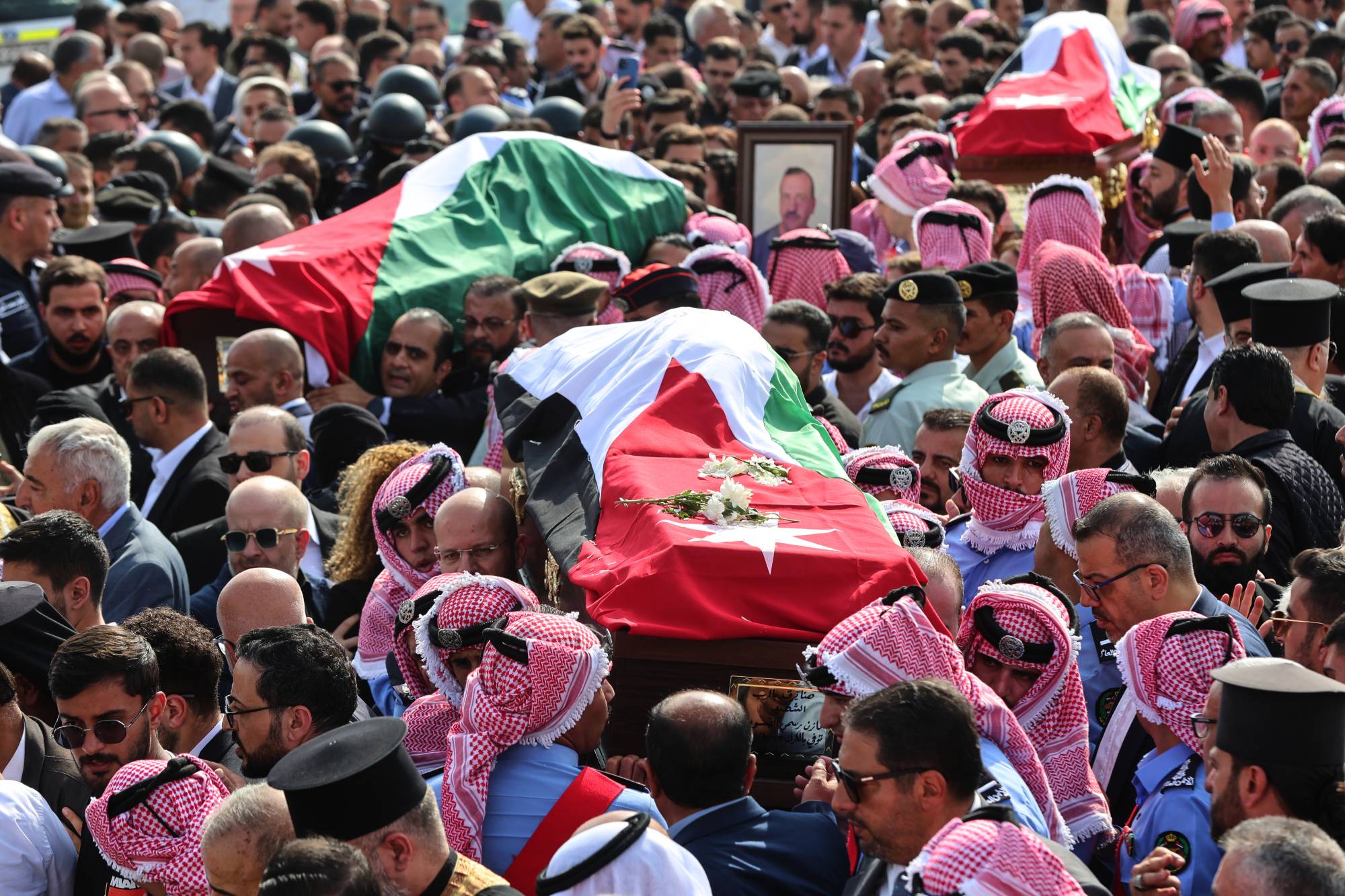
Jordanian honor guards carry a flag-draped coffin of on of the victims killed in an attack on a Greek Orthodox church during their funeral procession in Karak, Jordan, Sunday, Oct. 25, 2026. (AP)
Large Public and Official Turnout at Funerals of Jordan Church Attack Victims
Jordanian honor guards carry a flag-draped coffin of on of the victims killed in an attack on a Greek Orthodox church during their funeral procession in Karak, Jordan, Sunday, Oct. 25, 2026. (AP)
Thousands of Jordanians on Sunday laid to rest eight of the nine victims killed on Friday in a terrorist attack that targeted the Hamoud Church in the southern governorate of Karak, amid a large public and official turnout that underscored the principles of coexistence.
On Friday, gunmen suspected of being "takfiris" opened fire on churchgoers, killing nine and wounding about 25 others. The ninth victim will be buried Monday in the Sahab cemetery south of Amman, AFP reported, citing the victim's family.
The funerals extended far beyond the immediate tragedy at the church, as the village of Hamoud witnessed a national consensus that underscored Christian-Muslim fraternity and cast the terrorist crime as a catalyst for solidarity rather than strife.
An official presence dominated the funeral, with the heads of the constitutional authorities leading the ranks of mourners. Most of the governorate’s prominent figures, both Muslim and Christian, stood alongside the families of the church victims to receive condolences.
Jordanian honor guards carry the flag-draped coffins of victims killed in an attack on a Greek Orthodox church during their funeral procession in Karak, Jordan, Sunday, Oct. 25, 2026. (AP)
By order of Jordanian King Abdullah II, the Royal Hashemite Court undertook the arrangements and protocols for the massive funeral service, which drew thousands of people from across the kingdom.
In a reflection of the area's deep-rooted coexistence, the Christian victims killed at the church included Dr. Mohammad Al-Qassous. A member of the Al-Halsa clan, his parents chose his Muslim name out of a profound conviction that no distinction exists between the residents of a shared village. Widely recognized in the community, Al-Qassous was known as the "doctor of the poor."
Among the wounded in the terrorist attack were four Muslims, two of whom had arrived to help upon hearing the sound of gunfire.
Informed sources stated that "the past hours witnessed a continuation of search operations on a broader scale" for the attackers, noting that investigators are close to mapping and tracking the communication networks of the terrorist cell behind the church massacre.
According to the sources, the delay in announcing preliminary investigation results stems from search and tracking operations navigating the mountainous terrain east of the Karak governorate. They noted that the challenging topography of the search sites demands caution, particularly amid concerns that the militants may have cached weapons for use in further operations. Authorities are continuing to raid locations where suspects are believed to be hiding.
Prime Minister Jafar Hassan stated Sunday, during a cabinet meeting that opened with a recitation of Al-Fatiha for the victims, that "all state agencies are working to apprehend the terrorists behind the Karak crime so they face the punishment they deserve."
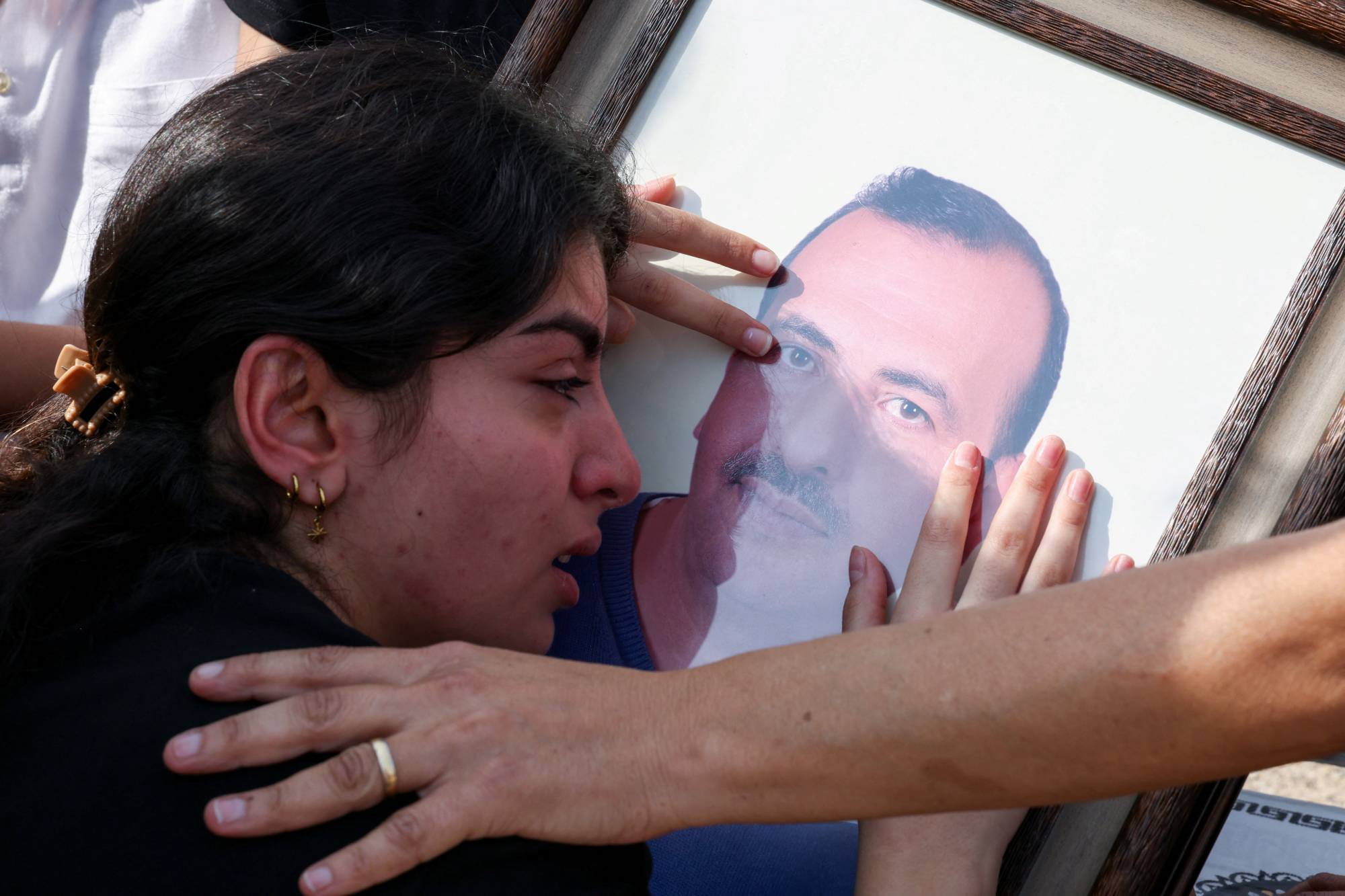
A woman reacts during the funeral of victims of a church shooting in Karak, Jordan, October 25, 2026. (Reuters)
"This is not merely a security battle; this is a battle of awareness and ideology. Nations and homelands collapse when strife, bigotry, racism, and extremism spread within their societies,” he added.
During the funeral ceremonies, Asharq Al-Awsat observed striking scenes that encapsulated feelings of grief, anger, and a commitment to national unity.
As Muslim clerics stood alongside Christian clergy around the church, the victims' coffins were placed at the beginning of the farewell ceremony on a white cloth bearing a message of peace and adorned with flowers, before being carried in a solemn military funeral on the shoulders of general security personnel, draped in Jordanian flags.
Another scene encapsulated the depths of anger, as young Jordanian men wore the Shemagh (a red Jordanian headdress) upside down - a tribal custom that symbolizes a demand for revenge - expressing their outrage over the crime.
Following the burials, the ululations of the victims' mothers, wives, daughters, and sisters filled the air, blending with the tears of farewell in a scene that united the pain of loss with immense pride in the departed.
لم تشترك بعد
انشئ حساباً خاصاً بك لتحصل على أخبار مخصصة لك ولتتمتع بخاصية حفظ المقالات وتتلقى نشراتنا البريدية المتنوعة