


A Real Gem: In Bahrain, Only Natural Pearls Will Do

Faten Mattar is one of the first women to work in the family business, one of the oldest pearl shops in Bahrain. (AFP)
TT

A Real Gem: In Bahrain, Only Natural Pearls Will Do

Faten Mattar is one of the first women to work in the family business, one of the oldest pearl shops in Bahrain. (AFP)

Customers at a Bahrain jewellery store study displays of pearls that are, unusually, 100 percent natural -- the result of attempts to preserve a centuries-old industry.

While rare elsewhere, natural pearls prised from seabed oysters by divers are the only variety produced in the Gulf kingdom, which is fiercely proud of its pearling tradition.

Bahrain is the sole country worldwide to have banned the cultivation of artificial pearls, which have flooded the market since the 1920s.

"We can't mass-produce," said Faten Mattar, who works at the family-run jewellery shop, told AFP.

It can take up to five years to complete one strand of a necklace by sourcing pearls directly from divers, she said, admitting it is "a challenge".

And larger pieces, which can go for up to $25,000, might take more than a decade to complete.

But with no two natural pearls identical, Mattar said that was part of the appeal.

"Each person... who owns or gets a piece of jewellery that contains natural pearls knows no one else has the same."

Mattar is one of the first women to work in a family business which was established more than two centuries ago, making it one of the oldest in Bahrain.

Pearls adorn bracelets, necklaces, cufflinks and other items in the small store.

"One of our goals... is to make pearls more attainable for everyone, so we created different lines instead of having just big pieces," she explained, mentioning designs for men and "daily jewellery for a younger crowd".

Cultured 'shock'

Like other Arab Gulf states, Bahrain's economy before the discovery of oil had relied on pearl harvesting.

Bahraini free-divers would spend months aboard traditional dhows, the wooden sailboats that have plied Gulf waters for centuries, to capture pearls prized by the region's royal families as well as European fashion houses.

But the natural pearl trade crashed after the Great Depression of the 1930s and the development in Japan of cultured pearls, artificially propagated in freshwater mussels, which are cheaper and easier to produce.

Muharraq, in Bahrain's north, is home to "the last remaining complete example of the cultural tradition of pearling", according to UNESCO, with a heritage site featuring oyster beds and a fortress where dhows used to set off.

Today, young gemologists at the Bahrain Institute for Pearls and Gemstones (DANAT) -- nestled among the capital Manama's skyscrapers -- scrutinize pearls using modern machinery or the naked eye.

One researcher passes a pearl through an X-ray machine under the watch of Fatima Almahmood, a graduate in physics and gemology.

The X-ray detects "growth lines" that distinguish natural pearls from cultured ones, she explained, pointing to an image of the scan projected onto a screen.

Created in 2017, DANAT appraises pearls at the request of merchants and individuals.

"You'd be surprised by how many clients come to DANAT that have inherited pieces and are then shocked to know... (they) contain cultured pearls," says Noora Jamsheer, who heads the research center.

Apart from appraisal, DANAT also monitors conditions in the water where natural pearls are harvested.

Jamsheer said climate change is a cause for concern.

"We have a research team that is continuously going to the field, researching and collecting data -- the water temperature, water quality, salinity -- to determine and study the impact of these factors."



UK Inflation Falls to 3.0% in January

Pedestrians cross Westminster Bridge in front of Parliament during the early morning hours in London, Tuesday, Feb. 10, 2026.(AP Photo/Kin Cheung)
TT

UK Inflation Falls to 3.0% in January

Pedestrians cross Westminster Bridge in front of Parliament during the early morning hours in London, Tuesday, Feb. 10, 2026.(AP Photo/Kin Cheung)

Britain's annual ‌rate of consumer price inflation fell to 3.0% in January from 3.4% in December, official figures showed on Wednesday.

A Reuters poll of economists had shown a median forecast of 3.0% in January and the Bank of England projected earlier this month that the headline measure of inflation would slow to ‌2.9%.

British inflation ‌has run higher than in ‌the ⁠United States and in ⁠the euro zone where it stood at 2.4% and 1.7% respectively in January.

But the BoE expects the pace of price rises to slow sharply to almost its 2% target in ⁠April as last year's rises ‌in utility costs and ‌other government-controlled tariffs fall out of ‌the annual comparison.

Investors expect the central bank ‌to cut its benchmark interest rate to 3.5% at its next meeting in March after a tight vote to keep borrowing costs ‌on hold in February although some policymakers remain worried about underlying ⁠inflation ⁠pressure.

Financial markets on Tuesday also priced a second quarter-point interest rate cut by the BoE by the end of in 2026.

ONS data last week painted a downbeat picture of Britain's economy at the end of 2025 with output barely growing. Figures released on Tuesday showed the labor market was still losing jobs although there were some signs of a stabilization.


Riyadh to Host Middle East’s Largest General Aviation Airshow in November 

The AERO Middle East x Sand & Fun 2026 will be held in Riyadh from November 24 to 28. (SPA)
TT

Riyadh to Host Middle East’s Largest General Aviation Airshow in November 

The AERO Middle East x Sand & Fun 2026 will be held in Riyadh from November 24 to 28. (SPA)

The Saudi Aviation Club announced that it will organize the AERO Middle East x Sand & Fun 2026 in Riyadh from November 24 to 28, reported the Saudi Press Agency on Tuesday.

The event is set to be the largest of its kind for general aviation in the Middle East, combining international business, investment, and innovation with live flying displays and interactive public experiences. It is being held in partnership with Messe Frankfurt Saudi Arabia.

Held at Thumamah Airport, the exhibition will bring together leading global companies operating in the general aviation industry, including aircraft and components manufacturers, avionics and navigation systems providers, as well as maintenance, repair, and overhaul (MRO) companies, offering an integrated platform that covers the full value chain of the sector.

The event will also spotlight startups in advanced air mobility (AAM) and innovators of electric vertical take-off and landing (eVTOL) aircraft, showcasing technologies and business models shaping the future of aviation.

General Supervisor of the Saudi Aviation Club Dr. Ahmed Alfahaid stated that AERO Middle East x Sand & Fun 2026 represents a qualitative leap for the Kingdom’s aviation sector and reinforces its positioning as a global hub for general aviation and advanced air mobility.

The partnership with Messe Frankfurt Saudi Arabia goes beyond presenting global innovations to providing a vital platform for international investment and strategic collaboration, he stressed.

Moreover, the event contributes to achieving Saudi Vision 2030 objectives, including the Kingdom’s ambition to rank among the world’s top 10 general aviation markets, he added.


Saudi Arabia, Kazakhstan Agree to Establish Coordination Council

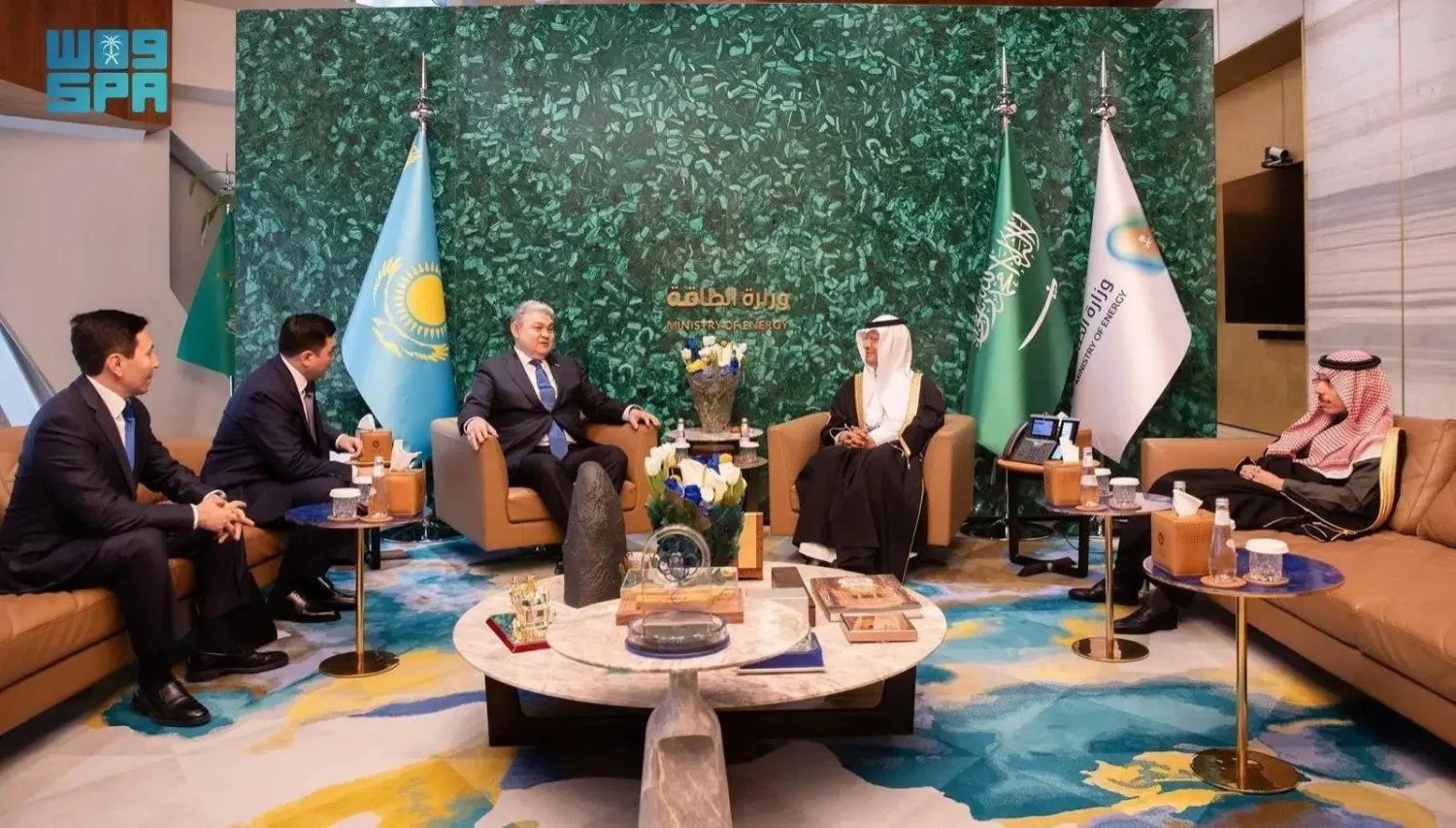
Saudi Minister of Energy Prince Abdulaziz bin Salman bin Abdulaziz receives Kazakhstan’s Foreign Minister Yermek Kosherbayev in Riyadh. (SPA)
TT

Saudi Arabia, Kazakhstan Agree to Establish Coordination Council

Saudi Minister of Energy Prince Abdulaziz bin Salman bin Abdulaziz receives Kazakhstan’s Foreign Minister Yermek Kosherbayev in Riyadh. (SPA)

Saudi Arabia and Kazakhstan agreed to establish a Saudi-Kazakh Coordination Council, reported the Saudi Press Agency on Tuesday.

Saudi Minister of Energy Prince Abdulaziz bin Salman bin Abdulaziz received in Riyadh Kazakhstan’s Foreign Minister Yermek Kosherbayev. Saudi FM Prince Faisal bin Farhan bin Abdullah and Minister of Energy of Kazakhstan Yerlan Akkenzhenov also attended the meeting.

The talks tackled the establishment of the coordination council, which will be chaired by the Saudi minister of energy and Kazakhstan’s foreign minister. The council reflects the two countries’ commitment to strengthening cooperation and expanding their bilateral partnership.

Prince Abdulaziz and Kosherbayev signed an agreement on the establishment of the council, which aims to boost coordination and consultation between the two countries and develop frameworks for cooperation across various sectors of mutual interest, elevating bilateral relations to broader levels.

Prince Abdulaziz and Kosherbayev discussed relations between their countries and ways to develop them further, especially in the energy field. They tackled opportunities for cooperation and investment in renewable energy and energy storage systems and discussed oil market developments.