


Rockets Fired from Gaza after Palestinian Hunger Striker Dies in Israeli Custody

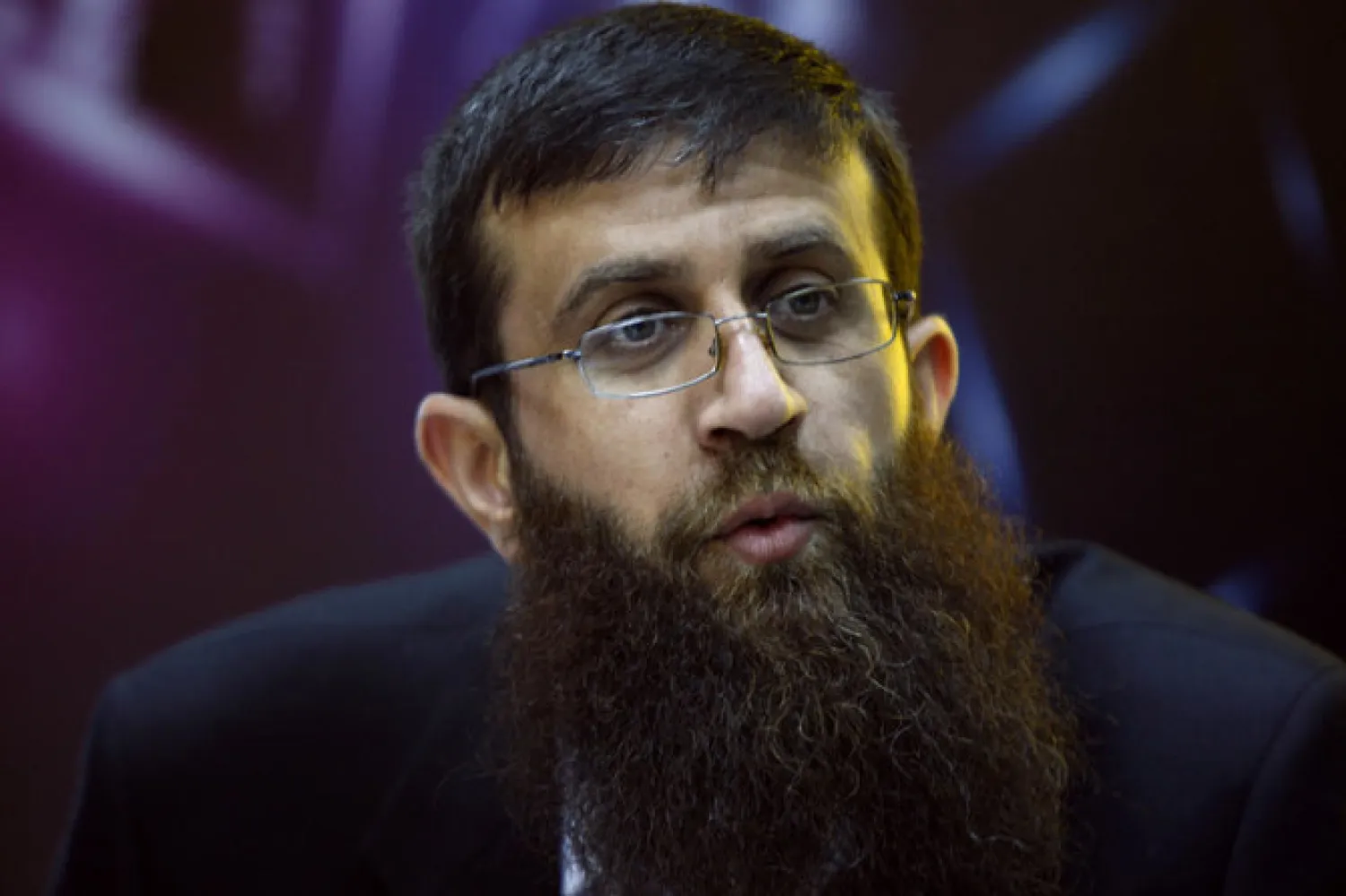
Palestinian Khader Adnan was a leading figure of Islamic Jihad group in northern West Bank. (AP)
TT

Rockets Fired from Gaza after Palestinian Hunger Striker Dies in Israeli Custody

Palestinian Khader Adnan was a leading figure of Islamic Jihad group in northern West Bank. (AP)

Palestinian armed groups fired salvoes of rockets from Gaza into southern Israel on Tuesday after an Islamic Jihad leader died in Israeli custody following an 87-day hunger strike, the first such death in more than three decades.

Khader Adnan, who was awaiting trial, was found unconscious in his cell and taken to a hospital, where he was declared dead after efforts to revive him, Israel's Prisons Service said.

Hundreds of people took to the streets in blockaded Gaza and the occupied West Bank to rally in support of Adnan and mourn his death, which Palestinian leaders described as an assassination. In Gaza, an umbrella group of armed Palestinian factions, including Hamas and Islamic Jihad, launched two separate rocket barrages towards Israel.

The Israeli military said at least three rockets were fired from Gaza in the hours after Adnan's death and a further 26 were launched later in the afternoon. Two landed in the southern city of Sderot, wounding three people, including a 25-year-old foreign national who Israel's ambulance service said sustained serious shrapnel wounds.

An Israeli Defense Force official said Israel would respond at a time and a place of its choosing.

Prime Minister Benjamin Netanyahu held a meeting with security officials to assess the situation and the military said it was investigating how two rockets had penetrated the Iron Dome air defense system.

Since 2011, Adnan had conducted at least three hunger strikes in protest at detentions without charges by Israel. The tactic has been used by other Palestinian prisoners, sometimes en masse, but none had died since 1992.

Adnan's lawyer Jamil Al-Khatib and a doctor with a human rights group who recently met him accused Israeli authorities of withholding medical care.

"We demanded he be moved into a civilian hospital where he could be properly monitored. Unfortunately, such a demand was met by intransigence and rejection," Al-Khatib told Reuters.

Adnan, 45, was a baker and a father of nine from Jenin in the Israeli-occupied West Bank. Islamic Jihad sources said he was one of its political leaders. The faction has a limited West Bank presence but is the second most powerful armed group in Hamas-ruled Gaza, where Israeli forces fought a brief war against it last August.

Lina Qasem-Hassan of Physicians for Human Rights in Israel said she saw Adnan on April 23, at which point he had lost 40 kg (88 pounds) and was having trouble breathing but was conscious.

"His death could have been avoided," Qasem Hassan told Reuters, saying several Israeli hospitals had refused to admit Adnan after he made brief visits to their emergency rooms.

The Prisons Service said hospitalization had not been an option as Adnan had declined "even a preliminary inspection".

‘Fight is continuing’

Physicians for Human Rights said Israeli authorities had denied requests by Adnan and his family to visit him in prison.

Speaking from the family's home in the northern West Bank town of Arraba near Jenin, Adnan's wife, Randa Musa, said: "Our message to all the resistance groups is, we do not want the weapons that were not used to free the sheikh (Adnan) to be used after his death. We do not want to see any bloodshed."

Adnan's 9-year-old son Ali led a march through Arraba. Perched on a man's shoulders, he chanted, "Khader, you hero, your name shook the prison!" as dozens followed.

Tuesday's rocket barrages came almost a month after the last cross-border exchanges of fire between Israel and Gaza, which followed an Israeli police raid in the al-Aqsa mosque complex during the Muslim holy month of Ramadan.

"Our fight is continuing and the enemy will realize once again that its crimes will not pass without a response," Islamic Jihad, which preaches Israel's destruction, said in a statement.

Israel said it was cancelling a military drill that had been planned for the areas surrounding Gaza "pursuant to a situational assessment" and was putting staff in security prisons on heightened alert.

According to the Palestinian Prisoners Association, Adnan had been arrested by Israel 12 times, spending around eight years in prison, mostly under so-called "administrative detention" - or detention without charges.

Israel says such detentions are required when evidence cannot be revealed in court due to the need to keep intelligence sources secret. Palestinians and rights groups say they deny due process of law.

This time, Adnan was arrested and indicted in an Israeli military court on charges that included links to an outlawed group and incitement to violence, the Prisons Service said.



Detainee Imad Amhaz Case Highlights Hezbollah’s Maritime Activities

Detainee Imad Amhaz Case Highlights Hezbollah’s Maritime Activities
TT

Detainee Imad Amhaz Case Highlights Hezbollah’s Maritime Activities

Detainee Imad Amhaz Case Highlights Hezbollah’s Maritime Activities

Israel’s disclosure of a naval commando operation in the northern Lebanese town of Batroun has thrust back into focus a case that straddles security, political, and legal fault lines.

The announcement, accompanied by Israeli claims surrounding Imad Amhaz, comes at a delicate moment, coinciding with ceasefire arrangements, meetings of the monitoring mechanism committee, and ongoing efforts to resolve the files of detainees and missing persons.

The Israeli announcement and security narrative

Israeli army spokesman Avichay Adraee said Israeli forces carried out an operation around a year ago in Batroun, far from the Lebanese Israeli border, during which Imad Amhaz was transferred to Israel for interrogation.

According to the Israeli account, Amhaz is linked to Hezbollah’s secret maritime file and its coastal missile unit, received military training inside and outside Lebanon, and acquired maritime expertise related to operational missions.

Adraee said the interrogation of Amhaz enabled, according to his statement, the acquisition of information related to organized maritime activities run under a secret framework and using civilian fronts.

He said this information helped obstruct the progress of this file at what he described as a sensitive stage, adding that Iran provided support for these activities.

A broader political and security context

In an analytical reading, security and defense researcher Riad Kahwaji told Asharq Al-Awsat that the case of Imad Amhaz and the timing of its disclosure could not be separated from the broader political and security context, particularly the meeting of the ceasefire monitoring mechanism committee and the ongoing negotiations.

He said Israel was trying through this timing to justify its refusal to withdraw from five points by arguing that Hezbollah remained present and continued to conduct military activity.

Kahwaji said the Israeli messages also aimed to show that Hezbollah’s role was far greater than perceived inside Lebanon, arguing that the group was no longer merely a local organization but part of a broad regional project led by Iran.

He said the issue was not related to a trench or one or two military positions, but rather to an integrated structure that included maritime capabilities, infrastructure, and strategic preparations.

He added that Iran had invested tens of millions of dollars in this project, saying Israel was seeking to highlight the scale of military investment in a country whose population was suffering severe internal pressures.

Kahwaji said the file went beyond the area south of the Litani River, noting that the issue was not limited to that region but included the maritime dimension and other areas, particularly since Amhaz was in Batroun in northern Lebanon at the time of the operation.

He said Israel was speaking about tunnels, weapons depots, and equipment in an attempt to show a contradiction between what the Lebanese state declared regarding the disarmament track and what Israel considered a continuation of Hezbollah’s military activity and armament.

He said attempts to strip Imad Amhaz of his civilian status fell within this context, explaining that Israel had from the outset sought to present him as linked to what it called Hezbollah’s naval weapons.

He added that the Lebanese state, in contrast, said the core problem lay in Israel’s continued occupation of the five points, while Israel responded that the main reason was that Hezbollah had not stopped arming itself and that the threat remained.

The Lebanese position and legal dimension

For his part, Nabih Awada, a member of the committee representing detainees and former prisoners in Israeli jails, told Asharq Al-Awsat that the case of Imad Amhaz was, from a legal perspective, that of a civilian abducted from a Lebanese area far from the border. He said his detention did not fall under military arrest.

Awada said this also applied to other documented cases, stressing that the file was being followed up with official Lebanese authorities and with the International Committee of the Red Cross.

He said the Lebanese state was dealing with Imad Amhaz on the basis that he was a civilian and considered that the location of his detention, its circumstances, and its nature did not fall within any military engagement or combat activity. He said this description was what the state relied on in addressing the file before international bodies.

Presidential stance regarding the detainees

Awada said the full details of the file were raised during a meeting with the president of the republic, who he said was fully convinced that the priority of the current stage was the release of Lebanese detainees.

He said the president stressed the need to start at least with civilians detained after the war, given that hostilities had stopped and there was no longer any legal justification for holding them.

He said the president had acted on this basis by communicating with the International Committee of the Red Cross, as well as international and US parties.

The Amhaz family’s stance

Alongside official positions, sources close to the family of Imad Amhaz told Asharq Al-Awsat they denied any knowledge of military activity attributed to him, saying Amhaz had been leading a normal civilian life and that the family had never been informed of any link between him and any military or security activity.

They said the information published did not reflect the family’s account.

Detainees and missing persons figures

On figures, Awada said the file submitted to the president included 20 Lebanese detainees whose presence in Israeli prisons had been confirmed, half of whom were arrested during the war and half afterward.

He said among those detained during the war were seven fighters and three civilians, including Imad Amhaz, who was considered a civilian.

Those detained after the ceasefire were all civilians, in addition to three people missing before the war and around 40 missing since it began.


Baghdad Pushes for Deeper Partnership with Washington against ISIS

Iraqi security says it carried out raid in Syria, arrested ISIS leaders (Government Media)
TT

Baghdad Pushes for Deeper Partnership with Washington against ISIS

Iraqi security says it carried out raid in Syria, arrested ISIS leaders (Government Media)

An Iraqi official said security cooperation with the United States is intensifying in the fight against terrorism, following a rare joint helicopter raid by Iraqi special forces inside Syrian territory.

An Iraqi intelligence unit, coordinating with Syrian security forces and the US-led international coalition, arrested two high value targets wanted by the Iraqi judiciary in a helicopter raid in northeastern Syria, according to a statement from the Security Media Cell.

A new phase

Hussein Allawi, adviser to the Iraqi prime minister, told Asharq Al-Awsat that Iraq is entering a new phase of strategic commitment to the Strategic Framework Agreement with the United States, which is moving toward broader political, economic, security and military dimensions, as well as technology transfer and infrastructure development.

He said recent operations in Syria and elsewhere reflect efforts to build a stronger partnership.

Allawi added that developing the relationship includes cooperation on building the capacities of the armed forces, sustaining counterterrorism efforts, enhancing cooperation to track and dry up financial assets, combating online propaganda by terrorist organizations including al-Qaeda and ISIS, and addressing the issue of al Hol camp.

He said both sides are serious about raising the level of security and intelligence cooperation in counterterrorism, in light of the completion of the first phase of ending the international coalition’s presence in Iraq under an agreement reached in September 2024, as well as targeting terrorist cells in Syria through cooperation between Iraq, the coalition and its member states.

The military operation came a day after the US Congress voted to repeal the authorization for the use of military force against Iraq. Iraq’s foreign ministry described the decision as historic and said it reinforces respect for sovereignty, while a government adviser said relations between the two countries have shifted from conflict to partnership.

State monopoly on arms

Politically, Ammar al-Hakim, leader of the National Wisdom Movement (Hikma) Movement, stressed that weapons should be held exclusively by the state, calling for an expedited formation of the Iraqi government.

In a speech on Friday, al-Hakim said weapons must be in the hands of the state in line with the constitution and the calls of the religious authority, so that the law stands above all by the will of Iraqis and their national political forces, not through external dictates.

In this context, Fahd al-Jabouri, a senior figure in the Hikma Movement, said the United States had raised concerns related to armed factions and individuals subject to sanctions or terrorism lists, and had conveyed these concerns clearly.

He said the Coordination Framework understood these messages and balanced them against the domestic reality, agreeing that some sovereign ministries would be assigned to figures not affiliated with any armed groups.

Al-Jabouri said dialogue is the best option and that the framework is always seeking to balance its external relations with internal requirements, correct misinformation reaching abroad, and strengthen the role of the state as the most powerful authority.

Kataib al-Imam Ali, a Shiite armed faction that recently won several seats in the new parliament, called for confining weapons to the state and strengthening the Popular Mobilization Forces.

In a statement, its secretary general Shibl al-Zaydi said ratifying the election results and the strong showing by factions aligned with the PMF placed these forces before an important national test.

He said the test lies in improving economic, security and service conditions, consolidating the authority and sovereignty of the state, and strictly confining weapons to the state in line with the constitution and the law, while reinforcing the Popular Mobilization Forces.

Diplomats and political observers say US pressure, particularly calls to limit weapons to the state, could complicate efforts to reach a settlement within the Coordination Framework over the next government lineup, as some forces remain committed to a political role for armed factions and their influence over the choice of prime minister.


Miami Talks Aim to Bridge Gaps in Gaza Deal’s Second Phase

Displaced Palestinians gather to receive food rations at a charity kitchen in Khan Younis, southern Gaza (AFP)
TT

Miami Talks Aim to Bridge Gaps in Gaza Deal’s Second Phase

Displaced Palestinians gather to receive food rations at a charity kitchen in Khan Younis, southern Gaza (AFP)

Mediators are convening for fresh talks in Miami, Florida, as efforts to advance the second phase of the Gaza ceasefire agreement remain stalled, months after the truce came into effect on Oct. 10.

The meeting, which mediators say will focus on outlining a framework for the next phase, comes amid attempts to narrow gaps over key issues, including how Israel’s withdrawal would be carried out, how stabilization forces would be deployed, and the question of Hamas’ disarmament.

An analyst said the momentum could translate into concrete steps as early as next month.

Miami is hosting a meeting between US President’s Special Envoy Steve Witkoff and senior officials from the mediating countries, Qatar, Egypt and Türkiye, aimed at pushing forward the second phase of the ceasefire agreement, a White House official told AFP on Thursday.

Qatari Prime Minister Sheikh Mohammed bin Abdulrahman Al Thani said during a visit to Washington on Wednesday that preparations were under way for a mediators’ meeting on Friday to discuss a framework for advancing the second phase of the Gaza agreement.

Ahead of the Miami talks, Hamas political bureau member Bassem Naim said in remarks that Palestinians expected the talks to result in an agreement to halt all Israeli violations and breaches, and to compel Israel to comply with the provisions of the Sharm el-Sheikh agreement.

Palestinian political analyst Ayman Al-Raqab said the Miami meeting fell within efforts to bridge gaps related to the implementation of Israel’s withdrawal, the deployment of stabilization forces and Hamas’ disarmament. If the momentum continued, he said, concrete steps could be seen next month.

He told Asharq Al-Awsat that Washington’s approach at the Miami meeting should focus on implementing the agreement rather than rebuilding Rafah in a new form or dividing the Gaza Strip.

He said the gaps in the second phase were linked to Israel’s withdrawal, the deployment of stabilization forces and Hamas’ disarmament, adding that discussions should center on practical implementation solutions, not US proposals that serve Israeli ideas.

Egyptian Foreign Minister Badr Abdelatty stressed on Friday, during talks with his Russian counterpart Sergei Lavrov in Cairo, the need to implement UN Security Council Resolution 2803 on the Gaza agreement and to operate the Rafah crossing from both directions.

Lavrov said diplomatic efforts must continue to ensure the sustainability of the Gaza ceasefire.

Abdelatty also discussed the situation with Algerian Foreign Minister Ahmed Attaf in Cairo on Friday, reviewing ongoing Egyptian efforts to solidify and sustain the ceasefire and to implement the requirements of the second phase.

They stressed the need for unimpeded humanitarian aid access, preparing conditions for early recovery and reconstruction, and rejecting any measures that could undermine the unity of Palestinian territory or liquidate the Palestinian cause, according to a statement by Egypt’s Foreign Ministry.

The European Council welcomed, at the conclusion of a summit of leaders from the European Union’s 27 member states in Brussels, UN Security Council Resolution 2803, which calls for the establishment of a Board of Peace and a temporary international stabilization force as part of a plan to end the conflict in Gaza.

European leaders stressed the need to fully implement the resolution and ensure lasting security stability in Gaza, reiterating the EU’s commitment to a two-state solution and international law.

Al-Raqab said Egyptian efforts were banking on achieving a breakthrough alongside Qatar and Türkiye, reaching concrete mechanisms to implement the agreement amid European support for this path.

He added that any arrangements were awaiting a meeting between Israeli Prime Minister Benjamin Netanyahu and US President Donald Trump later this month, describing it as decisive.