
The summer of 1982 left a deep mark on both Lebanon and the Palestinians. It was the summer when Israeli forces, for the first time in the conflict, occupied an Arab capital -Beirut. It was also when Yasser Arafat and his Palestine Liberation Organization fighters were forced into exile by the Israeli invasion.
That summer also saw the election of Bashir Gemayel as president of Lebanon, only to be assassinated before taking office. It was the season the Lebanese National Resistance Front (known by its Arabic acronym Jammoul) was born, only to be crushed by the regime of Syria’s Hafez al-Assad, who, together with Tehran, laid the foundations for Hezbollah and its “Islamic Resistance.”
The summer brought back memories of a conversation years earlier with Mohsen Ibrahim, head of Lebanon’s Communist Action Organization. “Assad believed we committed three crimes that merited the harshest punishment,” Ibrahim recalled. “First, with Kamal Jumblatt, we realized that Assad sought clients, not allies - and we paid the price. Second, with Arafat, we discovered that Assad wanted to seize control of the Palestinian decision-making process to secure his regime’s survival - and the punishment was severe. Third, we launched the Lebanese National Resistance Front and later refused to place it under Syrian control, which unleashed a brutal campaign of assassinations.”
Ibrahim said the full account of that “third crime” lay with Elias Atallah, a senior figure in Lebanon’s Communist Party and former commander of Jammoul’s armed operations.
At a time when debates over Hamas’s weapons in Gaza and Hezbollah’s arsenal in Lebanon are once again in the spotlight, Asharq Al-Awsat revisited the lessons and horrors of the summer of 1982.
Speaking to Atallah, Asharq Al-Awsat unearthed fresh details on Jammoul’s story, a string of security incidents and high-profile assassinations - from Gemayel and Rene Moawad to Rafik Hariri - as well as the shadow role of the Soviet KGB and the dramatic rescue of kidnapped Soviet diplomats after a tense meeting between one of its generals and the late cleric Mohammad Hussein Fadlallah.
Stage Set for War
By May 1982, speculation was mounting in Beirut that Israel was preparing a military operation to push Palestinian rockets out of range of its northern settlements. The prevailing view was that Prime Minister Menachem Begin’s government might advance some 40 kilometers into Lebanon, reaching the Awali River at the gateway to the south.
But Atallah, then a senior commander in the Lebanese Communist Party, believed such a move would fall short. He argued that Palestinian fighters and their allies could simply retreat to Beirut and preserve their strength. For that reason, he did not rule out the possibility of an Israeli drive into the capital itself to upend the balance of power.
Israel soon found its pretext. Sabri al-Banna, known as Abu Nidal, head of the splinter group Fatah-Revolutionary Council, attempted to assassinate Israel’s ambassador to Britain, Shlomo Argov. The following day, on June 4, Israeli warplanes bombed Beirut’s sports complex. Two days later, Defense Minister Ariel Sharon ordered Israeli ground forces into Lebanon.
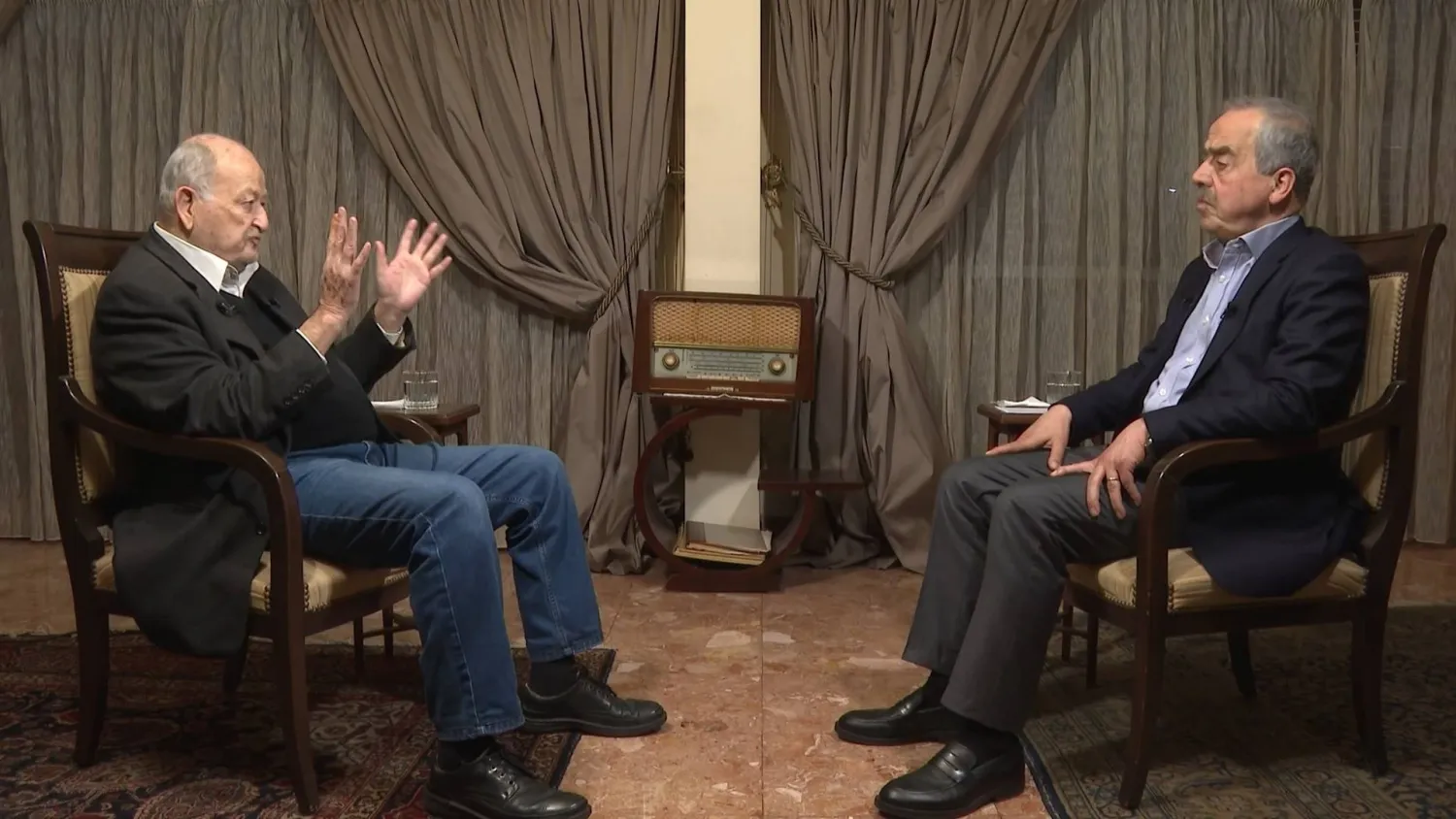
In an interview with Asharq Al-Awsat, Atallah recounted the birth of Jammoul, its most prominent operations, and the wave of assassinations that struck the Communist Party after it defied Syrian President Hafez al-Assad’s demand to coordinate with Syrian intelligence and merge with Hezbollah.
From his military and security vantage point, Atallah also offered new details on a string of high-profile killings that targeted presidents and political leaders, the factional wars that engulfed Beirut before Syrian troops re-entered the city, and the final days Arafat spent in an underground shelter before departing Beirut. In that bunker, Atallah recalled, Arafat was joined by Lebanese Communist Party chief George Hawi - later himself among the victims of the “shared” assassination campaign that culminated in the killing of former Prime Minister Rafik al-Hariri and others.
Siege of Beirut: Maps and Decisions
On the day after Israel launched its ground invasion, four men stood over a battlefield map in one of 14 Palestinian operations rooms in Beirut: Arafat, his Iraqi ally General Hassan al-Naqib, Hawi, and Atallah.
Arafat, ruler in hand, repeatedly asked where the Israeli advance had reached. He had been assured the army would not push beyond 40 kilometers. But Atallah phoned contacts in his hometown of Ramliyeh, just north of the Awali River, who confirmed Israeli forces had already passed through, driving towards Beirut.
By then, Fatah units had retreated towards Jezzine and the Bekaa Valley. Atallah said the real shock was that Fatah’s chief of staff “turned out to be an Israeli agent.” From that moment, it was clear the decisive battle would be fought in Beirut. Outmatched on every front, Palestinian fighters and their Lebanese allies could not mount serious defenses against the Israeli army’s advance. Soon, West Beirut was encircled. The Communist Party joined the city’s defense, though Arafat and his Fatah movement played the leading role.
Atallah recalled Arafat as the true commander of Beirut’s defense. “He had extraordinary courage, bordering on disregard for his own safety,” he said. “His obsession was for the cause to win. His calculations were never personal. He managed the most difficult moments without flinching. He assigned me to coordinate defense lines with one of his officers. Another crucial figure was Khalil al-Wazir, or Abu Jihad, who spoke little but was highly effective, with stronger military expertise than Arafat.”
Atallah believes Arafat’s assassination was among Israel’s war aims, given his symbolic and practical weight. “He was the man who reawakened the Palestinian cause in 1965, almost as if he reinvented it,” he said. Despite being Israel’s top target, Arafat roamed the besieged city, inspecting frontline positions and lifting morale, defying the relentless Israeli bombardment of Beirut.
Atallah also recalled the so-called “Horse Racing Battle.” Communist Party fighters, he said, single-handedly fought off an Israeli attempt to break into Beirut through the racecourse area to cut off the Fakhani district, where Fatah had its headquarters. “We confirmed the Israelis were preparing to move from the museum district through the racecourse,” Atallah said. “I calculated that our RPG-7s couldn’t reach from Tayouneh to the military court near the museum, so we dug more than 30 individual pits along both sides of the road. When the Israelis advanced, we hit them from both flanks. They lost tanks, and a general leading the assault was killed. What struck me was that after retreating, they never left anything behind on the battlefield.”
From a fifth basement level in Marinian building near the American University Hospital, Atallah and Hawi directed operations. One day, Atallah spotted a familiar keffiyeh at the entrance - it was Arafat. His aide, Fathi, explained: “The old man will sleep here tonight.”
Arafat’s office had just been bombed, Fathi said, and in the chaos a bodyguard tried to assassinate him, but was killed by other protectors. From then on, Arafat spent his final ten days in Beirut shuttling between the bunker and the frontlines, alongside Hawi and Atallah, until his departure into exile.
Arafat and the Rivalries of his Allies
Amid the siege of Beirut, Arafat kept up his contacts, but it did not take him long to realize that no one was coming to his rescue. In one meeting, he and Fatah Central Committee member Hani al-Hassan visited the Soviet embassy. Ambassador Alexander Soldatov was blunt: Moscow would not threaten Israel or its American backers, nor send ships to evacuate the wounded.
“Leave Beirut,” Soldatov told him. When Arafat asked how, the envoy replied: “Leave even on American destroyers, so you won’t be taken in the net as prisoners.” Arafat shot back that “a commander with two bullets in his pistol does not fall captive,” but he understood the message.
As conditions ripened for a negotiated withdrawal, US envoy Philip Habib brokered a deal. Arafat had to secure the backing of the Palestinian factions. Elias Atallah, who knew their secret hideouts, sent messengers. He recalled that George Habash of the Popular Front and Nayef Hawatmeh of the Democratic Front tried to outbid Arafat politically, opposing the departure. Furious, Arafat told them they could stay behind if they wished. Both eventually agreed to leave.
The siege did nothing to soften Arafat’s animosity toward Syrian President Hafez al-Assad. Atallah was present when someone in the Marinian bunker floated the idea of retreating overland to Syria. “Arafat’s response was sharp and final,” he recalled. “He said: I will execute anyone who suggests such a thing. I consider Assad an enemy, like Israel - and worse. Mention Assad again and I will execute you.”
Atallah believed this deep mutual hatred later fueled the bloody battle in Tripoli, Lebanon’s northern capital, lamenting that the Communist Party, which he led militarily, had become entangled in the fight. “Arafat told Mohsen Ibrahim in Tunis that surviving Beirut doubled the hatred both Sharon and Assad had for him,” Atallah said.
Despite his loathing of Damascus, Arafat showed concern for Syrian units trapped in Beirut, supplying them with food and weapons, Atallah said. “Some soldiers didn’t even have shoes,” he recalled. “One Syrian commando unit fought bravely, captured two Israeli tanks in Khaldeh, then received orders from Damascus to hand them over to Nabih Berri’s Amal movement.”
On another occasion, after repeated Israeli shelling around the Soviet embassy, Atallah visited the compound. “I went to check on them and asked if they wanted to move to a safer place,” he said. “Soldatov replied: ‘Comrade, if this flag (pointing to the Soviet one) can’t protect me, nothing can.’ The strikes, he noted, hit the embassy’s garden, not the building itself.”
Another hot issue gripped Beirut that summer: the presidential race. Gemayel, commander of the Lebanese Forces militia and son of Kataeb Party founder Pierre Gemayel, announced his candidacy to succeed Elias Sarkis. Before the Israeli invasion, Gemayel’s election had seemed nearly impossible, given the hostility of most leftist and Muslim factions and his battles against Syrian troops in Beirut and Zahle. But the invasion upended Lebanon’s political balance, making his once unlikely candidacy possible.
Atallah also recalled regular visits from a Soviet KGB officer in Beirut, known by the codename “the Rabbit.” As the Communist Party’s military chief, head of security, and member of its political bureau, Atallah was a key point of contact.
‘The Rabbit’s’ Counsel - Soviet Pressure and Lebanon’s Turning Point
About a month into the Israeli invasion, a Soviet intelligence officer known by the nickname “the Rabbit” paid Atallah an unexpected visit and delivered a surprising message. “Why don’t you Lebanese back Gemayel for the presidency?” he asked bluntly, even though the battle for Beirut was far from over and Arafat’s exit had not been finalized.
Atallah said he sent Albert Mansour - later a minister - to test the question. When Mansour asked Gemayel how he would govern if elected, Gemayel unfolded a pre-drawn map and pointed to color-coded areas. “These Christians in these areas are all armed,” Atallah quoted him as saying. “These other, non-aligned areas are disarmed.”
“Atallah asked the Rabbit: ‘Are you telling me to elect a president like this?’” Atallah recalled. The Soviet officer replied only that “things change - now he is this, and shortly after taking power he becomes something else.” When Atallah pressed whether that view reflected Moscow’s official position, the visitor merely repeated: “I tell you elect Bashir. He is the best option in your circumstances.”
The exchange exposed a rift. The Rabbit left visibly upset after Atallah implied the conversation was over. Atallah told Hawi he would refuse further visits; Hawi later said that was not enough and demanded an apology from the Soviet officer, though he did not pursue the matter further.
By the second half of August, as negotiations on the evacuation of Arafat and PLO forces accelerated under US envoy Philip Habib, Lebanon’s presidential contest grew hotter. Opponents of Gemayel sought a way to stop his election: some proposed extending Elias Sarkis’s term, others floated a transitional presidency for Camille Chamoun. None of the alternatives held. Gemayel’s candidacy, once implausible given his militia record and the hostility of leftist and Muslim factions, surged in the reshaped balance of power created by the invasion.
Whispers spread among opposition parties that the only sure way to block Gemayel was to bomb the venue to prevent the parliamentary session. Anxiety mounted in the National Movement and among Islamist groups. Some speculated Arafat might back such a bid - a notion that had circulated earlier.
Those calculations were off the mark. Arafat, negotiating his departure with Habib, had strong political instincts and did not wish to sabotage a course that had drawn international acceptance. When Atallah, who favored disrupting the vote, asked Arafat whether he would support such a plan, Arafat’s answer was curt and absolute: “Not a single shot.” He repeated the phrase when pressed.
Atallah said Arafat warned sternly: “Do not play with this; you will make us look bad.” The Palestinian leader’s insistence was, Atallah added, unusually strict - comparable only to a prior episode during heavy fighting near the southern suburbs, when Arafat personally ordered an immediate halt to fire rather than risk confrontation with Syrian President Hafez al-Assad.
Gemayel was elected president, gaining traction across confessional lines. Atallah later reflected on “dark days to come” - a fate, he suggested, shaped not only by political shifts but by the intervention of intelligence services whose influence would mark Lebanon’s next chapter.
Deadly East German Blanket
On Sept. 14, 1982, a thunderous explosion ripped through the Kataeb Party headquarters in Beirut’s Ashrafieh district, killing president-elect Gemayel and shattering a political project before it began.
Elias Atallah recalled that word of Gemayel’s impending assassination had circulated hours earlier. “A northern worker in Lebanese security at the Masnaa border crossing whispered that Bashir would be killed,” he said. “Few paid attention, since the general impression was that Bashir was heavily protected, especially by Israel.”
The attack was carried out by Habib Chartouni, a member of the Syrian Social Nationalist Party, under the guidance of Nabil Alam, who, according to Atallah, maintained links with East German intelligence.
“The bomb that killed Bashir came from East Germany disguised as an ordinary sleeping bag,” Atallah said. “Explosives were hidden inside, powerful enough to destroy the building. A detonator – maybe just a pin – was enough to set it off. This was beyond Chartouni’s ability alone. I believe Syrian intelligence, which had ties with East Germany and other services, was involved.”
Asked if the armed wing he commanded had plotted Gemayel’s assassination, Atallah replied: “Never. I was opposed to assassinations. Even the attempt on General Michel Aoun at Baabda Palace had nothing to do with my unit.”
Gemayel’s death was followed swiftly by the Sabra and Shatila massacres, and Israeli forces stormed West Beirut. Atallah, now charged with overseeing the operations of the Lebanese National Resistance Front, found himself at the center of the campaign that – along with other factors – would eventually force Israeli troops out of the capital.