
UK Chancellor of the Exchequer Rachel Reeves affirmed that strengthening relations and economic partnership with Saudi Arabia represents a top priority for her government, noting that under the ambitious Vision 2030, Saudi Arabia finds in the United Kingdom an ideal partner thanks to Britain’s stability, regulatory flexibility, and global expertise.
She revealed her government’s plan to support major projects that unleash growth, starting with the expansion of Heathrow Airport and extending to infrastructure spending exceeding £725 billion ($958.7 billion) over the next decade.
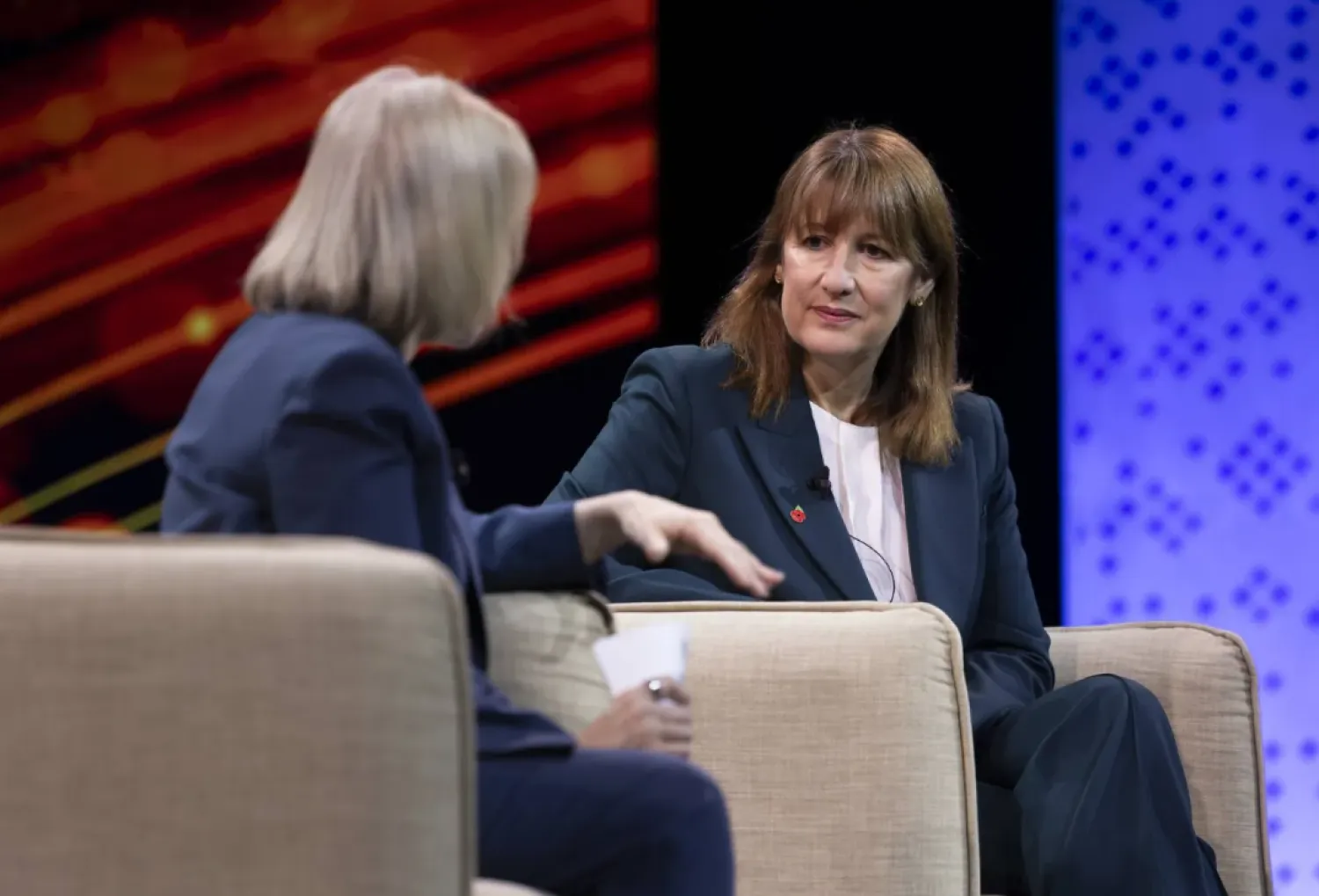
In an exclusive interview with Asharq Al-Awsat from Riyadh, Reeves said her participation in the Future Investment Initiative (FII) Conference stems from a key goal: deepening mutual investment and trade. She confirmed that this visit, the first by a UK Chancellor to the Gulf in six years, reflects London’s seriousness in strengthening regional relations.
“This visit marks the first time a UK Chancellor has travelled to the Gulf in six years, which reflects just how seriously this government takes our relationship with Saudi Arabia and the wider region,” Reeves said.
“I’m here with one of the largest UK business delegations to the Gulf in recent years, and our participation is driven by our number one priority: growth.”
“At a time of global uncertainty, the UK offers stability, regulatory agility and world-class expertise – qualities that make us an ideal partner for Saudi Arabia's ambitious Vision 2030 transformation,” she added.
Reeves emphasized the economic complementarity between the two nations, noting that her delegation includes UK business leaders in key sectors such as financial services, life sciences, AI, clean energy, and advanced manufacturing.
She pointed out that Britain’s expertise in these fields uniquely positions London to support Saudi Arabia’s economic diversification, while Gulf investment helps drive growth and create jobs across the UK. According to her, joint trade and investment deals exceeded £10 billion over the past 18 months alone, creating more than 4,100 jobs in the United Kingdom.

Deepening Mutual Investment and Trade
The Chancellor said: “My discussions are focused on deepening the two-way investment and trade that benefits families and businesses in both our countries. The £6.4 billion ($8.4 billion) package we've announced this week demonstrates the tangible results of this approach.”
According to Reeves, the package includes £5 billion in Saudi-backed exports supporting British manufacturing, alongside major investments by Barclays, HSBC and others, strengthening their presence in Saudi Arabia.
Key Priorities
Reeves said that one of her top priorities is accelerating progress on a UK–GCC Free Trade Agreement, noting that such a deal could boost bilateral trade by 16 percent and represents the kind of forward-looking partnership that creates prosperity for both sides.
“My vision is straightforward: I want Britain and Saudi Arabia to be partners of choice for each other. We regulate for growth, not just risk. We're backing key infrastructure projects like Heathrow expansion – where the Saudi Public Investment Fund holds a 15 percent stake,” she said.
She added: “We’re creating opportunities for co-investment, particularly through our National Wealth Fund and pension reforms that will unlock tens of billions for infrastructure and innovation.”
“My message at the FII this week was clear – I'm championing the UK as a stable investment destination,” she stressed, referring to Britain’s “ironclad commitment to fiscal rules and our modern Industrial Strategy focused on the sectors of the future.”

Saudi–British Cooperation
On the most prominent areas and nature of cooperation between Riyadh and London, Reeves said: “Our partnership – built on mutual respect and shared ambition – spans multiple high-value sectors and continues to deepen.”
“Over the past 18 months alone, we've secured over £10 billion in two-way trade and investment, creating more than 4,100 UK jobs and many others in Saudi Arabia. Over 1,600 UK companies also now have a presence in the Kingdom – this is a partnership that works to the benefit of families and businesses on both sides,” she added.
“In financial services, London remains a world-leading international financial centre. We’ve launched a new concierge service – the Office for Investment: Financial Services – to help international firms establish and expand in the UK, while banking giants like Barclays and HSBC are expanding their operations in Riyadh,” Reeves explained.
She highlighted that Riyadh Air’s first-ever flight landed in London this past weekend, powered by UK-manufactured wings and Rolls-Royce engines – showing how British engineering is integral to Gulf aviation ambitions.
According to Reeves, UK firms like Quantexa are launching new AI services in the region, while Saudi cybersecurity firm Cipher is investing $50 million to open its European headquarters in London, demonstrating a partnership at the forefront of technology and innovation.
She added: “We are also collaborating closely in areas like sustainable infrastructure, clean energy, education and the life sciences. But I feel we can and must go further – a UK–GCC Free Trade Agreement would unlock huge mutual benefits, including boosting bilateral trade by 16 percent.”

A British Plan to Contain Financial Challenges
On her government’s plan to address the financial challenges facing the United Kingdom, Reeves said: “After years of decline – from austerity to Brexit to the mini-budget – we inherited significant challenges. But we've moved decisively to address them whilst investing in our future.”
“We have an ironclad commitment to robust fiscal rules. This provides the stability and certainty that investors need. The IMF now projects that, after the US, the UK will be the fastest-growing G7 economy. This didn't happen by accident – it's the result of tough choices and disciplined economic management,” she added.
Reeves emphasized that “growth is our number one priority, because it's how we overcome challenges and put more money in working people's pockets. Our modern Industrial Strategy focuses on key sectors of the future – AI, life sciences, financial services, clean energy – where Britain has genuine competitive advantages, many of which are shared by our partners in the Gulf.”
She continued: “We're catalysing private investment through our National Wealth Fund, which is driving over £70 billion in investment, and pension reforms unlocking up to £50 billion for infrastructure and innovation. This creates opportunities for co-investment with partners like Gulf sovereign wealth funds.”
Reeves confirmed that the United Kingdom offers strength in uncertain times by combining stability with ambition. She referred to her government’s plan to support major projects that unleash growth, from Heathrow Airport expansion to infrastructure spending exceeding £725 billion over the next decade.
“We're open for business, but we're being strategic about building partnerships that create good jobs, boost business and bring investment into communities across the UK – from the North East to the Oxford–Cambridge corridor. That's how we build an economy that works for, and rewards, working people in Britain,” she said.
The minister concluded by stressing that “turning inwards is the wrong response to global challenges.” She affirmed that Britain remains open for business and is taking a strategic approach to building partnerships that create jobs and benefit working people across the United Kingdom.
“After landmark deals with the US, EU and India, we're accelerating progress with the GCC,” she said.