
House Hunting in ... Bali

Image by CreditDasha Almazova via New York Times
TT

House Hunting in ... Bali

Image by CreditDasha Almazova via New York Times

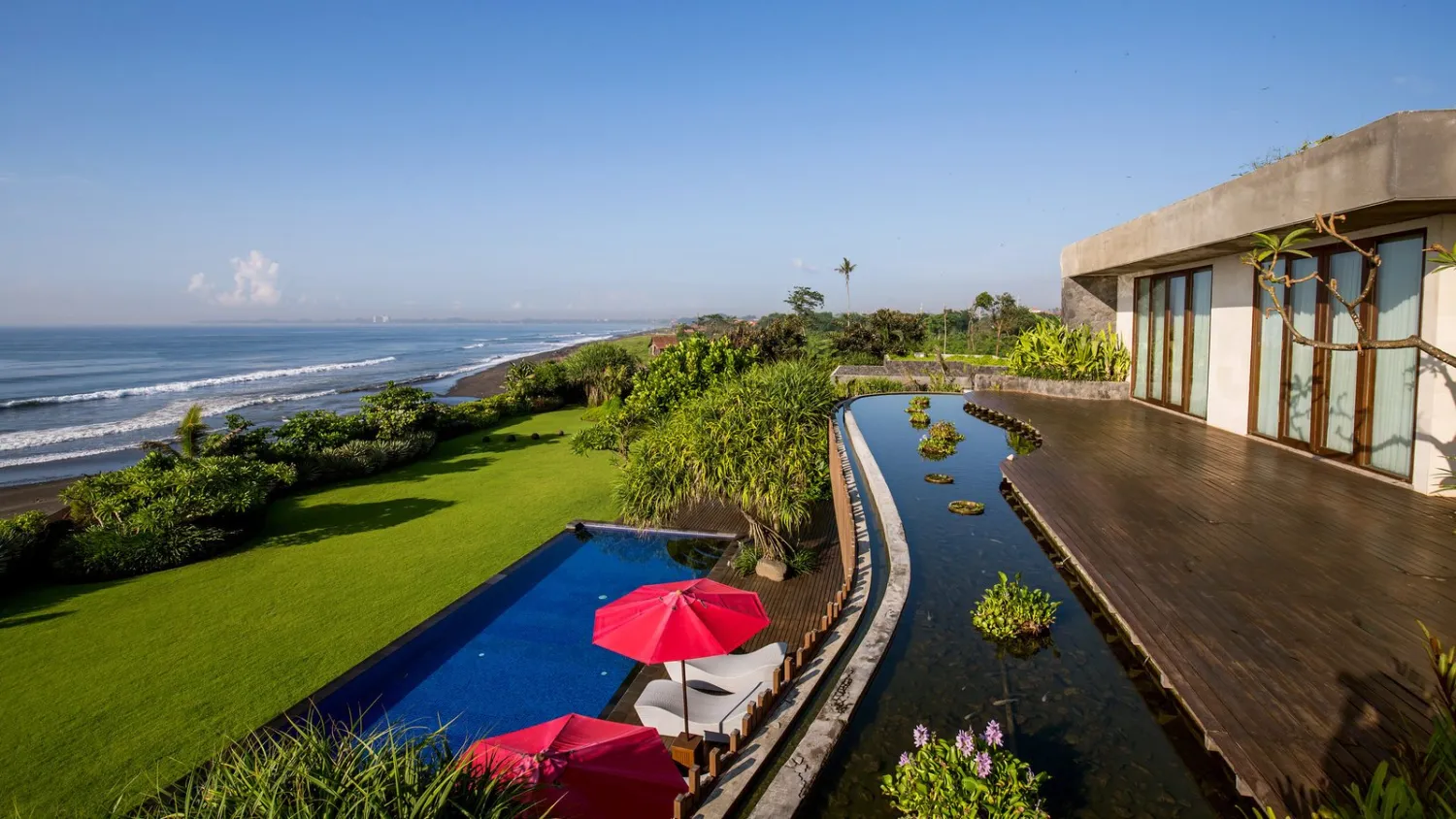
This villa, built in 2009, is on a lushly landscaped, one-acre beachfront lot on Bali’s southeastern coast, in the village of Ketewel. In the approximately 7,500-square-foot main building with four bedrooms, a foyer gives way to the spacious living room and a wall of sliding glass doors that open onto the pool deck and garden. Past that, several steps lead down to the beach. Because of its eastern orientation, facing the water, the house has views of “some of the best sunrises you could have in Bali,” said Joe White, the sales director of Seven Stones Indonesia, which has the listing.

To the left of the foyer is an open kitchen with cinnamon-red cabinets and a dining area with a table for 12. The seller is a professional chef who designed the kitchen, Mr. White said. To the right of the foyer are three bedrooms, one of which is now used as a television room. Two bedrooms are en suite and there is a half bath near the entrance of the villa. A staircase from the foyer leads to the master suite, which has a sitting area, a bathroom with an outdoor tub, and a long terrace with an ornamental pond. This property is being sold furnished, and it is available as a leasehold or freehold acquisition.

The 1,880-square-foot guesthouse has two en suite bedrooms and an open kitchen, dining and living area. The landscaping and gardening were designed to create privacy between the dwellings, Mr. White said. The lot’s beach frontage — around 330 feet — is exceptionally large for Bali, he added. The property has parking for seven cars, including four covered spaces, and staff lodging near the parking area.

The house is about a 25 minute drive east of the center of Denpasar, Bali’s capital city, which has a population of about 800,000. The area attracts surfers, scuba divers and cultural tourists, Mr. White said. Ngurah Rai International Airport is about 15 miles to the southwest of the property.

Market Overview

Bali’s real estate market has weathered various local and international events — from the SARS epidemic of 2003 to the global financial crisis — with resilience, agents said.

Andy Gray, a partner with Seven Stones Indonesia, estimated that between 2003 and 2014 prices for land in some places multiplied by 10. But that growth temporarily stalled in 2015 and 2016, with prices flattening for the first time in at least a decade and transaction volume dropping by about half, he said.

“Everyone seemed to think Bali was bulletproof. And it wasn’t,” he said. Mr. Gray attributed the price plateau to two factors: Buyers began resisting prices they saw as too high, and the influx of wealthy Indonesians who had been investing in Bali tapered for a while.

Since about 2005, new construction developments, including condo-hotel hybrids and resort-style apartments, have proliferated around the island’s southern side, said Dan Miller, head of the Bali office of Jones Lang LaSalle, a global real estate and investment company. Today the new resort-style construction developments make up about 10 percent of Bali’s real estate market and roughly 20 percent of its luxury market, he said.

Karl Wilkins, a marketing executive with Paradise Property Group, observed that prices last year continued to grow, but at a lesser rate than before — 10 or 15 percent, compared to 20 to 30 percent three to five years ago. He said Indonesian investors started returning this spring. Mr. Gray said that this year there have been more inquiries and transactions at both his firm and others, while prices have remained stable.

As a result of the earlier price growth and the recent stagnation, Mr. Gray described a “two-tier vendor system,” where sellers who bought 8 to 10 years ago are able to sell at “realistic” prices, while sellers who bought when prices were higher — three to four years ago — will struggle to make a profit. “It’s still absolutely a buyer’s market,” he said. He added that properties are closing at around 80 to 85 percent of their asking price.

Mr. Wilkins said luxury properties start at around $1 million and reach more than $10 million. Most fall between $1 million and $2 million. He has been introducing buyers to less developed islands in the country’s east, where prices are lower. He mentioned Flores, Rote, Lombok and Sumbawa as options in the 17,000 island archipelago.

Who Buys in Bali

Agents said the vast majority of their clients are Indonesian. Foreign buyers tend to come from around the region — Australia, Hong Kong, China and Singapore. Farther afield: Germany, Italy and France, agents said.

Buying Basics

Foreigners who wish to buy real estate in Indonesia face several restrictions that are determined by the type of title a property has, said Manish Antal, the sales manager with Kibarer Property, a Bali real estate agency and legal services firm. Leasehold titles are available to foreigners with a time limit. Freehold titles are reserved for Indonesians, he said.

To buy a property listed with a freehold title, a foreign buyer has several options. One is to first convert it to a right to use title, which is available to foreigners, said Devy Susanti, a notary based in Bali. This title allows for ownership of a property for a fixed term that can be extended and renewed, for a total of up to 80 years. This option is available to foreigners with residence permits, in cases where a property meets certain size and price criteria.

Foreigners do not use mortgages in Indonesia. Mr. Antal said.

Languages and Currency

Indonesian

Indonesian Rupiah ($1 = 13,351 rupiahs)

Taxes and Fees

Annual property taxes on this home are around $320, Mr. White said. Monthly payments to the banjar, a local community organization that provides maintenance, security and that organizes celebrations, are around $200, he said.

*The New York Times*


Russia Extends Ban on Gasoline Exports Until February

Gasoline tank trucks are seen outside the Rosneft Achinsk oil refinery plant, one of the biggest Siberian fuel suppliers, near the town of Achinsk, some 188 km (117 miles) west of Krasnoyarsk, April 28, 2011. REUTERS/Ilya Naymushin
TT

Russia Extends Ban on Gasoline Exports Until February

Gasoline tank trucks are seen outside the Rosneft Achinsk oil refinery plant, one of the biggest Siberian fuel suppliers, near the town of Achinsk, some 188 km (117 miles) west of Krasnoyarsk, April 28, 2011. REUTERS/Ilya Naymushin

Russia has extended the temporary ban on gasoline and fuel exports, including producers and intermediaries, until the end of next February, the Russian news agency Interfax said, citing a government website.

“The new decree extended the temporary ban on the export of gasoline outside the country until February 28, 2026, inclusive. It will be valid for all exporters, including direct producers,” the website wrote.

The decree also extends the ban on the export of marine fuel, vacuum gas oil and other types of gas oils, including volumes purchased at exchange auctions, until 28 February 2026. In this case, the restriction will not apply to direct producers of petroleum products.

Russia introduced the measures at the end of August due to the exacerbation of the fuel crisis.

Several major refineries were attacked by drones in August and September, including Surgutneftegaz's Kirishinefteorgsintez refinery, Lukoil's Volgograd refinery and Rosneft's Samara group of refineries.

Prices for gasoline, which are tightly monitored by authorities, were up 10.2%, above general inflation, since the start of the year, with the spike in part attributed to a step up in Ukrainian attacks on Russian refineries.

Last October, US President Donald Trump mentioned “long lines waiting for gasoline” and said the Russian “economy is going to collapse.”

Trump said his Russian counterpart Vladimir Putin should settle the war in Ukraine which was making Russia look bad.

Asked about Trump's remarks at an energy conference in Moscow, Deputy Prime Minister Alexander Novak, who oversees energy and the economy for the government, said that Russia had a stable supply of gasoline.

“We have a stable domestic market supply, we see no problems in this regard,” Novak said.

“The balance is maintained between production and consumption, and we, on the part of the government and the relevant ministries, are doing everything to ensure that this remains the case.”

Russia's seaborne oil product exports fell 17.1% in September from August to 7.58 million metric tons due to less fuel production as various refineries were impacted by drone attacks, data from industry sources and Reuters calculations showed.

The economy is slowing sharply this year and the government forecasts gross domestic product (GDP) growth of 1.0% after 4.3% growth in 2024 and 4.1% growth in 2023, though the International Monetary Fund has downgraded its 2025 forecast to 0.6% from 0.9%.


Hong Kong Expects 3.2% Growth this Year, Seeks to Maintain Momentum

FILE PHOTO: Tourists relax on the waterfront in front of Victoria Harbour, with the iconic skyline buildings as a backdrop, in Hong Kong, China June 28, 2023. REUTERS/Tyrone Siu/File Photo
TT

Hong Kong Expects 3.2% Growth this Year, Seeks to Maintain Momentum

FILE PHOTO: Tourists relax on the waterfront in front of Victoria Harbour, with the iconic skyline buildings as a backdrop, in Hong Kong, China June 28, 2023. REUTERS/Tyrone Siu/File Photo

Hong Kong Financial Secretary Paul Chan raised his 2025 economic growth forecast to 3.2% on Sunday, saying the city would bolster its role as a financial center, innovation hub and trade center to maintain the momentum.

In February, Chan had forecast growth of between 2% and 3%.

Hong Kong, the world's biggest venue for initial public offerings this year, will lure more listings from companies in areas such as Southeast Asia and the Middle East and will actively promote internationalization ⁠of China's yuan currency, Chan said in a blog post.

The city will also focus on developing artificial intelligence and biotech to lead the global race in technology and will strengthen its role as a trade hub by helping more Chinese companies expand overseas, Reuters quoted him as saying.

"Looking into ⁠next year, Hong Kong's economy is expected to keep the good trend of growth," Chan said. "Finance, tech innovation and trade will be Hong Kong's key engines of growth as the city actively embraces China's development strategy."

Hong Kong has one of the world's best-performing stock markets this year, with the Hang Seng Index up 30%.

Resilient exports, brisk fixed-asset investment and recovering consumption have helped Hong Kong's growth beat forecast, Chan said.

To ⁠bolster its status as a financial center, Hong Kong will strengthen the competitiveness of its stock market and develop areas including bonds, money market, fintech, commodities and gold trading, he said.

In terms of innovation, Hong Kong will develop AI into a "core industry,” as the technology will define economies' competitiveness and reshape the global economic landscape, he said.

The city is also establishing a center for cross-border supply chain management and trade finance, to better help Chinese companies expand offshore, Chan said.


China Passes Revised Foreign Trade Law to Bolster Trade War Capabilities

Containers are seen at the port in Shanghai, China, Oct. 13, 2025. (AFP)
TT

China Passes Revised Foreign Trade Law to Bolster Trade War Capabilities

Containers are seen at the port in Shanghai, China, Oct. 13, 2025. (AFP)

China on Saturday passed revisions to a key piece of legislation aimed at strengthening Beijing's ability to wage trade war, curb outbound shipments from strategic minerals, and further open its $19 trillion economy.

The latest revision to the Foreign Trade Law, approved by China's top legislative body, will take effect on March 1, 2026, state news agency Xinhua reported on Saturday.

The world's second-largest economy is overhauling its trade-related legal frameworks partly to convince members of a major trans-Pacific trade bloc created to counter China's growing influence that the manufacturing powerhouse ‌deserves a seat at ‌the table, as Beijing seeks to reduce ‌its ⁠reliance on the US.

Adopted ‌in 1994 and revised three times since China joined the World Trade Organization in 2001, most recently in 2022, the Foreign Trade Law empowers policymakers to hit back against trading partners that seek to curb its exports and to adopt mechanisms such as "negative lists" to open restricted sectors to foreign firms.

The revision also adds a provision that foreign trade should "serve national economic and social development" and help build China ⁠into a "strong trading nation", Xinhua said.

It further "expands and improves" the legal toolkit for countering external challenges, according ‌to the report.

The revision focuses on areas such ‍as digital and green trade, along ‍with intellectual property provisions, key improvements China needs to make to meet the ‍standards of the Comprehensive and Progressive Agreement for Trans-Pacific Partnership, rather than the trade defense tools the 2020 revamp honed in on following four years of tariff war with the first Trump administration.

Beijing is also sharpening the wording of its powers in anticipation of potential lawsuits from private firms, which are becoming increasingly prominent in China, according to trade diplomats.

"Ministries have become more concerned about private sector criticism," ⁠said one Western trade diplomat with decades' of experience working with China. "China is a rule-of-law country, so the government can stop a company's shipment, but it needs a reason."

"It's not totally lawless here. Better to have everything written out in black and white," they added, requesting anonymity, as they were not authorized to speak with media.

China's private exporting firms attracted global attention in November after the French government moved to suspend the Chinese e-commerce platform Shein.

The Chinese government increasingly could also find itself at odds with private enterprise when seeking to carry out sweeping bans, ‌such as Beijing's prohibition of all Japanese seafood imports, as Asia's top two economies continue to feud over Taiwan, trade diplomats say.