


NAUDI Chairman to Asharq Al-Awsat: Ukraine Aims to Resume, Expand Defense Cooperation with Saudi Arabia

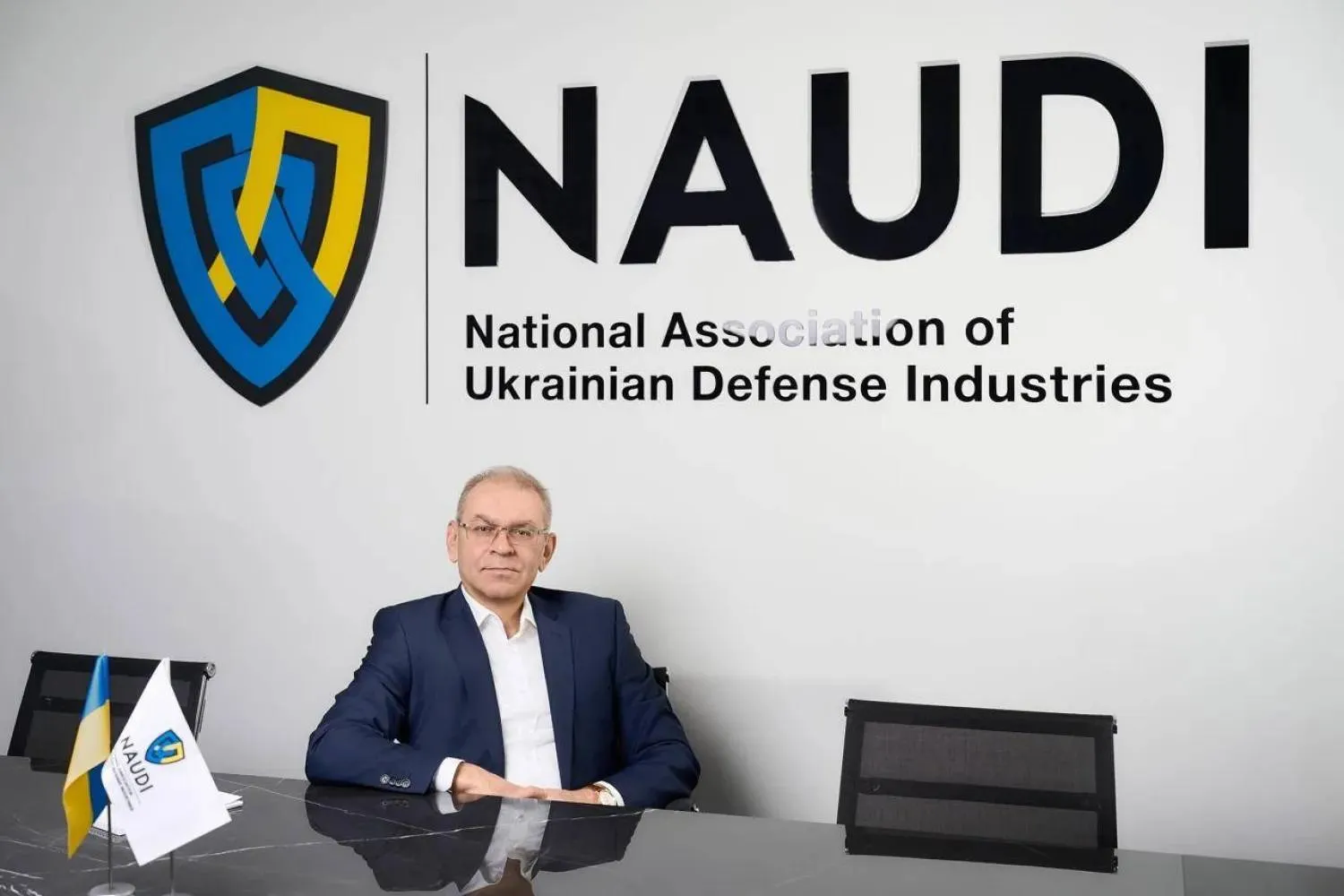
Chairman of the National Association of Ukrainian Defense Industries (NAUDI) Serhii Pashynskyi. (Asharq Al-Awsat)
TT

NAUDI Chairman to Asharq Al-Awsat: Ukraine Aims to Resume, Expand Defense Cooperation with Saudi Arabia

Chairman of the National Association of Ukrainian Defense Industries (NAUDI) Serhii Pashynskyi. (Asharq Al-Awsat)

Chairman of the National Association of Ukrainian Defense Industries (NAUDI) Serhii Pashynskyi revealed that Kyiv was counting on Saudi Arabia to achieve peace and stability in Ukraine given its role as a “significant and authoritative regional leader”.

In an interview to Asharq Al-Awsat, he said: “We aim in the near future to define concrete plans for the renewal and further expansion of Ukrainian-Saudi defense cooperation.”

He made his remarks as NAUDI took part in the World Defense Show 2026 in Riyadh.

“We are open to considering opportunities for establishing joint ventures, developing specific technologies, and localizing production on the territory of Saudi Arabia. We are ready to deepen cooperation that has been actively developing since 2014,” Pashynskyi said.

“Our participation in World Defense Show 2026 has a clear objective: to demonstrate the technological capability of Ukraine’s defense sector, which has undergone real testing in wartime conditions. At the joint NAUDI stand, we present our latest developments with confirmed combat experience, share practical insights into their operational use, and discuss tactics of employment,” he explained.

“Today, member companies of the Association already maintain dozens of international contracts in the format of industrial cooperation, and the geography of our partnerships continues to expand. This is precisely the message we seek to convey to our international and regional partners,” he stated.

Saudi-Ukrainian military cooperation

Commenting on military cooperation between Saudi Arabia and Ukraine, he said: “Prior to the full-scale invasion, there was active and effective cooperation between Ukraine’s defense-industrial complex and the Kingdom’s defense institutions and companies.”

“We are interested in restoring these contacts. In line with the position of Ukrainian President Volodymyr Zelenskyy, regarding controlled exports, we aim in the near future to define concrete plans for the renewal and further expansion of Ukrainian-Saudi defense cooperation,” he went on to say.

Moreover, Pashynskyi revealed that an official intergovernmental agreement between the Ukrainian and Saudi governments on cooperation in the field of defense was signed in Kyiv on February 5, 2020, and duly approved by the respective governments.

“The agreement establishes a comprehensive legal framework for bilateral defense interaction. It covers cooperation between the defense industries of both countries, military education and personnel training, exchange of information in the field of defense technologies, transfer of specific military technologies and equipment, including electronic, radar, and telecommunications systems, as well as issues related to defense medical support,” he explained.

“Ukraine highly values the principled and consistent position of Saudi Arabia, which is based on unwavering respect for the provisions of the UN Charter and the fundamental principles of international law, particularly with regard to ensuring territorial integrity and protecting state sovereignty,” he added.

“An important moral and humanitarian component of Ukrainian-Saudi relations is the Kingdom’s sincere solidarity with the Ukrainian people, which is reflected in the humanitarian assistance provided, particularly to support internally displaced persons,” he told Asharq Al-Awsat.

Ukrainian products at the World Defense Show

Elaborating on the Ukrainian products displayed at the World Defense Show, Pashynskyi said: “NAUDI member companies produce a full spectrum of defense products, from 7-inch FPV drones to the Bohdana self-propelled artillery system, which is physically displayed at the exhibition.”

“Ukraine has become a global pioneer in the mass combat use of FPV drones, as well as in the development and deployment of maritime unmanned platforms. We possess unique and extremely valuable experience in operating these systems under real combat conditions,” he stressed. “The private sector accounts for more than 70% of Ukraine’s total defense-industrial production.”

Among the key exhibits are the Bohdana self-propelled howitzer, manufactured in significant quantities by the company Ukrainian Armor and actively employed in combat operations; the Varta armored vehicle; the Protector unmanned ground system; the MAC maritime drone; reconnaissance UAVs Shark, PD-2, mini Shark, and Furia; the Krechet air defense command-and-control system; heavy drones Kazhan and Shmavik; UAV munitions produced by UBM; FPV drones manufactured by General Cherry; and electronic warfare systems developed by Piranya Tech.

Preserving lives

Pashynskyi revealed that more than 50% of the needs of Ukraine’s Defense Forces are currently met by the domestic defense-industrial complex, from FPV drones to cruise missiles, 155-mm artillery systems, ammunition, electronic warfare (EW) and electronic intelligence (ELINT) systems.

“According to last year’s results, NAUDI member companies supplied the Defense Forces with products worth approximately EUR 4 billion,” he said. “Since 2022, the industry has undergone large-scale relocation and deployment of new production facilities. Today, Ukraine is without exaggeration one of the world’s leaders in the pace of weapons and ammunition production.”

“Our primary priority is preserving the lives of service members. That is why special emphasis is placed on unmanned systems that enhance soldier effectiveness without replacing the soldier,” he continued.

“A key advantage is the direct connection with frontline units. This allows manufacturers to receive real-time feedback and rapidly modernize their solutions. While R&D processes in other countries may take years, for Ukrainian companies the path from concept to serial production often takes just 3 to 6 months.”

“Some companies have increased FPV drone production from several thousand units in 2023 to over 500,000 units in 2025 and these are not isolated cases,” Pashynskyi revealed.

Empty Quarter: Reservoir of Energy and Graveyard for Drones

The Empty Quarter lies atop two of the world’s largest oil and gas fields (SPA)
TT

Empty Quarter: Reservoir of Energy and Graveyard for Drones

The Empty Quarter lies atop two of the world’s largest oil and gas fields (SPA)

Stretching across the southern Arabian Peninsula, the Empty Quarter desert spreads like an endless sea of sand. It covers three Saudi administrative regions and extends across four countries, accounting for more than 67% of Saudi Arabia’s sand accumulations and about 22% of the Kingdom’s total land area.

Occupying nearly a fifth of the Arabian Peninsula, the vast desert is viewed by observers as both a reservoir of energy and a graveyard for drones targeting Saudi Arabia. Saudi defense authorities frequently announce interceptions of attacks headed for oil installations in the desert.

The Empty Quarter, one of the world’s largest sand seas, is also among its harshest environments, with temperatures reaching unbearable levels.

National Geographic describes it as a land “tamed only by the most resilient and wise of men despite its harshness,” a testament to the endurance of nomadic Bedouin tribes who forged unique bonds of kinship and marriage across generations.

Beneath the harsh landscape lie immense riches. The Empty Quarter sits atop some of the world’s largest oil and gas reserves. Nearby lie giant fields such as Shaybah, among the world’s largest crude oil fields on the desert’s edge, and Jafurah, Saudi Arabia’s largest unconventional gas field discovered to date. Jafurah alone holds an estimated 200 trillion standard cubic feet of gas and more than 60 billion barrels of condensate.

The Jafurah oil field. Aramco

The result is a striking contrast: a silent desert resting above resources that help drive the global economy.

Since March 5, the Empty Quarter has taken on another, unexpected role — a graveyard for drones targeting Saudi Arabia.

In just one week, its sands swallowed more than 63 drones as Saudi defenses carried out 27 interception and destruction operations, preventing them from striking the Shaybah field and reinforcing confidence in the Kingdom’s ability to protect energy supplies and ensure their delivery to global markets.

Ironically, three countries across which the Empty Quarter stretches — Saudi Arabia, which holds about 80% of the desert, along with Oman and the United Arab Emirates to the east, have faced Iranian drone, ballistic missile and cruise missile attacks.

The Shaybah oil field. Reuters

While many civilian and military sites have been affected, the attempt to target Shaybah marked what analysts described as an escalation threatening global energy sources.

A recent study by King Abdullah University of Science and Technology (KAUST) found that the Empty Quarter was once far different from the barren landscape it is known for today.

In the distant past, it was home to lakes, rivers and green plains that supported rich ecosystems and helped early human populations spread across the Arabian Peninsula.

Today it is among Saudi Arabia’s hottest and driest regions, with average rainfall of less than 50 millimeters a year and summer temperatures exceeding 50°C.

But researchers say these harsh conditions followed a wetter climate period known as “Green Arabia,” which lasted between 11,000 and 5,500 years ago in the late Quaternary era.

During that time, strong monsoon rains from Africa and India — driven by orbital climate shifts — fueled vegetation and wildlife across the region.

The desert’s name reflects both its scale and isolation. Saudi sources say it was called the “Empty Quarter” because it occupies roughly a quarter of the Arabian Peninsula and lacks permanent human settlement, aside from a small number of nomadic Bedouins, with limited wildlife and vegetation.

Some sources also refer to parts of the desert as “Al-Ahqaf,” believed to apply mainly to its southern reaches between Saudi Arabia, Oman, and Yemen.

Tradition links the area to the ancient people of ‘Ad and the legendary city of Iram, said to lie buried beneath the sands.

The Empty Quarter is more than a vast expanse of desert. It is a landscape where extremes meet — immense natural wealth beneath a silent sea of dunes, and a remote terrain that has quietly become a shield protecting vital energy supplies.


Saudi Foreign Minister Discusses Regional Escalation with Spanish Counterpart

Prince Faisal bin Farhan, Saudi Foreign Minister (Asharq Al-Awsat)
TT

Saudi Foreign Minister Discusses Regional Escalation with Spanish Counterpart

Prince Faisal bin Farhan, Saudi Foreign Minister (Asharq Al-Awsat)

Saudi Minister of Foreign Affairs Prince Faisal bin Farhan bin Abdullah received a phone call on Thursday from his Spanish counterpart José Manuel Albares.

During the call, they discussed the regional escalation and the efforts being exerted in this regard.


Pakistani Prime Minister Arrives in Jeddah

Pakistan's Prime Minister arriving in Jeddah - SPA
TT

Pakistani Prime Minister Arrives in Jeddah

Pakistan's Prime Minister arriving in Jeddah - SPA

Pakistan's Prime Minister Muhammad Shehbaz Sharif and his accompanying delegation arrived in Jeddah on Thursday, SPA reported.

At King Abdulaziz International Airport, the Pakistani prime minister was welcomed by Deputy Governor of Makkah Region Prince Saud bin Mishaal bin Abdulaziz, and several other officials.
