


Palestinian Government Sets Economic Reform Plan for Gaza Strip

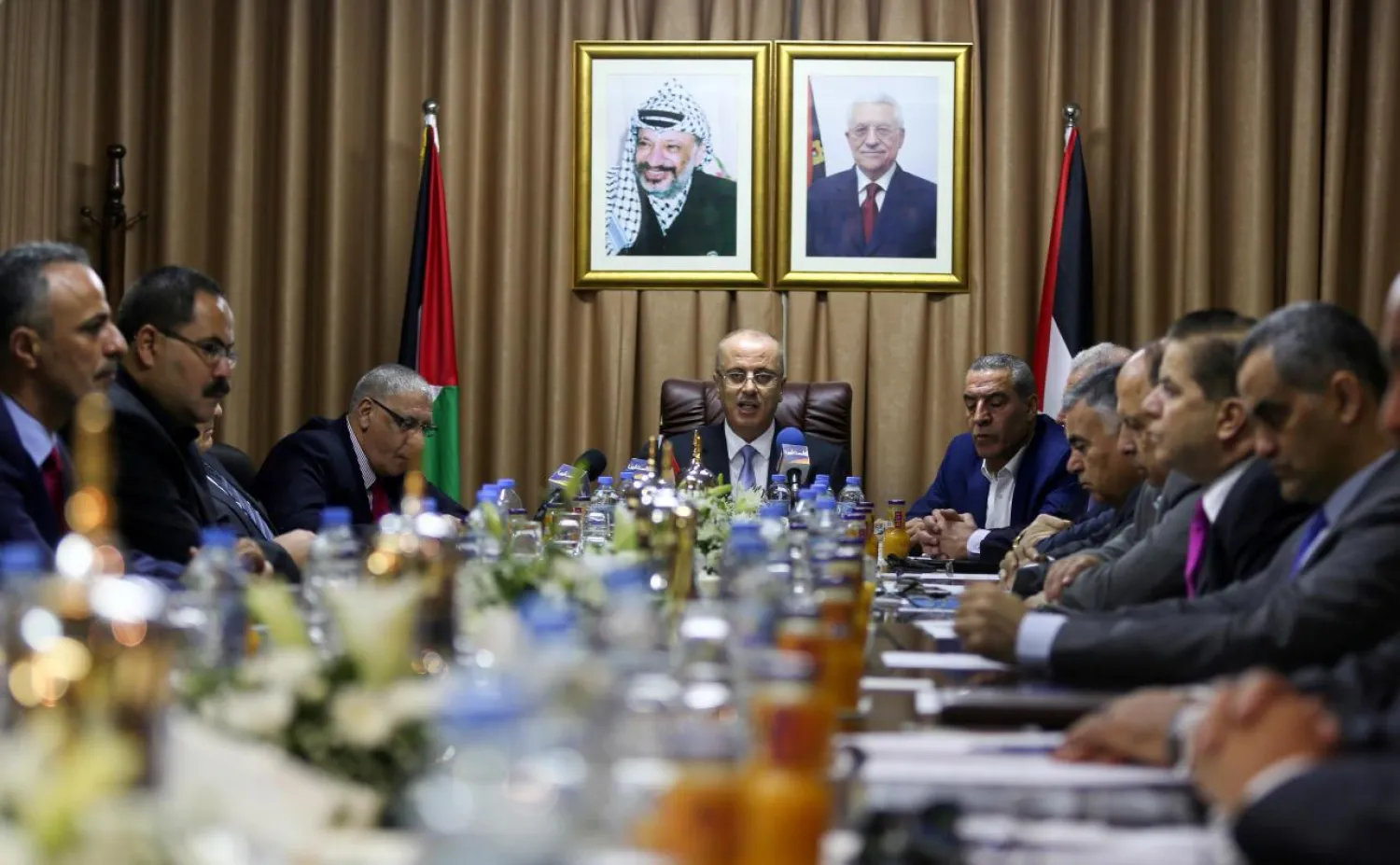
Palestinian Prime Minister Rami Hamdallah (C) chairs a cabinet meeting in Gaza City October 3, 2017. REUTERS/Mohammed Abed/Pool
TT

Palestinian Government Sets Economic Reform Plan for Gaza Strip

Palestinian Prime Minister Rami Hamdallah (C) chairs a cabinet meeting in Gaza City October 3, 2017. REUTERS/Mohammed Abed/Pool

Palestinian Prime Minister Rami Hamdallah presented on Wednesday highlights of his government’s economic reform plan in the Gaza Strip.

“We have plans ready for action,” said Hamdallah, who remained in Gaza with a group of ministers following a Cabinet session on Tuesday.

“We hope we can invest in industrial areas and gas fields,” he stated, addressing a group of Gazan businessmen.

The prime minister was referring to his intention to reproduce the experience of the West Bank in the establishment of large industrial zones, which is still in its early stages, and to start extracting gas from the natural gas field off the coast of Gaza, which was discovered in 1998.

The Authority highlighted an initial agreement with foreign companies for gas extraction, hoping that the Gaza gas field would be one of the foundations of the Palestinian economy.

In addition, Hamdallah said that his government was looking to improve the business and investment environment in Gaza, to work on the land settlement and water purification projects and to complete infrastructure and sanitation plans.

The economic file will be one of the most important issues that the Palestinian government will have to deal with, in the wake of the high rates of unemployment and poverty, and the significant and dangerous economic decline witnessed over the last period.

According to a recent study, the Gaza Strip incurred losses worth $15 billion over the past ten years.

Hamdallah stressed that his government would work to improve the economic situation, despite the decline of foreign aid by more than 70 percent, the delivery of only 35.5 percent of aid, and with many countries not fulfilling their commitments to reconstruction in Gaza.

The prime minister, however, linked the ability of his government to implement its economic plans with the agreement between Fatah and Hamas on the reconciliation files in Cairo.

“We hope that reconciliation will be a lever for our efforts in this context, which will contribute to improving our economy and the living conditions of citizens,” he said.

Two delegations from Fatah and Hamas are expected to arrive next Monday in Cairo, upon an invitation by Egyptian Intelligence Chief Khalid Fawzi.

On Tuesday, Hamdallah presided over a Cabinet meeting in the Gaza Strip, in a move towards reconciliation between Fatah and Hamas parties.



EU Condemns Israel's West Bank Control Measures

The Israeli settlement of Har Homa, seen from the West Bank city of Bethlehem, Tuesday, Dec. 17, 2024. (AP)
TT

EU Condemns Israel's West Bank Control Measures

The Israeli settlement of Har Homa, seen from the West Bank city of Bethlehem, Tuesday, Dec. 17, 2024. (AP)

The European Union on Monday condemned new Israeli measures to tighten control of the West Bank and pave the way for more settlements in the occupied Palestinian territory, AFP reported.

"The European Union condemns recent decisions by Israel's security cabinet to expand Israeli control in the West Bank. This move is another step in the wrong direction," EU spokesman Anouar El Anouni told journalists.


Atrocities in Sudan's El-Fasher Were 'Preventable Human Rights Catastrophe'

Sudanese displaced people who left El Fasher after its fall, sit in the shade in Tawila at the Rwanda camp reception point on December 17, 2025. (Photo by AFP)
TT

Atrocities in Sudan's El-Fasher Were 'Preventable Human Rights Catastrophe'

Sudanese displaced people who left El Fasher after its fall, sit in the shade in Tawila at the Rwanda camp reception point on December 17, 2025. (Photo by AFP)

The atrocities unleashed on El-Fasher in Sudan's Darfur region last October were a "preventable human rights catastrophe", the United Nations said Monday, warning they now risked being repeated in the neighbouring Kordofan region.


"My office sounded the alarm about the risk of mass atrocities in the besieged city of El-Fasher for more than a year ... but our warnings were ignored," UN rights chief Volker Turk told the Human Rights Council in Geneva.


He added that he was now "extremely concerned that these violations and abuses may be repeated in the Kordofan region".


Arab League Condemns Israel's Decisions to Alter Legal, Administrative Status of West Bank

A general view shows the opening session of the meeting of Arab foreign ministers at the Arab League Headquarters (Reuters)
TT

Arab League Condemns Israel's Decisions to Alter Legal, Administrative Status of West Bank

A general view shows the opening session of the meeting of Arab foreign ministers at the Arab League Headquarters (Reuters)

The General Secretariat of the Arab League strongly condemned decisions by Israeli occupation authorities to impose fundamental changes on the legal and administrative status of the occupied Palestinian territories, particularly in the West Bank, describing them as a dangerous escalation and a flagrant violation of international law, international legitimacy resolutions, and signed agreements, SPA reported.

In a statement, the Arab League said the measures include facilitating the confiscation of private Palestinian property and transferring planning and licensing authorities in the city of Hebron and the area surrounding the Ibrahimi Mosque to occupation authorities.

It warned of the serious repercussions of these actions on the rights of the Palestinian people and on Islamic and Christian holy sites.

The statement reaffirmed the Arab League’s firm support for the legitimate rights of the Palestinian people, foremost among them the establishment of their independent state on the June 4, 1967 borders, with East Jerusalem as its capital.