

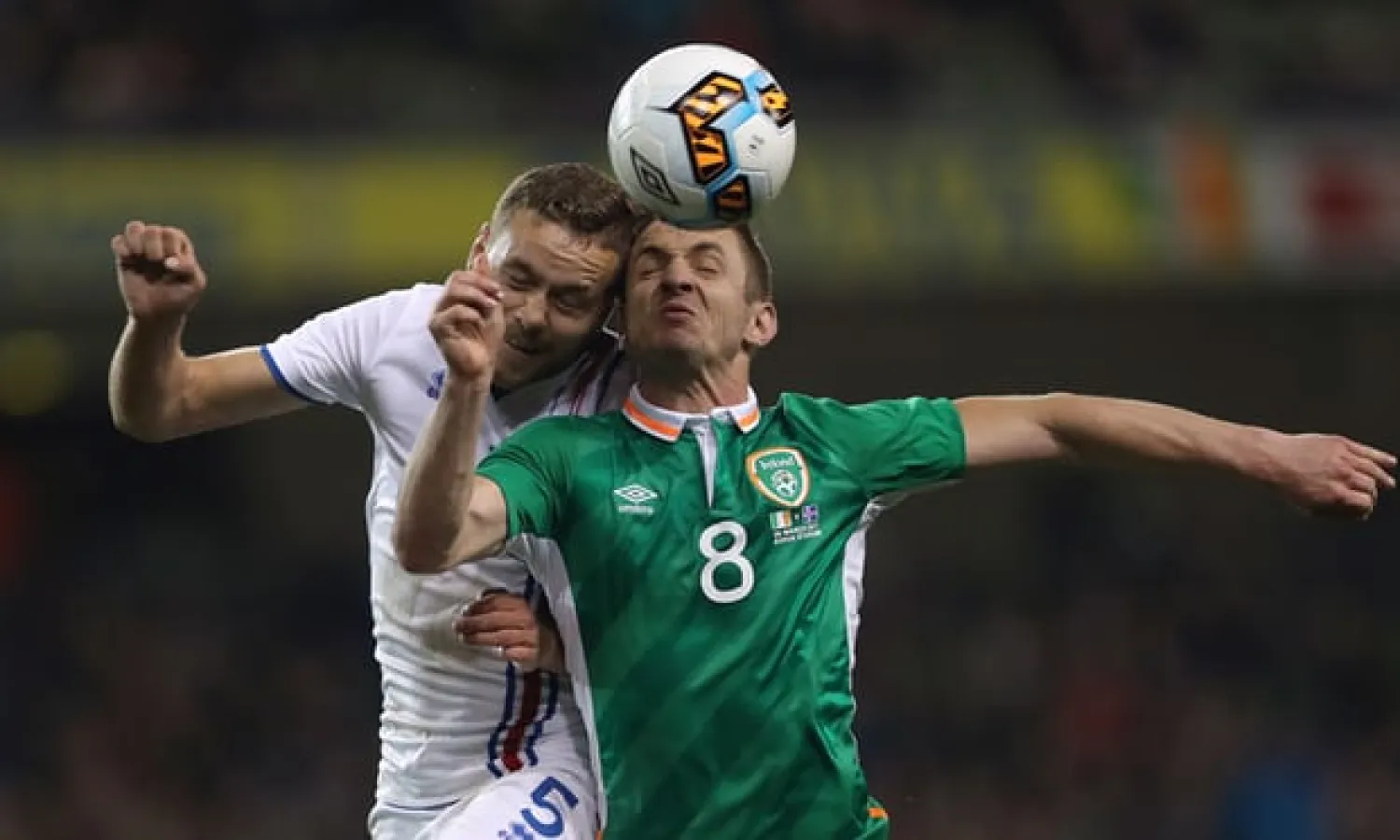

Football is Heading for Trouble Over Brain Injuries Caused by the Ball

Football is Heading for Trouble Over Brain Injuries Caused by the Ball
TT

Football is Heading for Trouble Over Brain Injuries Caused by the Ball

Football is Heading for Trouble Over Brain Injuries Caused by the Ball

In happier times, there was a story Eric Harrison used to tell his players at Manchester United, as the coach who helped bring through the Class of ’92, about a piece of advice he once received from the centre-half he regarded as the hardest man he had ever seen on a football pitch.

George Curtis will always be best remembered as John Sillett’s managerial partner on the day Coventry City won the 1987 FA Cup. Yet for Harrison’s generation in the 1950s and 1960s he was the kind of centre‑half who could trouble even the most granite-jawed opponent. Harrison played with him on their national service and was always fascinated how a man of 5ft 11in won so many headers against players who were well over 6ft. “No problem,” Curtis explained, “early in the game, when the first ball comes up the middle, I don’t head the ball. I head the back of the centre-forward’s head against the ball – and he doesn’t usually come back for more.”

Harrison liked what he heard so much he adopted the same tactic, as you might expect for a man whose nickname during 10 years as a wing‑half at Halifax Town was “Chopper”. Harrison, by his own admission, saw every header as a personal challenge, no matter what was in the way.

Yet it had its consequences. His wife, Shirley, told me a story recently about her first pregnancy and the arrival of their baby daughter, Kim. Harrison was in another part of the hospital that day, suffering one of his regular concussions, and missed the birth. That one wiped him out for three days.

He is 79 now and the most famous players from his list of successes Old Trafford are still in thrall of their old coach. Yet it hasn’t been easy for anyone when they have called in to see him this year. “Eric still talks about them – Giggsy, Beckham, Scholesy, the Nevilles – but he doesn’t recognise them now,” Shirley explains. “He recognises me and his daughters, but not even the grandchildren. The players have all been to visit but it wasn’t the Eric they knew. Scholesy, in particular, found it really hard. They all did. It was upsetting for all of them.” Beckham had turned up with a carrot cake he had baked with his children and a bottle of whisky. Afterwards, he sat in his car and wept.

By now, you have probably read about Harrison’s deteriorating health and the inevitable concerns that maybe he has suffered from what the coroner in Jeff Astle’s inquest described as “industrial disease”, namely dementia brought on by heading the ball.

Nobody can be sure if there is a connection but, as Shirley acknowledges, it is something she and her family have to consider when there are so many stories of other former pros from bygone eras – in particular, players who were renowned for their heading ability – who have suffered the same way. Astle’s family have led the campaign for greater research, first featured in this column in March 2014, and maybe we are finally getting somewhere now the Football Association and the Professional Footballers’ Association are planning to commission a study to examine the risks and see what can be done.

Yet it has been a bewilderingly slow process, to say the least, bearing in mind it was actually 2002 when the two organisations announced there would be a joint 10-year research programme and I wonder how Kevin Doyle feels about that now football has a story of a modern player who has been forced to retire, on medical advice, because heading the ball was causing persistent headaches. Doyle’s announcement follows what he describes as “numerous” concussions, including two this season, as a player who was always renowned for his aerial ability, scoring a high percentage of his goals that way at Reading, Wolverhampton Wanderers and Colorado Rapids. He is 34 and says his doctors have advised him to end a career that also features 64 caps for the Republic of Ireland to “avoid the possibility of these symptoms becoming more serious and permanent”. The risks are simply too great.

At least he has got out now, rather than subjecting himself to any more punishment, and hopefully that will mean no further problems, whereas there once would have been a time when a footballer in that position would have been encouraged to carry on regardless. Yet it always comes as a jolt when a professional sportsman is advised to quit on medical grounds and particularly in Doyle’s case when many of us, I imagine, might presume there is not a great deal to worry about from heading the ball in today’s game.

It is an easy assumption to make and I must confess I was one of those who thought the dangers had largely been removed once football phased out those heavy, leather balls, often saturated in water, that have been blamed for the issues relating to previous generations. That, however, might be a common mistake because if you listen to some of the experts who have been studying these cases it is a complete red herring.

The balls might be lighter these days but that just means they travel much faster. The game is getting quicker all the time and that means more crosses are being made and more headers are necessary. There might not be the same kind of physicality compared to the days, to quote Harrison, when “trying to break opponents in half” was part of your average Saturday afternoon. But the greater speed also means there is a higher risk of players taking accidental bangs to the head.

Willie Stewart, the neuropathologist who examined Astle and likened what he found to the brain of an old boxer, calls it a “lazy characterisation” to think of it as merely a problem of the past. Many people still do, however, and maybe that explains why the authorities in England have chosen to look the other way for so long, never taking the trouble to confront the evidence properly.

It is certainly worth recounting what happened after the FA promised the Astle family in 2002 that it would treat the issue as a high-level priority. Instead the family received two letters and did not hear from the governing body for 12 years until Greg Dyke, the then chairman, had the decency to apologise on behalf of a previous regime. The first letter was from the FA’s solicitors to advise against legal action. The next could easily be described as a sweetener – a tactic the FA used many years later with various sexual-abuse victims – by offering free tickets for the next England friendly, albeit with the rider that it would be difficult to squeeze them all in. Two seats was the limit.

Thankfully, there are other countries where they have devoted time to these studies without leaving the impression they had to be pushed into seeking answers. One study in New York found that players in their 30s who headed the ball 885 to 1,550 times a year had significantly lower water movement in three areas of their brains and those who did so more than 1,800 times tended to do notably worse in memory tests. American sports have been much quicker to recognise the dangers of concussion and when it comes to chronic traumatic encephalopathy (CTE), the brain disease caused by repeated blows, Boston University announced last week there had been a significant breakthrough diagnosing it in living humans rather than having to identify it posthumously, as was previously the case.

The United States feels so far ahead in terms of its research, its response (heading has been outlawed for under‑10s since 2015) and its understanding that the people playing sport have a right to know the risks. It might not change the way they play, or what their coaches demand, but at least they would be in possession of the facts. Doyle moved to Major League Soccer in 2015. It doesn’t reflect well on English football that he might still be going up for headers every Saturday, come what may, if he had stayed put.

Burden of proof on Ox to show worth

Who did Gareth Southgate mean when he admitted being dissatisfied with his latest England squad and volunteered the information that “one or two players” did not warrant their places judging by their club performances so far this season?

Southgate was too gentlemanly to say but nobody should be surprised if Alex Oxlade-Chamberlain featured prominently in the thoughts of the England manager after a run of form that has merely confirmed the view here that Arsenal did extraordinarily well to coax a transfer fee of £40m out of Liverpool.

Oxlade-Chamberlain is a curious player because he certainly does not lack admirers. Arsène Wenger wanted to keep him at Arsenal and, as well as Jürgen Klopp at Liverpool, Antonio Conte had him on his wish-list for Chelsea. Roy Hodgson spoke highly of him during his time as England manager and Southgate keeps selecting him.

At the same time, it is not always easy to understand the attraction and the difficult truth, looking back over his Arsenal years, is that it is trickier even still to recall a key fixture when Oxlade-Chamberlain has played the leading role. He has started only one game for Liverpool, a Carabao Cup tie, and if there are hidden layers it is time he found a way to bring them out. Oxlade-Chamberlain is 24 now and at that age no footballer should want to be talked about for mere potential.

The Guardian Sport


Salah Steers Egypt into Africa Cup Knockout Stages After VAR Denies South Africa Late Penalty

 Egypt's forward #10 Mohamed Salah shoots from the penalty spot to score the team's first goal during the Africa Cup of Nations (CAN) Group B football match between Egypt and South Africa at Adrar Stadium in Agadir on December 26, 2025. (AFP)
Egypt's forward #10 Mohamed Salah shoots from the penalty spot to score the team's first goal during the Africa Cup of Nations (CAN) Group B football match between Egypt and South Africa at Adrar Stadium in Agadir on December 26, 2025. (AFP)
TT

Salah Steers Egypt into Africa Cup Knockout Stages After VAR Denies South Africa Late Penalty

 Egypt's forward #10 Mohamed Salah shoots from the penalty spot to score the team's first goal during the Africa Cup of Nations (CAN) Group B football match between Egypt and South Africa at Adrar Stadium in Agadir on December 26, 2025. (AFP)
Egypt's forward #10 Mohamed Salah shoots from the penalty spot to score the team's first goal during the Africa Cup of Nations (CAN) Group B football match between Egypt and South Africa at Adrar Stadium in Agadir on December 26, 2025. (AFP)

Mohamed Salah scored again on Friday as Egypt's 10 men held on to beat South Africa 1-0 to reach the knockout stages of the Africa Cup of Nations.

Salah, who secured the Pharaohs’ opening win with a stoppage-time strike against Zimbabwe on Monday, did it again in Agadir and his penalty before the break secured progression from Group B.

But South Africa should arguably have been given a penalty in stoppage time when Yasser Ibrahim blocked a shot with his arm. After a long delay, the referee decided against awarding the spot kick after consulting video replays and Ibrahim sank to the ground in relief.

“We didn’t have much luck. We also had several refereeing decisions go against us,” South Africa coach Hugo Broos said.

Salah converted his penalty after he was struck in the face by the hand of the retreating South Africa forward Lyle Foster. Salah showed no ill effects from the blow and sent his shot straight down the middle while goalkeeper Ronwen Williams dived to his right.

There was still time before the break for Egypt defender Mohamed Hany to get sent off, after receiving a second yellow card for a foul on Teboho Mokoena.

Goalkeeper Mohamed El Shenawy was Egypt’s key player in the second half.

“We gave our all in this match right until the end, and we also hope for the best for what comes next,” the 37-year-old El Shenawy said.

Earlier, Angola and Zimbabwe drew 1-1 in the other group game, a result that suited neither side after opening losses.

Egypt leads with 6 points from two games followed by South Africa on 3. Angola and Zimbabwe have a point each. The top two progress from each group, along with the best third-place finishers.

Zambia drew 1-1 with Comoros in the early Group A fixture after both lost their opening games, meaning the winner of the late match could be sure of progressing.


Draper to Miss Australian Open Due to Injury

 Jack Draper, of Great Britain, reacts after defeating Federico Agustin Gomez, of Argentina, during the first round of the US Open tennis championships, Aug. 25, 2025, in New York. (AP)
Jack Draper, of Great Britain, reacts after defeating Federico Agustin Gomez, of Argentina, during the first round of the US Open tennis championships, Aug. 25, 2025, in New York. (AP)
TT

Draper to Miss Australian Open Due to Injury

 Jack Draper, of Great Britain, reacts after defeating Federico Agustin Gomez, of Argentina, during the first round of the US Open tennis championships, Aug. 25, 2025, in New York. (AP)
Jack Draper, of Great Britain, reacts after defeating Federico Agustin Gomez, of Argentina, during the first round of the US Open tennis championships, Aug. 25, 2025, in New York. (AP)

Briton Jack Draper said on Friday he will not compete in next month's Australian Open, citing ongoing recovery from an injury.

Draper, 10th in the world rankings, was forced to withdraw from the second round of ‌the US Open ‌in August ‌due ⁠to bone ‌bruising in his left arm.

"Unfortunately, me and my team have decided not to head out to Australia this year. It's a really, ⁠really tough decision," the British ‌number one said in ‍a video ‍posted on X.

The 24-year-old ‍is targeting a February return alongside preparation for the defense of his Indian Wells title in March.

"This injury has been the most difficult ⁠and complex of my career," Draper added. "It's weird, it always seems to make me more resilient. I'm looking forward to getting back out there in 2026 and competing."

The Australian Open begins on January 18 in ‌Melbourne.


Morocco Forced to Wait for AFCON Knockout Place After Mali Draw

Football - CAF Africa Cup of Nations - Morocco 2025 - Group A - Morocco v Mali - Prince Moulay Abdellah Stadium, Rabat, Morocco - December 26, 2025 Morocco's Ismael Saibari reacts after Mali's Lassine Sinayoko scored their first goal. (Reuters)
TT

Morocco Forced to Wait for AFCON Knockout Place After Mali Draw

Football - CAF Africa Cup of Nations - Morocco 2025 - Group A - Morocco v Mali - Prince Moulay Abdellah Stadium, Rabat, Morocco - December 26, 2025 Morocco's Ismael Saibari reacts after Mali's Lassine Sinayoko scored their first goal. (Reuters)

Morocco missed the chance to guarantee their spot in the last 16 of the Africa Cup of Nations after Lassine Sinayoko's second-half penalty earned Mali a 1-1 draw with the hosts on Friday.

The match was a tale of two spot-kicks, with Brahim Diaz giving Morocco the lead from a penalty deep in first-half injury time and Sinayoko replying on 64 minutes.

The stalemate at the Prince Moulay Abdellah Stadium in the capital Rabat ended Morocco's world record winning run which had been taken to 19 matches with their 2-0 victory over Comoros in the tournament's opening game.

It also means Morocco have not yet confirmed their place in the knockout phase, although they are on top of Group A with four points from two games.

Mali come next on two points alongside Zambia, who drew 0-0 with minnows Comoros earlier in Casablanca.

Morocco next face Zambia on Monday and a victory in that match against the 2012 champions will ensure that the hosts go through as group winners.

"We'll look back at the second half and see what the problem was but we didn't play the way we did in the first half. We didn't impose our game and had to drop off. The penalty changed the game a bit," Morocco midfielder Azzedine Ounahi told broadcaster beIN Sports.

"We go into the third game with the same approach, to win the game and finish top of the group."

Morocco captain Achraf Hakimi, the African player of the year, was again an unused substitute as he continues his recovery from an ankle injury suffered playing for Paris Saint-Germain at the start of November.

- Mbappe watches on -

His former PSG teammate Kylian Mbappe, the current Real Madrid superstar and France skipper, was among the spectators in the crowd of 63,844 and appeared to be wearing a Morocco shirt with Hakimi's number two on it.

With Hakimi on the sidelines, Mbappe's Real Madrid teammate Diaz was the main attraction on the pitch -- the little number 10 forced a good save from Mali goalkeeper Djigui Diarra on 17 minutes and then played a key part in the penalty which led to the opening goal just before the interval.

Mali defender Nathan Gassama brushed the ball with his hand as he tried to stop Diaz dribbling past him inside the box, and the referee eventually awarded a spot-kick following a lengthy look at the pitchside VAR monitor.

Morocco's Soufiane Rahimi had a spot-kick saved against Comoros but this time Diaz sent the goalkeeper the wrong way for his second goal of the tournament.

However, Walid Regragui's side, the best team in Africa according to the FIFA rankings, could not build on that as Mali won a penalty of their own just after the hour mark.

Sinayoko went down under a clumsy challenge by Jawad El Yamiq and 29-year-old Cameroonian referee Abdoul Abdel Mefire awarded the penalty after eventually being called over to check his screen.

Auxerre striker Sinayoko, having been booked apparently for something he said to the referee, kept his cool to stroke in the reward and restore parity.

Morocco substitute Youssef En-Nesyri was denied by a good Diarra save and Mali then held on through 10 minutes of stoppage time for a point, as the final whistle was greeted with jeers from the home fans.
