
Keep Politics out of Sport? Don’t Make me Laugh

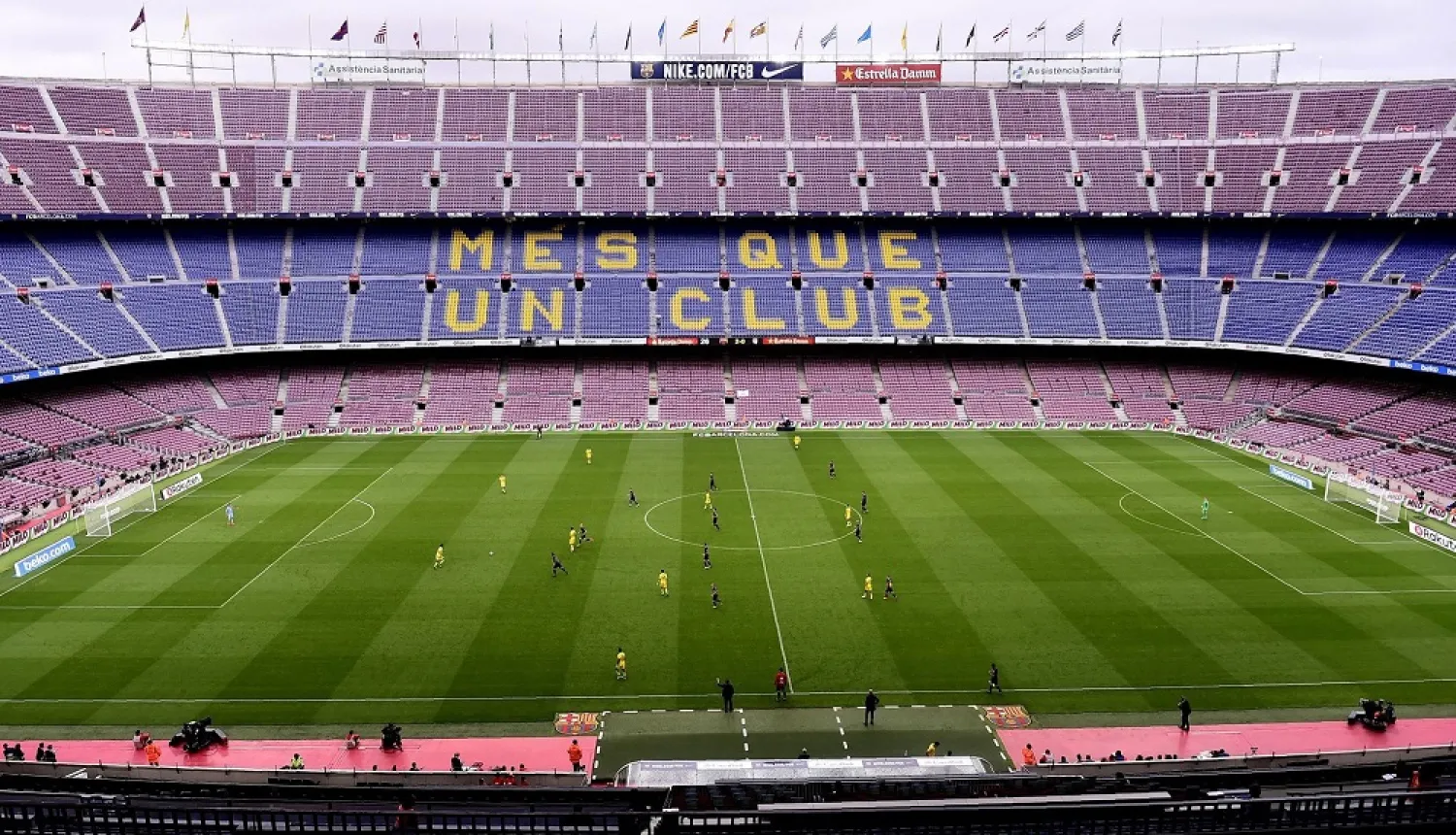
Spectator tribunes remain empty as the Spanish league football match FC Barcelona vs UD Las Palmas is played behind closed doors at the Camp Nou stadium in Barcelona on October 1, 2017. (AFP)
TT

Keep Politics out of Sport? Don’t Make me Laugh

Spectator tribunes remain empty as the Spanish league football match FC Barcelona vs UD Las Palmas is played behind closed doors at the Camp Nou stadium in Barcelona on October 1, 2017. (AFP)

Barcelona’s decision to play the October 1 match against Las Palmas in an empty stadium smacked of choosing points over principles, and overlooks the fact that sport has always found room for protest.

When it came down to it, FC Barcelona – mes que un club, remember – could not bring themselves to go all in. The threatened loss of six points – three for the defaulted match, three more as a penalty – was enough to persuade them to stage their match against Las Palmas behind locked doors in a deserted Camp Nou, while outside the streets of the city rang with the echoes of violent confrontations between police and voters in an independence referendum ruled illegal by the national government.

The club’s decision was an important one. Barça is a powerful international symbol of Catalan identity. A refusal to play Sunday’s match would have added tinder to the fire of the independence movement. But they compete in a league where their final standing against Real Madrid has been measured in the last three seasons by two points, one point and three points. So they took the safer option, leaving Gerard Piqué who has never made a secret of his Catalan pride, to join up with the Spain squad and face uncomfortable questions about divided loyalties.

Meanwhile, fans who had voted for independence pointed to the example of Welsh clubs competing in the English league as evidence that independence from Spain would not have to mean ejection from La Liga. Few would want an entirely autonomous Catalonia to incorporate a future of Barça competing in a domestic mini-league made up by FC Girona, Gimnàstic de Tarragona and Lleida Esportiu.

Keep politics out of sport? Don’t make me laugh. Politics infiltrates sport at all levels. Think about the decision to start next year’s Giro d’Italia in Israel. For one partner in the deal, that’s obviously a matter of money – €17m, apparently. For the other, it represents valuable image-polishing. This is not quite the same as launching the Tour de France in Yorkshire, which was not, the last time I looked, surrounded by walls aimed at keeping out people from Lancashire or County Durham. Or there’s Qatar, whose appalling treatment of migrant workers on the 2022 World Cup stadiums was exposed – not for the first time - by Human Rights Watch this week. Do we really think the Qataris are investing so heavily in football, at home and abroad, out of a sheer love of the game?

The coming days might tell us whether FC Barcelona has a further role to play in the dramatic reawakening of old regional tensions and whether the events of October 1 will join the line of football matches that played a part in shaping history, a phenomenon that could be said to have begun in 1969 with a conflict between El Salvador and Honduras that became known as the Football War.

Tensions between the two countries had been heightened by the migration to Honduras of hundreds of thousands of Salvadorans, leaving a country one-fifth the size of its neighbor but with a population 40 percent greater, prompting the Honduran government to enact reforms intended to keep land out of the hands of immigrant farmers while expelling Salvadoran laborers. The fuse for open conflict was lit when the two countries met in the qualifying tournament for the 1970 World Cup.

The first match was held in the Honduran capital, Tegucigalpa, where the visiting players were kept awake by crowds letting off firecrackers and breaking windows in their hotel. The home team won by a single goal, prompting an 18-year-old girl watching at home in El Salvador to take her father’s pistol from his desk and shoot herself dead. Amelia Bolianos was given a state funeral, her coffin accompanied by the president of the republic and the players of the football team.

When Honduras arrived in San Salvador for the return leg a week later, the welcome included rotten eggs and dead rats thrown through their hotel windows. They made their way to the Flor Blanca stadium in armored cars, passing through angry crowds holding portraits of the dead girl. El Salvador won this one 3-0, which meant that the tie progressed to a play-off on neutral ground in Mexico City. El Salvador won 3-2 with an extra-time goal from their right-winger, “Pipo” Rodríguez, a qualified civil engineer, a few hours after their government had dissolved diplomatic relationships with Honduras in protest against further mass expulsions.

Two weeks later the Salvadoran army and air force launched an invasion which drew a swift response. The war lasted 100 hours and killed 3,000 people, the majority of them civilians, before both sides obeyed a ceasefire call from the Organization of American States. Three months later El Salvador beat Haiti in a play-off to reach the 1970 finals in Mexico, where they lost all three of their group matches.

Twenty years later Red Star Belgrade traveled to meet Dinamo Zagreb in a Yugoslavian league fixture in the midst of rising fervor among Serb and Croat nationalists. Rioting between the home fans and 3,000 visiting supporters continued during the match itself and the game was on the verge of being abandoned, with several players having made it to the safety of the dressing rooms, when Zvonimir Boban, the Dinamo playmaker, kicked a police officer. Although criminal charges were brought and a suspension cost Boban his place in Yugoslavia’s team at the 1990 World Cup finals, his gesture made him a folk hero to his fellow Croats during the bloody war that raged from 1991 to 1995, by which time he was starring for Milan and sending part of his salary back home to help the fight against Serbia.

Back in Mexico City, the black-gloved fists of Tommie Smith and John Carlos in 1968 and the raised hand of Diego Maradona in 1986 were political statements, the first an explicit protest against racial injustice in the United States and the second an implicit response to England’s victory in the Falklands War. Two years ago the flag of a notional “Greater Albania” was flown from a drone into the Belgrade stadium where Serbia and Albania were playing in a Euro 2016 qualifying match, provoking fights among players and fans that led to the match being abandoned.

Like those examples, last weekend’s Barcelona affair and Donald Trump’s continuing assault on the take-a-knee movement in the NFL show that sport cannot seal itself off from the stresses and strains of the real world. From the anti-apartheid boycotts of the 1960s to the demonstrations against holding a grand prix in Bahrain, it offers a useful theater for protest. And those who complain about the temporary inconvenience are seldom on the side of the angels.

The Guardian Sport


Hospital: Vonn Had Surgery on Broken Leg from Olympics Crash

This handout video grab from IOC/OBS shows US Lindsey Vonn crashing during the women's downhill event at the Milano Cortina 2026 Winter Olympic Games on February 8, 2026. (Photo by Handout / various sources / AFP)
TT

Hospital: Vonn Had Surgery on Broken Leg from Olympics Crash

This handout video grab from IOC/OBS shows US Lindsey Vonn crashing during the women's downhill event at the Milano Cortina 2026 Winter Olympic Games on February 8, 2026. (Photo by Handout / various sources / AFP)

Lindsey Vonn had surgery on a fracture of her left leg following the American's heavy fall in the Winter Olympics downhill, the hospital said in a statement given to Italian media on Sunday.

"In the afternoon, (Vonn) underwent orthopedic surgery to stabilize a fracture of the left leg," the Ca' Foncello hospital in Treviso said.

Vonn, 41, was flown to Treviso after she was strapped into a medical stretcher and winched off the sunlit Olimpia delle Tofane piste in Cortina d'Ampezzo.

Vonn, whose battle to reach the start line despite the serious injury to her left knee dominated the opening days of the Milano Cortina Olympics, saw her unlikely quest halted in screaming agony on the snow.

Wearing bib number 13 and with a brace on the left knee she ⁠injured in a crash at Crans Montana on January 30, Vonn looked pumped up at the start gate.

She tapped her ski poles before setting off in typically aggressive fashion down one of her favorite pistes on a mountain that has rewarded her in the past.

The 2010 gold medalist, the second most successful female World Cup skier of all time with 84 wins, appeared to clip the fourth gate with her shoulder, losing control and being launched into the air.

She then barreled off the course at high speed before coming to rest in a crumpled heap.

Vonn could be heard screaming on television coverage as fans and teammates gasped in horror before a shocked hush fell on the packed finish area.

She was quickly surrounded by several medics and officials before a yellow Falco 2 ⁠Alpine rescue helicopter arrived and winched her away on an orange stretcher.


Meloni Condemns 'Enemies of Italy' after Clashes in Olympics Host City Milan

Demonstrators hold smoke flares during a protest against the environmental, economic and social impact of the Milano-Cortina 2026 Winter Olympics in Milan, Italy, February 7, 2026. REUTERS/Kevin Coombs
TT

Meloni Condemns 'Enemies of Italy' after Clashes in Olympics Host City Milan

Demonstrators hold smoke flares during a protest against the environmental, economic and social impact of the Milano-Cortina 2026 Winter Olympics in Milan, Italy, February 7, 2026. REUTERS/Kevin Coombs

Italian Prime Minister Giorgia Meloni has condemned anti-Olympics protesters as "enemies of Italy" after violence on the fringes of a demonstration in Milan on Saturday night and sabotage attacks on the national rail network.

The incidents happened on the first full day of competition in the Winter Games that Milan, Italy's financial capital, is hosting with the Alpine town of Cortina d'Ampezzo.

Meloni praised the thousands of Italians who she said were working to make the Games run smoothly and present a positive face of Italy.

"Then ⁠there are those who are enemies of Italy and Italians, demonstrating 'against the Olympics' and ensuring that these images are broadcast on television screens around the world. After others cut the railway cables to prevent trains from departing," she wrote on Instagram on Sunday.

A group of around 100 protesters ⁠threw firecrackers, smoke bombs and bottles at police after breaking away from the main body of a demonstration in Milan.

An estimated 10,000 people had taken to the city's streets in a protest over housing costs and environmental concerns linked to the Games.

Police used water cannon to restore order and detained six people.

Also on Saturday, authorities said saboteurs had damaged rail infrastructure near the northern Italian city of Bologna, disrupting train journeys.

Police reported three separate ⁠incidents at different locations, which caused delays of up to 2-1/2 hours for high-speed, Intercity and regional services.

No one has claimed responsibility for the damage.

"Once again, solidarity with the police, the city of Milan, and all those who will see their work undermined by these gangs of criminals," added Meloni, who heads a right-wing coalition.

The Italian police have been given new arrest powers after violence last weekend at a protest by the hard-left in the city of Turin, in which more than 100 police officers were injured.


Liverpool New Signing Jacquet Suffers 'Serious' Injury

Soccer Football - Ligue 1 - RC Lens v Stade Rennes - Stade Bollaert-Delelis, Lens, France - February 7, 2026  Stade Rennes' Jeremy Jacquet in action REUTERS/Benoit Tessier
Soccer Football - Ligue 1 - RC Lens v Stade Rennes - Stade Bollaert-Delelis, Lens, France - February 7, 2026 Stade Rennes' Jeremy Jacquet in action REUTERS/Benoit Tessier
TT

Liverpool New Signing Jacquet Suffers 'Serious' Injury

Soccer Football - Ligue 1 - RC Lens v Stade Rennes - Stade Bollaert-Delelis, Lens, France - February 7, 2026  Stade Rennes' Jeremy Jacquet in action REUTERS/Benoit Tessier
Soccer Football - Ligue 1 - RC Lens v Stade Rennes - Stade Bollaert-Delelis, Lens, France - February 7, 2026 Stade Rennes' Jeremy Jacquet in action REUTERS/Benoit Tessier

Liverpool's new signing Jeremy Jacquet suffered a "serious" shoulder injury while playing for Rennes in their 3-1 Ligue 1 defeat at RC Lens on Saturday, casting doubt over the defender’s availability ahead of his summer move to Anfield.

Jacquet fell awkwardly in the second half of the ⁠French league match and appeared in agony as he left the pitch.

"For Jeremy, it's his shoulder, and for Abdelhamid (Ait Boudlal, another Rennes player injured in the ⁠same match) it's muscular," Rennes head coach Habib Beye told reporters after the match.

"We'll have time to see, but it's definitely quite serious for both of them."
Liverpool agreed a 60-million-pound ($80-million) deal for Jacquet on Monday, but the 20-year-old defender will stay with ⁠the French club until the end of the season.

Liverpool, provisionally sixth in the Premier League table, will face Manchester City on Sunday with four defenders - Giovanni Leoni, Joe Gomez, Jeremie Frimpong and Conor Bradley - sidelined due to injuries.