

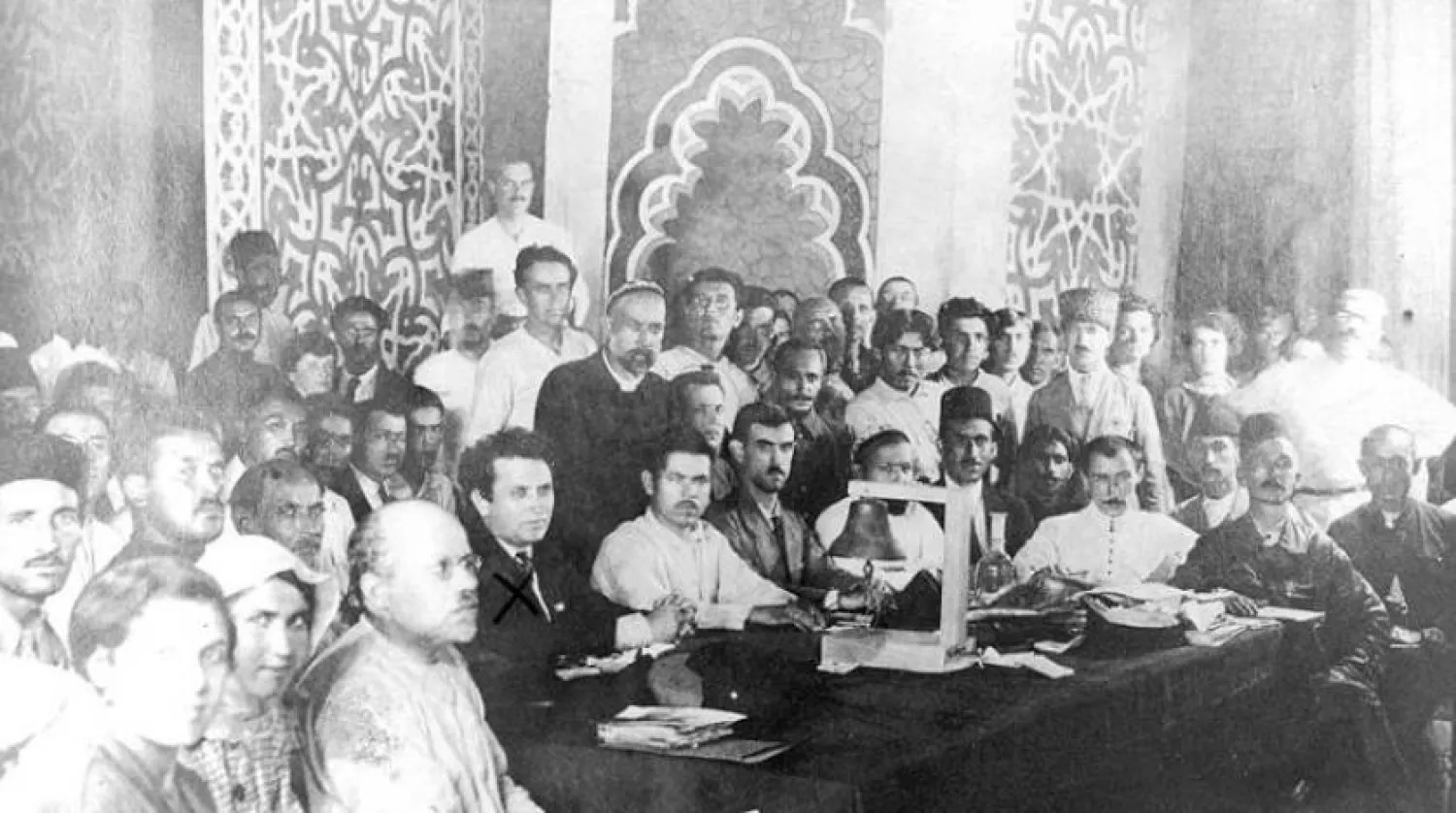

The ‘Autumn of Sorrows’ for Russia’s Muslims

Zinoviev while heading a meeting in Azerbaijan in 1920. Getty images
TT

The ‘Autumn of Sorrows’ for Russia’s Muslims

Zinoviev while heading a meeting in Azerbaijan in 1920. Getty images

“Set the East ablaze!” This was the brief order that the leader of the Bolshevik revolution Vladimir Ilycyh Ulianov, alias Lenin, gave to Zinoviev when he sent him on a mission to mobilize the Muslim subjects of the Russian Empire in support of the October Revolution.

Zinoviev was the party name of Ovseï-Gerchen Aronovitch Radomyslski-Apfelbaum, a Ukrainian Jewish intellectual who had spent years in exile in Europe and had almost no knowledge of the “wild frontiers” of Central Asia and the Caucasus where the Tsar’s Muslim subjects lived. Used to café discussions with Westernized intellectuals, Zinoviev failed to establish any rapport with Muslim tribes of the regions concerned and antagonized the religious leadership in Central Asia and the Caucasus by advancing the slogan: “You believe either in God or in Revolution!”

Having failed to set the Muslim East ablaze, Zinoviev was transferred back to the center to lead the Communist International (COMINTERN) with the task of seizing control of Socialist and Social-Democrat parties in Europe, a mission which he performed with great efficiency before Stalin, emerging as sole dictator after Lenin’s death, put Zinoviev and many other top Bolsheviks to death on charges of treason.

Having learned from Zinoviev’s experience with Muslims of Russia, Lenin decided that “education and persuasion” wouldn’t do the trick among people firmly attached to their religion and traditional way of life. His next emissary was Mikhail Frunze who was determined to win Russia’s Muslims over by force rather than persuasion. When Kazakh, Kyrgyz, Qarapakh and Uzbek tribes rebelled against the new Bolshevik regime, Frunze didn’t ask for more ideological instructors. He demanded more guns and aircraft to bomb the rebels. Lenin cabled him succinctly: “Shoot their men, seize their animals, drive their women and children across the border!”

Frunze did that with extra zeal, writing one of the darkest chapters of Soviet history, known by Central Asians as “The Autumn of Sorrows.” Frunze died a year after Lenin, before Stalin had a chance to also kill him.
However, the Bolshevik Revolution did have some genuine supporters among a small number of Westernized Muslim intellectuals in the Caucasus and central Asia.

The best known among them was Sultan Aliev, a Tatar who came to be known as “The Muslim Lenin”. A brilliant and charismatic propagandist Aliev, or in Russian Galiev, enjoyed much prestige with the Bolshevik leadership to the point that he was one of those who carried Lenin’s coffin. Aliev wanted a straight Communist revolution in the Muslim lands of the Russian Empire. His teachings inspired such events as “the burning of burqahs” and the mass shaving of beards in Tatar, Bashkir and Uzbek territories.

Other Muslim intellectuals searched for ways of producing a version of Communism that could be reconciled with at least some aspects of traditional Islamic teachings. They emphasised the importance of education, equality for men and woman, and acceptance of intellectual diversity. The most brilliant among them were Sadreddin Ayni, Ahmad Danesh and Abdul-Rauf Fitrat.

The Bolshevik Revolution’s full effect on the Muslim world took several decades to materialize with the creation of Communist parties in Iran, Turkey and several Arab countries. By the 1950s, Communism had become an important, and fashionable part of political and intellectual life in the Middle East and among the Muslims in the Indian Subcontinent and Indonesia.

The Communist word view in general and Leninist methods of organization and agitation, was adopted by many Islamist activists who regarded Communism as a form of “kufr”(infidelity). In Egypt, Hassan al-Banna, the teacher who founded the Muslim Brotherhood, admitted he had learned much from Lenin’s modus operandi. Sayyed Qutb, the chief theoretician of the Brotherhood, modelled his book “Signposts” on Lenin’s “What Is To be Done?” The Pakistani religious-political leader al-Maudoodi said he had no objection to being regarded as a pupil of Lenin “when it comes to the role of an organized vanguard to reshape society.”

Ayatollah Ali Khamenei, the current Iranian “Supreme Guide” is also a not so secret admirer of Lenin. In a strange choice of timing, in a talk last month, Khamenei repeated Lenin’s parable of the mountain climbers almost word for word.

On a wide scale, however, the Muslim world proved inhospitable to Communism as governments crushed its adepts and people shunned them.



Iran Leaders Join Crowds on Tehran’s Streets to Project Control in Wartime

An Iranian flag is seen on a residential building that was damaged by recent strikes at Vahdat town in Karaj, southwest of Tehran on April 3, 2026. (AFP)
TT

Iran Leaders Join Crowds on Tehran’s Streets to Project Control in Wartime

An Iranian flag is seen on a residential building that was damaged by recent strikes at Vahdat town in Karaj, southwest of Tehran on April 3, 2026. (AFP)

After more than a month of being stalked by targeted assassinations, Iran's leadership has adopted a new tactic to show it is still in control - with senior officials walking openly in the streets among small crowds who have gathered in support of the regime.

In recent days, Iran's president and foreign minister have separately mixed with groups of several hundred people in central Tehran. On Tuesday, state television aired footage of the two posing for selfies, talking to members of the public and shaking hands with supporters who had gathered in public areas.

According to insiders and analysts, the appearances are part of a calculated effort by Iran's theocratic leadership to project resilience and authority — not only over the vital Strait of Hormuz but also over the population — despite a sustained US-Israeli campaign aimed at "obliterating" it.

One insider close to the hardline establishment said such public outings are intended to show that the regime is "unshaken by strikes and that it remains in control and vigilant" as the war grinds on.

The US-Israeli war ‌on Iran began on ‌February 28 with the killing of veteran Supreme Leader Ali Khamenei and several senior military ‌commanders ⁠in waves of ⁠strikes that have since continued to target top officials.

Iran's new Supreme Leader, Mojtaba Khamenei, has not been seen in public since taking over on March 8 from his father. Foreign Minister Abbas Araqchi, meanwhile, was removed from Israel's hit list amid mediation efforts last month, including by Pakistan, to bring Tehran and Washington together for talks to end the war.

Talks aimed at ending the war have since appeared to have petered out, as Tehran brands US peace proposals "unrealistic". Against that backdrop, recent public appearances by President Masoud Pezeshkian and Araqchi appear designed to project defiance, if not a convincing display of public support.

A senior Iranian source said officials' public presence demonstrates that "the establishment is not intimidated by Israel's targeted killing of top Iranian ⁠figures".

Asked whether Iran's foreign minister or president were on any sort of kill list, an Israeli ‌military spokesperson, Nadav Shoshani, said on Friday he would not "speak about specific personnel."

NIGHTLY RALLIES TO ‌SHOW RESILIENCE

Despite widespread destruction, Tehran appears emboldened by surviving weeks of intense US-Israeli attacks, firing on Gulf countries hosting US troops and demonstrating its ability ‌to effectively block the Strait of Hormuz.

On Wednesday, US President Donald Trump vowed more aggressive strikes on Iran, without offering a timeline ‌for ending hostilities. Tehran responded by warning the United States and Israel that "more crushing, broader and more destructive" attacks were in store.

Encouraged by clerical rulers, supporters of the regime take to the streets each night, filling public squares to show loyalty even as bombs rain down across the country.

Analysts say the establishment is also seeking to raise the "political and reputational" cost of the strikes at a time when civilian casualties are deeply disturbing for Iranians.

Omid Memarian, ‌a senior Iran analyst at DAWN, a Washington-based think tank, said the decision to send officials into gatherings reflects a layered strategy, including an effort to sustain the morale of core supporters ⁠at a moment of acute pressure.

"The system ⁠relies heavily on this base; if its supporters withdraw from public space, its ability to project control and authority weakens significantly," Memarian said.

Speaking to state television, some in the crowds voice unwavering loyalty to Iran's leadership; others oppose the bombing of their country regardless of politics; and some have a stake in the system, including government employees, students and others whose livelihoods are tied to it.

Hadi Ghaemi, head of the New York-based Center for Human Rights in Iran, said the establishment is using such loyal crowds as human shields to raise the cost of any assassination attempts.

"By being in the middle of large crowds they have protections that would make Israeli-American attacks against them very bloody and generate sympathy worldwide," he said.

POTENTIAL PROTESTERS STAY OFF STREETS AT NIGHT

The Islamic republic emerged from a 1979 revolution backed by millions of Iranians. But decades of rule marked by corruption, repression and mismanagement have thinned that support, alienating many ordinary people.

While there has been little sign so far of anti-government protests that erupted in January and abated after a deadly crackdown, the establishment has adopted harsh measures, such as arrests, executions and large-scale deployment of security forces, to prevent any sparks of dissent.

Rights groups have warned about "rushed executions" during wartime after Iran hanged at least seven political prisoners during the war.

"Many potential protesters are frightened by the continuing presence of armed men and violent crowds in the streets and largely stay at home once darkness falls," Ghaemi said.


'Metals of the Future': Copper and Silver Flow Beneath Poland's Surface

Smelter workers process copper at the Glogow plant in southwestern Poland, owned by KGHM. Wojtek RADWANSKI / AFP
TT

'Metals of the Future': Copper and Silver Flow Beneath Poland's Surface

Smelter workers process copper at the Glogow plant in southwestern Poland, owned by KGHM. Wojtek RADWANSKI / AFP

Thousands of meters beneath the ground, amid suffocating heat, lies one of the keys to Poland's rumbling mining sector -- and the world economy.

Whitish ore, rich in copper and silver, is extracted from the country's depths and exported around the world to fuel technological and energy transitions.

"These are the metals of the future," Ariel Wojciuszkiewicz, a geologist at the Polkowice-Sieroszowice mine in the west of the country, tells AFP, noting that copper and silver are "indispensable for electronic equipment, electric cars, and renewable energy installations".

Driven by the rise of artificial intelligence, renewable energies, and global defense needs, demand for these metals is expected to keep increasing in the future, with copper even being referred to as "red gold" and a "barometer" for world economic development.

Poland, responsible for as much as half of Europe's supply, is one of the industry's key players.

Equipped with a helmet and an emergency breathing device, Wojciuszkiewicz leads AFP journalists through the Polkowice-Sieroszowice mine -- one of three sites operated by KGHM, the Polish metals giant, which also owns local smelters and companies in the Americas.

The 24-hour operation runs at a constant roar as machines grind rock at deafening volumes, its tunnels stretching for hundreds of kilometers beneath Poland's surface.

The world's second-largest silver producer, the KGHM group also supplies between 40 percent and 50 percent of the copper produced in Europe.

Last year, it ranked eighth worldwide in terms of copper extraction volume, behind global giants such as BHP Group, Glencore Plc and Rio Tinto, according to industry statistics.

Global copper demand, already high, is expected to climb by over 40 percent by 2040, according to a 2025 UN Report.

To meet this demand, "it might take 80 new mines and 250 billion dollars in investments by 2030," the organization estimates.

The International Energy Agency (IEA), however, predicts that supply will lag 30 percent behind demand by as early as 2035.

- 1,200 degrees Celsius -

Dependence on copper is growing exponentially across the world economy's most innovative sectors.

"We don't realize how much we are surrounded by copper on all sides," Piotr Krzyzewski, KGHM vice president in charge of finance, explains to AFP.

"An electric car contains 80 kg of copper, compared with 20 kg in a conventional one," he notes, while "a wind turbine contains between four and ten tons of copper per megawatt."

Farther away, at the Glogow smelter, two workers in protective suits, armed with long lances, open huge furnaces where the ore is melted.

They work diligently as sparks fly from metal heated to 1,200C.

Several processing stages later, 99.99 percent pure copper plates, each weighing more than a hundred kilos, are shipped all over the world.

Last year, the KGHM group as a whole generated more than 36 billion zlotys ($9.7 billion) in revenue. Copper production reached 710,000 tons and silver production 1,347 tons, according to the group's annual report, published at the end of March.

No less than half of the silver is used in industry, mainly for electronics, solar panels, and medical applications. The rest goes to jewelery or serves as a safety net and financial asset.

But it is copper, now an irreplaceable metal for the economy, that has become the object of global strategic contention.

"Copper is on the strategic list of critical metals in Europe, the United States, and China," Krzyzewski tells AFP.

The metal's impact on geopolitics is already being noted in real time.

In July, US President Donald Trump announced a 50 percent tariff on copper, eventually limiting the measure to products made with the metal.

To justify his decision, he invoked the need to "defend national security".

"Copper is the second most used material by the Department of Defense!" he said.

- Record prices -

In 2025, copper prices jumped 41.7 percent, before hitting a record high of $14,527.50 a ton in January of this year.

Even in the face of the war in the Middle East and the slowdown of the global economy, the price remains high at about 12,000 dollars per ton.

In this uncertain context, Poland's subsoil appears to be a major asset for the energy sovereignty of the Old Continent.

"It's no longer about the security of our country alone, but the security of all of Europe," Krzyzewski says, adding that KGHM's resources "are still estimated to last for at least 40 years," not counting new exploration and concessions.

But mining consumes enormous amounts of water, making it subject to the effects of global warming and drought.


Trump’s Anger Over Iran Thrusts NATO into Fresh Crisis

A NATO flag flutters at the Tapa military base, Estonia April 30, 2023. (Reuters)
TT

Trump’s Anger Over Iran Thrusts NATO into Fresh Crisis

A NATO flag flutters at the Tapa military base, Estonia April 30, 2023. (Reuters)

The NATO alliance has in recent years survived existential challenges - ranging from the war in Ukraine to multiple bouts of pressure and insults from US President Donald Trump, who has questioned its core mission and threatened to seize Greenland.

But it is the US-Israeli war with Iran, thousands of miles from Europe, that has nearly broken the 76-year-old bloc and threatens to leave it in its weakest state since its creation, say analysts and diplomats.

Trump, enraged that European countries have declined to send their navies to open up the Strait of Hormuz to global shipping following the start of the air war on Feb 28, has declared he is considering withdrawing from the alliance.

"Wouldn't you if you were me?" Trump asked Reuters in a Wednesday interview.

In a speech on Wednesday night, Trump criticized US allies but stopped short of condemning NATO, as many experts thought he might.

But combined with other barbs aimed at Europeans in recent weeks, Trump's comments have provoked unprecedented concern that the US will not come to the aid of European allies should they be attacked, whether or not Washington formally walks away.

The result, say analysts and diplomats, is that the alliance created in the Cold War that has long served as the basic fabric of European security is fraying and the mutual defense agreement at its core is no longer taken as a given.

"This is the worst place (NATO) has been since it was founded," said Max Bergmann, a former State Department official who now leads the Europe, Russia, and Eurasia Program at the Center for Strategic and International Studies in Washington.

"It's really hard to ‌think of anything that ‌even comes close."

That reality is sinking in for Europeans, who have counted on NATO as a bulwark against an increasingly assertive Russia.

As recently ‌as February, ⁠NATO Secretary-General Mark ⁠Rutte had dismissed the idea of Europe defending itself without the US as a "silly thought." Now, many officials and diplomats consider it the default expectation.

"NATO remains necessary, but we must be capable of thinking of NATO without the Americans," said General Francois Lecointre, who served as France's armed forces chief from 2017 to 2021.

"Whether it should even continue to be called NATO - North Atlantic Treaty Organization - is a valid question."

White House spokeswoman Anna Kelly said: “President Trump has made his disappointment with NATO and other allies clear, and as the President emphasized, ‘the United States will remember.’”

A NATO representative did not immediately respond to a request for comment.

THIS TIME IT'S DIFFERENT

NATO has been challenged before, not least during Trump's first term from 2017 to 2021, when he also considered withdrawing from the alliance.

But while many European officials until recently believed that Trump could be kept on board with pomp and flattery, fewer now hold that belief, according to conversations with dozens of former and current US and European officials.

Trump and his officials have expressed frustration over what they see as NATO's unwillingness to help the United ⁠States in a time of need, including by not directly assisting with the Strait of Hormuz and by restricting US use of some airfields and ‌airspace. US officials have declared NATO cannot be a "one-way street".

European officials counter that they have not received US requests for specific ‌assets for a mission to open the strait and complain that Washington has been inconsistent about whether such a mission would operate during or after the war.

"It's a terrible situation for NATO to be in," said ‌Jamie Shea, a former senior NATO official who is now a senior fellow at the Friends of Europe think tank.

"It is a blow to the allies who, since Trump returned to ‌the White House, have worked hard to show that they are willing and able to take more responsibility (for their own defense)."

Trump's latest comments follow other signs of an increasingly unsteady alliance.

Those include his stepped-up threats in January to wrest Greenland away from Denmark and recent moves by the US that Europeans see as particularly accommodating toward Russia, which NATO defines as its principal security threat.

The administration has remained essentially mum amid reports that Moscow has provided targeting data for Iran to attack US assets in the Middle East and has lifted sanctions on Russian oil in a bid to ease global energy prices that have spiked during the war.

At a meeting of G7 foreign ministers ‌near Paris last week, US Secretary of State Marco Rubio and Kaja Kallas, the foreign policy chief of the European Union, had a tense exchange, according to five people familiar with the matter, underlining the increasingly fraught transatlantic relationship.

Kallas asked when US patience with Russian President Vladimir ⁠Putin would run out over Ukraine peace negotiations, prompting Rubio ⁠to respond with irritation that the US was trying to end the war while also providing support to Ukraine, but the EU was welcome to mediate if it wanted to.

NO GOING BACK

Legally, Trump may lack the authority to withdraw from NATO. Under a law passed in 2023, a US president cannot exit the alliance without the consent of two-thirds of the US Senate, a nearly impossible threshold.

But analysts say that, as commander-in-chief, Trump can decide whether the US military will defend NATO members. Declining to do so could imperil the alliance without a formal withdrawal.

To be sure, not everyone sees the current crisis as existential. One French diplomat described the president's rhetoric as a passing temper tantrum.

Trump has changed his position on NATO before.

In 2024, he said on the campaign trail that he would encourage Putin to attack NATO members that do not pay their fair share on defense. By the last annual NATO summit, in June 2025, the alliance was in his good graces, with Trump delivering a speech effusively praising European leaders as people who "love their countries."

Next week, Rutte, the NATO secretary-general, who has a strong relationship with Trump, is set to visit Washington in an effort to change Trump's view once again.

Analysts say European nations have good reason to keep the US engaged in NATO despite doubts over whether Trump would come to their defense. Among other reasons, the US military provides a range of capabilities NATO can't easily replace, such as satellite intelligence.

Even if Trump and the Europeans find a way to stay together in NATO, diplomats, analysts and officials say, the transatlantic alliance that has been central to the global order since World War Two may never be the same.

"I do think we're turning the page of 80 years of working together," said Julianne Smith, the US ambassador to NATO under Democratic President Joe Biden.

"I don't think it means the end of the transatlantic relationship, but we're on the cusp of something that's going to have a different look and feel to it."