Macron Stresses Security with Egyptian Leader Sisi

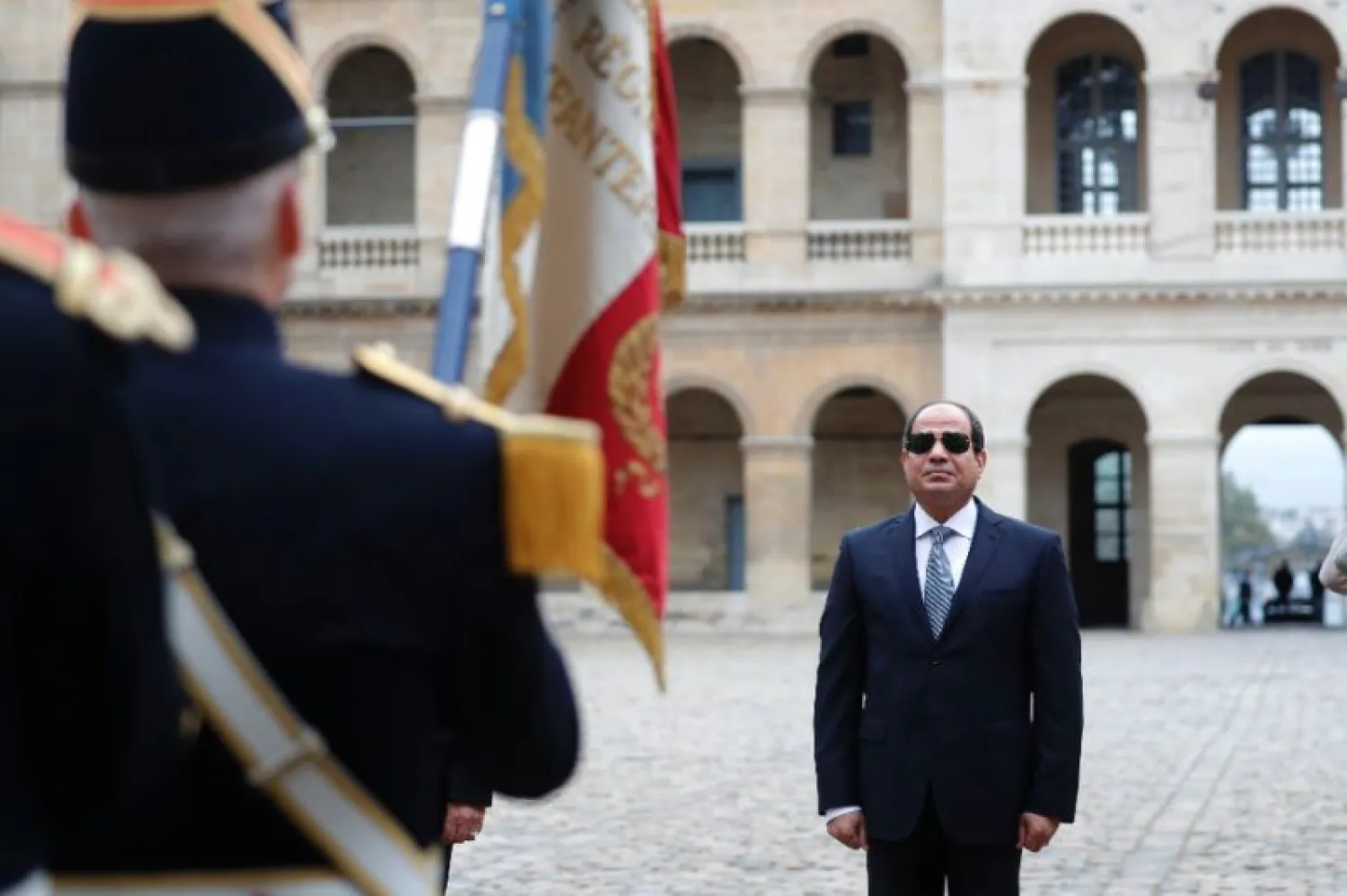
Egyptian President Abdel Fattah al-Sisi attends a military ceremony at the Hotel des Invalides in Paris on October 24, 2017 (AFP Photo/CHARLES PLATIAU)
TT

Macron Stresses Security with Egyptian Leader Sisi

Egyptian President Abdel Fattah al-Sisi attends a military ceremony at the Hotel des Invalides in Paris on October 24, 2017 (AFP Photo/CHARLES PLATIAU)

French President Emmanuel Macron backed visiting Egyptian leader Abdel Fattah al-Sisi in his country's fight against terrorism on Tuesday.

According to AFP, Macron stressed how Egypt was a vital partner in the fight against Islamist extremism in the Middle East and Europe, as well as key in the search for lasting political solutions in war-wracked Libya and Syria.

Responding to claims of rights groups, Macron said he would not "give lessons" to a sovereign state.

"The first battle that we have in common is the fight against terrorism," Macron said during a joint press conference which underlined their common purpose against extremists that have claimed hundreds of victims in both countries.

Macron said he had stated that combating extremism "should be carried out with respect for the rule of law and human rights."

As French president Macron said, "I would not accept that another leader gave me lessons about how to govern my country... I believe in the sovereignty of states and I am not here to give lessons without taking account of the context."

Egypt is a major buyer of French military equipment with orders worth more than 5.0 billion euros ($5.8 billion) since 2015.

They include an order for 24 fighter jets from the Rafale series for which France had long struggled to find a buyer.

French Economy Minister Bruno Le Maire said Tuesday that Macron and Sisi would discuss the possibility of further Rafale orders.

"If there can be new contracts, all the better," he told Europe 1 radio.

Macron's backing for Egypt's tough stance on security is in line with that of other Western leaders, who see Sisi as a source of stability.

US President Donald Trump memorably praised the Egyptian for doing a "fantastic job" in April.

The most populous country in the Middle East is fighting the Egyptian branch of the ISIS group in the north of the Sinai peninsula and has faced a series of attacks that has affected its vital tourism industry.

At least 16 Egyptian police officers were killed at the weekend in an ambush by fighters in the country's Western Desert in a rare flare-up outside the Sinai.

Macron and Sisi both stressed the need to step up the fight against terrorism in Egypt's lawless neighbor Libya, where ISIS ultrahardliners have gained a foothold.


‘AlUla Manifesto’ Ends Era of ‘Economic Dependency’

Group photo of participants at the Conference for Emerging Market Economies held in AlUla. X
TT

‘AlUla Manifesto’ Ends Era of ‘Economic Dependency’

Group photo of participants at the Conference for Emerging Market Economies held in AlUla. X

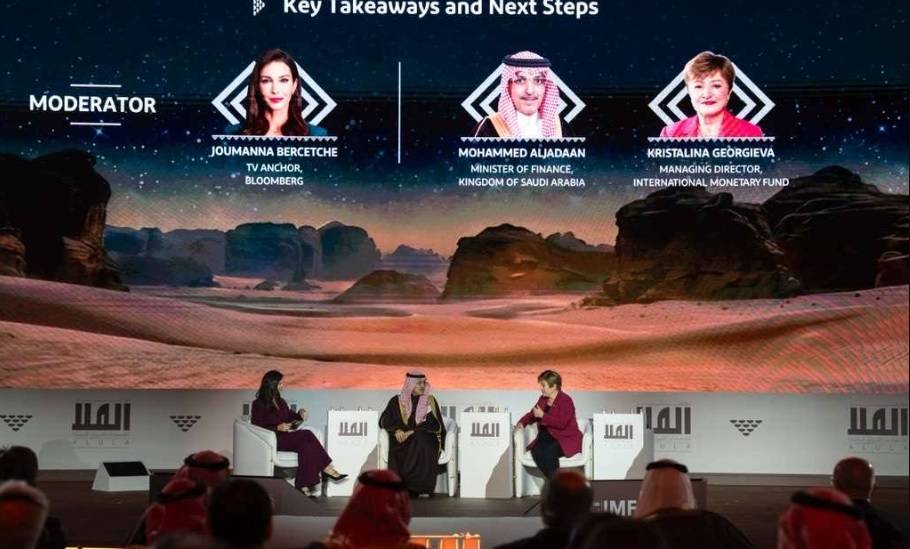
A joint statement issued by Mohammed Aljadaan, the Saudi Minister of Finance, and International Monetary Fund (IMF) Managing Director Dr. Kristalina Georgieva following the second annual Conference for Emerging Market Economies held in AlUla could be described as the “AlUla Manifesto.”

A manifesto is a public, written declaration of intentions, and acts as a guide for action. At the heart of AlUla, this statement was not merely words; it was a “charter” laying out a roadmap to end the era of “economic dependency” and to establish a new phase in which emerging economies are the leaders, not the followers.

For an in-depth analysis of the outputs of this “manifesto,” a fundamental shift is revealed:

Emerging economies are no longer the “weak link” groaning under the weight of crises in advanced countries; rather, they have transformed into a “safety valve” now driving 70 percent of global growth.

The conference highlighted the exceptional resilience of emerging economies in the face of geopolitical storms, while issuing a firm warning that “this is no time for complacency.”

The closing statement issued by Aljadaan and Georgieva stressed that the conference, in its second edition, has “reaffirmed the value of a dedicated global forum focused on the shared challenges, opportunities, and aspirations of emerging market economies.”

They said “discussions focused on how emerging markets can navigate a global environment marked by persistent uncertainty, geopolitical shifts, evolving trade patterns, and rapid technological change.”

“These transformative trends highlight the urgency of strengthening policy frameworks and institutions to support resilience and leverage opportunities ahead,” they added.

According to Aljadaan and Georgieva, “the experience across many emerging markets shows that credible policy frameworks and institutional upgrades have helped achieve better inflation outcomes, maintain financial stability, and preserve market access, even amid heightened uncertainty.”

Aljadaan and Georgieva in the closing session of the conference. X

The joint statement also stressed that the real challenge is moving to the next phase of reforms that deliver higher, more sustained, and more job-rich growth.

“Unleashing the private sector will be central to this effort, including through deepening financial markets, reducing barriers to entrepreneurship and investment, and harnessing artificial intelligence by investing in digital infrastructure and equipping young people with skills necessary to thrive in the evolving global job market,” it said.

The conference also sent a message that in a world of shifting trade and investment patterns, deeper intra-regional and inter-regional integration offers big opportunities.

“Boosting trade and strengthening regional cooperation remain critical for emerging markets as they adapt to the changing global economic landscape,” said Aljadaan and Georgieva.

The Saudi minister and the IMF managing director also wrote an analysis published by “Project Syndicate” that said: “It used to be that when advanced economies sneezed, emerging markets caught a cold.”

“That is no longer true,” they added.

According to the analysis, “following recent global shocks, such as the post-pandemic inflation surge and a new wave of tariffs, emerging markets have held up well. Inflation has continued to slow, currencies have generally retained their value, and debt issuance costs have remained at manageable levels.”

But Aljadaan and Georgieva warned that “while emerging markets have made great strides in improving their policy frameworks and enhancing credibility, this is no time for complacency.”

They called for reforms in a turbulent world and urged policymakers to position their economies to take advantage of the potential productivity gains from AI. “Saudi Arabia, India, and other members of the Gulf Cooperation Council, for example, have unveiled impressive infrastructure investments that will lay the foundation for AI adoption for decades to come.”

They concluded their statement by saying that emerging market economies are coming together to discuss how they can leverage their growing scale and build on their hard-won resilience.


Ten Dead After Shooter Opens Fire at High School in Canada 

Police officers in the vicinity of a shooting in the Tumbler Ridge area of British Columbia, Canada.
TT

Ten Dead After Shooter Opens Fire at High School in Canada 

Police officers in the vicinity of a shooting in the Tumbler Ridge area of British Columbia, Canada.

Ten people including the shooter are dead after an assailant opened fire at a high school in western Canada on Tuesday in one of the country's deadliest mass casualty events in recent history.

The outburst brought to Canada the type of mass shooting more common in the neighboring United States, and was carried out by a shooter described as female, police said.

Six people were found dead inside a high school in the town of Tumbler Ridge in British Columbia, two more people were found dead at a residence believed to be connected to the incident, and another person died on the way to hospital, the Royal Canadian Mounted Police said.

At least two other people were hospitalized with serious or life-threatening injuries, and as many as 25 people ‌were being treated for ‌non-life-threatening injuries, police said.

A suspected shooter was also found dead from what appears ‌to be ⁠a self-inflicted injury, ⁠police said, adding they did not believe there were any more suspects or ongoing threat to the public.

"It's hard to know what to say on a night like tonight. It's the kind of thing that feels like it happens in other places and not close to home," British Columbia Premier David Eby told reporters.

Police released almost no details about the shooter except to say the person was described a female - potentially an unusual development as mass shootings in North America are almost always carried out by men.

A police active shooter alert said the suspect was described "as female in a dress ⁠with brown hair." Police Superintendent Ken Floyd later confirmed at a news conference ‌that the suspect described in the alert was the same person found ‌dead in the school. Police did not say how many of the victims may have been minors.

‘TIGHT-KNIT COMMUNITY’

Tumbler Ridge is a ‌remote municipality with a population of around 2,400 people in the foothills of the Rocky Mountains in northern British ‌Columbia, approximately 1,155 km (717 miles) northeast of Vancouver. Images of the town show a snow-covered landscape filled with pine trees.

Tumbler Ridge Secondary School has 160 students in grades seven through 12, roughly ages 12 to 18, according to its website. The school was closed for the rest of the week and counseling will be made available to those in need, school officials said.

Officials said ‌the town's small police force was on the scene within two minutes of receiving a call, and that victims were still being assessed hours after the incident.

"This ⁠is a small, tight-knit ⁠community with a small RCMP detachment as well, who responded in two minutes, no doubt saving lives today," Nina Krieger, British Columbia's public safety minister, told reporters.

The shooting ranks among the deadliest in Canadian history.

In April 2020, a 51-year-old man disguised in a police uniform and driving a fake police car shot and killed 22 people in a 13-hour rampage in the Atlantic province of Nova Scotia, before police killed him at a gas station about 90 km (60 miles) from the site of his first killings.

In Canada's worst school shooting, in December 1989, a gunman killed 14 female students and wounded 13 at the Ecole Polytechnique in Montreal, Quebec, before committing suicide.

In response to the shooting, Canadian Prime Minister Mark Carney postponed a planned announcement in Halifax on Wednesday for a new Defense Industrial Strategy and subsequent trip to Germany for the Munich Security Conference, a spokesperson said.

"I am devastated by today’s horrific shootings in Tumbler Ridge, B.C. My prayers and deepest condolences are with the families and friends who have lost loved ones to these horrific acts of violence," Carney said on X.


Oman Stresses Importance of Resumption of Negotiations between US and Iran 

Oman’s Sultan Haitham bin Tarik meets with Secretary of Iran's Supreme National Security Council Ali Larijani in Muscat on Tuesday. (ONA)
TT

Oman Stresses Importance of Resumption of Negotiations between US and Iran 

Oman’s Sultan Haitham bin Tarik meets with Secretary of Iran's Supreme National Security Council Ali Larijani in Muscat on Tuesday. (ONA)

Oman stressed on Tuesday the importance of the resumption of dialogue and negotiations between the United States and Iran in wake of talks hosted in Muscat on Friday between the two sides. Tehran said last week’s indirect talks allowed it to assess how serious Washington was about resuming that path.

Oman’s Sultan Haitham bin Tarik received in Muscat on Tuesday Ali Larijani, a former Iranian parliament speaker who now serves as the secretary to the country's Supreme National Security Council, for talks on the latest developments of the Iranian-American negotiations, reported the Sultanate’s official news agency ONA.

The nearly three-hour meeting also addressed paths toward achieving a balanced and equitable agreement for all parties.

It underscored the critical importance of resuming dialogue and returning to the negotiating table to bridge divides and resolve outstanding differences through peaceful means. Such efforts are fundamental to promoting and sustaining peace and security both in the region and the world at large, said ONA.

Sultan Haitham later sent a cable of greetings to Iran’s President Masoud Pezeshkian on his country's National Day.

He expressed his sincere wishes for Iran to achieve further accomplishments. He hoped relations of cooperation and partnership would grow and expand across various sectors in a manner that serves the interests of both countries.

Oman’s Foreign Minister Badr Albusaidi later received Larijani for a “productive” meeting on recent developments, especially the Iran-US talks, he wrote on X.

“Regional peace and security is our priority, and we urge restraint and wise compromise,” he stressed.

Larijani's entourage shared photos of him meeting with the FM, the chief intermediary in the US-Iran talks, with what appeared to be a letter sheathed in plastic and sitting alongside the Omani diplomat.

Iranian media had said Larijani would deliver an important message. However, Iranian state television hours after that meeting described Albusaidi as having “handed over a letter” to Larijani. It did not elaborate from where the letter came.

Iran talks a global focus

Iran and the US held new nuclear talks last week in Oman. Foreign Minister Abbas Araghchi, speaking Sunday to diplomats at a summit in Tehran, signaled that Iran would stick to its position that it must be able to enrich uranium — a major point of contention with US President Donald Trump. Israel’s war on Iran in June disrupted earlier rounds of nuclear talks between Washington and Tehran.

“The Muscat meeting, which was not a long one, it was a half-day meeting. For us it was a way to measure the seriousness of the other side, and to find out how we could continue the process. Therefore we mostly addressed the generalities,” Iranian Foreign Ministry spokesman Esmail Baghaei told journalists at a news conference Tuesday in Tehran.

“Our principles are clear. Our demand is to secure the interests of the Iranian nation based on international norms and the Non-Proliferation Treaty and peaceful use of nuclear energy,” Baghaei said. “So as for the details, we should wait for the next steps and see how this diplomatic process will continue.”

Israeli Prime Minister Benjamin Netanyahu also arrived in Washington for talks with Trump. Iran is expected to be the major subject of discussion.

Larijani accused Israel of trying to play a “destructive role” in the talks.

“Americans must think wisely and not allow him, through posturing, to imply before his flight that ’I want to go and teach Americans the framework of the nuclear negotiations,” Larijani said in a post on X.

Elsewhere, US Ambassador to Israel Mike Huckabee said there is “extraordinary alignment” between Washington and Israel over the talks with Tehran.

“Everyone would love to see something that would resolve without a war, but it’ll be up to Iran,” said Huckabee before he boarded a flight to Washington with Netanyahu.

The United States has moved the aircraft carrier USS Abraham Lincoln, ships and warplanes to the Middle East to pressure Iran into an agreement and have the firepower necessary to strike the country should Trump choose to do so.

Already, US forces shot down a drone they said got too close to the Lincoln and came to the aid of a US-flagged ship that Iranian forces tried to stop in the Strait of Hormuz, the narrow mouth of the Arabian Gulf.

The US Transportation Department's Maritime Administration issued a new warning Monday to American vessels in the strait to “remain as far as possible from Iran’s territorial sea without compromising navigational safety.”

Anti-government chants from people's homes

Meanwhile, people in various neighborhoods of Iran’s capital chanted “death to the dictator” from windows and rooftops on the eve of the anniversary of the 1979 revolution, witnesses said, turning the annual celebration into a protest.

State television in recent days has routinely encouraged people to chant pro-government slogans accompanied by fireworks across the city, an annual ritual in the country. The government plans to hold rallies Wednesday to celebrate the anniversary.

The move came nearly one month after a bloody crackdown in Iran on anti-government protests that led to the deaths of thousands of people and tens of thousands more being detained.