

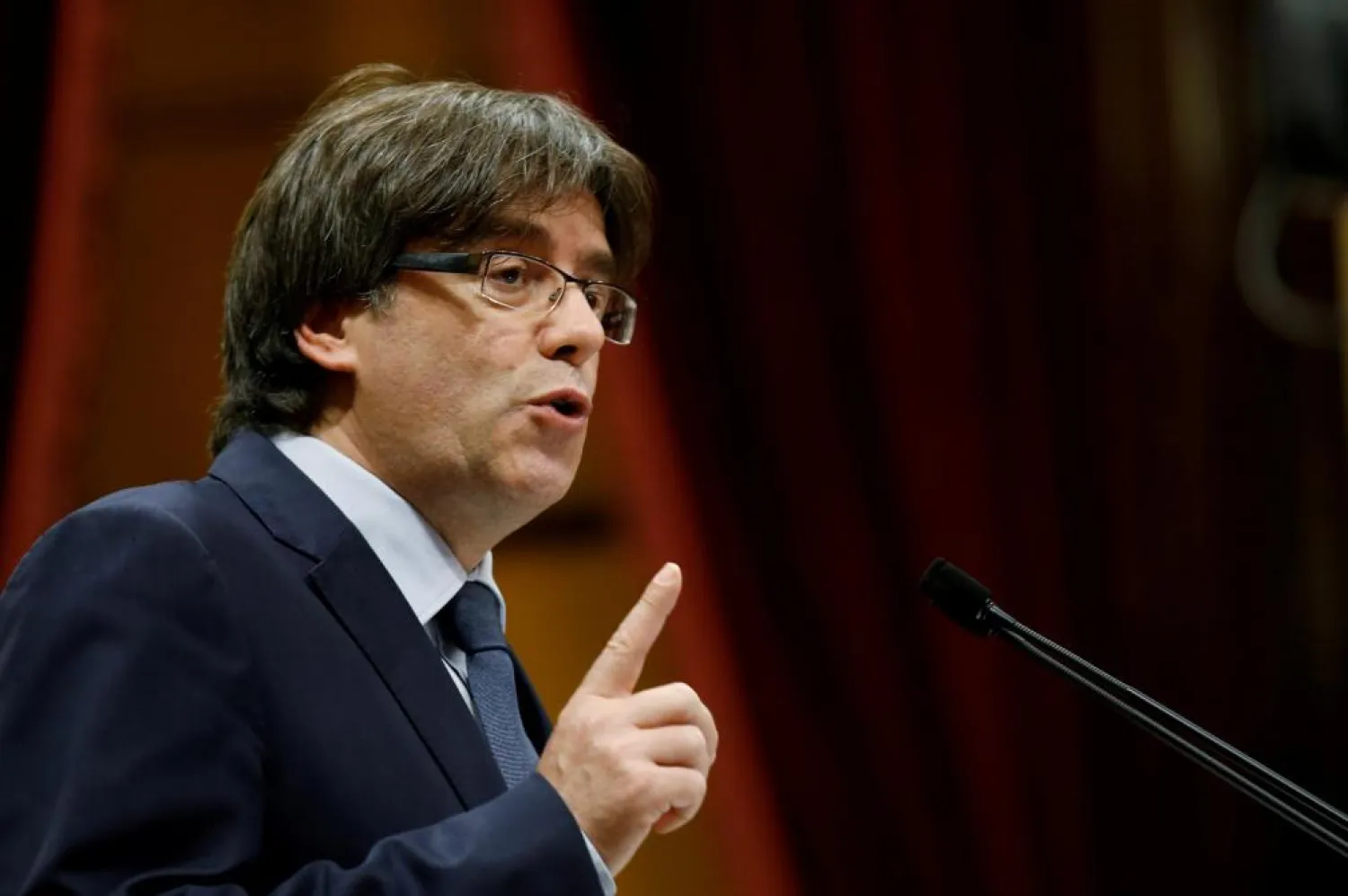

Puigdemont Criticizes European Passivity in Showing Solidarity with Catalonia

Sacked Catalan leader Carles Puigdemont. (Reuters)
TT

Puigdemont Criticizes European Passivity in Showing Solidarity with Catalonia

Sacked Catalan leader Carles Puigdemont. (Reuters)

The ousted leader of Catalonia said on Tuesday there was an “absolute” disconnect by European officials towards the independence drive of the northeastern Spanish region.

In an interview in Brussels with Catalan public radio, Carles Puigdemont criticized the passivity of European politicians in showing solidarity with the deposed and jailed government of Catalonia.

He spoke of an "absolute disconnect between the interests of the people and the European elites" and that Catalonia's problem is an "issue of human rights that requires maximum attention."

Puigdemont is fighting extradition to Spain, where other members of the ousted cabinet have been sent to jail while awaiting the results of a probe for allegedly weaving a strategy to secede from Spain.

The Spanish central authorities are now in direct control of the northeastern region, where early polls on December 21 are shaping into an electoral battle between separatists and unionists.

Puigdemont himself was spared custody on Monday when a Brussels court ruled he could remain at liberty in Belgium until it had heard Spanish charges against him of rebellion.

The court’s decision means Puigdemont, who left Spain last month, is free to campaign for independence in the December 21 elections.

Puigdemont said on Monday his government’s actions were legitimate and criticized the Spanish judicial system for a “clear lack of independence and neutrality”.

The December vote is shaping up to be a de facto independence referendum.

Puigdemont’s PDeCAT and another secessionist party said at the weekend they might run on a combined ticket, but would need to make a decision on any formal alliance - which might also include other parties - by a deadline of Tuesday.

Alliances could however also form after the election.

The independence push has dragged Spain into its worst political crisis since its return to democracy four decades ago. It has deeply divided the country, fueling anti-Spanish feelings in Catalonia and nationalist tendencies elsewhere.

Puigdemont turned himself in to Belgian police on Sunday along with four of his ex-ministers, after Spain issued a European arrest warrant on charges of rebellion as well as misuse of public funds.

All five are barred from leaving Belgium without a judge’s consent.

They will appear before a Belgian court on November 17 for a hearing to discuss the arrest warrant, prosecutors in Brussels said in a statement.

Puigdemont, writing in Britain’s Guardian newspaper, called for scrutiny of the Spanish judicial system and said the crisis could be solved only with a political and not a judicial solution.

“Does anyone think that the sacked Catalan government can expect a fair and independent hearing, uninfluenced by political and media pressure? I do not,” he wrote.

Spain’s central government took control of Catalonia, which accounts for a fifth of the national economy, after local leaders held an independence referendum on October 1 despite a Constitutional Court ban.

The region’s parliament then passed a unilateral declaration of independence. In response, Spain’s Prime Minister Mariano Rajoy fired the government and called the snap regional elections.

On Sunday, the first part of a GAD3 survey showed that pro-independence parties would win the election in Catalonia but may not gain the parliamentary majority needed to continue with secession.

On Monday, the second part showed just one in seven people in the region believe the current standoff between Barcelona and Madrid will end in independence, while more than two thirds think the process has been bad for the economy.

Published in La Vanguardia newspaper, that survey polled 1,233 people between October 30 and Nov. 3.

Optimism that a negotiated solution would be found was low, with just over a fifth of respondents thinking the crisis would lead to talks between regional authorities and Madrid.

The uncertainty has prompted more than 2,000 companies to relocate their legal headquarters out of the region since October 1. The Bank of Spain has said that if the conflict persists it could lead to slower growth and job creation.



Trump Hints at Land Strike as Venezuela Pressure Mounts

A US Air Force C-130J Super Hercules aircraft approaches for landing at Rafael Hernandez Airport, amid tensions between US President Donald Trump's administration and the government of Venezuelan President Nicolas Maduro, in Aguadilla, Puerto Rico, December 28, 2025. (Reuters)
TT

Trump Hints at Land Strike as Venezuela Pressure Mounts

A US Air Force C-130J Super Hercules aircraft approaches for landing at Rafael Hernandez Airport, amid tensions between US President Donald Trump's administration and the government of Venezuelan President Nicolas Maduro, in Aguadilla, Puerto Rico, December 28, 2025. (Reuters)

A throwaway remark last week by President Donald Trump has raised questions about whether US forces may have carried their first land strike against drug cartels in Venezuela.

Trump said the US knocked out a "big facility" for producing trafficking boats, as he was discussing his pressure campaign against Venezuelan President Nicolas Maduro in an interview broadcast Friday.

"They have a big plant or a big facility where they send, you know, where the ships come from," Trump said in an interview with billionaire supporter John Catsimatidis on the WABC radio station in New York.

"Two nights ago we knocked that out. So we hit them very hard."

Trump did not say where the facility was located or give any other details. US forces have carried out numerous strikes in both the Caribbean Sea and eastern Pacific Ocean since September, killing more than 100 people.

The Pentagon referred questions about Trump's remarks to the White House. The White House did not respond to requests for comment from AFP.

There has been no official comment from the Venezuelan government.

Trump has been saying for weeks that the United States will "soon" start carrying out land strikes targeting drug cartels in Latin America, but there have been no confirmed attacks to date.

The Trump administration has been ramping up pressure on Maduro, accusing the Venezuelan leader of running a drug cartel himself and imposing an oil tanker blockade.

Maduro has accused Washington of attempting regime change.


UN Chief Says ‘Get Serious’ in Grim New Year Message

 UN Secretary-General Antonio Guterres. (AFP)
UN Secretary-General Antonio Guterres. (AFP)
TT

UN Chief Says ‘Get Serious’ in Grim New Year Message

 UN Secretary-General Antonio Guterres. (AFP)
UN Secretary-General Antonio Guterres. (AFP)

The United Nations urged global leaders Monday to focus on people and the planet in a New Year's message depicting the world in chaos.

"As we enter the new year, the world stands at a crossroads. Chaos and uncertainty surround us. Division. Violence. Climate breakdown. And systemic violations of international law," UN Secretary-General Antonio Guterres said in a video message.

In 2026, as war rages in Ukraine and elsewhere, world leaders must work to ease human suffering and fight climate change, he added.

"I call on leaders everywhere: Get serious. Choose people and planet over pain," said Guterres, criticizing the global imbalance between military spending and financing for the poorest countries.

Military spending is up nearly 10 percent this year to $2.7 trillion, which is 13 times total world spending on development aid and equivalent to the entire gross domestic product of Africa, he said.

Wars are raging at levels unseen since World War II, he added.

"In this New Year, let's resolve to get our priorities straight. A safer world begins by investing more in fighting poverty and less in fighting wars. Peace must prevail," said Guterres, who will be serving his last year as secretary general.


Türkiye and Armenia Agree to Simplify Visa Procedures to Normalize Ties

Türkiye’s President Recep Tayyip Erdogan, right, and Armenia's Prime Minister Nikol Pashinyan shake hands before a meeting at Prague Castle in Prague, Czech Republic, Thursday, Oct. 6, 2022. (Turkish Presidency via AP, File)
TT

Türkiye and Armenia Agree to Simplify Visa Procedures to Normalize Ties

Türkiye’s President Recep Tayyip Erdogan, right, and Armenia's Prime Minister Nikol Pashinyan shake hands before a meeting at Prague Castle in Prague, Czech Republic, Thursday, Oct. 6, 2022. (Turkish Presidency via AP, File)

Türkiye and Armenia have agreed to simplify visa procedures as part of efforts to normalize ties, Türkiye’s Foreign Ministry announced Monday, making it easier for their citizens to travel between the two countries.

Relations between Türkiye and Armenia have long been strained by historic grievances and Türkiye’s alliance with Azerbaijan. The two neighboring countries have no formal diplomatic ties and their joint border has remained closed since the 1990s.

The two countries, however, agreed to work toward normalization in 2021, appointing special envoys to explore steps toward reconciliation and reopening the frontier. Those talks have progressed in parallel with efforts to ease tensions between Armenia and Azerbaijan.

Türkiye supported Azerbaijan during its 2020 conflict with Armenia for control of the Karabakh region, known internationally as Nagorno-Karabakh, a territorial dispute that had lasted nearly four decades.

The Turkish Foreign Ministry said in a statement posted on social platform X that Ankara and Yerevan agreed that holders of diplomatic, special and service passports from both countries would be able to obtain electronic visas free of charge as of Jan. 1.

“On this occasion, Türkiye and Armenia reaffirm once again their commitment to continue the normalization process between the two countries with the goal of achieving full normalization without any preconditions,” the ministry said.

Türkiye and Armenia also have a more than century-old dispute over the deaths of an estimated 1.5 million Armenians in massacres, deportations and forced marches that began in 1915 in Ottoman Türkiye. Historians widely view the event as genocide.

Türkiye denies the deaths constituted genocide, saying the toll has been inflated and those killed were victims of civil war and unrest. It has lobbied to prevent countries from officially recognizing the massacres as genocide.