


ISIS Besieging Civilians Delays Liberation of Its Final Stronghold in Iraq

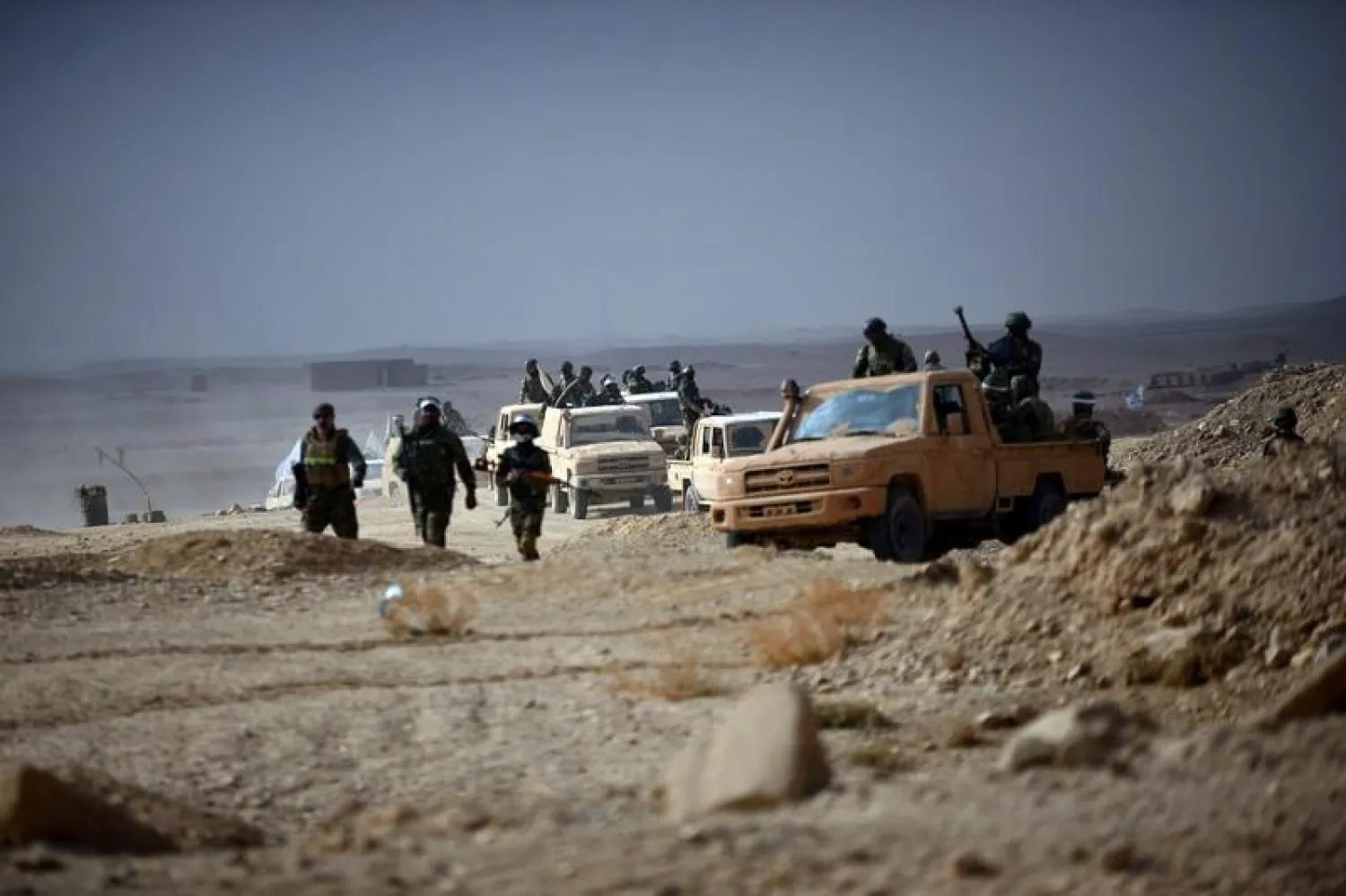
Popular Mobilization Forces (PMF) advance towards the city of al-Qaim, Iraq November 3, 2017. REUTERS/Stringer
TT

ISIS Besieging Civilians Delays Liberation of Its Final Stronghold in Iraq

Popular Mobilization Forces (PMF) advance towards the city of al-Qaim, Iraq November 3, 2017. REUTERS/Stringer

Iraqi High Commission for Human Rights (OHCHR) expressed its concern for the fate of innocents besieged inside Rawa, last ISIS' stronghold in Iraq.

Military observers believe that the presence of civilians inside the city might force the security forces to change their military tactics in launching the liberation operation.

OHCHR added that “according to the detecting sources at the commission’s offices in Anbar, ISIS terrorists are still holding nearly 2500 families, equivalent to 10,000 individuals, to use them as human shields and hamper the advance of Iraqi forces”.

The commission said ISIS militants have prevented civilians from reaching safe routes created by Iraqi security forces for their evacuation.

The commission asked the Federal government and security forces to increase humanitarian efforts to create safe passages for the civilians to leave the city. It also requested the local Anbar government to manage the crisis and ensure relief aid and humanitarian support to all civilians who escaped Rawa siege. It also urged to expedite liberation operations and secure humanitarian needs from local and world relief organizations.

Since then, there have been conflicting reports on whether Rumana subdistrict of al-Qaim district was really liberated or not.

The official website of Popular Mobilization Forces (PMF) announced the launch of liberation operations of Rumana, which was later denied by the joint operations' leadership.

Following the statement, the website said that the news published earlier appeared by mistake. Contradicting news between the operations' leadership and PMF indicate that both parties are in disagreement over priorities and battle management in the west of Iraq.

Iraqi Prime Minister Haider al-Abadi rejected the request of certain PMF-linked parties to increase PMF's allocations in the federal budget, describing it as a fallacy.

Abadi attacked the requests saying they will be used in elections and political parties' bureaus.

In his weekly press conference, the PM said that he has ordered armed forces to fight ISIS, even from within Syrian territory.

Abadi also said that there are joint efforts with Iraq's neighboring countries to protect the borders from any threats posed by ISIS.



Iraq’s PMF Declares ‘Complete Split’ from Parties, Factions

PMF chief Faleh al-Fayyadh. (INA)
TT

Iraq’s PMF Declares ‘Complete Split’ from Parties, Factions

PMF chief Faleh al-Fayyadh. (INA)

The head of Iraq’s Popular Mobilization Forces announced the start of implementation of a government order by Prime Minister Ali al-Zaidi, who is also commander-in-chief of the armed forces, to form a committee tasked with reorganizing the relationship with armed factions.

The move is officially being presented as part of a broader effort to place all weapons under state control.

PMF chief Faleh al-Fayyadh said in a television interview that the new committee had begun work on mechanisms for the “complete disengagement” of the PMF from any political, factional, or partisan frameworks.

The aim was to turn the PMF into an institution governed by a unified system and linked to the commander-in-chief of the armed forces, he added.

Fayyadh said the effort was based on the 2016 law governing the PMF and on successive government orders. But he said the war against ISIS had prevented full implementation over the past years.

In a related development, Sabah al-Numan, spokesman for the commander-in-chief of the armed forces, confirmed that a government order had been issued to form a “sovereign” committee that would set binding mechanisms to end the possession of weapons outside state control.

He warned against what he described as the continued “politicization of the military institution,” saying national security required control over weapons.

Fayyadh rejects calls to dissolve PMF

At the same time, Fayyadh rejected local and diplomatic calls to dissolve the PMF after the end of “major battles”, describing such demands as “unrealistic.”

He said the need for security forces, including the PMF, was “permanent” as long as security threats continued.

Fayyadh said those who believed the PMF’s role had ended had a “superficial view,” referring to criticism he sees as driven by political opposition to his forces.

In a more sensitive file, Fayyadh revealed special arrangements involving brigades affiliated with Saraya al-Salam, which is linked to the Sadrist movement, in Samarra.

He said the brigades would be integrated into the PMF structure under new professional arrangements.

The Saraya al-Salam had handed over their security responsibilities to the Iraqi army in Samarra city on Thursday.

Fayyadh said these formations would be “received as individuals and restructured or redeployed in the field as needed.”

He said the objective was to end the idea of “areas belonging to certain factions” in favor of unified military administration.

In a notable statement, he added that some sites would be placed under temporary transitional arrangements supervised by the Iraqi army before being finally redistributed within the PMF.

The developments come as the head of the Security Media Cell, Lieutenant General Saad Maan, announced the start of steps to implement the decision to place weapons under state control.

He said a number of factions, including Asaib Ahl al-Haq and Kataib al-Imam Ali, had begun legal procedures to hand over heavy and medium weapons ahead of integration into official institutions.

Other factions, including Kataib Hezbollah, the Nujaba movement, and Kataib Sayyid al-Shuhada, continue to reject handing over their weapons.

They said disarmament depends on achieving the “goals for which they were formed,” particularly those linked to the presence of foreign forces in Iraq.

The security spokesman for Kataib Hezbollah, Abu Mujahid al-Assaf, said some current initiatives “do not represent the factions of the Islamic Resistance.” The Nujaba said in a statement that weapons were a “red line.”

‘Unified standards’

Fayyadh said the current stage represented a “starting point” for applying unified standards to all formations.

He warned against any political or partisan links within the military structure and said implementation would include all brigades without exception.

Local press reports said leaders of the Coordination Framework have received signals that Washington will not accept symbolic disarmament.

The reports said Washington is instead pushing for the “dissolution of the PMF” and firmly rejects its integration into other security institutions.

Separately, Numan denied on Friday reports of changes in senior leadership positions in the military and security institutions.

He said current commanders were continuing to perform their duties and national responsibilities normally.


Sources to Asharq Al-Awsat: Palestinian Factions Link Gaza Talks Progress to Halt in Assassinations

A Palestinian woman stands at the site of an Israeli strike after residents were warned to evacuate their home in al-Zawaida, central Gaza Strip. (AFP)
TT

Sources to Asharq Al-Awsat: Palestinian Factions Link Gaza Talks Progress to Halt in Assassinations

A Palestinian woman stands at the site of an Israeli strike after residents were warned to evacuate their home in al-Zawaida, central Gaza Strip. (AFP)

Israel is stepping up assassinations of Hamas and Islamic Jihad members even as attention turns to Cairo on Saturday for the first meetings on proposals aimed at breaking the deadlock over the second phase of the Gaza ceasefire.

Asharq Al-Awsat learned from two Hamas sources and a third source from a Palestinian faction that the groups will meet among themselves on Saturday, before the Hamas delegation meets the mediators, to discuss the demands they see as essential to any progress in the talks.

The three sources said the factions will clearly demand an end to the assassinations, which have escalated since Israel killed Ezzeddine al-Haddad, commander of the Qassam Brigades, Hamas’s armed wing, on May 15.

His killing was followed by a series of assassinations targeting prominent figures. Similar operations had preceded it, targeting operatives who took part in a series of attacks, including the Oct. 7, 2023, attack.

“The assassinations and daily violations, in all their details, must stop to show goodwill by Israel and achieve real progress that reflects a positive Israeli acceptance of the mediators’ efforts,” the source said.

The two Hamas sources said halting the assassinations and violations would be a clear condition, and a demand backed unanimously by the factions, to ensure the negotiations succeed.

They said the Palestinian side would show significant flexibility in the current round of talks in a way that serves Palestinian demands.

Those demands will also include requiring Israel to implement its commitments under the first phase, including completing the withdrawal, expanding the operation of crossings, allowing aid into the enclave, and enabling the Gaza administrative committee to assume its duties in Gaza.

A factional source expected the current round to be difficult, citing Israel’s threats to escalate assassinations and carry out larger operations inside Gaza in the coming period if no agreement is reached.

The source said the factions would show flexibility, but not at the expense of their legitimate demands.

All the sources acknowledged that the assassinations had affected internal consultations and decision-making and had also had an operational impact inside the enclave.

The Gaza Health Ministry said 119 Palestinians were killed in May, the highest monthly toll recorded since the start of the year. Women, children, and the elderly made up 30% of the victims. The dead included 19 children, or 16%, and 10 women, or 8.5%.

According to Asharq Al-Awsat’s monitoring, Israel has assassinated more than 17 operatives since targeting Haddad, most of them from Hamas.

On Thursday and Friday, Israel assassinated four commanders and activists from the General Security apparatus and attempted to assassinate two others.


Lebanon Sentences Activists in Absentia for inciting Israeli Attacks

A UN convoy in southern Lebanon, near the Israel-Lebanon border, as seen from northern Israel, June 2, 2026. REUTERS/Shir Torem
TT

Lebanon Sentences Activists in Absentia for inciting Israeli Attacks

A UN convoy in southern Lebanon, near the Israel-Lebanon border, as seen from northern Israel, June 2, 2026. REUTERS/Shir Torem

Lebanon's judiciary has charged two anti-Hezbollah activists in absentia with inciting Israeli attacks against the Iran-backed group and sentenced them to 15 years in prison, a judicial official told AFP on Friday.

It is the harshest sentence yet against activists expressing support for Israel, which has officially been at war with Lebanon for decades.

The official, who requested anonymity, said the two individuals, Ahmed Yassine and Joumana Gebara, both living outside Lebanon, were charged with "collaborating with Israel and inciting it to continue its military operations against Hezbollah in Lebanon" by the military tribunal in a trial that began in November 2024.

Yassine, a Paris-based university professor, is accused of "inciting the Israeli army to bomb the historic Baalbek Citadel by disseminating information claiming that the citadel housed Hezbollah weapons depots".

Yassine also has a YouTube channel where he shares political commentary to more than 140,000 subscribers.

Gebara is accused of "praising Israeli army spokesman Avichay Adraee and thanking him for the bombings of Lebanon, as well as calling for normalization with Israel" during the previous Israel-Hezbollah war in 2024, the official said.

Lebanon has no formal ties with Israel, and any contact is punishable by imprisonment.

It has previously arrested people accused of spying for Israel.

Lebanon was drawn into the wider Middle East war when Hezbollah attacked Israel on March 2 to avenge the February 28 killing of Iran's supreme leader.

More than 3,500 people have been killed in Israeli strikes since then, according to Lebanese authorities.