

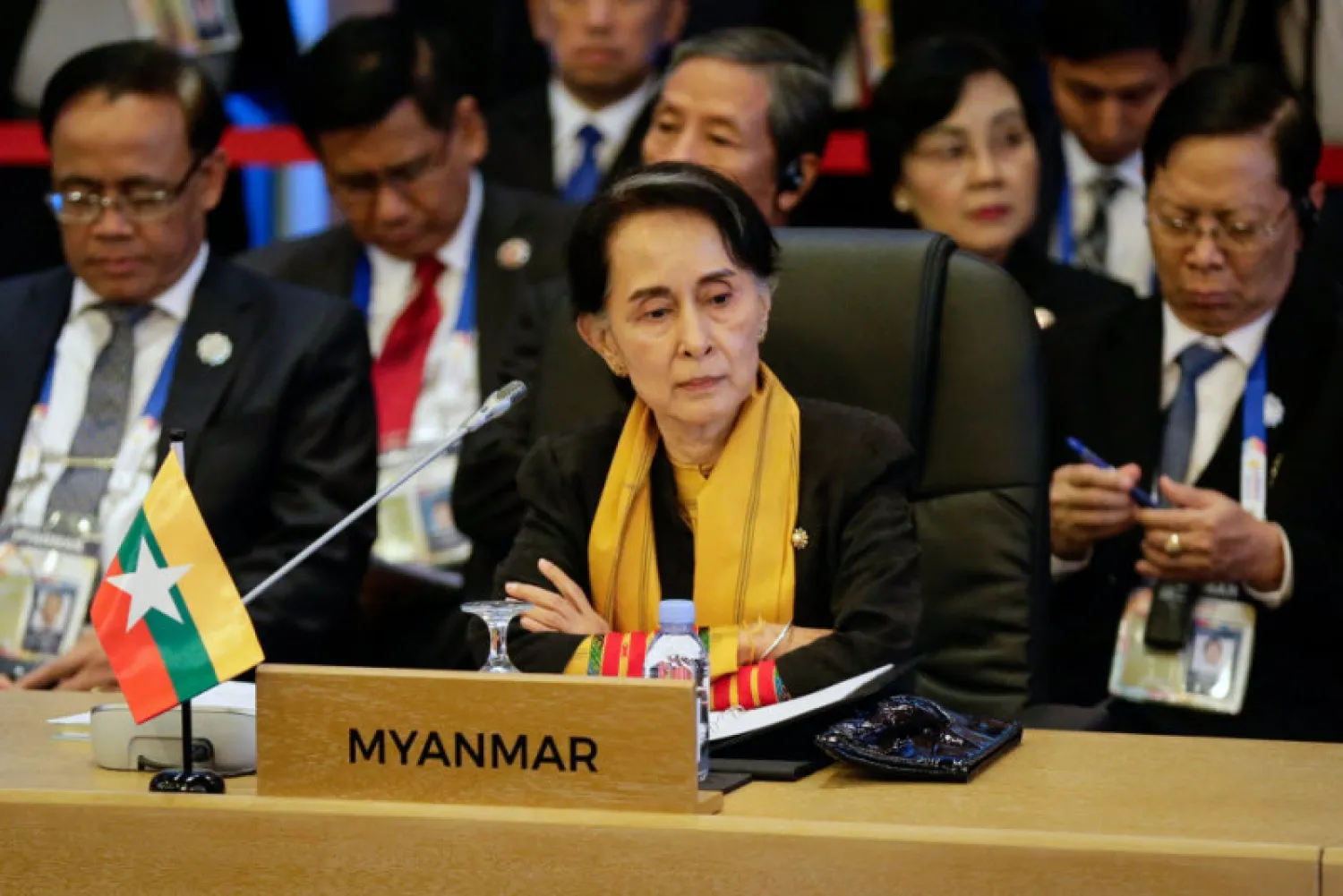

Suu Kyi Meets Tillerson, UN chief amid Myanmar Rohingya Crisis

Myanmar's State Councilor and Foreign Minister Aung San Suu Kyi looks on during the 9th Asean UN Summit in Manila on November 13, 2017. (AFP)
TT

Suu Kyi Meets Tillerson, UN chief amid Myanmar Rohingya Crisis

Myanmar's State Councilor and Foreign Minister Aung San Suu Kyi looks on during the 9th Asean UN Summit in Manila on November 13, 2017. (AFP)

Myanmar leader Aung San Suu Kyi held talks on Tuesday with United Nations chief Antonio Guterres and United States Secretary of State Rex Tillerson amid the mounting criticism against her country’s crackdown against Rohingya Muslims.

Guterres demanded that the hundreds of thousands of displaced Rohingya, who had sought refuge in neighboring Bangladesh, should be allowed to return to their homes.

"The Secretary General highlighted that strengthened efforts to ensure humanitarian access, safe, dignified, voluntary and sustained returns, as well as true reconciliation between communities, would be essential," a UN statement said, summarizing comments to Suu Kyi.

Guterres' comments came hours before Suu Kyi sat down with Tillerson on the sidelines of the East Asia Summit in Manila.

Washington has been cautious in its statements on the situation in Rakhine, and has avoided outright criticism of Suu Kyi.

Supporters say she must navigate a path between outrage abroad and popular feeling in a majority Buddhist country where most people believe the Rohingya are interlopers.

At a photo opportunity at the top of her meeting with Tillerson, Suu Kyi ignored a journalist who asked if the Rohingya were citizens of Myanmar.

At a later appearance after the meeting, Tillerson -- who is headed to Myanmar on Wednesday -- was asked by reporters if he "had a message for Burmese leaders".

He apparently ignored the question, replying only: "Thank you", according to a pool report of the encounter.

Canada's Justin Trudeau said he had spoken to Myanmar's de facto leader.

"This is of tremendous concern to Canada and many, many other countries around the world.

"We are always looking at... how we can help, how we can move forward in a way that reduces violence, that emphasizes the rule of law and that ensures protection for all citizens," he said.

More than 600,000 Rohingya have flooded into Bangladesh since late August, and now live in the squalor of the world's biggest refugee camp.

The crisis erupted after Rohingya rebels attacked police posts in Myanmar's Rakhine state, triggering a military crackdown that saw hundreds of villages reduced to ashes and sparked a massive exodus.

The UN says the Myanmar military is engaged in a "coordinated and systematic" attempt to purge the region of Rohingya in what amounts to a "textbook example of ethnic cleansing".

The stream of desperate refugees who escape across the riverine border bring with them stories of rape, murder and the torching of villages by soldiers and Buddhist mobs.

The Burmese government insists military action in Rakhine is a proportionate response to violence by militants. Following its first official investigation into the crisis, the army published a report this week in which it cleared itself of any abuses.

However, it heavily restricts access to the region by independent journalists and aid groups, and verification of events on the ground is virtually impossible.

Suu Kyi, a former democracy activist, has been lambasted by rights groups for failing to speak up for the Rohingya or condemn festering anti-Muslim sentiment in the country.

Musician and campaigner Bob Geldof on Monday slammed Suu Kyi as a "murderer" and a "handmaiden to genocide", becoming the latest in a growing line of global figures to disavow the one-time darling of the human rights community.

Human rights groups poured scorn on the Myanmar military investigation into atrocities against Rohingya Muslims, branding it a “whitewash” and calling for UN and independent investigators to be allowed into the country.

Pramila Patten, the UN special representative of the secretary general on sexual violence in conflict, said she would raise accusations against the Myanmar military with the International Criminal Court in the Hague.

The military, known as the Tatmadaw, has consistently protested its innocence, and on Monday it posted the findings of an internal investigation on the Facebook page of its commander in chief, Senior General Min Aung Hlaing.

It said it had found no instances where its soldiers had shot and killed Rohingya villagers, raped women or tortured prisoners. It denied that security forces had torched Rohingya villages or used “excessive force”.

The military said that, while 376 “terrorists” were killed, there were no deaths of innocent people.

“The Burmese military’s absurd effort to absolve itself of mass atrocities underscores why an independent international investigation is needed to establish the facts and identify those responsible,” said Brad Adams, Asia director at Human Rights Watch in a statement.

Amnesty International also dismissed the military’s internal investigation and called for a UN fact finding mission and for other independent investigators to be given full access to Rakhine.

“There is overwhelming evidence that the military has murdered and raped Rohingya and burned their villages to the ground,” the group said.

British Prime Minister Theresa May also said in foreign policy address on Monday that Myanmar’s military should be called to account.

“This is a major humanitarian crisis which looks like ethnic cleansing,” she said in a speech in London.

“And it is something for which the Burmese authorities - and especially the military - must take full responsibility.”



Trump Hints at Land Strike as Venezuela Pressure Mounts

A US Air Force C-130J Super Hercules aircraft approaches for landing at Rafael Hernandez Airport, amid tensions between US President Donald Trump's administration and the government of Venezuelan President Nicolas Maduro, in Aguadilla, Puerto Rico, December 28, 2025. (Reuters)
TT

Trump Hints at Land Strike as Venezuela Pressure Mounts

A US Air Force C-130J Super Hercules aircraft approaches for landing at Rafael Hernandez Airport, amid tensions between US President Donald Trump's administration and the government of Venezuelan President Nicolas Maduro, in Aguadilla, Puerto Rico, December 28, 2025. (Reuters)

A throwaway remark last week by President Donald Trump has raised questions about whether US forces may have carried their first land strike against drug cartels in Venezuela.

Trump said the US knocked out a "big facility" for producing trafficking boats, as he was discussing his pressure campaign against Venezuelan President Nicolas Maduro in an interview broadcast Friday.

"They have a big plant or a big facility where they send, you know, where the ships come from," Trump said in an interview with billionaire supporter John Catsimatidis on the WABC radio station in New York.

"Two nights ago we knocked that out. So we hit them very hard."

Trump did not say where the facility was located or give any other details. US forces have carried out numerous strikes in both the Caribbean Sea and eastern Pacific Ocean since September, killing more than 100 people.

The Pentagon referred questions about Trump's remarks to the White House. The White House did not respond to requests for comment from AFP.

There has been no official comment from the Venezuelan government.

Trump has been saying for weeks that the United States will "soon" start carrying out land strikes targeting drug cartels in Latin America, but there have been no confirmed attacks to date.

The Trump administration has been ramping up pressure on Maduro, accusing the Venezuelan leader of running a drug cartel himself and imposing an oil tanker blockade.

Maduro has accused Washington of attempting regime change.


UN Chief Says ‘Get Serious’ in Grim New Year Message

 UN Secretary-General Antonio Guterres. (AFP)
UN Secretary-General Antonio Guterres. (AFP)
TT

UN Chief Says ‘Get Serious’ in Grim New Year Message

 UN Secretary-General Antonio Guterres. (AFP)
UN Secretary-General Antonio Guterres. (AFP)

The United Nations urged global leaders Monday to focus on people and the planet in a New Year's message depicting the world in chaos.

"As we enter the new year, the world stands at a crossroads. Chaos and uncertainty surround us. Division. Violence. Climate breakdown. And systemic violations of international law," UN Secretary-General Antonio Guterres said in a video message.

In 2026, as war rages in Ukraine and elsewhere, world leaders must work to ease human suffering and fight climate change, he added.

"I call on leaders everywhere: Get serious. Choose people and planet over pain," said Guterres, criticizing the global imbalance between military spending and financing for the poorest countries.

Military spending is up nearly 10 percent this year to $2.7 trillion, which is 13 times total world spending on development aid and equivalent to the entire gross domestic product of Africa, he said.

Wars are raging at levels unseen since World War II, he added.

"In this New Year, let's resolve to get our priorities straight. A safer world begins by investing more in fighting poverty and less in fighting wars. Peace must prevail," said Guterres, who will be serving his last year as secretary general.


Türkiye and Armenia Agree to Simplify Visa Procedures to Normalize Ties

Türkiye’s President Recep Tayyip Erdogan, right, and Armenia's Prime Minister Nikol Pashinyan shake hands before a meeting at Prague Castle in Prague, Czech Republic, Thursday, Oct. 6, 2022. (Turkish Presidency via AP, File)
TT

Türkiye and Armenia Agree to Simplify Visa Procedures to Normalize Ties

Türkiye’s President Recep Tayyip Erdogan, right, and Armenia's Prime Minister Nikol Pashinyan shake hands before a meeting at Prague Castle in Prague, Czech Republic, Thursday, Oct. 6, 2022. (Turkish Presidency via AP, File)

Türkiye and Armenia have agreed to simplify visa procedures as part of efforts to normalize ties, Türkiye’s Foreign Ministry announced Monday, making it easier for their citizens to travel between the two countries.

Relations between Türkiye and Armenia have long been strained by historic grievances and Türkiye’s alliance with Azerbaijan. The two neighboring countries have no formal diplomatic ties and their joint border has remained closed since the 1990s.

The two countries, however, agreed to work toward normalization in 2021, appointing special envoys to explore steps toward reconciliation and reopening the frontier. Those talks have progressed in parallel with efforts to ease tensions between Armenia and Azerbaijan.

Türkiye supported Azerbaijan during its 2020 conflict with Armenia for control of the Karabakh region, known internationally as Nagorno-Karabakh, a territorial dispute that had lasted nearly four decades.

The Turkish Foreign Ministry said in a statement posted on social platform X that Ankara and Yerevan agreed that holders of diplomatic, special and service passports from both countries would be able to obtain electronic visas free of charge as of Jan. 1.

“On this occasion, Türkiye and Armenia reaffirm once again their commitment to continue the normalization process between the two countries with the goal of achieving full normalization without any preconditions,” the ministry said.

Türkiye and Armenia also have a more than century-old dispute over the deaths of an estimated 1.5 million Armenians in massacres, deportations and forced marches that began in 1915 in Ottoman Türkiye. Historians widely view the event as genocide.

Türkiye denies the deaths constituted genocide, saying the toll has been inflated and those killed were victims of civil war and unrest. It has lobbied to prevent countries from officially recognizing the massacres as genocide.