


Germany in Crisis after Government Talks Collapse

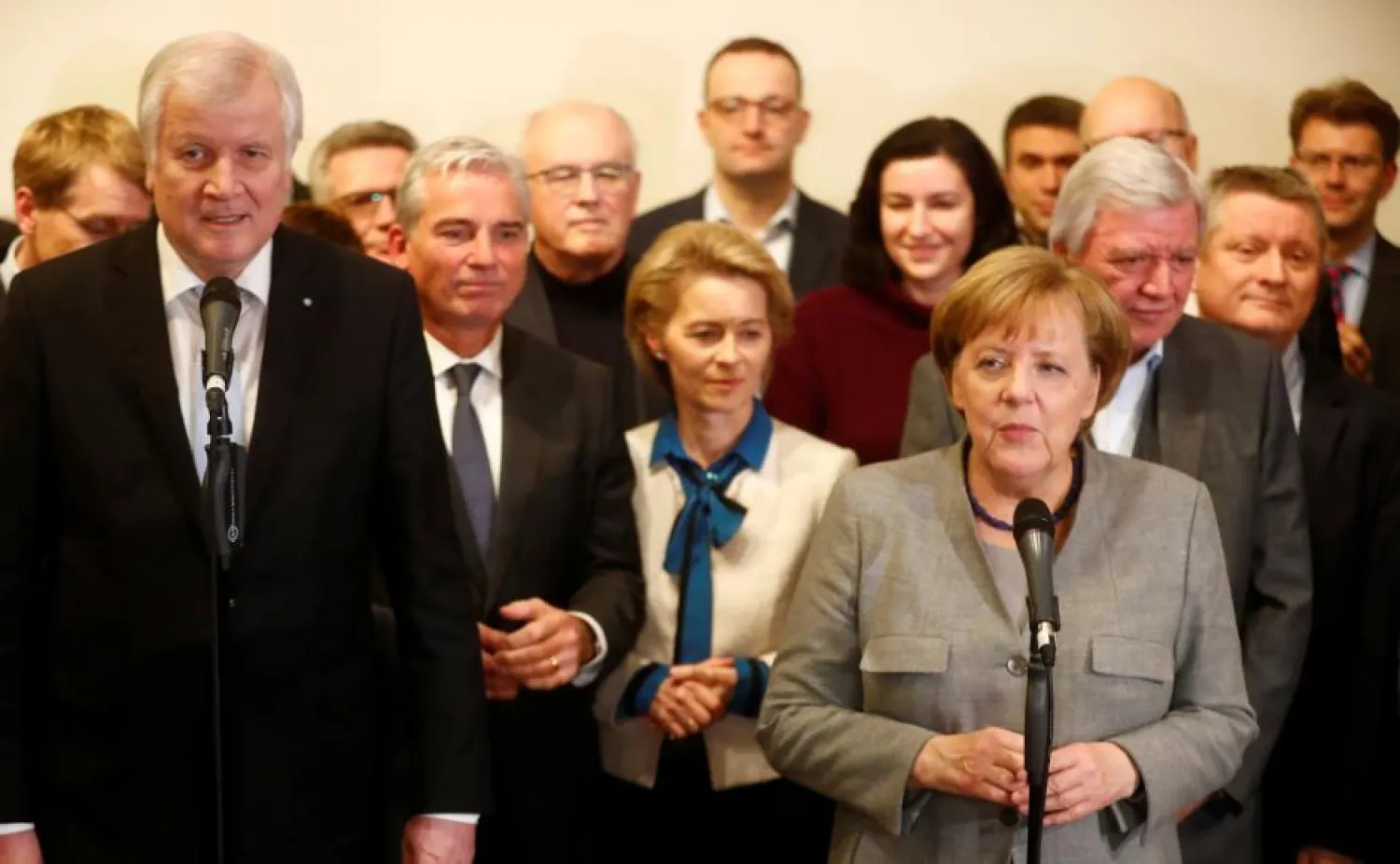
German Chancellor Angela Merkel addresses the media after the exploratory talks about forming a new coalition government collapsed in Berlin, Germany. (Reuters)
TT

Germany in Crisis after Government Talks Collapse

German Chancellor Angela Merkel addresses the media after the exploratory talks about forming a new coalition government collapsed in Berlin, Germany. (Reuters)

Germany was plunged in a political crisis after talks to form a new government collapsed, threatening Chancellor Angela Merkel’s fourth term in office.

The failure of the high-stakes talks could force Germany to hold snap elections as there seemed no viable coalition in sight.

Merkel, whose liberal refugee policy has proved deeply divisive, had been forced to seek an alliance with an unlikely group of parties after September elections left her without a majority.

But following more than a month of grueling negotiations, the leader of the pro-business FDP, Christian Lindner, walked out of talks overnight, saying there was no "basis of trust" to forge a government with Merkel's conservative alliance CDU-CSU and ecologist Greens.

"It is better not to govern than to govern badly," he said, adding that the parties did not share "a common vision on modernizing" Germany.

Voicing regret for the FDP's decision, Merkel vowed to steer Germany through the crisis.

"As chancellor... I will do everything to ensure that this country comes out well through this difficult time," she said.

News magazine Der Spiegel called the breakdown in negotiations a "catastrophe" for Merkel and said Germany, long seen as an island of stability in a turbulent West, was having its "Brexit moment, its Trump moment".

The negotiations, which turned increasingly acrimonious, stumbled on a series of issues including immigration policy.

Merkel's liberal refugee policy that let in more than one million asylum seekers since 2015 had also pushed some voters to the far-right AfD, which captured 12.6 percent of the vote after an Islamophobic and anti-immigration campaign.

The parties also differed on environmental issues, with the ecologists wanting to phase out dirty coal and combustion-engine cars, while the conservatives and FDP emphasized the need to protect industry and jobs.

Party chiefs had initially set a deadline of 6:00 pm (1700 GMT) on Sunday, but that passed without a breakthrough -- after already blowing through a previous target on Thursday.

The Greens angrily deplored the collapse of talks, saying they had believed a deal could be done despite the differences and accusing the FDP of negotiating in bad faith.

Merkel could now try to convince the Social Democratic Party (SPD), which has been the junior coalition partner in her government since 2013, to return to the fold.

But after suffering a humiliating loss at the polls, the party's top brass has repeatedly said the SPD's place was now in the opposition.

Merkel, who has been in power for 12 years, could also lead a minority government although she had signaled that she was not in favor of such instability.

Germany could therefore be forced to hold new elections, which would have to be called by President Frank-Walter Steinmeier.

Merkel ally Jens Spahn said he was not yet thinking about new elections and held out the possibility of teaming up with the SPD, with whom the conservatives still rule in a caretaking capacity.

“We have a capable acting government, the necessary things can get done,” he said. “There is no grounds for panic.”

Snap elections are not without peril for Merkel, who would face questions from within her party on whether she is still the best candidate to carry their banner into a new campaign.

Top-selling Bild daily said a failure to forge a tie-up -- a so-called "Jamaica coalition" because the parties' colors match those of the Jamaican flag -- put "her chancellorship in danger".

A poll by Welt online also found that 61.4 percent of people surveyed said a collapse of talks would mean an end to Merkel as chancellor. Only 31.5 percent thought otherwise.

There is however little appetite for a new election as main parties fear that the AfD would add to the votes it secured in September.

As talks dragged on without a breakthrough, Steinmeier issued a warning to parties not to recklessly force new elections.

"All sides are aware of their responsibilities. And this responsibility means not returning their mandate to voters," he said in an interview with Welt am Sonntag.

"It's bad news for Europe that the government in Germany will take a little longer," new Dutch Foreign Minister Halbe Zijlstra told reporters on arrival for talks with his EU peers in Brussels.

"Germany is a very influential country within the EU so if they don't have a government and therefore don't have a mandate it'll be very hard for them to take positions."

Failure to form a government in Europe’s largest economy could have implications for everything from euro zone reforms championed by French President Emmanuel Macron to the shape of relations with Britain after it leaves the EU.

Macron said on Monday he had spoken with Merkel late on Sunday when her efforts to form a coalition government collapsed and that it was not in French interests for the process to stall.

"It's not in our interests that the process freezes up," Macron told reporters in Paris.

The next government was also expected to increase spending, raising hopes of more fiscal stimulus for an economy that has been relying on consumption and state spending for growth.

The DIHK Chambers of Industry and Commerce said a prolonged period of uncertainty would be bad for the economy.




US Justice Department Opens Unredacted Epstein Files to Lawmakers

This combination of three undated pictures provided by the US Department of Justice on January 30, 2026 as part of the Jeffrey Epstein files show an Austrian passport Jeffrey Epstein used under the assumed name of Marius Robert Fortelni (AFP) 
TT

US Justice Department Opens Unredacted Epstein Files to Lawmakers

This combination of three undated pictures provided by the US Department of Justice on January 30, 2026 as part of the Jeffrey Epstein files show an Austrian passport Jeffrey Epstein used under the assumed name of Marius Robert Fortelni (AFP) 

The US Justice Department opened the unredacted Jeffrey Epstein files to review by members of Congress on Feb 9 as several lawmakers expressed concern that some names have been removed from the publicly released records, according to AFP.

The Epstein Files Transparency Act (EFTA), passed overwhelmingly by Congress in November, compelled the Justice Department to release all of the documents in its possession related to the convicted sex offender.

It required the redaction of the names or any other personally identifiable information about Epstein’s victims, who numbered more than 1,000 according to the FBI.

But it said no records could be “withheld, delayed, or redacted on the basis of embarrassment, reputational harm, or political sensitivity, including to any government official, public figure, or foreign dignitary.”

Representative Ro Khanna, a Democrat from California, is among the members of the House of Representatives questioning some of the redactions in the more than three million documents released by the Justice Department.

Khanna posted examples on his Facebook page. The name of the sender of a 17 January 2013 email to Epstein is blacked out in the released files.

“New Brazilian just arrived, sexy and cute. She is 9 years old,” the message said.

The name of the sender of a 11 March 2014 email to Epstein is also redacted. “Thank you for a fun night,” the message said. “Your littlest girl was a little naughty.”

Khanna said the names of the senders of the emails need to be revealed.

“Concealing the reputations of these powerful men is a blatant violation of the Epstein Transparency Act,” he said.

Epstein, who had ties to business executives, politicians, celebrities and academics, was found dead in his New York jail cell in 2019 while awaiting trial for sex trafficking minor girls.

Ghislaine Maxwell, Epstein's former girlfriend, is the only person convicted of a crime in connection with Epstein. She was convicted in 2021 of sex trafficking underage girls to the financier and is serving a 20-year prison sentence.

Republican committee chairman James Comer said Maxwell had invoked her right to not incriminate herself, guaranteed by the Fifth Amendment of the US Constitution.

“As expected, Ghislaine Maxwell took the fifth and refused to answer any questions,” Comer told reporters. “This is obviously very disappointing.”

“We had many questions to ask about the crimes she and Epstein committed as well as questions about potential co-conspirators,” he said.

Maxwell's lawyers told the House panel that the former British socialite was prepared to testify only if she was first granted clemency by President Donald Trump, Comer said.

The lawyers had pushed for Congress to grant her legal immunity in order to testify, but lawmakers refused.

Trump fought for months to prevent release of the vast trove of documents about Epstein – a longtime former friend – but a rebellion among Republicans forced him to sign off on the law mandating release of all the records.


Israel’s Netanyahu Is Meeting with Trump This Week to Push for a Far Broader Iran Deal

President Donald Trump answers a question from a reporter at the end of a news conference with Israel's Prime Minister Benjamin Netanyahu at Mar-a-Lago, Dec. 29, 2025, in Palm Beach, Fla. (AP)
TT

Israel’s Netanyahu Is Meeting with Trump This Week to Push for a Far Broader Iran Deal

President Donald Trump answers a question from a reporter at the end of a news conference with Israel's Prime Minister Benjamin Netanyahu at Mar-a-Lago, Dec. 29, 2025, in Palm Beach, Fla. (AP)

Prime Minister Benjamin Netanyahu is heading to Washington on Tuesday to encourage President Donald Trump to expand the scope of high-stakes nuclear talks with Iran. The negotiations resumed last week against the backdrop of an American military buildup.

Israel has long called for Iran to cease all uranium enrichment, dial back its ballistic missile program and cut ties to militant groups across the region. Iran has always rejected those demands, saying it would only accept some limits on its nuclear program in return for sanctions relief.

It's unclear if Iran's bloody crackdown on mass protests last month, or the movement of major US military assets to the region, has made Iran’s leaders more open to compromise, or if Trump is interested in broadening the already difficult negotiations.

Netanyahu, who will be in Washington through Wednesday, has spent his decades-long political career pushing for stronger US action toward Iran. Those efforts succeeded last year when the US joined Israel in 12 days of strikes on Iran's military and nuclear sites, and the possibility of additional military action against Iran is likely to come up in this week’s discussions.

Decisions are being made

Netanyahu's visit comes just two weeks after Trump’s special envoy Steve Witkoff and Jared Kushner, Trump’s son-in-law and Middle East adviser, met with the prime minister in Jerusalem. The US envoys held indirect talks in Oman with Iran's foreign minister on Friday.

“The Prime Minister believes that any negotiations must include limiting ballistic missiles and ending support for the Iranian axis,” Netanyahu's office said over the weekend, referring to Iran-backed armed groups like the Palestinian Hamas and Lebanon's Hezbollah.

Years of nuclear talks have made little progress since Trump scrapped a 2015 agreement with Iran, with strong encouragement from Israel. Iran has shown little willingness to address the other issues, even after suffering repeated setbacks. But the meeting with Trump gives Netanyahu an opportunity to shape the process and may also bolster his standing back home.

“Clearly these are the days when decisions are being made, America is expected to complete its force buildup, and it’s trying to exhaust the prospect of negotiations,” said Yohanan Plesner, head of the Israel Democracy Institute, a Jerusalem-based think tank.

“If you want to have influence on the process, only so much can be done via Zoom.”

Israel fears a narrow agreement

rump threatened a military strike against Iran last month over the killing of protesters and concerns of mass executions, moving a number of military assets into the region. Thousands were killed and tens of thousands detained at Iranian authorities crushed the protests over widespread economic distress.

As the protests largely subsided, Trump shifted his focus to Iran's nuclear program, which the US, Israel and others have long suspected is aimed at eventually developing weapons. Iran insists its program is entirely peaceful and says it has the right to enrich uranium for civilian purposes.

Sima Shine, an Iran expert formerly with Israel's Mossad spy agency who is now an analyst at Israel's Institute for National Security Studies, said Israel fears that the US might reach a narrow agreement with Iran in which it would temporarily halt uranium enrichment.

A deal in which Iran halts enrichment for several years would allow Trump to claim victory. But Israel believes any such agreement that does not end Iran's nuclear program and reduce its ballistic missile arsenal will eventually require Israel to launch another wave of strikes, she said.

Iran might be unable to enrich uranium after last year’s strikes, making the idea of a temporary moratorium more appealing.

In November, Iranian Foreign Minister Abbas Araghchi said Iran was no longer enriching uranium due to the damage from last year's war. The US and Israeli airstrikes killed nearly 1,000 people in Iran, while Iranian missile barrages killed almost 40 in Israel.

It's unclear how much damage was done to Iran's nuclear program. Inspectors from the International Atomic Energy Agency have been unable to visit the bombed nuclear sites. Satellite images show activity at two of them.

Netanyahu faces election this year

Netanyahu, who faces elections later this year, has long touted his close ties to world leaders, particularly Trump, who he has praised as the best friend Israel has ever had in the White House. This week's meeting allows Netanyahu to show Israelis he is a player in the Iran talks.

“The issue of relations between Netanyahu and Trump will be the issue of the campaign, and he is saying, ‘Only I can do this, it’s only me,’” Shine said.

Netanyahu is Israel's longest-serving prime minister, having held the office for a total of over 18 years. His government, the most nationalist and religious in Israel's history, is expected to survive until the election in October, or close to it.

Netanyahu was originally scheduled to visit Washington next week for the Feb. 19 launch of Trump's Board of Peace, an initiative that was initially framed as a mechanism for rebuilding Gaza after the Israel-Hamas war but has taken on a larger mandate of resolving global crises.

Netanyahu agreed to join the initiative, but is wary of it because it includes Türkiye and Qatar, countries he does not want to have a presence in postwar Gaza because of their relations with Hamas.

Moving the visit up could provide an “elegant solution” that allows Netanyahu to skip the launch without offending Trump, Plesner said. Netanyahu's office declined to comment.


France Accuses Iran of ‘Repression’ in Sentence for Nobel Laureate

People cross an intersection in downtown Tehran, Iran, Monday, Feb. 9, 2026. (AP)
TT

France Accuses Iran of ‘Repression’ in Sentence for Nobel Laureate

People cross an intersection in downtown Tehran, Iran, Monday, Feb. 9, 2026. (AP)

France accused Iran on Monday of "repression and intimidation" after a court handed Nobel Peace Prize laureate Narges Mohammadi a new six-year prison sentence on charges of harming national security.

Mohammadi, sentenced Saturday, was also handed a one-and-a-half-year prison sentence for "propaganda" against Iran's system, according to her foundation.

"With this sentence, the Iranian regime has, once again, chosen repression and intimidation," the French foreign ministry said in a statement, describing the 53-year-old as a "tireless defender" of human rights.

Paris is calling for the release of the activist, who was arrested before protests erupted nationwide in December after speaking out against the government at a funeral ceremony.

The movement peaked in January as authorities launched a crackdown that activists say has left thousands dead.

Over the past quarter-century, Mohammadi has been repeatedly tried and jailed for her vocal campaigning against Iran's use of capital punishment and the mandatory dress code for women.

Mohammadi has spent much of the past decade behind bars and has not seen her twin children, who live in Paris, since 2015.

Iranian authorities have arrested more than 50,000 people as part of their crackdown on protests, according to US-based Human Rights Activists News Agency (HRANA).