

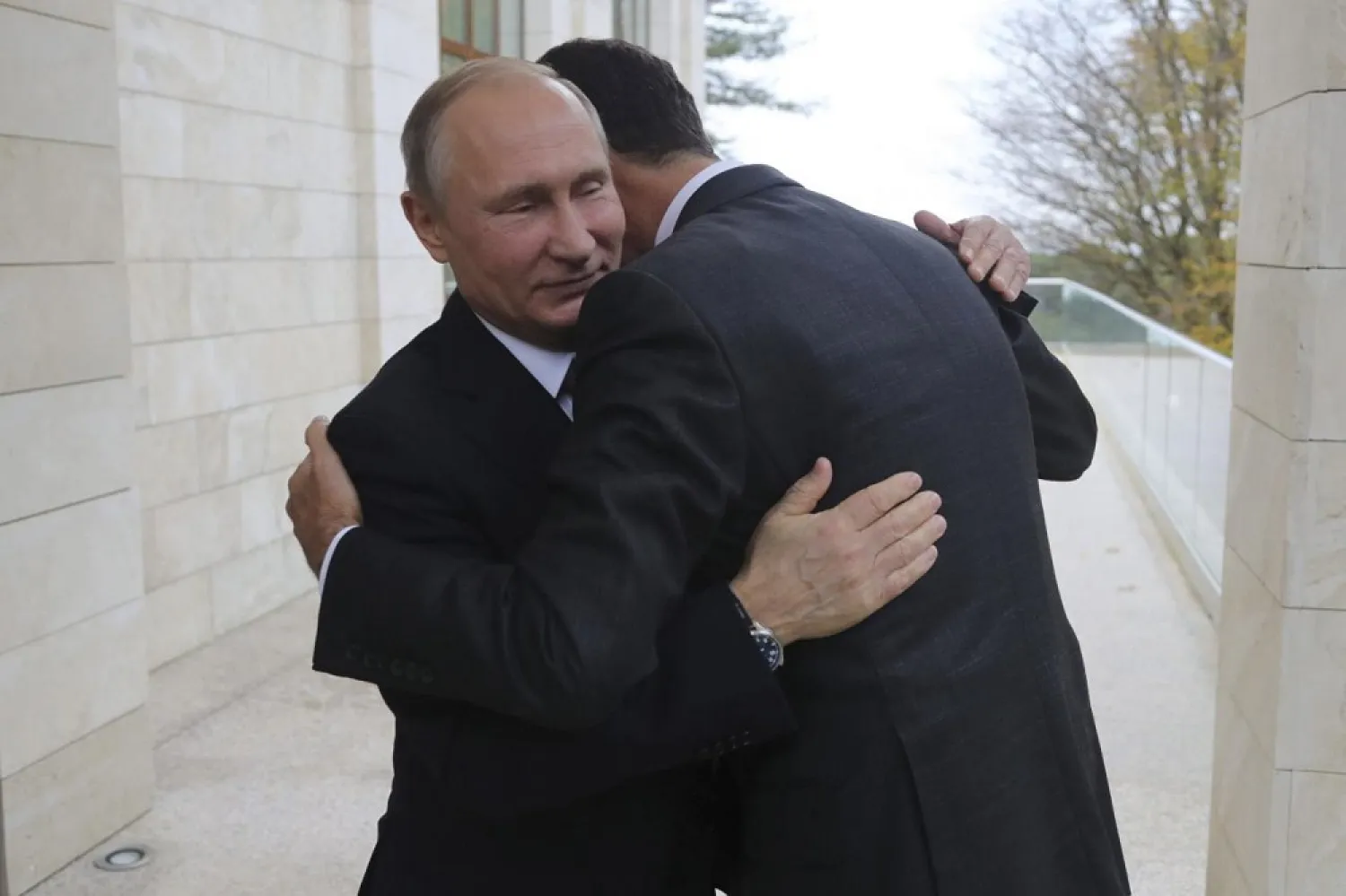

Putin to Assad on Eve of Sochi Summit: It is Time for Political Settlement

Russian President Vladimir Putin welcomes Syrian regime leader Bashar Assad during a meeting in the Black Sea resort of Sochi, Russia November 20, 2017. (Reuters)
TT

Putin to Assad on Eve of Sochi Summit: It is Time for Political Settlement

Russian President Vladimir Putin welcomes Syrian regime leader Bashar Assad during a meeting in the Black Sea resort of Sochi, Russia November 20, 2017. (Reuters)

The Kremlin stated that the military operation against terrorism in Syria was on the verge of ending and therefore it is time to launch the political settlement for the crisis.

The settlement should be overseen by the United Nations and regional and international powers that are in one way or another involved in the conflict and that Russia should be credited with creating the conditions for the settlement.

These are the stances that were stressed by Russian President Vladimir Putin during talks he held on Monday with his Syrian counterpart Bashar Assad in the Russian city of Sochi.

Putin underscored at the start of the talks that the terrorism in Syria was reaching its inevitable demise, stressing that attention should now be directed towards the long-term political settlement.

He then listed the parties that will be involved in this settlement. Putin will meet in Sochi later on Wednesday with Turkish President Recep Tayyip Erdogan and Iranian President Hassan Rouhani to discuss the settlement. Other countries that Russia is in contact with over Syria are Jordan, Saudi Arabia, the United States, Iraq and Egypt.

Putin is also expected to later contact the Emir of Qatar, US President Donald Trump and, later, regional leaders.

His talks will focus on the main principles of the political process and holding the Syrian dialogue congress. He also highlighted the role the UN could play in the process, saying that it should be its sponsor and hoping that it would play an effective role in ensuring its implementation.

The Russian president acknowledged the Riyadh-hosted Syrian opposition meeting that is aimed at unifying its ranks. Putin said that Moscow has a role to play in the gathering and that he will dispatch his Syrian Affairs special envoy Alexander Lavrentiev to attend its proceedings.

For his part, Assad said: “We are concerned with forging ahead with the political process.”

He also hoped that he will receive Russian support to ensure that “no foreign players will meddle in this process.”

Furthermore, he voiced a readiness to cooperate with all the forces that want to achieve a political solution to the Syrian crisis.

“We are ready to hold dialogue with them,” he remarked.

Putin then introduced Assad to the military commanders who took part in the operations in Syria, starting with Defense Minister Sergei Shoigu and Chief of Staff Valery Gerasimov.

“I want to introduce you to the people who played a decisive role in saving Syria,” he said.

“Assad may know some of you and others he may not. He does know however, and he told me this, that it is due to Russian troops that Syria was saved as a state,” Putin stressed before the military commanders.

“I want to say that we would not have been able to achieve anything if it weren’t for the efforts of the armed forces and your efforts and those of your soldiers and their heroics,” he told Assad.

Later on Tuesday, Russian presidential spokesman Dmitry Peskov told reporters that Putin will contact Trump and Arab leaders to discuss the Syrian settlement.

He refused however to comment on Russia’s vision on what Assad’s role will be in the upcoming phase.

No one but the Syrian people will decide his fate, he added.


Iraq’s Nujaba Movement Warns against ‘US Plot’ to Integrate PMF in New Security Ministry

Slain Iranian Supreme Leader Ali Khamanei (R) and Nujaba Movement leader Akram al-Kaabi in Tehran in December 2018. (Supreme leader’s website)
TT

Iraq’s Nujaba Movement Warns against ‘US Plot’ to Integrate PMF in New Security Ministry

Slain Iranian Supreme Leader Ali Khamanei (R) and Nujaba Movement leader Akram al-Kaabi in Tehran in December 2018. (Supreme leader’s website)

The Iran-aligned Nujaba Movement in Iraq warned on Saturday against an “American plot” to merge the pro-Iran Popular Mobilization Forces (PMF) in state institutions, presenting new Prime Minister Ali al-Zaidi with his first test in imposing state monopoly over arms.

It made its warning in wake of a visit to Iraq earlier this week by former US Central Command Commander David Petraeus, who also previously led US forces stationed in Iraq.

The new Iraqi government appears to be a taking a tougher stance against the Iran-aligned armed factions in the country in wake of attacks launched from Iraq against Saudi Arabia and the United Arab Emirates.

Riyadh and Abu Dhabi have said the attacks were launched from Iraqi territory. Zaidi has slammed the attacks as “criminal acts”.

Spokesperson for the Commander-in-Chief of the Iraqi Armed Forces Sabah al-Numan said the committee probing the attacks will cooperate with Riyadh and Abu Dhabi to uncover the perpetrators.

“The official statements are not up for debate: the security of our brothers is a read line and there can be no replacing the rule of law,” he said in statements carried by the official state news agency INA.

Any party found responsible for the attacks will face judicial and military measures, he vowed, adding that the attacks were a “threat to Iraq’s national security and flagrant violation of its sovereignty”.

On the state monopoly over arms, al-Numan said the decision “is not a mere political slogan, but a security strategy that must be implemented.”

“The success of the government will be measured by how much it establishes itself as the sole party that holds power over weapons,” he stressed.

Prominent armed factions, such as the Kataib Hezbollah and Kataib Sayyid al-Shuhada, have not made any statements over the recent developments.

The Nujaba Movement, however, has openly defied the state’s decision to impose monopoly over weapons.

The party, which is seen as the most hardline, has also rejected attempts to restructure the PMF.

Deputy head of the movement’s executive council Hussein al-Saeedi said: “The resistance’s weapons are not open to compromise.”

“Stripping the factions of their weapons will leave society exposed to the ongoing threats,” he declared from Basra.

He also slammed as an “American plot” the alleged plan to merge the PMF with the federal police and other forces as part of a new “federal security ministry”.

He said such efforts are “futile” and “impossible to execute”, warning that insisting on forging ahead with the plan will have “political and popular implications.”


10,000 Kurds Apply for Syrian Citizenship

Syrian Kurds demonstrate to mark Kurdish Language Day, demanding constitutional recognition of the Kurdish language by the Syrian government, in Qamishli, Syria, May 14, 2026. (Reuters)
TT

10,000 Kurds Apply for Syrian Citizenship

Syrian Kurds demonstrate to mark Kurdish Language Day, demanding constitutional recognition of the Kurdish language by the Syrian government, in Qamishli, Syria, May 14, 2026. (Reuters)

Damascus announced on Saturday that it has received over 10,000 applications for Syrian citizenship from Kurds in wake of a recent decree that preserves their rights in the country.

The Interior Ministry said it received applications for citizenship from 2,892 families and 10,516 individuals.

The majority of the applications were filed in the northeastern Hasakeh region, followed by Aleppo, Raqqa, then Deir Ezzor.

Authorities began receiving applications for citizenship from the Kurds on April 6. A May 7 deadline for receiving applications was extended to allow people more time to complete their official procedures ahead of applying.

Receiving the application is the first step towards citizenship. It will be followed by interviews with applicants to verify their documents and eligibility. The final step culminates in receiving citizenship and a document that allows them to enjoy all of their civilian rights.

The process covers all Kurds who do not have an identification document in Syria, as well as expatriates.


Lebanon Civil Defense Says Israeli Strike Destroys its Nabatieh Facility

Smoke rises from the site of an Israeli strike that targeted the southern Lebanese village of Kfar Tibnit on May 21, 2026. (Photo by Abbas FAKIH / AFP)
TT

Lebanon Civil Defense Says Israeli Strike Destroys its Nabatieh Facility

Smoke rises from the site of an Israeli strike that targeted the southern Lebanese village of Kfar Tibnit on May 21, 2026. (Photo by Abbas FAKIH / AFP)

Lebanon's civil defense agency said early on Sunday its regional facility in the southern city of Nabatieh had been destroyed by an Israeli strike.

The Directorate General of Civil Defense said the building had collapsed and a large number of vehicles and equipment had been damaged by a "direct hit in a hostile Israeli strike".

It added there were no reports of casualties among its personnel, who had been moved to another location before the incident, said AFP.

The civil defense agency condemned "this attack on a center dedicated to humanitarian and relief work", stressing that it was facing "growing risks and challenges" in carrying out its operations.

Israeli strikes in Lebanon have continued despite a truce that came into effect on April 17, with Israel saying it is targeting Iran-backed Hezbollah.

Lebanon's health ministry has recorded the deaths of 123 rescuers and health workers in Israeli strikes since the country was drawn into the wider regional war on March 2 when Hezbollah launched rockets at Israel in retaliation for the death of Iran's supreme leader in US-Israeli strikes.
