


Europe Soldiers Guard Europe’s Streets from Terrorism

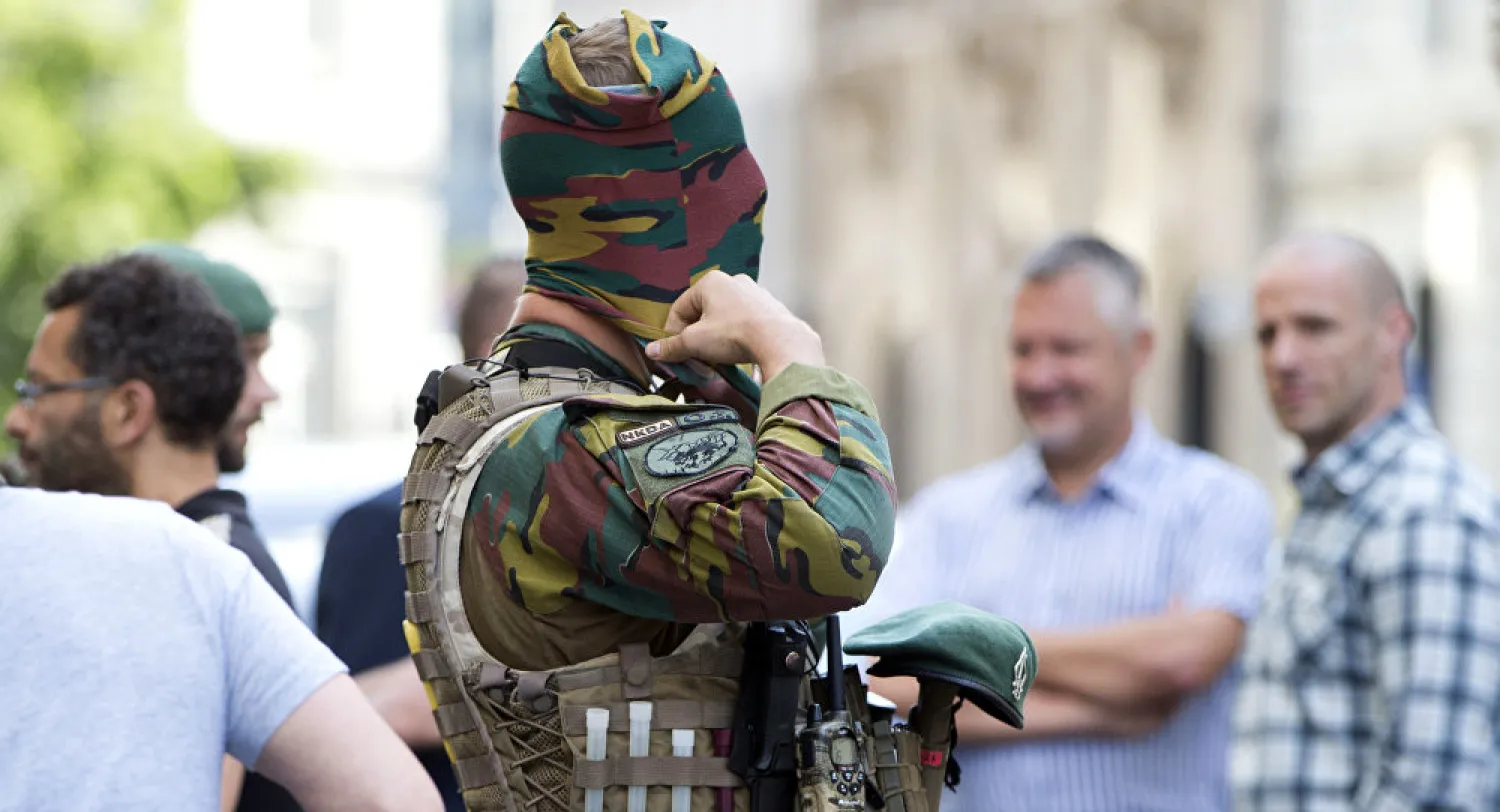
A Belgian soldier adjusts his face mask as he patrols outside the prime minister’s office in Brussels in June. (Virginia Mayo/AP)
TT

Europe Soldiers Guard Europe’s Streets from Terrorism

A Belgian soldier adjusts his face mask as he patrols outside the prime minister’s office in Brussels in June. (Virginia Mayo/AP)

Green army trucks are rumbling across the cobbled streets of Brussels. Stiff-spined soldiers are patrolling the Champs-Elysees in Paris. Italian troops are guarding the Colosseum. And critics say the years-long deployments at home are sapping the ability of these militaries to fight wars.

Taken together, the domestic deployments — to guard against terrorism — are among the largest in Western Europe since World War II. They come as European militaries are tapped to address an unusually wide range of challenges at once: a resurgent Russia, grinding conflicts in the Middle East, migration across the Mediterranean and smaller wartime deployments far from their borders.

Confronted by terrorism, European leaders rushed their armies onto their streets in the aftermath of attacks starting in 2015. Although advocates say the deployments help bolster security, the peacetime duty has stretched forces thin.

Until recently, 40 percent of Belgium’s combat-ready soldiers were devoted to domestic guard duty. Some officers worry that the lack of time to practice warfare means basic skills are getting rusty. In France, the former leader of the military said last month that he quit in July in part to protest that his forces were “overheating.”

President Trump has pressed NATO allies to commit more toward their own defense and to international missions, but the domestic deployments have made that a challenge. The latest sign came last month at a meeting of defense chiefs in Brussels, when the alliance fell short on pledges toward the NATO training operation in Afghanistan.

In Belgium, a country of 11 million people, military leaders say their troops are feeling the strain.

“I had machine gunners with the rifle section who didn’t fire a machine gun in 16 months because they had become riflemen,” said Maj. Gen. Marc Thys, commander of Belgium’s land forces. “It’s like asking our national team that hasn’t played a game of soccer all year to go to the world championships. It doesn’t work.”

Until October, 1,250 Belgian soldiers were deployed across the country, guarding grand boulevards, train stations and other crowded public places that make tempting targets. The intention was to increase public safety and to give police officers more freedom to do investigative work rather than tie them up on guard duty.

The domestic deployments came as European nations struggled to find a way to protect themselves against attacks in a new era of terrorism strategies. Some recent ISIS-inspired strikes used explosives and required large networks that could be disrupted through aggressive counterterrorism work, but other attacks were as simple as renting a truck and plowing it into a crowd.

Proponents of the military approach say that such attacks can be prevented by quick-thinking soldiers. They point to June’s attempted attack in the Brussels Central railway station, where soldiers patrolling the platforms shot dead a suspected bomber after he set off a small explosive that failed to hurt anyone.

“We weren’t ready for the threats that we were facing,” Belgian Defense Minister Steven Vandeput said about the aftermath of the 2015 terrorist attacks in Paris. Both the January Charlie Hebdo newspaper attack and the November Bataclan nightclub attack that year had Brussels connections, and authorities were searching for a quick solution.

“After November, the threat was high and at the same time police need to do police work,” Vandeput said. “If we’re not able to contribute to our defense, how can we contribute to others’ defense?”

France also deployed soldiers to its streets following the terrorist attacks and has faced similar challenges. Italian troops have been deployed since 2008. Britain made such deployments an option this year, but it has done so sparingly. In the United States, federal law generally forbids military deployments for law enforcement purposes, although state National Guards have more flexibility when commanded at a state level.

Germany has also been struck repeatedly by small-scale terrorist attacks, and its Parliament recently considered a measure to allow the army to be used domestically. That would have been a significant step because the country’s World War II history has made lawmakers wary of using their military at home. In the end, the legislature took no action.

In Belgium, the soldiers do not have the power to make arrests or investigate crimes. Advocates say their powerful rifles serve as a deterrent as they walk through crowded weekend markets or stand watch at train stations during rush hour.

The Washington Post



Trump Says the US Has Seized an Oil Tanker off the Coast of Venezuela

This image from video posted on Attorney General Pam Bondi's X account, and partially redacted by the source, shows an oil tanker being seized by US forces off the coast of Venezuela, Wednesday, Dec. 10, 2025. (US Attorney General's Office/X via AP)
TT

Trump Says the US Has Seized an Oil Tanker off the Coast of Venezuela

This image from video posted on Attorney General Pam Bondi's X account, and partially redacted by the source, shows an oil tanker being seized by US forces off the coast of Venezuela, Wednesday, Dec. 10, 2025. (US Attorney General's Office/X via AP)

President Donald Trump said Wednesday that the United States has seized an oil tanker off the coast of Venezuela as tensions mount with the government of President Nicolás Maduro.

Using US forces to take control of a merchant ship is incredibly unusual and marks the Trump administration’s latest push to increase pressure on Maduro, who has been charged with narcoterrorism in the United States. The US has built up the largest military presence in the region in decades and launched a series of deadly strikes on alleged drug-smuggling boats in the Caribbean Sea and eastern Pacific Ocean. The campaign is facing growing scrutiny from Congress.

“We’ve just seized a tanker on the coast of Venezuela, a large tanker, very large, largest one ever seized, actually,” Trump told reporters at the White House, later adding that "it was seized for a very good reason.”

Trump did not offer additional details. When asked what would happen to the oil aboard the tanker, Trump said, “Well, we keep it, I guess", The Associated Press reported.

The seizure was led by the US Coast Guard and supported by the Navy, according to a US official who was not authorized to comment publicly and spoke on the condition of anonymity. The official added that it was conducted under U.S. law enforcement authority.

Storming the oil tanker

The Coast Guard members were taken to the oil tanker by helicopter from the aircraft carrier USS Gerald R. Ford, the official said. The Ford is in the Caribbean Sea after arriving last month in a major show of force, joining a fleet of other warships.

Video posted to social media by Attorney General Pam Bondi shows people fast-roping from one of the helicopters involved in the operation as it hovers just feet from the deck.

The Coast Guard members can be seen later in the video moving throughout the superstructure of the ship with their weapons drawn.

Bondi wrote that “for multiple years, the oil tanker has been sanctioned by the United States due to its involvement in an illicit oil shipping network supporting foreign terrorist organizations.”

Venezuela’s government said in a statement that the seizure “constitutes a blatant theft and an act of international piracy.”

“Under these circumstances, the true reasons for the prolonged aggression against Venezuela have finally been revealed. ... It has always been about our natural resources, our oil, our energy, the resources that belong exclusively to the Venezuelan people,” the statement said.

Half of ship's oil is tied to Cuban importer The US official identified the seized tanker as the Skipper.

The ship departed Venezuela around Dec. 2 with about 2 million barrels of heavy crude, roughly half of it belonging to a Cuban state-run oil importer, according to documents from the state-owned company Petróleos de Venezuela S.A., commonly known as PDVSA, that were provided on the condition of anonymity because the person did not have permission to share them.

The Skipper was previously known as the M/T Adisa, according to ship tracking data. The Adisa was sanctioned by the US in 2022 over accusations of belonging to a sophisticated network of shadow tankers that smuggled crude oil on behalf of Iran’s Revolutionary Guard and Lebanon's Hezbollah militant group.

The network was reportedly run by a Switzerland-based Ukrainian oil trader, the US Treasury Department said at the time.

Hitting Venezuela's sanctioned oil business Venezuela has the world’s largest proven oil reserves and produces about 1 million barrels a day.

PDVSA is the backbone of the country’s economy. Its reliance on intermediaries increased in 2020, when the first Trump administration expanded its maximum-pressure campaign on Venezuela with sanctions that threaten to lock out of the US economy any individual or company that does business with Maduro’s government. Longtime allies Russia and Iran, both also sanctioned, have helped Venezuela skirt restrictions.

The transactions usually involve a complex network of shadowy intermediaries. Many are shell companies, registered in jurisdictions known for secrecy. The buyers deploy so-called ghost tankers that hide their location and hand off their valuable cargoes in the middle of the ocean before they reach their final destination.

Maduro did not address the seizure during a speech before a ruling-party organized demonstration in Caracas, Venezuela’s capital. But he told supporters that the country is “prepared to break the teeth of the North American empire if necessary.”

Maduro has insisted the real purpose of the US military operations is to force him from office.

Democrat says the move is about ‘regime change’

Sen. Chris Van Hollen, D-Md., a member of the Senate Foreign Relations Committee, said the US seizing the oil tanker cast doubt on the administration’s stated reasons for the military buildup and boat strikes.

“This shows that their whole cover story — that this is about interdicting drugs — is a big lie,” the senator said. “This is just one more piece of evidence that this is really about regime change — by force.”

Vincent P. O’Hara, a naval historian and author of “The Greatest Naval War Ever Fought,” called the seizure “very unusual” and "provocative." Noting that the action will probably deter other ships from the Venezuela coastline, he said, "If you have no maritime traffic or access to that, then you have no economy.”

The seizure comes a day after the US military flew a pair of fighter jets over the Gulf of Venezuela in what appeared to be the closest that warplanes had come to the South American country’s airspace. Trump has said land attacks are coming soon but has not offered more details.

The Trump administration is facing increasing scrutiny from lawmakers over the boat strike campaign, which has killed at least 87 people in 22 known strikes since early September, including a follow-up strike that killed two survivors clinging to the wreckage of a boat after the first hit.

Some legal experts and Democrats say that action may have violated the laws governing the use of deadly military force.

Lawmakers are demanding to get unedited video from the strikes, but Defense Secretary Pete Hegseth told congressional leaders at a classified briefing Tuesday that he was still weighing whether to release it.

The Coast Guard referred a request for comment about the tanker seizure to the White House.


Washington Cool on Nuclear Talks, Tehran Signals Conditional Readiness

Iranian flags in central Tehran on Wednesday (EPA)
TT

Washington Cool on Nuclear Talks, Tehran Signals Conditional Readiness

Iranian flags in central Tehran on Wednesday (EPA)

Washington’s silence toward Iran’s repeated calls to revive nuclear negotiations is not simply a lapse in diplomatic attention. For many analysts, it resembles a calculated test of nerves at a moment of exceptional sensitivity in Tehran.

As the United States juggles a crowded foreign policy agenda, critics say Iran’s state is fraying from within under the strain of a deep economic downturn and growing uncertainty over who will rule after Supreme Leader Ali Khamenei.

And while Tehran continues to signal conditional readiness for talks, Washington appears content to wait, perhaps for deeper internal unraveling or for a political landscape reshaped by a full reordering of Iran’s power structure.

In recent weeks, Iranian officials have repeatedly spoken of Tehran’s willingness to enter serious negotiations with the United States over the nuclear program, while Washington’s silence toward these overtures has been striking.

Tehran insists on showing a desire for dialogue under what it calls fair and balanced terms, but Washington appears in no hurry.

Analysts describe Washington’s posture as a mix of tactical patience and prioritization at a moment when Iran faces economic and political strains and lingering uncertainty over who will lead the country after Khamenei.

Washington’s Priorities

Patrick Clawson, director of research at the Washington Institute for Near East Policy, says the cool US reaction is not a final rejection but a natural result of an American political arena crowded with urgent issues from Venezuela to Ukraine, along with domestic pressures.

Clawson told Asharq Al-Awsat that President Donald Trump’s team believes Iran’s nuclear program has suffered major setbacks in recent years and no longer represents an immediate threat, making the file less pressing.

He added that US chief negotiator Steve Witkoff is overseeing dossiers the White House sees as more urgent at the moment.

This approach gives Washington comfortable room to maneuver.

The US administration does not want to enter a new round of complex and politically costly negotiations before ensuring that the right conditions exist, particularly in the absence of clear signals that Iran is ready to offer substantive concessions beyond rhetoric.

Signals of Conditional Openness

Tehran has amplified its public messaging. In an interview with Japan’s Kyodo news agency, Iranian Foreign Minister Abbas Araghchi said Iran remains open to diplomacy but is not convinced Washington is ready for genuine and serious negotiations.

Araghchi said Washington still operates with an attitude of dictates and that any return to the negotiating table must be based on fair and balanced outcomes.

Tehran also opened a technical channel with Japan, seeking assistance based on Japanese experience in dealing with nuclear crisis fallout to help secure Iranian facilities damaged by recent Israeli and US attacks.

The request reflects an implicit acknowledgment of the scale of damage to Iran’s nuclear infrastructure, even as Araghchi described the attacks as the greatest violation of international law.

This technical engagement does not indicate a shift in Tehran’s core position.

Iran continues to insist on the right to enrichment under the Nuclear Non-Proliferation Treaty and links any acceptance of new constraints to the lifting of sanctions and international recognition of its peaceful nuclear program.

Deepening Internal Divisions

Inside Iran, the situation is becoming more complex.

Clawson points to unprecedented public sparring among Iranian officials and open speculation about post-Khamenei scenarios, which he says reflect sharp disagreements within the elite.

Iranian researcher Farzin Nadimi argues the real confrontation is between two principal camps: Khamenei and his institutions on one side, and former president Hassan Rouhani and his team seeking to play a decisive role in the next phase.

There are other groups in between, Nadimi says, but these two blocs are the main poles.

Nadimi told Asharq Al-Awsat that the Islamic Revolutionary Guard Corps is acting as an observer for now, despite its direct allegiance to Khamenei.

It could, however, move forcefully after Khamenei exits the scene, possibly triggering a power struggle between the Guard and Rouhani unless the latter is pushed aside before then.

Iran is also grappling with a severe economic crisis. The national currency has lost more than 10 percent of its value in only ten days, amid persistent water shortages, repeated power outages, and what critics describe as an ineffective economic model.

Clawson cited the new gasoline pricing system, which imposes a high rate on excess consumption but remains below the cost of importing fuel, for which the government pays four billion dollars annually. Experts describe this approach as a clear sign of poor governance.

Missile Buildup and Preparing for Israel

Regionally, Israel remains a central factor in Tehran’s calculations.

Barak Barfi, a researcher at the New America Foundation in Washington, told Asharq Al-Awsat that Iran is offering no indication it is prepared to scale back its nuclear or missile programs and is instead building up its missile stockpile in preparation for another confrontation with Israel.

Barfi believes Iran aims to acquire a capacity that can overwhelm Israeli defenses through dense volleys of missile fire.

Barfi does not expect Israel to launch a military strike in the near term, citing its need to preserve freedom of action in Iranian airspace and concerns that Tehran could rebuild its air defenses.

Israeli decision makers are also weighing the risks of overstretching the home front and the possibility of an inconclusive strike, especially with the 2026 US midterm elections approaching.

A Strategy of Waiting

For now, Washington appears positioned to wait, while Tehran appears intent on buying time. With internal pressures escalating and factional rivalries sharpening, Iran’s leadership may need external de-escalation more than it needs a comprehensive agreement.

The US administration, meanwhile, believes any new negotiations require a different environment and stronger leverage, whether through sanctions or Israel’s continued “campaign between the wars.”

The American coolness is not a definitive rejection but part of a strategy of waiting and watching as Iran’s domestic situation evolves.

The only scenario that could open a genuine window for negotiation, analysts say, is Iran’s transition to the post-Khamenei era, when the system reshapes its hierarchy and when the battered economy and looming social crisis could drive Tehran to offer concessions that are not possible under current conditions.


Europeans Discuss Ukraine with Trump at ‘Critical Moment’ for Peace

This photograph taken on December 10, 2025 shows the building of a power plant of Ukrainian energy provider DTEK, which was heavily damaged during air attacks, at an undisclosed location, amid the Russian invasion of Ukraine. (AFP)
TT

Europeans Discuss Ukraine with Trump at ‘Critical Moment’ for Peace

This photograph taken on December 10, 2025 shows the building of a power plant of Ukrainian energy provider DTEK, which was heavily damaged during air attacks, at an undisclosed location, amid the Russian invasion of Ukraine. (AFP)

The leaders of Britain, France and Germany held a call on Wednesday with US President Donald Trump to discuss Washington's latest peace efforts to end the war in Ukraine, in what they said was "a critical moment" in the process.

Kyiv is under pressure from the White House to secure a quick peace but is pushing back on a US-backed plan proposed last month that many see as favorable to Moscow.

French President Emmanuel Macron, arriving late for a public debate in western France, said he had just held a 40-minute discussion with Trump and his European colleagues to see how to move forward on "a subject that concerns all of us".

Separate statements from the so-called E3 powers said the leaders had commended the Trump administration's mediation efforts to achieve a robust and lasting peace in Ukraine, nearly four years after Russia launched its full-scale invasion.

"(The leaders) agreed that this is a critical moment for Ukraine, for its people and for the common security of the Euro-Atlantic region," the British readout said.

UKRAINE UNDER INCREASED US PRESSURE TO AGREE PEACE DEAL

The three countries, along with other European partners and Ukraine, have been working frantically in the last few weeks to refine the original US proposals that envisaged Kyiv giving up swathes of its territory to Moscow, abandoning its ambition to join NATO and accepting limits on the size of its armed forces.

Among the key elements the E3 powers are trying to hammer out are potential security guarantees for Ukraine once there is a peace accord.

"Intensive work on the peace plan is continuing and will continue in the coming days," the E3 statements said.

Macron, British Prime Minister Keir Starmer and Germany's Chancellor Friedrich Merz met Ukrainian President Volodymyr Zelenskiy in London on Monday and pledged their continued support for Kyiv, amid concerns that it may be forced into accepting many of Russia's demands.

Leaders from the so-called "Coalition of the Willing" group of nations backing Ukraine will hold a follow-up meeting via videocall on Thursday, the French presidency said. Zelenskiy said he would also attend that call.

Separately, Macron and Starmer will join Merz for further talks next Monday in Berlin, two European Union diplomats told Reuters on condition of anonymity.