


Türkiye Says Third Ballistic Missile from Iran Shot Down

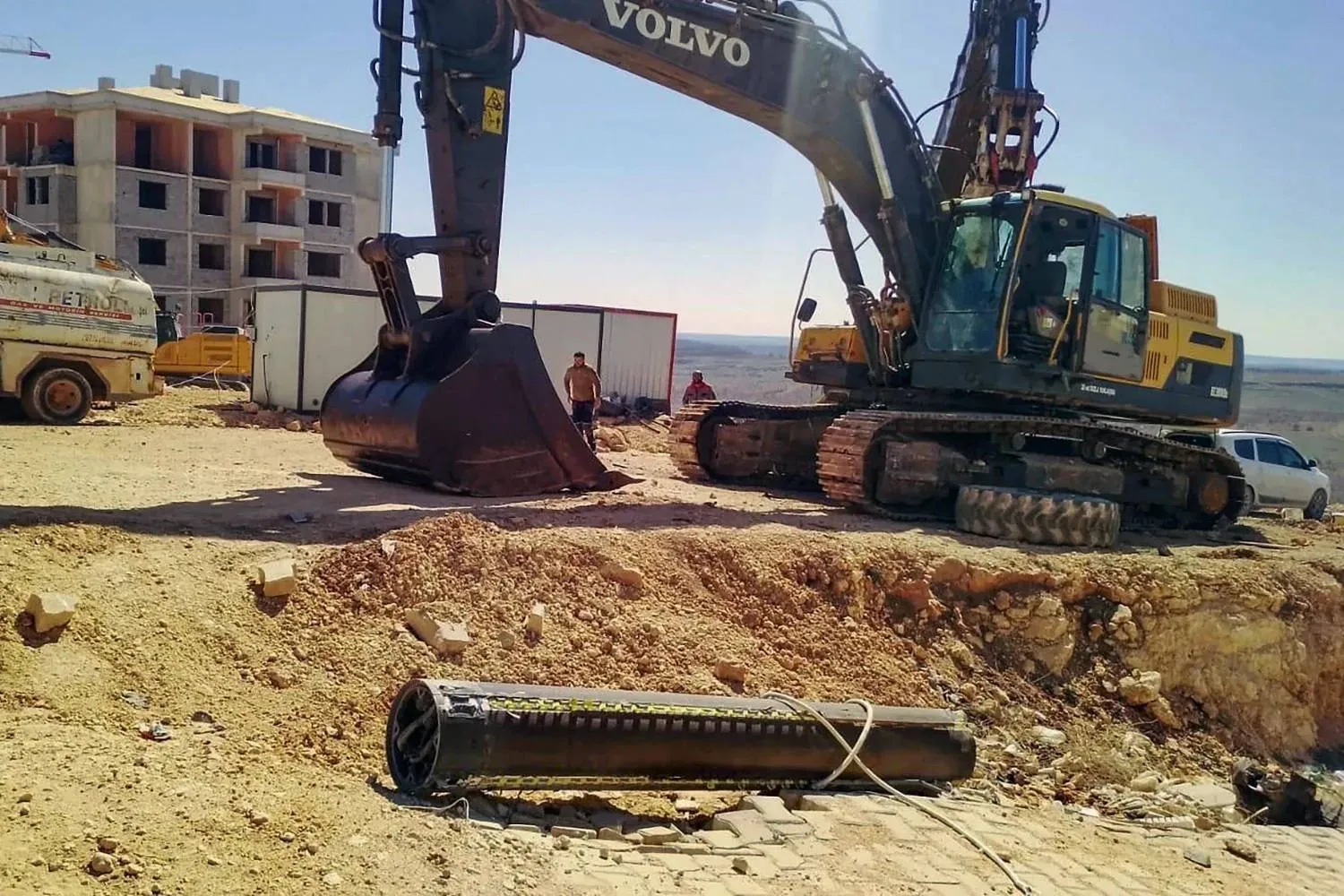
 This handout photograph taken and released on March 9, 2026, by Turkish news agency DHA (Demiroren News Agency) shows part of a second Iranian ballistic missile destroyed by NATO in Turkish airspace. (Photo by Handout / DHA (Demiroren News Agency) / AFP)
This handout photograph taken and released on March 9, 2026, by Turkish news agency DHA (Demiroren News Agency) shows part of a second Iranian ballistic missile destroyed by NATO in Turkish airspace. (Photo by Handout / DHA (Demiroren News Agency) / AFP)
TT

Türkiye Says Third Ballistic Missile from Iran Shot Down

 This handout photograph taken and released on March 9, 2026, by Turkish news agency DHA (Demiroren News Agency) shows part of a second Iranian ballistic missile destroyed by NATO in Turkish airspace. (Photo by Handout / DHA (Demiroren News Agency) / AFP)
This handout photograph taken and released on March 9, 2026, by Turkish news agency DHA (Demiroren News Agency) shows part of a second Iranian ballistic missile destroyed by NATO in Turkish airspace. (Photo by Handout / DHA (Demiroren News Agency) / AFP)

Türkiye's defense ministry on Friday said a ballistic missile from Iran had been shot down in Turkish airspace by NATO forces, the third such incident of the Middle East war. 

"A ballistic munition launched from Iran and entering Turkish airspace was neutralized by NATO air and missile defense assets deployed in the eastern Mediterranean," a ministry statement said. 

Hours earlier, sirens sounded at Türkiye's southern Incirlik airbase, a key NATO facility where US troops are stationed just outside the southern city of Adana, state news agency Anadolu reported. 

NATO air defenses shot down a first ballistic missile fired from Iran on March 4, with a second intercepted on Monday. 

Adana residents were woken by sirens at 3:25 am (0025 GMT), several posting footage of a fast-moving object in the night sky that appeared to be on fire, the Ekonomim business news website reported. 

Defense news site SavunmaSanayiST said they could be "fragments of a third ballistic missile" or of the interceptor, which would have caught fire upon entering the atmosphere. 

Iran's embassy in Ankara immediately denied any involvement, saying "no projectile" had been fired towards Türkiye, but experts said it was unlikely. 

"The first one you can explain it away, the second one possibly, but the third? No. This cannot be accidental," Sinan Ulgen, senior fellow with Carnegie Europe told AFP. 

This leaves Ankara in a real bind," he added, saying Türkiye would have to find some kind of "low-threshold way to respond". 

"In a way, the Gulf countries have not responded but Türkiye's political and military culture is different. It's a matter of demonstrating deterrence to Iran, so that things don't escalate further," he said. 

- Patience not 'limitless' - 

Security sources quoted by local media said Ankara had acted with caution to avoid being drawn into the war. 

But one of them also said Türkiye did not have limitless patience and wouldn't "hesitate to take the necessary punitive measures". 

Monday's incident prompted Washington to close its consulate in Adana and urge all US citizens to leave southeastern Türkiye. 

Incirlik is an important NATO facility used by US troops for decades. It also hosts military personnel from Spain and Poland, its website says. 

Experts say it also houses 50-60 US-owned tactical nuclear weapons. 

US troops are stationed at Kurecik base in Malatya where they man an early-warning radar system NATO describes as a "key element" of its missile shield that can detect Iranian missile launches. 

Although Ankara has categorically denied radar data has ever been used to help Israel, its presence has rattled Tehran. 

On Tuesday, Türkiye said a Patriot missile defense system was being deployed in Malatya just days after NATO moved to strengthen its "alliance-wide ballistic missile defense posture". 

Just hours before the third missile was intercepted, Türkiye's transport minister said a Turkish-owned ship had crossed the Strait of Hormuz with Iran's permission, without saying when. 

The crucial shipping route has been almost totally closed to traffic since the war began. 


Britain Warns Iran It Will Not Tolerate Hostile Activity on UK Soil

Britain's Foreign Minister Ed Miliband arrives to attend an informal meeting of EU foreign affairs ministers at Druids Glen in Wicklow, south of Dublin, Ireland, on September 2, 2026.  (Photo by Paul Faith / AFP)
Britain's Foreign Minister Ed Miliband arrives to attend an informal meeting of EU foreign affairs ministers at Druids Glen in Wicklow, south of Dublin, Ireland, on September 2, 2026. (Photo by Paul Faith / AFP)
TT

Britain Warns Iran It Will Not Tolerate Hostile Activity on UK Soil

Britain's Foreign Minister Ed Miliband arrives to attend an informal meeting of EU foreign affairs ministers at Druids Glen in Wicklow, south of Dublin, Ireland, on September 2, 2026.  (Photo by Paul Faith / AFP)
Britain's Foreign Minister Ed Miliband arrives to attend an informal meeting of EU foreign affairs ministers at Druids Glen in Wicklow, south of Dublin, Ireland, on September 2, 2026. (Photo by Paul Faith / AFP)

Britain's foreign minister met his Iranian counterpart on the sidelines of the UN General Assembly in New York and told him his country would "not tolerate intimidation, threats or hostile activity on UK soil" from groups linked to Iran.

British Foreign Secretary Ed Miliband and Iranian Foreign Minister Abbas Araghchi also discussed the war in the Middle East, the importance of reopening the Strait of Hormuz and Britain's "unwavering resolve ‌to combat ‌threats from Iranian-linked groups on UK soil," ‌a ⁠Foreign Office statement said.

"The ⁠Foreign Secretary reiterated the UK's unwavering resolve to combat threats from Iranian-linked groups on UK soil, including attacks on the British Jewish community," it said.

In July, Britain banned support for Iran's Revolutionary Guard Corps and a linked group following a series of ⁠antisemitic attacks, using new legal powers designed ‌to stop the use ‌of state-sponsored proxies, said
Reuters.

Iran has previously denied using proxies. The British statement ‌did not say how Araghshi responded to ‌Miliband.

A statement on Araghchi’s Telegram account said he had used the meeting to call for a correction to "the destructive and irresponsible approaches of some European governments towards Iran and regional ‌developments."

He also said an "insistence on interfering in countries’ internal affairs and the instrumental ⁠use of ⁠human rights concepts is in no way acceptable."

Britain's National Cyber Security Center said last week Iranian state-linked cyber actors had used a spyware family known as "CHOSEN BRICK" to steal emails, messages and other sensitive information through "spear-phishing" campaigns on messaging platforms including WhatsApp and Telegram.

"The Foreign Secretary made clear that Britain will not tolerate intimidation, threats or hostile activity on UK soil and set out the measures the Government has taken in response," the Foreign Office statement added.


Zelensky Says Trump Made 'Final Decision' to Give Ukraine Patriot License

NEW YORK, NEW YORK - SEPTEMBER 23: President of Ukraine Volodymyr Zelensky addresses the 81st session of the United Nations (UN) General Assembly at UN Headquarters on September 23, 2026 in New York City. Alexi J. Rosenfeld/Getty Images/AFP
TT

Zelensky Says Trump Made 'Final Decision' to Give Ukraine Patriot License

NEW YORK, NEW YORK - SEPTEMBER 23: President of Ukraine Volodymyr Zelensky addresses the 81st session of the United Nations (UN) General Assembly at UN Headquarters on September 23, 2026 in New York City. Alexi J. Rosenfeld/Getty Images/AFP

Ukrainian President Volodymyr Zelensky on Friday said US President Donald Trump told him he would allow Ukraine to produce advanced Patriot air defense missiles, after a series of reversals on the issue.

Kyiv is facing a shortage of the missiles, which remain the only ones reliably able to counter the ballistic missiles that Russia launches at Ukraine.

"At our last meeting, President Trump emphasized to me that yes, I have made a final decision. Ukraine will receive licenses for the production of Patriot missiles," Zelensky said in a voice note to journalists.

In July, Trump said it would be "pretty cool" to grant Ukraine the licenses, before backtracking, saying the United States should be "very careful" before granting Ukraine authorization.

Ukraine has reported an acute shortage of Patriot interceptors since the United States and Israel went to war with Iran in February, diverting supplies of the advanced systems.

Even if the licenses are granted, establishing industrial capacity would require more than a year and would not meet Kyiv's immediate needs.

And Kyiv has renewed calls for urgent support ahead of winter, and the threat of a repeated campaign of Russian strikes against Ukraine's power and heating infrastructure.

Kyiv needs five percent of the United States' Patriot interceptor missiles to get through the winter and 10 percent to destroy all of Russia's ballistic projectiles, Zelensky said last month.

In parallel, he said Kyiv is working on its own anti-ballistic systems, Freya.


Iran Proposes Reopening Hormuz Within 7 Days

FILE PHOTO: Vessels at the Strait of Hormuz, as seen from Musandam, Oman, September 23, 2026. Picture taken through a window. REUTERS/Stringer/File Photo
TT

Iran Proposes Reopening Hormuz Within 7 Days

FILE PHOTO: Vessels at the Strait of Hormuz, as seen from Musandam, Oman, September 23, 2026. Picture taken through a window. REUTERS/Stringer/File Photo

Iran has submitted a proposal to the United States to end their war and reopen the Strait of Hormuz within seven days, its foreign minister told media outlets in New York.

"If certain conditions are met, the strait will be open within seven days and talks will start," Abbas Araghchi, who is in the US for the UN General Assembly, told media outlets including the New York Times and The Guardian.

Japanese news agency Kyodo was the first to report the proposal, citing a senior Iranian official on Tuesday.

Iranian media, however, denied the Kyodo report, while authorities in Tehran have not clarified their position.

Araghchi also met for talks on Tuesday with US President Donald Trump's envoy Steve Witkoff.

Iran has previously set out seven conditions for ending the war and reopening the strait.

According to Araghchi, as quoted by the New York Times, the latest plan calls for a cessation of all hostilities in the Middle East for seven days, including in Lebanon.

It also calls for the release of frozen Iranian assets estimated to be worth at least $12 billion, as well as the lifting of sanctions on Iranian oil and an end to the US naval blockade of Iran.

On the seventh day of the truce, Iran would reopen Hormuz.

Araghchi said he was waiting for a US response to the plan and maintained that China supported the proposal.

Chinese President Xi Jinping is visiting the United States this week where he is meeting with Trump for talks.

Hossein Mohebi, a spokesman for the Revolutionary Guards, the ideological arm of Iran's military, told AFP in an exclusive interview on Tuesday that ending hostilities in Yemen was also among Tehran's demands.

The US and Iran signed a memorandum of understanding in June that aimed to end the war, reopen the strait and launch talks on Iran's nuclear program.

But the deal broke down shortly afterwards when Iran fired on commercial ships in Hormuz that it accused of deviating from its approved route through the waterway.

Iran requires ships to obtain authorization before passage, citing security and sovereignty reasons.

Ships that refuse to comply are regularly targeted, while the United States sporadically bombs Iranian coastal areas in retaliation.
