Saudi Aramco reported a sharp rise in first-quarter profit for 2026, beating analyst expectations as higher oil prices and increased crude sales offset geopolitical disruptions linked to shipping constraints in the Strait of Hormuz.
Aramco’s adjusted net income rose nearly 26% to $33.6 billion (SAR126.0 billion), above analysts’ average forecast of SAR109 billion and up from SAR99.8 billion a year earlier, according to a company statement on Sunday.
The company approved a base dividend of $21.89 billion (SAR82.08 billion), in line with its strategy to provide sustainable and growing returns backed by strong cash flow generation and a solid balance sheet.
The results highlighted Aramco’s ability to generate cash flow from operating activities of $30.7 billion despite heightened geopolitical tensions affecting global energy markets.
Iran’s blockade of shipping through the Strait of Hormuz during the US-Israeli conflict disrupted global energy supplies and pushed oil prices higher, prompting Aramco to increase crude flows from its eastern facilities to the Red Sea port of Yanbu through its East-West pipeline network.
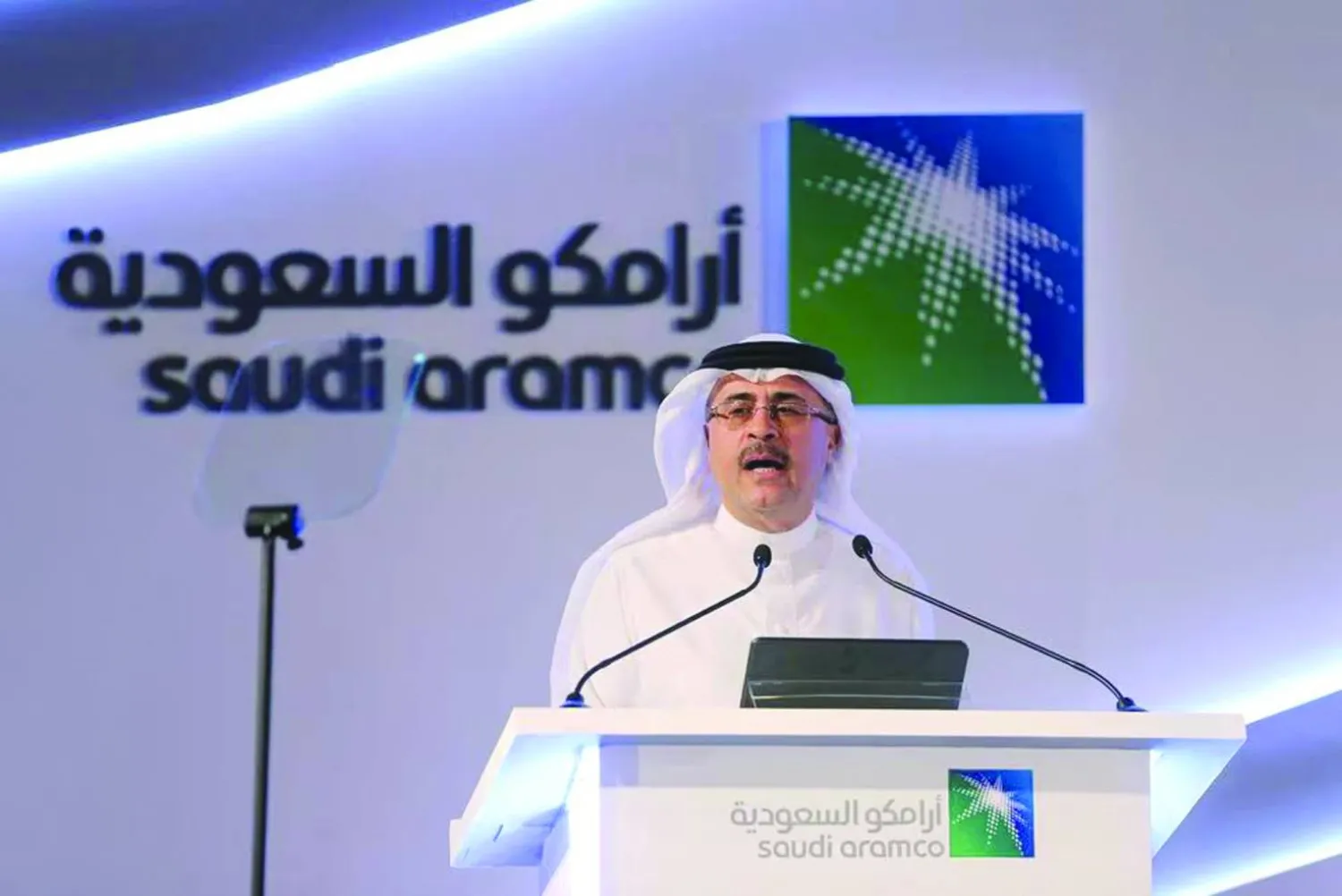
Aramco President and CEO Amin Nasser said in this regard: “Our East-West Pipeline, which reached its maximum capacity of 7.0 million barrels of oil per day, has proven itself to be a critical supply artery, helping to mitigate the impact of a global energy shock and providing relief to customers affected by shipping constraints in the Strait of Hormuz.”
“Recent events have clearly demonstrated the vital contribution of oil and gas to energy security and the global economy, and are a stark reminder that reliable energy supply is critical,” Nasser added.
Crude prices climbed from around $65 per barrel in early February to more than $100 in March after Iran closed the Strait of Hormuz, triggering a global energy shock.
Strong revenue and profit growth
Adjusted net income of $33.6 billion (SAR125.97 billion) exceeded analysts’ consensus estimate of $31.16 billion.
The figure reflects underlying operating performance excluding non-recurring items and accounting impacts related to replacement costs, fair-value movements in certain derivatives and financing costs totaling about $1.06 billion (SAR3.96 billion), according to results published on the Saudi stock exchange website.
Net income rose more than 25% year-on-year to $32.04 billion (SAR120.13 billion), compared with $25.51 billion (SAR95.68 billion) in the same quarter of 2025, driven by higher crude oil prices and increased sales volumes.
Revenue increased 7% to $115.49 billion (SAR433.10 billion), supported by higher prices for crude oil, refined products and chemicals, as well as higher sales volumes of crude and chemical products.
On a quarterly basis, net income jumped 72.9% from the fourth quarter of 2025, rising from $18.53 billion to $32.04 billion, helped by stronger margins and lower operating costs despite higher taxes and zakat payments.
Aramco said shareholders’ equity rose 3.9% year-on-year to $408.46 billion (SAR1.5 trillion), while earnings per share reached $0.13 (SAR0.50).
Cash flow and financial position
Cash flow from operating activities totaled $30.7 billion (SAR115.2 billion).
Free cash flow came in at $18.6 billion (SAR69.9 billion), down slightly from $19.2 billion a year earlier, reflecting a strategic increase in working capital of $15.8 billion (SAR59.1 billion) aimed at ensuring business continuity.
The company maintained a strong capital structure, with gearing at 4.8%, up from 3.8% at the end of 2025. Return on average capital employed stood at 20.7%.
Aramco shares rose 0.8% after the results announcement to close at SAR27.42, with trading volume of around 12 million shares.
Dividends and expansion plans
Aramco’s board declared a first-quarter base dividend of $21.9 billion (SAR82.1 billion), up 3.5% from a year earlier, to be paid in the second quarter.
The company also invested $12.1 billion (SAR45.4 billion) in capital expenditure during the quarter as part of plans to expand production capacity and strengthen strategic infrastructure.
Nasser said the company’s first-quarter performance reflected “strong resilience and operational flexibility in a complex geopolitical environment.”
“Despite these headwinds, Aramco remains focused on its strategic priorities and is leveraging both its domestic infrastructure and its global network to navigate disruption,” he stated.
In comments to Reuters, Nasser warned the global oil market could take time to stabilize after recent disruptions.
The world has lost about one billion barrels of oil over the past two months, Nasser said, adding: “Our goal is simple: to ensure energy keeps flowing, even under the pressure the system is facing.”
Resilience
Hussein Al-Attas, a financial and economic adviser, told Asharq Al-Awsat that Aramco’s results demonstrated the strength of its operating model and its ability to benefit from higher oil prices.
“What stands out in these results is not only profit growth, but also the company’s operational flexibility in managing supply chains and exports under complex geopolitical conditions, which preserved strong cash flow levels and sustainable shareholder distributions,” he noted.
Al-Attas said part of the earnings growth was linked to exceptional price increases during the quarter, meaning future profitability would remain closely tied to global oil price trends and supply stability.
For his part, Mohammed Al-Farraj, senior head of asset management at Arbah Capital, said Aramco’s large cash distributions enhanced the stock’s appeal as a defensive investment for institutional and long-term investors, particularly sovereign wealth funds and pension funds.
He told Asharq Al-Awsat that the company’s low production costs and strong balance sheet supported its ability to continue distributing dividends despite energy market volatility.
Al-Farraj also said Aramco’s $3 billion share buyback program, announced in March, reflected management confidence in the company’s valuation and long-term cash generation capacity.
The repurchased shares will be held as treasury shares and allocated to employee stock programs, the company said.
Al-Farraj added that Aramco continued pursuing diversification through investments in natural gas, liquefied natural gas and projects such as the Jafurah field, while also deploying artificial intelligence technologies to improve efficiency and reduce costs.