


‘Taxi Therapy’ for Young Cancer Patients in Italy

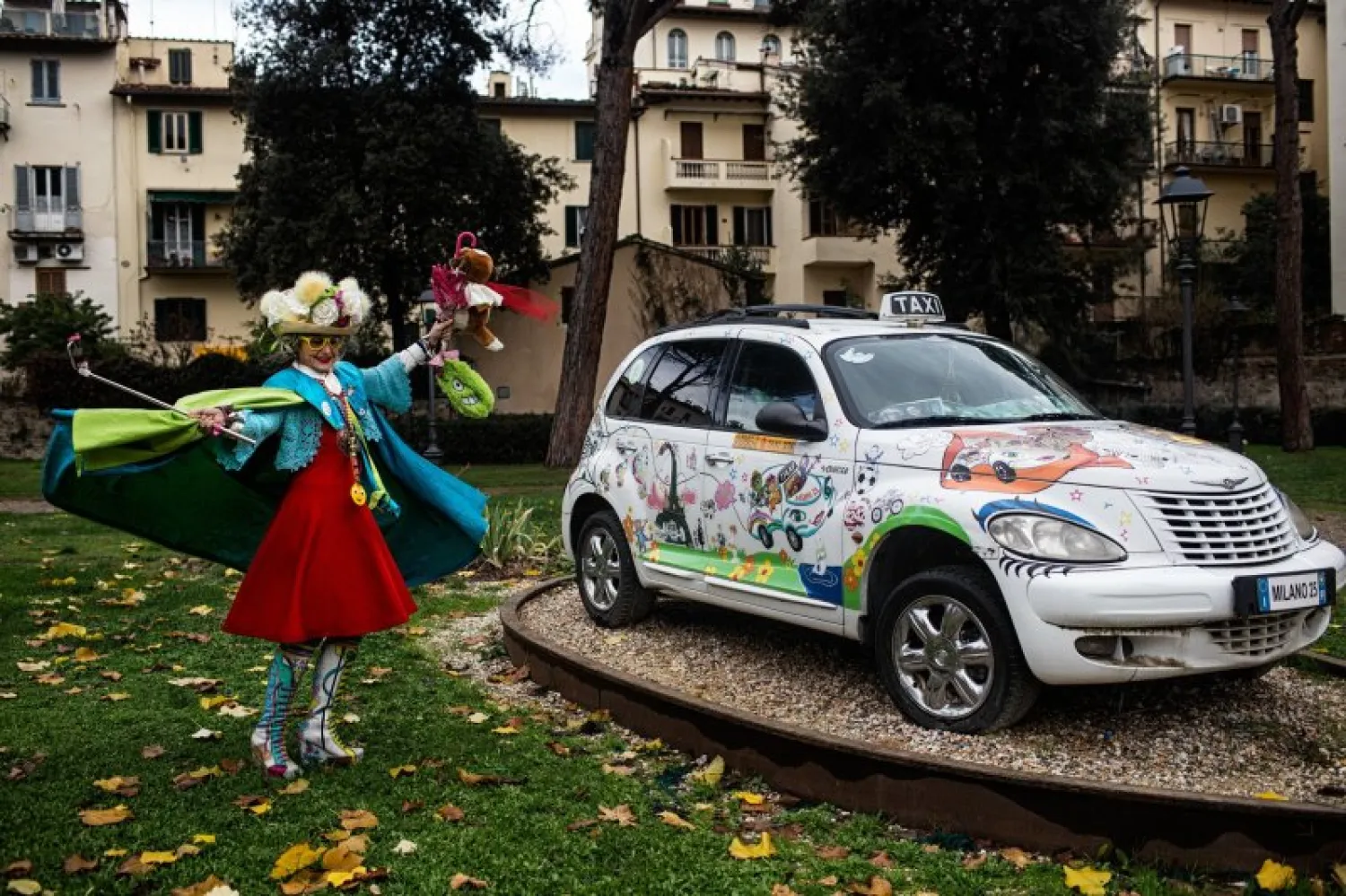
Caterina Bellandi dancing around her first taxi, now a monument in the Garden of Horticulture in Florence. Nadia Shira Cohen for The New York Times
TT

‘Taxi Therapy’ for Young Cancer Patients in Italy

Caterina Bellandi dancing around her first taxi, now a monument in the Garden of Horticulture in Florence. Nadia Shira Cohen for The New York Times

The black-and-white checkered floor of the taxi looks a bit like home flooring. The seats are yellow, purple and orange leather, while the pea-green interiors are plastered with daisy stickers. When riding in the cab, passengers can play with plastic swords and a megaphone, or make soap bubbles.

Welcome to Milano 25, the Florentine taxi that for 16 years has offered free travel, by day, between a pediatric hospital and the homes of young cancer patients — and, in the evening, carried regular clients around Tuscany’s main city.

Its soul and operator, Caterina Bellandi, 52, is better known in Florence and across the country as Zia Caterina (Auntie Caterina). She drives her Chrysler taxi wearing a flashy green-and-azure cloak topped by a straw top hat decorated with pompoms, and fabric roses and gerberas. An army of little bells sound at the movement of her wrists and of her necklace, a polka-dot rosary of yellow, orange and red.

“This is not a show,” she said, looking in the rear mirror through her fluorescent glasses. Her warm smile was accented by her red lipstick. “My children may be sick, but they can and have to be happy.”

Ms. Bellandi’s partner, the original owner of Milano 25, died prematurely in 2001. His taxi license was his legacy to her.

“I found such a profound love in him and in his death that I decided to make his taxi live on,” she explained. “I wanted to pay homage to him, making his Milano 25 the most wonderful cab in the world, so special to be remembered by anyone.”

Ms. Bellandi surely succeeded. With a sense of style reminiscent of Mary Poppins, she and her taxi are one-of-a-kind.

Not even Patch Adams, the American doctor in a clown suit whom she highly regards for his work with sick children, could get her to wear the outfits that those attending his clown tours in hospitals worldwide usually put on. In 2007, she drove 1,800 miles from Florence to Moscow to attend his course in clown therapy, but she refused to wear a red nose.

“I am not a clown,” she explained. “I am a taxi driver. So I do taxi-therapy.”

Her creative idea initially ran into city rules. Taxis usually look alike here, and hers carries unusual items, like a stuffed figure of Disney’s dwarf Grumpy on the passenger seat.

The local authorities also objected to the pictures she glued to the windows, saying they could hamper the driver’s view. After getting multiple tickets, she complained vigorously.

“She is an extraordinary engine of solidarity and I felt her city should help her a little,” said Eugenio Giani, now president of Tuscany’s regional cabinet, who interceded for her with the municipal police.

He is planning to recognize Ms. Bellandi as “Tuscany’s Solidarity Ambassador,” an honorific title signaling the region’s institutional backing.

“She is capable of involving ill children in anything, from soccer matches to trips abroad, and she does it from one child to another, nonstop,” Mr. Giani said. “She puts a positive spell on them.”

Ms. Bellandi is not only a taxi driver for these young patients, but a friendly presence throughout these challenging moments of their lives. She visits families in their homes and arranges vacations. She takes sick children to watch sports games and shake hands with their sports heroes, and has even taken some to the Vatican to meet Pope Francis.

A generous network of people helps Ms. Bellandi. A Florentine bakery donates a crunchy flatbread and pizza that even patients undergoing chemotherapy can swallow. Mothers sew her cloaks. A designer fabricates her extravagant hats.

She is so well known these days that some parents of children who are battling serious illnesses search for her on the internet. A new version of the Monopoly board game that has famous figures of Tuscany on the play money includes Ms. Bellandi.

“I was desperate and I was looking for support,” said Francesca Scaturro, mother of Giulia, a 5-year-old who had an aggressive form of brain cancer. So she wrote an email to Ms. Bellandi’s website.

Ms. Bellandi showed up in style at the hospital where Giulia was being treated. She brought pizza with her and insisted that Ms. Scaturro, 34, have a slice.

Ms. Bellandi became a frequent presence during Giulia’s year of treatment, spending weekends with her and other families facing similar medical challenges, and even coming on a holiday in Sicily last summer.

She is now considered a family member, Ms. Scaturro said. Giulia calls her “Auntie.”

“It is enough just to see her,” Ms. Scaturro said. “Her hug is everything to me.”

The New York Times


Trying to Improve Your Health and Wellness in 2026? Keep it Simple

A man is silhouetted against the sky at sunset as he jogs in a park at the close of a hot summer day, Aug. 1, 2022, in Kansas City, Mo. (AP Photo/Charlie Riedel, File)
TT

Trying to Improve Your Health and Wellness in 2026? Keep it Simple

A man is silhouetted against the sky at sunset as he jogs in a park at the close of a hot summer day, Aug. 1, 2022, in Kansas City, Mo. (AP Photo/Charlie Riedel, File)

The new year is a time when many try to start new good habits and commit to improving health and wellness.

But resolutions, lofty as they may be, can turn daunting quickly with all the advice and sometimes contradicting information coming at you from news reports, advertisers, influencers, friends and even politicians.

But they don't have to be.

This year, The Associated Press got the downlow on all manner of health and wellness claims and fads. The good news is that the experts mostly say to keep it simple.

As 2026 arrives, here's what you can skip, what you should pay attention to and how to get credible information when you are inevitably faced with more confusing claims next year.

Protein and fiber are important, but you probably don't need to pay more When it comes to your diet, experts say most people can skip the upcharge. If you're eating enough, you're probably getting enough protein and don't need products that promise some big boost.

And it's true that most people could use more fiber in their diets. But, please, ditch the “fiber-maxxing” trend. Instead, eat whole foods such as fruits, vegetables, beans and whole grains.

A good skin care routine is not expensive or complicated That 20-step skin care routine and $200 serum some TikToker sold you on? Dermatologists say you really don't need it. Stay away from the beef tallow and slather on a good sunscreen instead (yes, even if you have darker skin ), they say.

And the same rule for simplicity applies to that hourlong “everything shower." The best showers are simple and short, dermatologists say, no "double cleansing" required.

There are many simple ways to get that workout in If the gym and all its equipment feel intimidating, you can drop the illusion that a good workout requires either. This year, the comeback of calisthenics put the focus back on no frills, bodyweight workouts you can do in the comfort of home. Research shows calisthenics helps with muscle strength and aerobic conditioning. You may eventually need weightlifting or other equipment, but it is a great place to start to build consistency and confidence.

Be wary of wellness fads and treatments — they are often too good to be true Even if you imbibe too much this New Year's Eve, doctors say you can do without “ IV therapy ” which have vitamins you can get more easily and cheaper in pill form — if you even need more, which is unlikely if you have a balanced diet. You're pretty much just paying for “expensive urine,” one doctor said.

Same for “wellness” focused products like microbiome testing kits that generate information that doctors can't actually act on. And if you don't have diabetes, there's scant evidence that you need a continuous glucose monitor.

To improve your health, go back to the basics The idea of a panacea pill, product or routine can be enticing. But science already knows a lot about how to improve mental and physical health, and they are tried and true:

1. Whether you're in the city or the country — walk more. Research shows walking is great for physical and mental health. It's so good for you, doctors are literally prescribing time in the outdoors to their patients.

2. Take steps to get certain health metrics under control, likehigh blood pressure, which often goes undiagnosed and is known to cause a range of health problems down the road. Prioritize getting enough sleep, and make sure your family does too. Don't just eat right — eat slower.

3. Give your mind some care too. Set better boundaries with your technology andregain and retrain your attention span. Build out your social networks and invest inall forms of love for the people around you.

These lifestyle changes don't just make you feel better in the moment. Research shows they impact your life for years to come, by lowering the risk of dementia and many other health issues.

Don't know who to trust? Start with your doctor It can be tough to know who to listen to about your health, faced with compelling personal stories on social media from people who swear something worked from them, or clever marketing and advertising from companies that scare you or promise an easy fix.

Doubts have been raised this year about established medicine, including the safety of food dyes, fluoride dental treatments,hepatitis B shot for newborns, and hormone therapies for menopause.

While the medical system is not perfect, your doctor remains the best person to talk to about prevention, health concerns and potential treatments.

If you can't get to a human doctor and turn to Dr. Google instead, be sure to follow these tips and never use it to diagnose yourself. When you do get that doctor's appointment, you can make the most of it by bringing a list of written questions — and don't hesitate to ask for any clarification you need.


Citrus Harvest Season Kicks off in AlUla

The citrus harvest in AlUla is a significant agricultural and economic event  - SPA
The citrus harvest in AlUla is a significant agricultural and economic event - SPA
TT

Citrus Harvest Season Kicks off in AlUla

The citrus harvest in AlUla is a significant agricultural and economic event  - SPA
The citrus harvest in AlUla is a significant agricultural and economic event - SPA

The citrus harvest season has officially begun in AlUla Governorate, which is renowned for its agricultural production, according to SPA.

Citrus groves in AlUla cover approximately 654.57 hectares and contain around 261,826 trees, yielding about 6,545.65 tons of fruit annually.

The governorate produces a variety of delicious and nutritious citrus fruits, most notably navel oranges, citron, and sweet lemons. The citrus harvest season typically runs from December to March.

These fruits are distinguished by their high quality, attributed to the governorate's unique climate and fertile soil, resulting in exceptional flavor and high nutritional value.

The citrus harvest in AlUla is a significant agricultural and economic event that highlights the diversity of the governorate's agricultural production. It also plays a crucial role in supporting agricultural activity and promoting local products in the marketplace.


Saudi Arabia's Qassim National Park Records Third Consecutive Arabian Oryx Births

Saudi Arabia's Qassim National Park recorded the birth of an Arabian oryx for the third consecutive year. (SPA)
TT

Saudi Arabia's Qassim National Park Records Third Consecutive Arabian Oryx Births

Saudi Arabia's Qassim National Park recorded the birth of an Arabian oryx for the third consecutive year. (SPA)

Saudi Arabia's Qassim National Park in Buraidah recorded the birth of an Arabian oryx for the third consecutive year, reported the Saudi Press Agency on Monday.

The development is an important environmental milestone that reflect the ongoing success of release and reintroduction programs led by the National Center for Wildlife (NCW), which aims to preserve endangered wild species and boost biodiversity in their natural habitats.

The achievement exemplifies a pioneering collaboration between the NCW and the National Center for Vegetation Cover Development and Combating Desertification through initiatives such as vegetation enhancement, natural habitat rehabilitation, and the creation of suitable conditions for the breeding and sustainability of wild species.

Qassim National Park is one of several national parks implementing afforestation and environmental rehabilitation projects under the Saudi Green Initiative, strengthening the region’s ecological diversity and showcasing the role of national parks as models of successful environmental sustainability programs in the Kingdom.
