


US Urges Negotiations between Syria Regime, Opposition as France Accuses Damascus of Mass Crimes

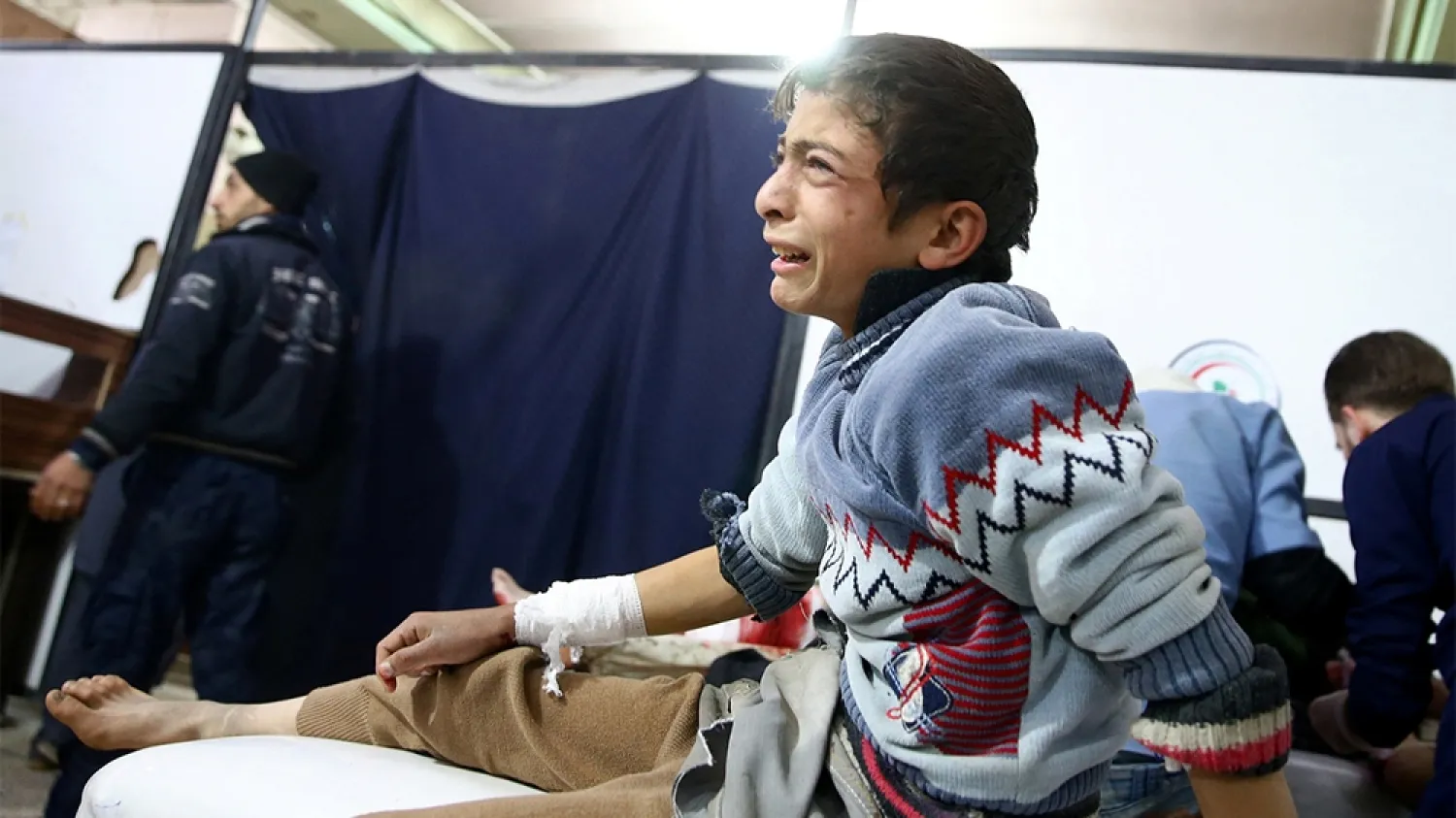
The UN says about 400,000 civilians are besieged in Eastern Ghouta as the Syrian regime continues to block aid deliveries. (Reuters)
TT

US Urges Negotiations between Syria Regime, Opposition as France Accuses Damascus of Mass Crimes

The UN says about 400,000 civilians are besieged in Eastern Ghouta as the Syrian regime continues to block aid deliveries. (Reuters)

The United States called on Friday the supporters of the Syrian regime to press it to “fully” take engage in negotiations with the opposition in order to reach a political settlement to their country’s war.

In a statement, a spokeswoman for the State Department said the United States wanted the regime’s supporters "to use their leverage to urge the regime to participate fully in tangible negotiations with the opposition in Geneva."

The eighth round of the Geneva talks concluded on Thursday in what United Nations special envoy Staffan de Mistura called a “missed opportunity” after the regime refused to hold direct talks with the opposition.

He laid most of the blame of the failure at the feet of the regime.

"The United States urges all parties to work seriously toward a political resolution to this conflict or face continued isolation and instability indefinitely in Syria," spokeswoman Heather Nauert said in a statement.

France was more damning on Friday of its assessment of the regime, saying that it has done nothing to reach a peace agreement after almost seven years of war and said it was "committing mass crimes" in the Eastern Ghouta region where 400,000 people are besieged by regime forces.

"The Assad regime never entered in any negotiation since the beginning of the civil war," France's Ambassador to the US Gerard Araud said on Twitter. "They don't look for a political compromise but for the eradication of their enemies."

Despite being a leading backer of the Syrian opposition, France has sought a more pragmatic approach to the Syrian conflict since the arrival of President Emmanuel Macron, saying that the departure of Syrian regime head Bashar Assad was not a precondition for talks.

However, on Friday the lack of progress in Geneva and continuing assault of the besieged rebel enclave of Eastern Ghouta near Damascus brought scathing criticism from Paris.

"There is no alternative to a negotiated political solution agreed by both parties under the auspices of the United Nations," deputy foreign ministry spokesman Alexandre Giorgini told reporters in a daily briefing, reiterating Paris' support for de Mistura and appearing to dismiss a separate Russian initiative planned in Sochi next year.

"We deplore the attitude of the Syrian regime, which has refused to engage in the discussion. The Syrian regime is responsible for the lack of progress in the negotiations," he said.

He also pointed the finger at Russia and Iran, who both back Assad, over their inability to enforce a ceasefire in Eastern Ghouta, which according to a September 15 accord between Russia, Turkey and Iran, is included among several de-escalation zones.

"It is therefore urgent that Russia and Iran, guarantors of the Astana process and allies of the Damascus regime, take steps for the cessation of the bombings and (enable) humanitarian aid to arrive safely and without those who need it being hindered," Giorgini said.

The United Nations says about 400,000 civilians are besieged and face "complete catastrophe" because aid deliveries by the Syrian regime were blocked and hundreds of people who need urgent medical evacuation have not been allowed outside the enclave.

"By denying humanitarian access, the Damascus regime is responsible for mass crimes, particularly through the use of the siege as a weapon of war," Giorgini said.



Hezbollah Chief Accuses Lebanese Authorities of Working ‘in the Interest of What Israel Wants’

Hezbollah leader Naim Qassem
TT

Hezbollah Chief Accuses Lebanese Authorities of Working ‘in the Interest of What Israel Wants’

Hezbollah leader Naim Qassem

Hezbollah leader Naim Qassem on Sunday said moves to disarm the group in Lebanon are an "Israeli-American plan,” accusing Israel of failing to abide by a ceasefire agreement sealed last year.

Under heavy US pressure and fears of expanded Israeli strikes, the Lebanese military is expected to complete Hezbollah's disarmament south of the Litani River -- located about 30 kilometers from the border with Israel -- by the end of the year.

It will then tackle disarming the Iran-backed movement in the rest of the country.

"Disarmament is an Israeli-American plan," Qassem said.

"To demand exclusive arms control while Israel is committing aggression and America is imposing its will on Lebanon, stripping it of its power, means that you are not working in Lebanon's interest, but rather in the interest of what Israel wants."

Despite a November 2024 ceasefire that was supposed to end more than a year of hostilities between Israel and Hezbollah, Israel has kept up strikes on Lebanon and has maintained troops in five areas it deems strategic.

According to the agreement, Hezbollah was required to pull its forces north of the Litani River and have its military infrastructure in the vacated area dismantled.

Israel has questioned the Lebanese military's effectiveness and has accused Hezbollah of rearming, while the group itself has rejected calls to surrender its weapons.

"The deployment of the Lebanese army south of the Litani River was required only if Israel had adhered to its commitments... to halting the aggression, withdrawing, releasing prisoners, and having reconstruction commence," Qassem said in a televised address.

"With the Israeli enemy not implementing any of the steps of the agreement... Lebanon is no longer required to take any action on any level before the Israelis commit to what they are obligated to do."

Lebanese army chief Rodolphe Haykal told a military meeting on Tuesday "the army is in the process of finishing the first phase of its plan.”

He said the army is carefully planning "for the subsequent phases" of disarmament.


Israel Army Ends Crackdown on West Bank Town after Attack

Smoke rises following an explosion detonated by the Israeli army, which said it was destroying buildings used by Palestinian militants in the West Bank Jenin refugee camp, Sunday, February 2, 2025. © Majdi Mohammed, AP
TT

Israel Army Ends Crackdown on West Bank Town after Attack

Smoke rises following an explosion detonated by the Israeli army, which said it was destroying buildings used by Palestinian militants in the West Bank Jenin refugee camp, Sunday, February 2, 2025. © Majdi Mohammed, AP

The Israeli military said on Sunday it had ended its operation in a town in the occupied West Bank that it had sealed off after a Palestinian from the area killed two Israelis.

Around 50 residents of Qabatiya were briefly detained during the two-day operation, the official Palestinian news agency Wafa reported, quoting the town's mayor Ahmed Zakarneh.

The attacker's father and two brothers remained in custody, it added.

The military launched the operation on Friday, shortly after a 34-year-old Palestinian fatally stabbed an 18-year-old Israeli woman and ran over a man in his sixties with his vehicle.

When contacted by AFP on Sunday morning, the military confirmed the end of its operation in the area.

Defense Minister Israel Katz previously said the army had completely sealed off the town.

Wafa also reported that Israeli troops had withdrawn from Qabatiya, near the city of Jenin.

Zakarneh said the town had been in a state of "total paralysis" during the military activity.

Israeli army bulldozers tore up pavement on several streets and erected roadblocks to halt traffic, he said, adding that around 50 houses were searched.

Wafa reported that a school had been turned into a detention and interrogation center.

AFPTV footage filmed on Saturday showed Israeli soldiers carrying automatic rifles and patrolling the streets, where several armoured vehicles were deployed.

Shops were closed, though men and children were seen walking through the village.

On Sunday, the Israeli army said it had sealed off the assailant's home and was finalising "the procedures required for its demolition".

Israeli authorities argue that demolishing the homes of Palestinians who carry out attacks against Israelis has a deterrent effect.

Critics, however, condemn the practice as collective punishment that leaves families homeless.


Arab League Council Holds Extraordinary Session on Latest Developments in Somalia

A general view shows the opening session of the meeting of Arab foreign ministers at the Arab League Headquarters (Reuters)
TT

Arab League Council Holds Extraordinary Session on Latest Developments in Somalia

A general view shows the opening session of the meeting of Arab foreign ministers at the Arab League Headquarters (Reuters)

At the request of the Federal Republic of Somalia and with the support of Arab League member states, the Arab League Council on Sunday began its extraordinary session at the league’s General Secretariat, at the level of permanent representatives and under the chairmanship of the United Arab Emirates, to discuss developments regarding the Israeli occupation authorities’ declaration on mutual recognition with the Somaliland region.

The Kingdom’s delegation to the meeting was headed by its Permanent Representative to the Arab League Ambassador Abdulaziz bin Abdullah Al-Matar, SPA reported.

The meeting is discussing ways to strengthen the unified Arab position in addressing this step, to affirm full solidarity with Somalia, and to support its legitimate institutions in a manner that contributes to preserving security and stability in the region.

The meeting also aims to reaffirm the Arab League’s categorical rejection of any unilateral measures or decisions that could undermine Somalia’s sovereignty and territorial integrity, and to emphasize commitment to the principles of international law and the relevant resolutions of the Arab League and the African Union.