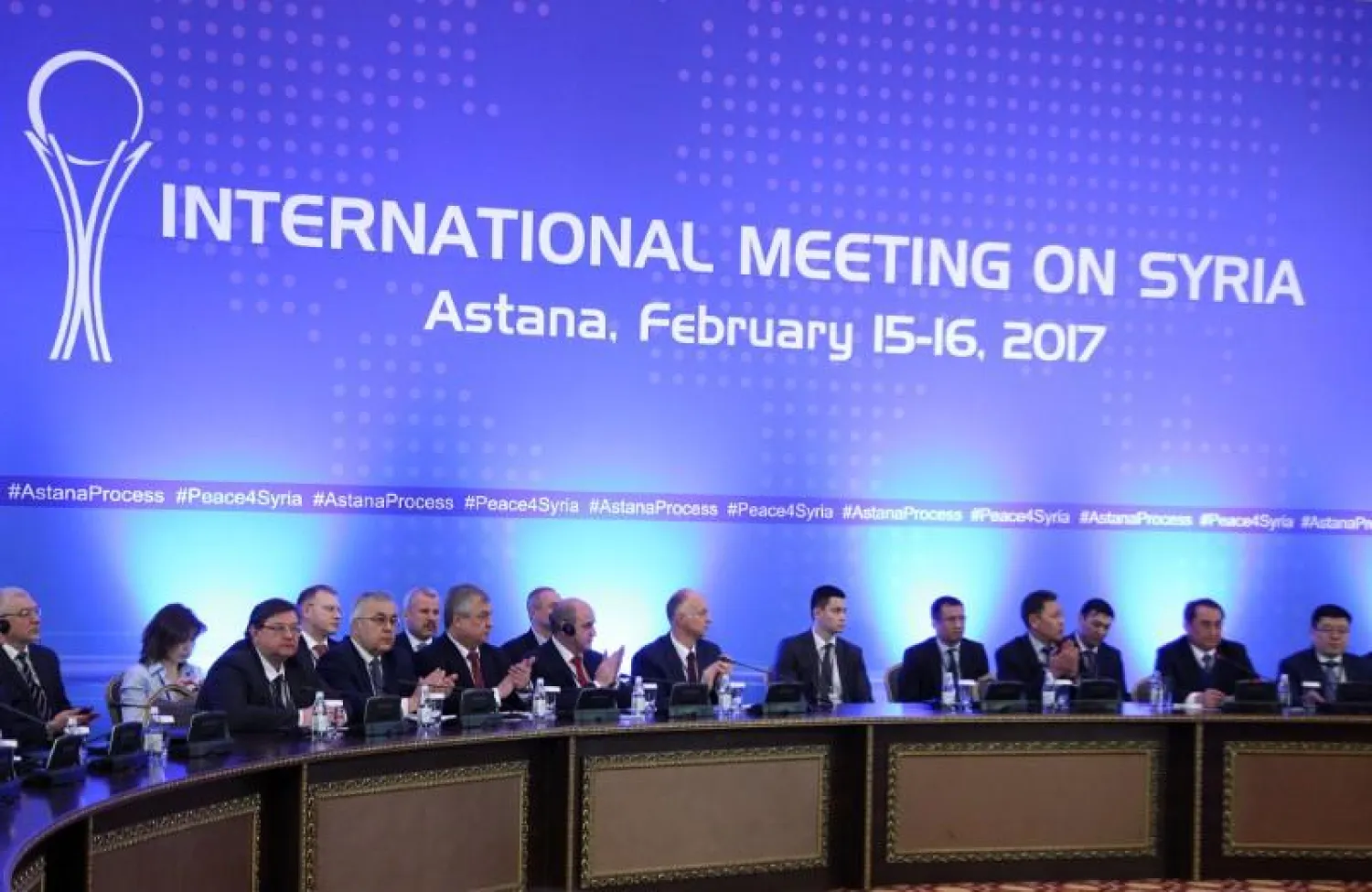
Astana 8 Kicks Off with Expectations to Focus on Sochi

Participants of Syria peace talks attend a meeting in Astana, Kazakhstan February 16, 2017. REUTERS/Mukhtor Kholdorbekov
TT

Astana 8 Kicks Off with Expectations to Focus on Sochi

Participants of Syria peace talks attend a meeting in Astana, Kazakhstan February 16, 2017. REUTERS/Mukhtor Kholdorbekov

The 8th round of consultations in Astana on the Syrian crisis will kick off on Thursday, with the participation of UN Special Envoy Staffan de Mistura and representatives of the United States and Jordan.

The Kazakh Foreign Ministry said that the delegations of the Guarantor States had confirmed their participation in the current round of consultations.

Sources expected that Astana 8 would see a shift from focusing on military files, which had been the main theme of the Astana process since its inception, to issues of a political settlement.

A source familiar with the preparations for the meeting told Asharq al-Awsat that the delegations of the guarantor states would review the situation and developments in the Syrian de-escalation zones, adding that talks would focus on countering terrorist groups, specifically Al-Nusra Front in Idlib, and the means to face terrorism in order to better prepare the atmosphere for the political process.

RIA Novosti, quoting sources with knowledge of the matter, said that states participating in Astana 8 would center their attention on the Syrian dialogue conference in Sochi, adding that participants were working on some of the issues proposed in Sochi, such as the constitution and the elections.

The sources noted that meeting would also review the situation in the de-escalation zone in Idlib, as the province is witnessing confrontations and is subject to aerial bombardment. The Syrian opposition and the Syrian Observatory for Human Rights (SOHR) held the Syrian regime and Russian forces responsible for the airstrikes.

SOHR reported on Tuesday that nineteen civilians, including seven children, were killed in heavy bombardment on Idlib.

“Suspected Russian airstrikes targeted several houses in Maarshurin,” said Rami Abdel Rahman, head of SOHR. He added that 13 members of a single family were among the dead.

Idlib’s civil defense, a rescue service known as the White Helmets which operates in rebel territory, said fierce bombing after midnight killed 19 people. The Observatory said 25 others had been injured.

There was no immediate comment from the Syrian regime forces. The Russian defense ministry later on Wednesday denied that its jets had carried out the strikes.

De Mistura is expected to arrive in Moscow on Thursday, where he will hold talks with Russian Foreign Minister Sergei Lavrov and Defense Minister Sergei Shoygu on the Syrian settlement.


US Stops Israel’s Plan to Drag Syria to War on Hezbollah

Lebanese General Security members stand guard at the Masnaa border crossing with Syria in the Bekaa Valley, eastern Lebanon, 05 April 2026, following an Israeli warning to target the M30 highway between Lebanon and Syria. (EPA)
TT

US Stops Israel’s Plan to Drag Syria to War on Hezbollah

Lebanese General Security members stand guard at the Masnaa border crossing with Syria in the Bekaa Valley, eastern Lebanon, 05 April 2026, following an Israeli warning to target the M30 highway between Lebanon and Syria. (EPA)

Political sources in Tel Aviv revealed that Washington stopped Israel from striking the Masnaa border crossing between Lebanon and Syria, as well as a plan to drag Damascus into the war against Hezbollah.

Israel radio said that the American administration stopped Israel from bombing the crossing shortly after Tel Aviv had threatened to attack it over the weekend.

Israel had bombed an area close to the crossing, claiming Hezbollah was using it for “military” purposes.

Israel radio reported that the US had asked Tel Aviv to refrain from attacking the crossing for “political reasons” and to leave the issue to Syrian security officials who are working on behalf of Syrian President Ahmed al-Sharaa.

It quoted an informed source as saying that the Damascus government had told the Americans that it was working against Hezbollah and that it had thwarted in recent days attempts to smuggle weapons from Syria to Lebanon.

Other sources revealed that Israel wants Syria to become involved in the war against Hezbollah, despite the previous past experience when Israel allowed the Syrian army to enter Lebanon 1976 under the pretext of restoring peace when the country was in civil war. The military intervention led to years of Syrian hegemony over Lebanon, straining relations between Beirut and Damascus.

The sources told Israel’s Maariv that Israel is convinced that Lebanon has failed in confronting Hezbollah and American and western powers have lost faith in the Lebanese state. So, Israel has turned to the new Syrian authorities to “handle security responsibilities in Lebanon,” they said.

The US believes that the Lebanese government has not met the least of its commitments in disarming Hezbollah, while the army is incapable - or unwilling - to really confront the Iran-backed party, the sources continued.

Washington believes that it has no real partner in Lebanon and that no state and military authority has the power to disarm Hezbollah, they added.

Observers believe that the only two parties capable of and willing to fight Hezbollah are Israel and the new Syrian authorities led by Sharaa.

Israeli sources said Tel Aviv and Damascus have this common goal even if they are not allied with each other. The Syrian authorities view Hezbollah as an enemy, making it a convenient partner in achieving interests in Lebanon.

Tel Aviv believes that it can eventually reach understandings with Damascus whereby the Israeli military can control southern Lebanon and Syrian army controls the north and they can both work against Hezbollah.

“This appears to be the least of evils amid the current impasse,” said the observers.

Tel Aviv is trying to convince Washington of its position, explaining that it would not be waging war against the Lebanese state or imposing hegemony over it. Rather, it would be acting to remove the Hezbollah threat and impose a new reality in Lebanon.

Israel wants the US to relay these messages to Syria.

Former US Secretary of State Henry Kissinger had in the 1970s held indirect talks between late Syrian President Hafez al-Assad's regime and Israel on Damascus sending troops to Lebanon with the aim to break the alliance between Lebanese leftists and the PLO.

The regime sent its forces in 1976, but over the years it became obvious that Assad sought to impose Syrian hegemony over Lebanon. In the ensuing years, he acted against Israeli invasions of Lebanon in 1978 and 1982.

The current Israeli government is hoping to avoid similar failures in Lebanon by reaching understandings with the current Syrian authorities.


Blasts Heard Near Erbil Airport in Iraqi Kurdistan as Factions Threaten US Interests

 A worker rides a bicycle at the Zubair oil field in Basra, Iraq, April 6, 2026. (Reuters)
A worker rides a bicycle at the Zubair oil field in Basra, Iraq, April 6, 2026. (Reuters)
TT

Blasts Heard Near Erbil Airport in Iraqi Kurdistan as Factions Threaten US Interests

 A worker rides a bicycle at the Zubair oil field in Basra, Iraq, April 6, 2026. (Reuters)
A worker rides a bicycle at the Zubair oil field in Basra, Iraq, April 6, 2026. (Reuters)

Two blasts were heard near Erbil's airport, which hosts advisers from the US-led anti-ISIS coalition, in Iraq's northern Kurdistan region, an AFP journalist said on Monday.

Some hours earlier, air defense systems downed four missiles headed towards the US consulate in Erbil, a security source told AFP.

Local authorities also reported a separate deadly drone incident in a civilian area in the early hours of Tuesday morning.

The autonomous region's Counter-Terrorism Service said a "bomb-laden drone coming from Iran" crashed into a home in the Dara Shakran subdistrict of Erbil province after midnight, killing a couple.

Since the Middle East war erupted on February 28, shadowy Iraq-based groups have been claiming near daily attacks on US interests in the country and beyond.

The groups are nominally part of the "Islamic Resistance in Iraq", a loose alliance of pro-Iran factions opposed to the US presence in the country.

These groups have in turn come under attacks blamed on the United States and Israel.

Efforts to restore calm

Amid the tensions, media and political sources within the pro-Iran ruling Coordination Framework have spoken of efforts by head of the Badr organization Hadi al-Ameri to stop the escalation between the armed factions and Washington.

An official source in the Framework told Asharq Al-Awsat that it was unlikely that Ameri or others would be able to reach an agreement between the two parties to stop the attacks.

Speaking on condition of anonymity, the source said the situation inside the Framework is "in disarray" and the conditions on the ground are complicated, so achieving de-escalation is "very difficult", noting that previous efforts to restore calm had failed.

The majority of Framework leaders are operating independently from each other because they are pursuing their own interests and seeking their own survival. Some are approaching the US and others Iran, added the source.

All of these actions are driven by post-war interests, it explained.

The source stressed that Iran is the only party capable of controlling the armed factions, whether in ordering them to continue to the attacks or stop them.

So, all other efforts, including the ones by the government, will fail, he said.

Threats

Meanwhile, head of the Kataib Hezbollah in Iraq Abu Hussein al-Hamidawi warned in a statement on Monday that the Hormuz Strait "will not be opened to enemies."

In a statement, he said: "Any attempt to open the strait by force will lead to the disappearance of oil or gas platforms" - a possible threat to attacks on platforms in the Gulf.

"They must realize that either everyone or no one is safe," he went on to say.

He also said that the "Syrian front has now entered our defensive war and it will have a grievous impact on the enemies." He did not elaborate.

The Harakat al-Nujaba threatened to attack energy interests, bases and stations tied to the US at dawn on Tuesday, saying they were all "legitimate targets for the resistance."

"There are no red lines in this confrontation," said the group's military aide.

‘Egregious attacks’

The Pentagon has acknowledged that helicopters have carried out strikes against pro-Iran armed groups in Iraq during the war.

On Sunday, the US embassy in Baghdad said: "Iraqi terrorist militias affiliated with Iran conducted two more egregious attacks against US diplomatic facilities in Iraq overnight in an attempt to kill American diplomats."

The embassy spokesperson urged Iraqi authorities to prevent further attacks on the US mission and facilities.

"We will not hesitate to defend our personnel and facilities should the Iraqi government be unable to fulfill its obligations," the spokesperson said.

On Thursday, the Iraqi foreign ministry said it was "exerting maximum effort to prevent any escalation", including strengthening security to protect foreign and diplomatic interests as well as maintaining internal stability.

The Kurdistan region's Peshmerga security forces have also faced multiple attacks since the start of the war, with six of their fighters killed in an Iranian attack in March.

On Monday, the Peshmerga ministry said its command headquarters was attacked overnight by four explosive-laden drones, without specifying whether there were any casualties.

"Until now, there has not been a serious stance or practical steps to deter these terrorist attacks and put an end to them" by Iraq's federal authorities, the ministry said.


Israeli Airstrike Kills at Least 10 Near Gaza School as Ceasefire Strains

 Palestinians react following an Israeli strike outside a school sheltering displaced people, according to medics, at Al-Aqsa Martyrs Hospital in Deir al-Balah in the central Gaza Strip, April 6, 2026. (Reuters)
Palestinians react following an Israeli strike outside a school sheltering displaced people, according to medics, at Al-Aqsa Martyrs Hospital in Deir al-Balah in the central Gaza Strip, April 6, 2026. (Reuters)
TT

Israeli Airstrike Kills at Least 10 Near Gaza School as Ceasefire Strains

 Palestinians react following an Israeli strike outside a school sheltering displaced people, according to medics, at Al-Aqsa Martyrs Hospital in Deir al-Balah in the central Gaza Strip, April 6, 2026. (Reuters)
Palestinians react following an Israeli strike outside a school sheltering displaced people, according to medics, at Al-Aqsa Martyrs Hospital in Deir al-Balah in the central Gaza Strip, April 6, 2026. (Reuters)

An Israeli airstrike killed at least 10 people and wounded several others outside a school housing displaced Palestinians on Monday, health officials said, in the latest violence overshadowing the fragile US-backed Gaza ceasefire deal.

Before the strikes, some Palestinians had clashed with members of an Israeli-backed militia, who they said attacked the school in an attempt to abduct some people, medics and residents said.

In the midst of the clashes, east of the Maghazi refugee camp in the central Gaza Strip, Israeli drones fired two missiles into the area, killing at least 10 people and wounding several others, they added.

It was not immediately ‌clear how many ‌civilians had been killed in the strikes, which hit ‌in ⁠a closely packed neighborhood ⁠of mostly displaced Palestinians.

Ahmed al-Maghazi, an eyewitness, said their area was attacked by members of the Israeli-backed militia who operate in the territory adjacent to where the Israeli forces are in control, before they opened fire.

"The residents tried to defend their homes, but the occupation forces targeted them directly," he told Reuters.

Earlier on Monday, an Israeli airstrike killed one Palestinian and wounded ⁠a child as they traveled on a motorbike in ‌Gaza City, medics said.

Medics said that ‌Israeli forces killed another Palestinian when they opened fire on a vehicle in central ‌Gaza, taking Monday's death toll to at least 12.

The Israeli military ‌had no immediate comment on any of the three incidents on Monday.

The Palestinian group Hamas, which has run Gaza since 2007, and Israel have traded blame over violations of the ceasefire that kicked off in October.

The Gaza health ministry says ‌Israeli fire has killed at least 700 people since the ceasefire began. Israel says four soldiers have been killed ⁠by militants ⁠in Gaza over the same period.

The violence comes as Hamas has continued to resist relinquishing its weapons, a major obstacle in talks to implement the next steps in US President Donald Trump’s proposed peace plan for Gaza.

On Sunday, Hamas' armed wing said that discussing the group's disarmament before Israel fully implements the first phase of Trump's Gaza plan was an attempt to continue what it called a genocide against the Palestinian people.

Hamas' October 7, 2023, attacks on Israel killed 1,200 people, according to Israeli tallies.

Israel's ensuing two-year campaign killed more than 72,000 Palestinians, most of them civilians, according to Gazan health authorities.

The offensive spread famine, reduced most of the strip to rubble, and displaced the majority of its population.