


Premier League Slides into the Grip of Radical Non-Possession

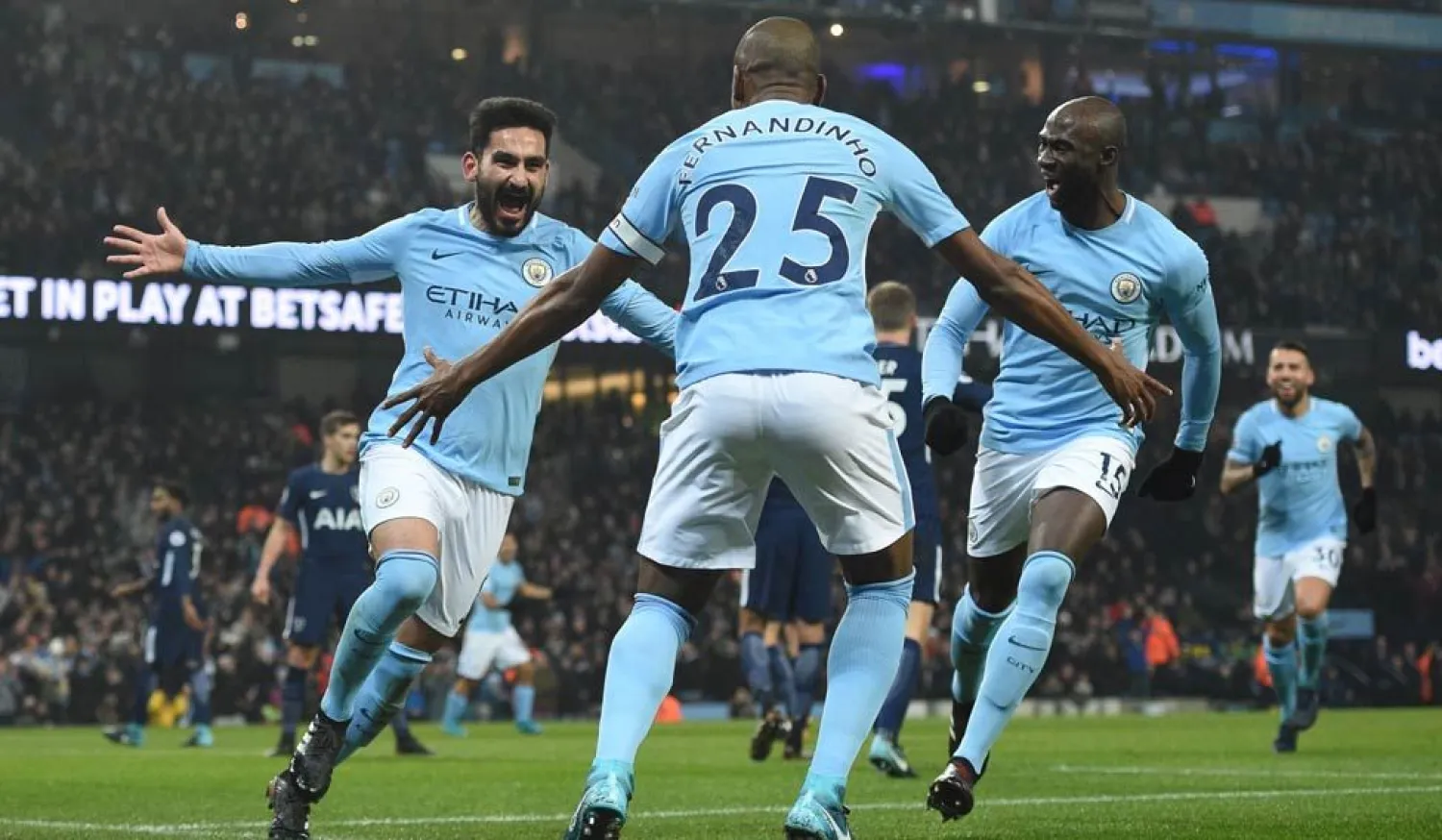
Manchester City's Ilkay Gundogan (left) celebrates after scoring a goal during their match against Tottenham Hotspur at the Etihad Stadium in December 2017. (AFP)
TT

Premier League Slides into the Grip of Radical Non-Possession

Manchester City's Ilkay Gundogan (left) celebrates after scoring a goal during their match against Tottenham Hotspur at the Etihad Stadium in December 2017. (AFP)

Manchester City’s dominance is increasing the trend towards one side dominating ball possession in games and that threatens to diminish the spectacle.

In 1970, when studying the effects of the appearance of robots, the Japanese robotics professor Masahiro Mori discovered something strange was going on. The more human a robot’s appearance became, the more people demonstrated empathy towards it up to a certain point at which they felt strong revulsion.

After that point, though, the more humanoid the robot became the more people began to respond positively again. There was a zone of resemblance, of almost‑humanness, that people found deeply disturbing: it was familiar enough for them to begin to engage on a human level only to find the robot deficient in all the usual points of reference. Mori called this the “uncanny valley”.

Last Wednesday Manchester City beat Newcastle United 1-0. It looked a lot like a football match but it somehow was not quite a football match. The mood in the stadium was, frankly, weird: City’s technical virtuosity was admirable and yet strangely uncompelling. Newcastle fans quickly accepted they were watching something to which the usual rules did not apply and began celebrating every time their side touched the ball in the City half. On Sky, Jamie Carragher called it “a joke” and said the Premier League was “becoming an embarrassment”.

Gary Neville described it as “not acceptable”. Social media were aflame. Something about that game repelled people; it had fallen into the uncanny valley, close enough to football to engage and yet so far from expected norms that it disgusted.

At half-time City had had 83 percent possession and were on course to break the Premier League record of 82.28 percent they had set in beating Queens Park Rangers on the final day of the 2011-12 season (by the end, though, City were down to 78 percent). Yet Newcastle survived, nearly snatched an equalizer on a couple of occasions and lost only 1-0. From that point of view Rafael Benítez’s tactics worked (while acknowledging City could have won 3-0 or 4-0 without anybody thinking there was anything outlandish about the scoreline).

Carragher’s wider point was that the joy of the Premier League is the sense of spectacle and that is diminished when the game essentially becomes a drill with a punchbag. The pattern of matches becoming attack against defense is increasingly prevalent.

In the first three seasons that Opta collected data, between 2003-04 and 2005-06, there were only three games in which one team had 70 percent or more of the ball. That figure rose gradually to 36 in 2016-17.

This season there have already been 37 instances. The number of games in which one team had 65 percent or more of possession has risen from 11 in 2003-04 to 94 last season (and 64 so far this); 60 percent or more is up from 63 in 2003-04 to 181 last season (and 100 so far this).

In part that is because it is easier to hold possession now. The liberalization of the offside law makes it much harder for teams to set their basic defensive line high up the pitch, increasing the effective playing area and so making the midfield less congested. With referees far more inclined to show cards, it is much harder now than it was even 15 years ago to bully creative players out of the game. The result is an era in which the likes of Xavi, Luka Modric and David Silva have thrived.

There is also perhaps a sense that Pep Guardiola’s Barcelona, and the way it was combated, changed perceptions of what was acceptable and, indeed, possible. Manchester United were panicked in the 2009 Champions League final by the fact they could not get the ball off Barcelona; it was not just that they were not used to playing without the ball, it was that it somehow felt unseemly for them to have so little of it. The examples of Inter and Chelsea in the semi-finals of 2010 and 2012, though, showed it was possible to prevail even with 20 percent of the ball, a lesson that swiftly passed down the leagues: against top sides, sit deep, keep the shape and worry about the ball later. Radical possession begat radical non-possession.

Many criticized Benítez for his set-up and perhaps, as Roy Hodgson showed four days later, a more proactive approach might have yielded a better result. Benítez, perhaps, would argue that he lacks anybody of the pace and quality of Wilfried Zaha to do that. The specifics matter less than the general point that a manager’s prime responsibility is to set up his team in the way that will best equip them to get the best result possible.

The beauty of football lies in the struggle and the fact that a weaker side can hold off a stronger one. It is not all about tricks and flicks and the “better” side winning. There is an extraordinary arrogance about those armchair viewers who demand a team should play in an ineffective way so that they may be entertained. But that is not to say that there is not a problem. As Carragher said, the sides at the top are now so far ahead of those at the bottom that increasingly teams feel their only option is radical non-possession.

That is a direct consequence of the iniquities of the game’s finance and it probably does diminish the spectacle. What may be enthralling in a Champions League semi-final against one of the greatest sides of all time palls when it happens a couple of times a week in the league.

The Premier League is walking in the shadow of the uncanny valley.

The Guardian Sport


Hospital: Vonn Had Surgery on Broken Leg from Olympics Crash

This handout video grab from IOC/OBS shows US Lindsey Vonn crashing during the women's downhill event at the Milano Cortina 2026 Winter Olympic Games on February 8, 2026. (Photo by Handout / various sources / AFP)
TT

Hospital: Vonn Had Surgery on Broken Leg from Olympics Crash

This handout video grab from IOC/OBS shows US Lindsey Vonn crashing during the women's downhill event at the Milano Cortina 2026 Winter Olympic Games on February 8, 2026. (Photo by Handout / various sources / AFP)

Lindsey Vonn had surgery on a fracture of her left leg following the American's heavy fall in the Winter Olympics downhill, the hospital said in a statement given to Italian media on Sunday.

"In the afternoon, (Vonn) underwent orthopedic surgery to stabilize a fracture of the left leg," the Ca' Foncello hospital in Treviso said.

Vonn, 41, was flown to Treviso after she was strapped into a medical stretcher and winched off the sunlit Olimpia delle Tofane piste in Cortina d'Ampezzo.

Vonn, whose battle to reach the start line despite the serious injury to her left knee dominated the opening days of the Milano Cortina Olympics, saw her unlikely quest halted in screaming agony on the snow.

Wearing bib number 13 and with a brace on the left knee she ⁠injured in a crash at Crans Montana on January 30, Vonn looked pumped up at the start gate.

She tapped her ski poles before setting off in typically aggressive fashion down one of her favorite pistes on a mountain that has rewarded her in the past.

The 2010 gold medalist, the second most successful female World Cup skier of all time with 84 wins, appeared to clip the fourth gate with her shoulder, losing control and being launched into the air.

She then barreled off the course at high speed before coming to rest in a crumpled heap.

Vonn could be heard screaming on television coverage as fans and teammates gasped in horror before a shocked hush fell on the packed finish area.

She was quickly surrounded by several medics and officials before a yellow Falco 2 ⁠Alpine rescue helicopter arrived and winched her away on an orange stretcher.


Meloni Condemns 'Enemies of Italy' after Clashes in Olympics Host City Milan

Demonstrators hold smoke flares during a protest against the environmental, economic and social impact of the Milano-Cortina 2026 Winter Olympics in Milan, Italy, February 7, 2026. REUTERS/Kevin Coombs
TT

Meloni Condemns 'Enemies of Italy' after Clashes in Olympics Host City Milan

Demonstrators hold smoke flares during a protest against the environmental, economic and social impact of the Milano-Cortina 2026 Winter Olympics in Milan, Italy, February 7, 2026. REUTERS/Kevin Coombs

Italian Prime Minister Giorgia Meloni has condemned anti-Olympics protesters as "enemies of Italy" after violence on the fringes of a demonstration in Milan on Saturday night and sabotage attacks on the national rail network.

The incidents happened on the first full day of competition in the Winter Games that Milan, Italy's financial capital, is hosting with the Alpine town of Cortina d'Ampezzo.

Meloni praised the thousands of Italians who she said were working to make the Games run smoothly and present a positive face of Italy.

"Then ⁠there are those who are enemies of Italy and Italians, demonstrating 'against the Olympics' and ensuring that these images are broadcast on television screens around the world. After others cut the railway cables to prevent trains from departing," she wrote on Instagram on Sunday.

A group of around 100 protesters ⁠threw firecrackers, smoke bombs and bottles at police after breaking away from the main body of a demonstration in Milan.

An estimated 10,000 people had taken to the city's streets in a protest over housing costs and environmental concerns linked to the Games.

Police used water cannon to restore order and detained six people.

Also on Saturday, authorities said saboteurs had damaged rail infrastructure near the northern Italian city of Bologna, disrupting train journeys.

Police reported three separate ⁠incidents at different locations, which caused delays of up to 2-1/2 hours for high-speed, Intercity and regional services.

No one has claimed responsibility for the damage.

"Once again, solidarity with the police, the city of Milan, and all those who will see their work undermined by these gangs of criminals," added Meloni, who heads a right-wing coalition.

The Italian police have been given new arrest powers after violence last weekend at a protest by the hard-left in the city of Turin, in which more than 100 police officers were injured.


Liverpool New Signing Jacquet Suffers 'Serious' Injury

Soccer Football - Ligue 1 - RC Lens v Stade Rennes - Stade Bollaert-Delelis, Lens, France - February 7, 2026  Stade Rennes' Jeremy Jacquet in action REUTERS/Benoit Tessier
Soccer Football - Ligue 1 - RC Lens v Stade Rennes - Stade Bollaert-Delelis, Lens, France - February 7, 2026 Stade Rennes' Jeremy Jacquet in action REUTERS/Benoit Tessier
TT

Liverpool New Signing Jacquet Suffers 'Serious' Injury

Soccer Football - Ligue 1 - RC Lens v Stade Rennes - Stade Bollaert-Delelis, Lens, France - February 7, 2026  Stade Rennes' Jeremy Jacquet in action REUTERS/Benoit Tessier
Soccer Football - Ligue 1 - RC Lens v Stade Rennes - Stade Bollaert-Delelis, Lens, France - February 7, 2026 Stade Rennes' Jeremy Jacquet in action REUTERS/Benoit Tessier

Liverpool's new signing Jeremy Jacquet suffered a "serious" shoulder injury while playing for Rennes in their 3-1 Ligue 1 defeat at RC Lens on Saturday, casting doubt over the defender’s availability ahead of his summer move to Anfield.

Jacquet fell awkwardly in the second half of the ⁠French league match and appeared in agony as he left the pitch.

"For Jeremy, it's his shoulder, and for Abdelhamid (Ait Boudlal, another Rennes player injured in the ⁠same match) it's muscular," Rennes head coach Habib Beye told reporters after the match.

"We'll have time to see, but it's definitely quite serious for both of them."
Liverpool agreed a 60-million-pound ($80-million) deal for Jacquet on Monday, but the 20-year-old defender will stay with ⁠the French club until the end of the season.

Liverpool, provisionally sixth in the Premier League table, will face Manchester City on Sunday with four defenders - Giovanni Leoni, Joe Gomez, Jeremie Frimpong and Conor Bradley - sidelined due to injuries.
