UNRWA Responds to Netanyahu: We Will Continue Until Refugee Crisis is Resolved

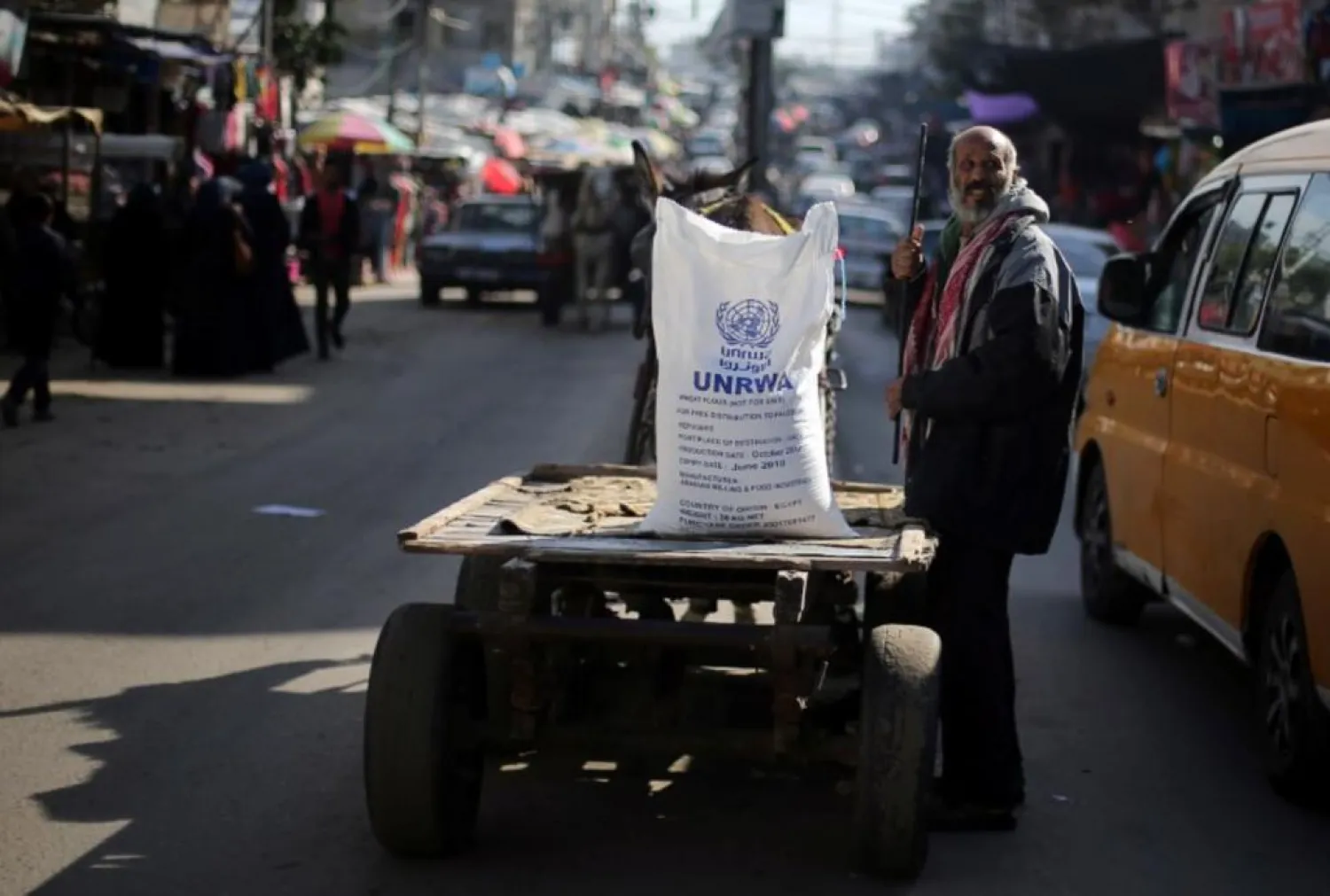
A Palestinian man stands next to a cart carrying a flour sack distributed by UNRWA in Khan Younis refugee camp in the southern Gaza Strip. Photo: Reuters
TT

UNRWA Responds to Netanyahu: We Will Continue Until Refugee Crisis is Resolved

A Palestinian man stands next to a cart carrying a flour sack distributed by UNRWA in Khan Younis refugee camp in the southern Gaza Strip. Photo: Reuters

In the wake of escalating and angry reactions over the decisions of the US Administration and Israel to strike the United Nations Relief and Works Agency for Palestinian Refugees (UNRWA), a spokesman for the UN agency said it would maintain its mission despite the recent crisis, until reaching a solution to the situation of Palestinian refugees.
 
UNRWA official Sami Mushasha stressed that the agency would continue to provide help to Palestinian refugees until a solution to their problem is reached.
 
“UNRWA is assigned by the General Assembly to continue its services until a fair solution to Palestinian refugees issue is reached,” he said in a press statement.
 
In response to Israeli Prime Minister Benjamin Netanyahu’s remarks that the agency was “perpetuating the Palestinian refugee problem” and not providing a solution, Mushasha stated: “What leads to perpetuation of the refugee crisis is the failure of the parties to deal with the issue, which needs to be resolved by the parties to the conflict in the context of peace talks, based on UN resolutions and international law, and with the active participation of the international community.”
 
For his part, the director of the PLO’s Department of Refugee Affairs, Ahmad Hanoun, revealed that contacts were underway to hold an urgent meeting of the UNRWA Advisory Committee to discuss the US threats to stop its financial contributions to UNRWA in an attempt to force the Palestinian Authority to return to the negotiating table with Israel.
 
Hanoun said in a radio interview on Monday that the UN Secretary-General would also be asked that the UN assumes responsibility for the financial deficit resulting from the US decision, noting that there was a financial crisis in the agency before Trump’s threat to stop US financial contribution.
 
He added that the amount of US funding for the agency reached two thirds of UNRWA’s budget and any funding cut would paralyze its work.
 
Meanwhile, Palestinian Prime Minister Rami al-Hamdallah met on Monday with Norwegian Foreign Minister Anne-Marie Eriksen, whose country is one of the largest contributors to UNRWA, to discuss the recent crisis.
 
Hamdallah said that the recent US steps were undermining the two-state solution, calling on the countries of the world, particularly Norway, to recognize the Palestinian state with East Jerusalem as its capital.



Syria Imposes Night Curfew on Port City of Latakia

People watch as Syrian Security forces are deployed after clashes erupted during a protest in the city of Latakia, Syria, 28 December 2025. EPA/AHMAD FALLAHA
TT

Syria Imposes Night Curfew on Port City of Latakia

People watch as Syrian Security forces are deployed after clashes erupted during a protest in the city of Latakia, Syria, 28 December 2025. EPA/AHMAD FALLAHA

Syrian authorities imposed an overnight curfew in the coastal city of Latakia on Tuesday.

Authorities announced a "curfew in Latakia city, effective from 5:00pm (1400 GMT) on Tuesday, December 30, 2025, until 6:00am (0300 GMT) on Wednesday, December 31, 2025".


Jailed Turkish Kurd Leader Calls on Government to Broker Deal for Syrian Kurds

(FILES) Supporters display a poster depicting jailed leader of the Kurdistan Workers' Party (PKK) Abdullah Ocalan, after he called on the Kurdistan Workers' Party (PKK) to disarm and dissolve itself in Diyarbakir, southeastern Türkiye, on February 27, 2025. (Photo by Yasin AKGUL / AFP)
TT

Jailed Turkish Kurd Leader Calls on Government to Broker Deal for Syrian Kurds

(FILES) Supporters display a poster depicting jailed leader of the Kurdistan Workers' Party (PKK) Abdullah Ocalan, after he called on the Kurdistan Workers' Party (PKK) to disarm and dissolve itself in Diyarbakir, southeastern Türkiye, on February 27, 2025. (Photo by Yasin AKGUL / AFP)

Jailed Turkish Kurd leader Abdullah Ocalan said Tuesday that it was "crucial" for Türkiye’s government to broker a peace deal between the Kurdish-led Syrian Democratic Forces (SDF) and the Damascus government.

Clashes between Syrian forces and the SDF have cast doubt over a deal to integrate the group's fighters into the army, which was due to take effect by the end of the year, reported AFP.

Ocalan, founder of the Kurdistan Workers' Party (PKK) group, called on Türkiye to help ensure implementation of the deal announced in March between the SDF and the Syrian government.

"It is essential for Türkiye to play a role of facilitator, constructively and aimed at dialogue," he said in a message released by Türkiye's pro-Kurdish DEM party.

"This is crucial for both regional peace and to strengthen its own internal peace," Ocalan, who has been jailed for 26 years, added.

"The fundamental demand made in the agreement signed on March 10 between the SDF and the government in Damascus is for a democratic political model permitting (Syria's) peoples to govern together," he added.

"This approach also includes the principle of democratic integration, negotiable with the central authorities. The implementation of the March 10 agreement will facilitate and accelerate that process."

The backbone of the US-backed SDF is the YPG, a Kurdish group seen by Türkiye as an extension of the PKK.

Türkiye and Syria both face long-running unrest in their Kurdish-majority regions, which span their shared border.

In Türkiye, the PKK agreed this year at Ocalan's urging to end its four-decade armed struggle.

In Syria, Sharaa has agreed to merge the Kurds' semi-autonomous administration into the central government, but deadly clashes and a series of differences have held up implementation of the deal.

The SDF is calling for a decentralized government, which Sharaa rejects.

Turkish Foreign Minister Hakan Fidan, whose country sees Kurdish fighters across the border as a threat, urged the SDF last week not to be an "obstacle" to stability.

Syrian Kurdish leader Mazloum Abdi said Thursday that "all efforts" were being made to prevent the collapse of talks.


Yemen's PLC Imposes No Fly-Zone, Sea and Ground Blockade on All Ports and Crossings

Chairman of Yemen's Presidential Leadership Council Dr. Rashad al-Alimi. (Saba)
TT

Yemen's PLC Imposes No Fly-Zone, Sea and Ground Blockade on All Ports and Crossings

Chairman of Yemen's Presidential Leadership Council Dr. Rashad al-Alimi. (Saba)

Chairman of Yemen's Presidential Leadership Council Dr. Rashad al-Alimi declared on Tuesday a state of emergency throughout the country in wake of the "internal strife caused by the military rebellion in eastern provinces aimed at dividing the republic."

He called for all military formations and forces in the Hadhramaut and Al-Mahra governorates to coordinate completely with the Coalition to Restore Legitimacy in Yemen, represented by Saudi Arabia, and to immediately return to their original positions without a fight. They should cede their positions in the two governorates to the National Shield forces.

Al-Alimi said the state of emergency will last 90 days, which can be extended. He also imposed a no fly-zone, sea and ground blockade on all ports and crossings for 72 hours.

The move also stems from "the commitment to the unity of Yemen, its sovereignty, independence, and territorial integrity and the need to confront the Houthi coup that has been ongoing since 2014," he stressed.

Moreover, al-Alimi called on "all United Arab Emirates forces to leave the country within 24 hours."

"We will firmly deal with any rebellion against state institutions," he warned.

He called on the Southern Transitional Council to "return to reason and quickly and unconditionally withdraw its forces from Hadhramaut and Al-Mahra."

Al-Alimi announced the state of emergency shortly after the Saudi-led Arab coalition carried out a "limited" airstrike targeting a military shipment that had arrived in Yemen's Al-Mukalla port.

In a statement, coalition spokesman Major General Turki al-Malki said the forces detected on Saturday and Sunday the arrival of two vessels from the Port of Fujairah to Mukalla without obtaining any permits from the Joint Forces Command.

Saudi Arabia expressed on Tuesday its disappointment in the United Arab Emirates for pressuring the STC to carry out military operations on the Kingdom's southern borders in Hadhramaut and Al-Mahra.

A Saudi Foreign Ministry statement said: "The steps taken by the UAE are considered highly dangerous, inconsistent with the principles upon which the Coalition to Restore Legitimacy in Yemen was established, and do not serve the coalition's purpose of achieving security and stability for Yemen."

"The Kingdom stresses that any threat to its national security is a red line, and the Kingdom will not hesitate to take all necessary steps and measures to confront and neutralize any such threat," it declared.