

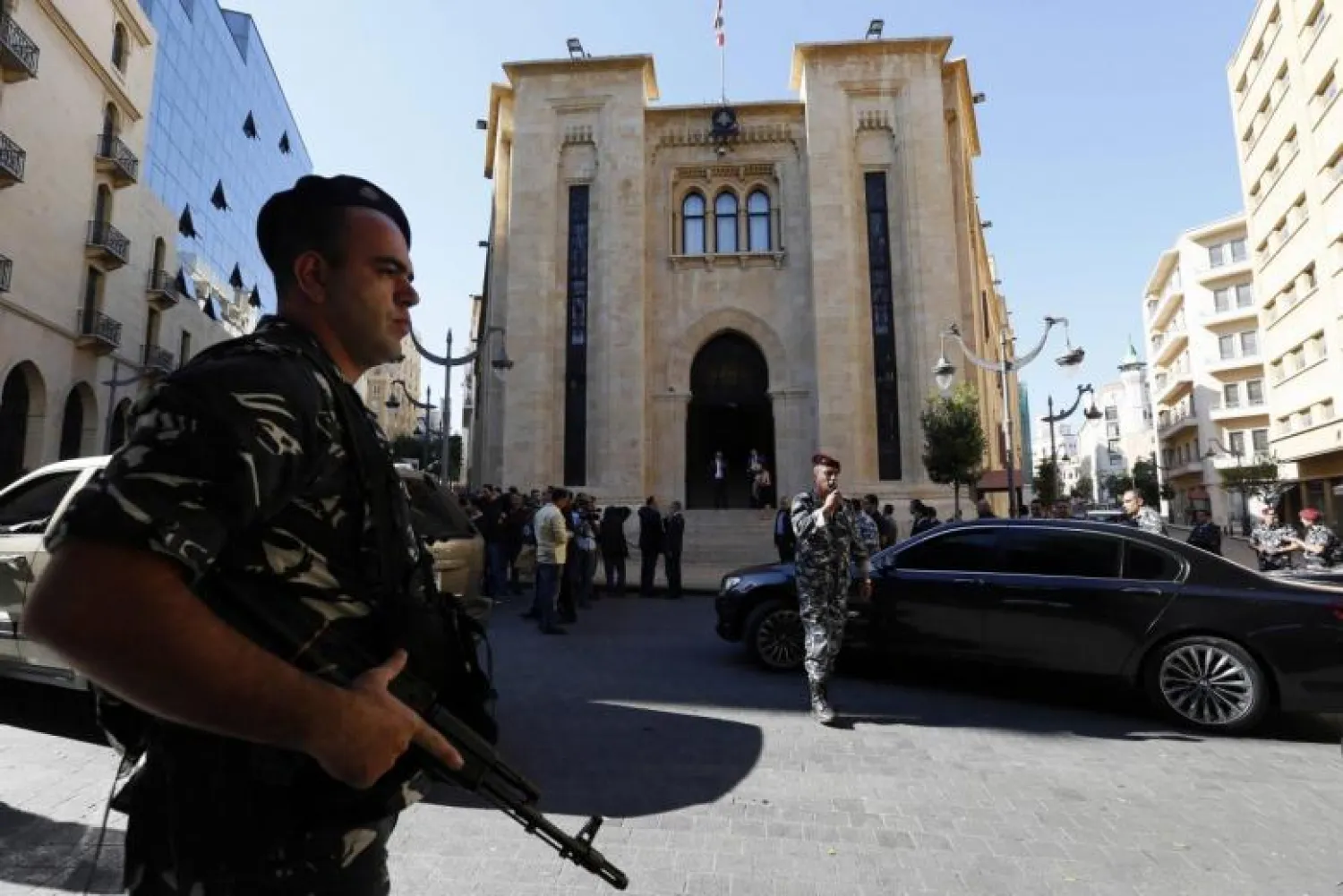

Lebanon: Hezbollah, Amal Finalize Electoral Alliance

Police forces gather outside the parliament building in Downtown Beirut November 5, 2014. REUTERS
TT

Lebanon: Hezbollah, Amal Finalize Electoral Alliance

Police forces gather outside the parliament building in Downtown Beirut November 5, 2014. REUTERS

Active negotiations between Hezbollah and Amal Movement have neared completion after the so-called “Shi’ite duo” agreed that the sect’s parliamentary seats would be shared consensually.

Such a deal means the two sides would run in the elections in May under the framework of an alliance that would be open to electoral understandings with other parties.
 
Hezbollah and Amal Movement have agreed to share the two Shi’ite parliamentary seats in Beirut’s second electoral district, as well as in Baabda, while Hezbollah would occupy the only Shi’ite seat in Jbeil, upon an agreement with the Free Patriotic Movement (FPM).
 
As for Baalbek-Hermel electoral district, Amal would have one seat against four seats for Hezbollah, provided that the movement would nominate the single Shi’ite candidate in Western Bekaa, while Hezbollah would nominate the Shi’ite candidate in Zahle. In South Lebanon, the sect’s electoral distribution is expected to remain the same, i.e. five deputies for Hezbollah and eight for Amal.
 
Since the adoption of the new electoral law, which is based on the proportional representation system, electoral experts, as well as parties opposed to the Shi’ite duo, have emphasized that the party and Amal were the main beneficiaries, although the new law would allow the Shi’ite opposition to win two seats for the first time in Parliament.
 
Researcher at Information International Mohammed Shamseddine said that the new law was tailored to best suit the interests of the Shi’ite duo. He told Asharq Al-Awsat that the bloc formed of Hezbollah, Amal, the National Party and Baath Movement would not only maintain the same size in Parliament, but might also gain one more parliamentary seat to reach 31 deputies.
 
Shamseddine added that the Shi’ite opposition could win in two districts: Baalbek-Hermel, where the opposition is expected to secure around 18,000 votes, winning one out of the six Shi’ite seats. The other district is Nabatieh-Bint Jbeil-Zahrani, where the opposition, if united, would be able to win one out of 11 parliamentary seats in the constituency.
 
He also said that Zahrani-Tyre district would witness an electoral battle, but the opposition would not be able to break the Amal-Hezbollah alliance, as the electoral scale there ranges between 22,000 and 25,000 votes, which would be difficult for the opposition to secure.


Somali President to Visit Türkiye After Israeli Recognition of Somaliland

 Somalia's President Hassan Sheikh Mohamud delivers a joint press conference with the German Chancellor after talks at the Chancellery in Berlin, on November 5, 2024. (AFP)
Somalia's President Hassan Sheikh Mohamud delivers a joint press conference with the German Chancellor after talks at the Chancellery in Berlin, on November 5, 2024. (AFP)
TT

Somali President to Visit Türkiye After Israeli Recognition of Somaliland

 Somalia's President Hassan Sheikh Mohamud delivers a joint press conference with the German Chancellor after talks at the Chancellery in Berlin, on November 5, 2024. (AFP)
Somalia's President Hassan Sheikh Mohamud delivers a joint press conference with the German Chancellor after talks at the Chancellery in Berlin, on November 5, 2024. (AFP)

Somalia's president is to visit Türkiye on Tuesday following Israel's recognition of the breakaway territory of Somaliland, Türkiye’s presidency said.

Somali President Hassan Sheikh Mohamud will hold talks "on the current situation in Somalia in the fight against terrorism, measures taken by the federal Somali government towards national unity and regional developments", Burhanettin Duran, head of the Turkish presidency's communications directorate, said on X.

Türkiye on Friday denounced Israel's recognition of Somaliland, a self-proclaimed republic, calling it "overt interference in Somalia's domestic affairs".

Somaliland declared independence in 1991.

The region has operated autonomously since then and possesses its own currency, army and police force.

It has generally experienced greater stability than Somalia, where Al-Shabaab militants periodically mount attacks in the capital Mogadishu.

Diplomatic isolation has been the norm -- until Israel's move to recognize it as a sovereign nation, which has been criticized by the African Union, Egypt, the six-nation Gulf Cooperation Council and the Saudi-based Organization of Islamic Cooperation.

The European Union has insisted Somalia's sovereignty should be respected.

The recognition is the latest move by Israel that has angered Türkiye, with relations souring between the two countries in recent years.

Ankara has strongly condemned Israel's offensive in the Gaza Strip, and Israel has opposed Türkiye’s participation in a future stabilization force in the Palestinian territory.


Iraq's Parliament Elects Al-Halbousi as Its New Speaker

 The new speaker of parliament Haibet Al-Halbousi, center, looks on before the start of their first legislative session in Baghdad, Iraq, Monday, Dec. 29, 2025. (AP Photo/Hadi Mizban)
The new speaker of parliament Haibet Al-Halbousi, center, looks on before the start of their first legislative session in Baghdad, Iraq, Monday, Dec. 29, 2025. (AP Photo/Hadi Mizban)
TT

Iraq's Parliament Elects Al-Halbousi as Its New Speaker

 The new speaker of parliament Haibet Al-Halbousi, center, looks on before the start of their first legislative session in Baghdad, Iraq, Monday, Dec. 29, 2025. (AP Photo/Hadi Mizban)
The new speaker of parliament Haibet Al-Halbousi, center, looks on before the start of their first legislative session in Baghdad, Iraq, Monday, Dec. 29, 2025. (AP Photo/Hadi Mizban)

Iraq's parliament on Monday elected a new speaker following overnight talks to break a political deadlock.

Haibet Al-Halbousi received 208 votes from the 309 legislators who attended, according to The AP news. He is a member of the Takadum, or Progress, party led by ousted speaker and relative Mohammed al-Halbousi. Twenty legislators did not attend the session.

Iraq held parliamentary elections in November but didn’t produce a bloc with a decisive majority. By convention, Iraq’s president is always Kurdish, while the more powerful prime minister is Shiite and the parliamentary speaker is Sunni.

The new speaker must address a much-debated bill that would have the Hashd al-Shaabi, or Popular Mobilization Units become a formal security institution under the state. Iran-backed armed groups have growing political influence.

Al-Halbousi also must tackle Iraq’s mounting public debt of tens of billions of dollars as well as widespread corruption.

Babel Governor Adnan Feyhan was elected first deputy speaker with 177 votes, a development that might concern Washington. Feyhan is a member of the Asaib Ahl al-Haq, or League of the Righteous, a US-sanctioned, Iran-backed group with an armed wing led by Qais al-Khazali, also sanctioned by Washington.


Hamas Armed Wing Refuses to Surrender Weapons, Confirms Spokesman Killed by Israel in August

FILE Photo of Hamas now late spokesperson Abu Ubaida. (Screengrab from al-Qassam brigades video)
TT

Hamas Armed Wing Refuses to Surrender Weapons, Confirms Spokesman Killed by Israel in August

FILE Photo of Hamas now late spokesperson Abu Ubaida. (Screengrab from al-Qassam brigades video)

Hamas's armed wing reiterated on Monday that it would not surrender its weapons, a key issue expected to feature in talks later in the day between US President Donald Trump and Israeli Prime Minister Benjamin Netanyahu. 

In a video statement, the Ezzedine al-Qassam Brigades also confirmed the death of their longtime spokesperson, months after Israel announced he had been killed in an air strike in Gaza on August 30. 

"Our people are defending themselves and will not give up their weapons as long as the occupation remains," said the group's new spokesman, who has adopted the nom de guerre of his predecessor, Abu Obeida. 

The statement came just hours before Trump and Netanyahu were scheduled to meet in Florida. 

Israeli government spokeswoman Shosh Bedrosian said Netanyahu would discuss the second phase of the Gaza truce deal, which includes ensuring that "Hamas is disarmed, Gaza is demilitarized". 

Rejecting that demand, the new Abu Obeida instead called for Israel to be disarmed of its weapons. 

"We call on all concerned parties to work toward disarming the lethal weapons of the occupation, which have been and continue to be used in the extermination of our people," he said. 

In the same statement, he confirmed the death of his predecessor, and also announced the deaths of four other Hamas commanders in Israeli attacks during the war. 

"We pause in reverence before... the masked man loved by millions... the great martyred commander and spokesperson of the Qassam Brigades, Abu Obeida," he said. 

During the war, Abu Obeida, whose real name was Hudhayfa Samir al-Kahlout, emerged as a central figure eagerly awaited by Gazans, as well as by Arab and international media, for official statements from Hamas's military wing, particularly those related to hostage-prisoner swaps. 

Born on February 11, 1985, and raised in the Jabalia refugee camp in northern Gaza, Abu Obeida joined Hamas at an early age before becoming a member of the Ezzedine al-Qassam Brigades. 

He later became the group's spokesman, delivering video statements in military uniform with his face consistently concealed by a red keffiyeh. 

He survived multiple Israeli assassination attempts over the years. 

Hamas officials have described him as a symbol of "resistance", known for fiery speeches that often included threats against Israel or announcements of military operations. 

"For many years, only a very small circle of Hamas officials knew his true identity," a Hamas official told AFP. 

Israel has decimated Hamas's leadership, saying it seeks to eradicate the group following Hamas's October 7, 2023 attack on Israel, which triggered the war.
