


Saudi Arabia Supports Yemen with Oil Derivatives

Saudi Ambassador to Yemen Mohammed Al Jaber (left) and Arab Coalition spokesman Col. Turki Al-Malki brief diplomats at a meeting in Riyadh on Tuesday. (SPA)
TT

Saudi Arabia Supports Yemen with Oil Derivatives

Saudi Ambassador to Yemen Mohammed Al Jaber (left) and Arab Coalition spokesman Col. Turki Al-Malki brief diplomats at a meeting in Riyadh on Tuesday. (SPA)

Saudi Arabia will provide oil derivatives to Yemen and the Arab Coalition will provide the Central Bank of Yemen with a deposit, officials confirmed during a meeting held at the headquarters of the Saudi Foreign Ministry in Riyadh on Tuesday.

The meeting was attended by a number of ambassadors and members of the diplomatic corps. It was chaired by Saudi Ambassador to Yemen Mohammed bin Saeed Al Jaber, who also serves as director of Comprehensive Coordination of Humanitarian Affairs in Yemen, and spokesman for the Coalition Forces to Support Legitimacy in Yemen Col. Turki Al-Malki.

It dealt with aspects of the humanitarian operations in Yemen, which are aimed at meeting the needs of the Yemeni people in all regions and delivering commercial shipments and oil derivatives to all Yemeni areas, including Sanaa and Hodeidah.

The meeting also explained that the humanitarian plan aims at the restoration of trade flows and the humanitarian situation to the way it was before November 6.

According to a statement issued Tuesday, Saudi Arabia will provide oil derivatives to Yemen to support the economy and alleviate the suffering of the Yemeni people. The coalition will provide the Central Bank of Yemen with a deposit to maintain control of the exchange rates and improve the living conditions of the people.

The goals of the plan takes into consideration the threat posed by Iranian-backed Houthi militias to the security of the Kingdom of Saudi Arabia, the countries of the region and international water trade routes.

The Houthi militias had fired more than 250 ballistic missiles, at least 80 of which targeted the Kingdom.

Officials said that Saudi humanitarian contributions amounted to more than $900 million, including direct and indirect aid to Yemeni displaced people and joint programs with the legitimate Yemeni government worth more than eight billion dollars.

The comprehensive humanitarian plan for Yemen includes delivering four World Food Program (WFP) mobile cranes and installing them in Hodeidah port.

The plan aims to increase the capacity of Yemeni ports and allow the country to receive imports amounting to 1.4 million tons per month compared to 1.1 million tons per month in 2017.

It also aims to increase the capacity of the ports in Aden, Mukalla and Mokha to 500,000 tons per month of oil derivatives as soon as possible, up from 250,000 tons per month in 2017.


Türkiye Signals May Launch ‘Simple’ Military Operation Against PKK in Iraq

PKK fighters in the Qandil Mountains of northern Iraq. (Reuters)
TT

Türkiye Signals May Launch ‘Simple’ Military Operation Against PKK in Iraq

PKK fighters in the Qandil Mountains of northern Iraq. (Reuters)

Türkiye has indicated it may launch a limited military operation against the Kurdistan Workers’ Party (PKK) in the Sinjar region of northern Iraq, while stressing its readiness to work with any government that assumes power in Baghdad.

Turkish Foreign Minister Hakan Fidan said the PKK is set to become a major issue for Iraq, noting that the group does not control any territory inside Türkiye, but “occupies large areas in Iraq”.

“How can a sovereign state allow this?” he asked, adding that “changes could soon take place” in several areas, including Iraq’s Sinjar, Makhmour and the Qandil Mountains.

Fidan outlined what he described as the PKK’s current deployment, saying Makhmour, south of Erbil near the Nineveh province, hosts the group’s civilian structures, while Sinjar, northwest of Mosul near the Syrian border, hosts its armed elements.

He said the leadership and command structures are based in the Qandil Mountains, with other strongholds near Duhok lying outside the area covered by Türkiye’s ongoing Claw Operation.

In a televised interview late Monday, Fidan stated that Sinjar is surrounded by Iraq’s Popular Mobilization Forces (PMF), revealing that Ankara has held around 20 meetings with PMF leader Faleh al-Fayyad to address the issue.

On possible military action against the PKK, he described it as “a simple military operation,” in which PMF forces would advance on the ground while Türkiye conducts air operations, estimating it would take two or three days.

Since 2024, Türkiye has pursued negotiations with imprisoned PKK leader Abdullah Ocalan, which led to his call on February 27, 2025, for the group to dissolve and lay down its arms.

The PKK subsequently announced a ceasefire, declared its dissolution on May 12, 2025, and held symbolic weapons-burning ceremonies in the Qandil Mountains in July. In October, it announced the withdrawal of its fighters from Türkiye to areas in Qandil.

On Baghdad’s position, Fidan said the Iraqi government would be forced to demonstrate genuine political will toward the PKK, insisting that the group cannot remain in Sinjar.

Iraq began addressing the issue during the tenure of former prime minister Mustafa al-Kadhimi and that, under current Prime Minister Mohammed Shia al-Sudani, the PKK has sought to expand its presence in Baghdad, he remarked.

Baghdad is in the process of forming a new government, months after holding parliamentary elections.

Over the past two years, Ankara and Baghdad have established a high-level security coordination mechanism to confront the PKK, holding five meetings in both capitals. The latest took place in April. Following Turkish President Recep Tayyip Erdogan’s visit to Iraq in April 2024, Iraq’s National Security Council formally designated the PKK a banned organization.

Fidan also said the Kurdish issue in Syria has direct implications for Iraq, hoping that Baghdad would draw lessons from recent developments in Syria, including the integration of Kurdish forces into the Syrian army, and take “prudent decisions to ease Iraq’s own transition”.


SDF Starts Withdrawing from Frontlines in Syria’s Hasakah  

Members of the SDF in Hasakah, northeastern Syria, on Tuesday during their withdrawal from frontline positions under an agreement with the Syrian government. (Reuters)
TT

SDF Starts Withdrawing from Frontlines in Syria’s Hasakah  

Members of the SDF in Hasakah, northeastern Syria, on Tuesday during their withdrawal from frontline positions under an agreement with the Syrian government. (Reuters)

The Syrian Democratic Forces (SDF) have begun withdrawing their troops from frontline positions in the city of Hasakah under an agreement reached with the Syrian government, according to news reports and photographs published by Reuters.

Earlier on Tuesday, SDF units started preparations to pull back from southern rural areas of Hasakah. Images circulated by local media showed SDF fighters withdrawing from the Panorama Roundabout checkpoint south of the city, ahead of handing it over to General Security forces.

The move followed a security meeting between the Internal Security Forces (Asayish) and Syrian security services to coordinate the deployment of internal security forces in the city, according to North Press.

Syrian security sources told Asharq Al-Awsat that implementation of the agreement is proceeding smoothly, including steps toward integration.

The SDF has nominated units to be incorporated as brigades within the Ministry of Defense, while some Asayish personnel are expected to join the General Security forces in predominantly Kurdish areas.

On Tuesday, the SDF also began withdrawing its military units and heavy equipment from contact lines inside Hasakah, particularly in southern neighborhoods around the Panorama Roundabout. This step is part of a permanent ceasefire and the launch of a gradual integration process stipulated in the January agreement.

Syrian affairs researcher from the Jusoor Center for Studies Mohammad Suleiman said the withdrawal involves redeploying SDF military forces from inside Hasakah to agreed barracks outside the city, including Dirbasiyah, Amuda, and the outskirts of Qamishli. At the same time, government internal security forces will deploy in the city centers of Hasakah and Qamishli to oversee security integration.

Suleiman noted differing interpretations of the agreement. The SDF considers the withdrawal limited to its military forces, with the Asayish remaining responsible for internal security, while the government views it as a timetable for a full SDF withdrawal from city neighborhoods.

He added that Syrian army units will also pull back to areas around Hasakah, including Shaddadi, while maintaining a ban on military forces entering cities, particularly those with a Kurdish majority.

The current phase marks the second stage of the agreement and includes the transfer of oil wells and Qamishli Airport to state control. A third phase will place border crossings under state control, notably the Nusaybin crossing with Türkiye and the Semalka crossing with the Iraqi Kurdistan Region.

The agreement also calls for the integration of Kurdish autonomous administration institutions into state bodies, stabilization of civilian employees, settlement of Kurdish civil and educational rights, and guarantees for the return of displaced residents to their homes.


Loss of Allies Forces Hezbollah to Tone Down Rhetoric Against the Lebanese State 

People gather as Lebanese Prime Minister Nawaf Salam tours areas in southern Lebanon, seen here in the village of Yarine, Saturday, Feb. 7, 2026. (AP)
TT

Loss of Allies Forces Hezbollah to Tone Down Rhetoric Against the Lebanese State 

People gather as Lebanese Prime Minister Nawaf Salam tours areas in southern Lebanon, seen here in the village of Yarine, Saturday, Feb. 7, 2026. (AP)

Hezbollah has shifted position in Lebanon from open confrontation with the state to “managing” its differences with it as it starts to realize that keeping up its defiant approach has cost it its allies.

Hezbollah Secretary-General Sheikh Naim Qassem made conciliatory statements on Monday, marking a shift in tone that in recent months had been sharply critical of the president and government.

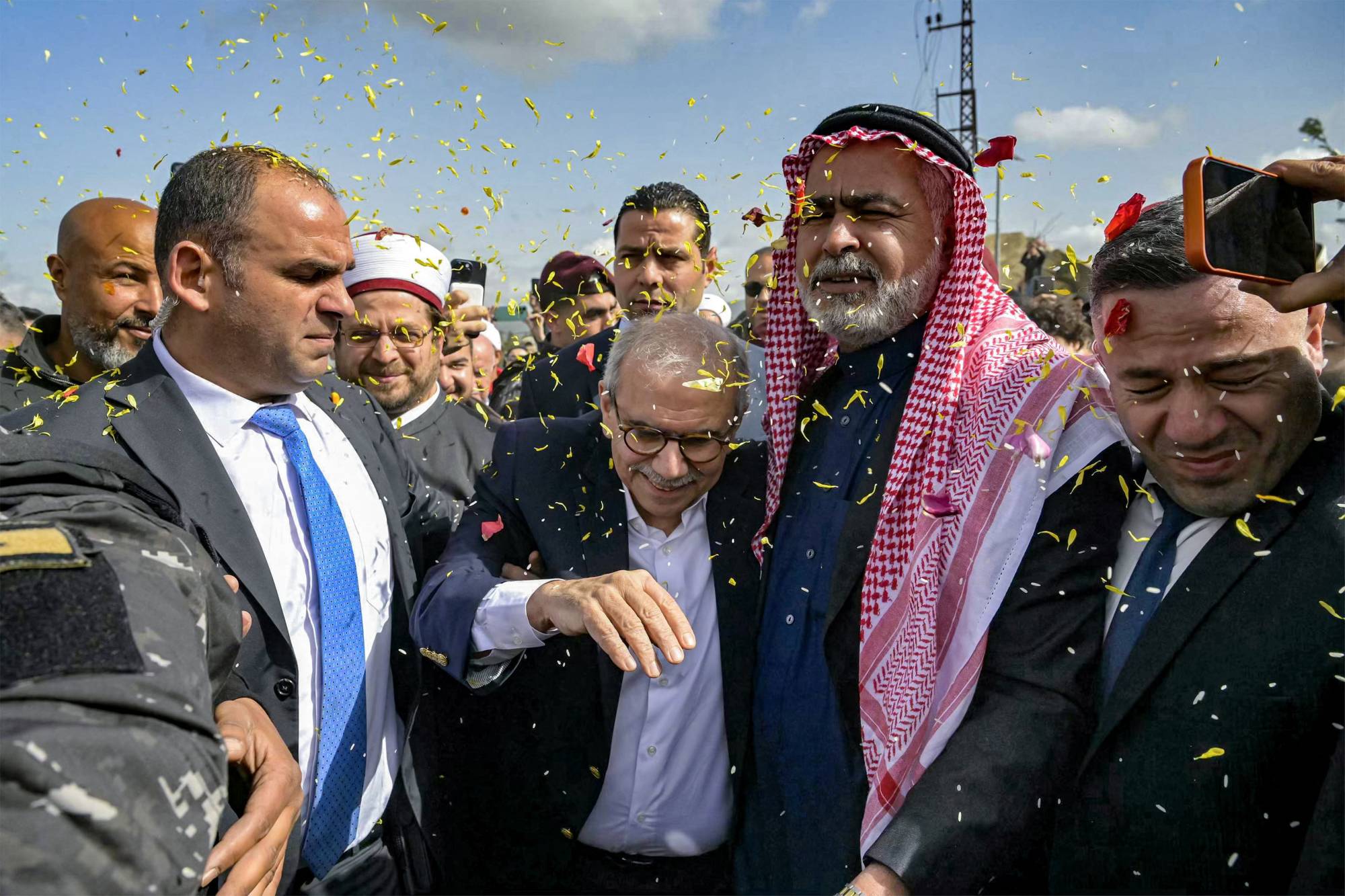
Over the weekend, Prime Minister Nawaf Salam carried out a historic two-day tour of the South, a Hezbollah stronghold, where he was warmly welcomed across political divides, especially among Hezbollah supporters.

The visit itself would not have been possible without a green light from Hezbollah’s leadership. Qassem even described the tour as “positive”, adding that disputes with President Joseph Aoun were being “managed.”

Hezbollah's shift in tone cannot be separated from the ongoing regional tensions between its main backer Iran and the United States. However, even when the party had intensified its criticism of the state, on the ground, the Lebanese army succeeded in completing the first phase of the government’s plan to impose state monopoly over arms.

Opponents of the group explained that the heated rhetoric was largely aimed at rallying Hezbollah supporters around the party, which is in crisis in wake of the major blows Israel dealt it during the 2024 war and the ongoing pressure on it to disarm as regional balances of power continue to change.

Ministerial sources close to the presidency described Hezbollah’s recent stances as “positive” and “realistic” given that it lacks other options.

This handout picture released by the Lebanese Government Press Office shows Lebanon's Prime Minister Nawaf Salam being showered with confetti as he is received by locals during a tour in the heavily-damaged southern village of Dhayra near the border with Israel on February 7, 2026. (Lebanese Government Press Office / AFP)

They told Asharq Al-Awsat, however, that “nothing in politics is free” and so it remains to be seen what Hezbollah wants in return of its change in position.

Moreover, they noted that the change is aimed at Hezbollah supporters, who are still reeling from the war and demanding reconstruction of areas destroyed by Israel in the war, which is another issue that is weighing heavily on the party.

Hezbollah has effectively realized that maintaining a critical position against the president will be costly for it and its support base, explained the sources.

Adapting to the new reality

Former Minister Rashid Derbas said Qassem’s “conciliatory” statements stand in contrast with his previous stances.

He told Asharq Al-Awsat: “The warm welcome received by the PM in the South aims to demonstrate to Hezbollah’s support base that the state does embrace them and there is nothing wrong with that. On the contrary, it is in their best interest given the current reality.”

“Hezbollah is realizing that it is now without friends or allies inside Lebanon and beyond because balances of power are changing due to the tensions between Iran and the US that could lead to war,” he added.

“So, Hezbollah is adapting to this reality,” Derbas went on to say. “Two states can no longer exist within one. This situation needs to be rectified, especially in wake of all the tragedies Hezbollah’s support base has endured. The base is already frustrated and starting to realize that maintaining a defiant tone will not lead anywhere.”

Given the pressure, shift in position and regional tensions, the real countdown for Hezbollah’s disarmament has effectively begun, stressed Derbas.

“The weapons are slowly losing their role, while their regional missions have come to an end,” he added.
