


US Accuses Syrian Regime of Making Chemical Arms in Violation of 2013 Deal

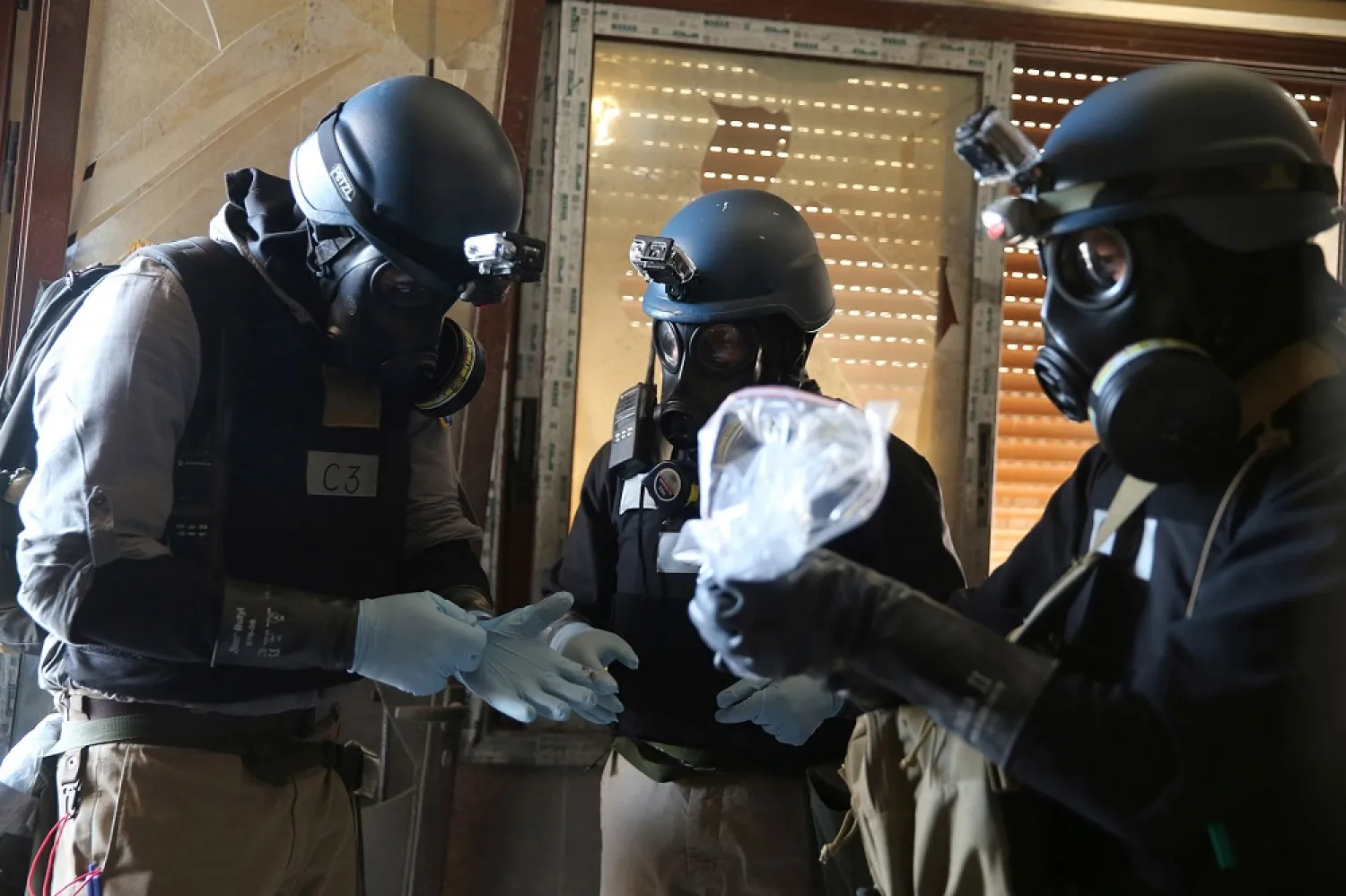
A UN chemical weapons expert holds samples from one of the sites of a chemical weapons attack in the Ain Tarma neighborhood of Damascus in August, 2013. (Reuters)
TT

US Accuses Syrian Regime of Making Chemical Arms in Violation of 2013 Deal

A UN chemical weapons expert holds samples from one of the sites of a chemical weapons attack in the Ain Tarma neighborhood of Damascus in August, 2013. (Reuters)

The United States accused on Thursday the Syrian regime of continuing on developing chemical weapons in what is a violation of an agreement to abolish its program in 2013.

Senior US officials said that the regime of Bashar Assad is believed to have secretly kept part of Syria’s chemical weapons stockpile despite a US-Russian deal under which Damascus was supposed to have handed over all such weapons for destruction in 2014, the officials said.

Regime forces have instead “evolved” their chemical weapons and made continued occasional use of them in smaller amounts since a deadly attack last April that drew a US missile strike on a Syrian air base, the officials told reporters in a briefing.

Characteristics of some of those recent attacks suggest that Syria may be developing new weapons and methods for delivering poison chemicals, possibly to make it harder to trace their origin, the officials said, speaking on condition of anonymity, but they declined to provide specifics.

Barrel bombs used earlier in the war to disperse chemicals indiscriminately, for example, have been replaced by ground-launched munitions, officials said. More recent attacks have involved both chlorine, which has non-chemical uses and is easier to acquire, and the more sophisticated chemical sarin, the officials said.

A deadly sarin attack on a rebel-held area in April prompted US President Donald Trump to order a missile strike last year on the Shayrat air base, from which the Syrian operation is said to have been launched.

“We reserve the right to use military force to prevent or deter the use of chemical weapons,” one official said, while declining to specify how serious a chemical attack would have to be to draw a fresh US military response.

A second official said, however, that the Trump administration hopes that stepped-up international sanctions and diplomatic pressure will help rein in Assad’s chemical weapons program.

If the international community does not act quickly to tighten the screws on Assad, Syria’s chemical weapons could spread beyond its borders and possibly even “to US shores,” the second official said.

“It will spread if we don’t do something,” the official warned.

Western officials have cast suspicion on the Syrian regime for a chlorine gas attack on a rebel-held enclave east of Damascus last week that sickened at least 13 people.

State Department spokeswoman Heather Nauert said on Thursday the United States was “extremely concerned” about reports that Syrian forces had carried out another chlorine gas attack this week in the Eastern Ghouta area.

Later on Friday, Secretary of Defense Jim Mattis expressed US concern over the potential use of sarin gas in Syria.

Mattis, speaking with reporters, said the regime had repeatedly used chlorine as a weapon.

“We are even more concerned about the possibility of sarin use, (but) I don’t have the evidence,” he added. “What I am saying is that other groups on the ground - NGOs, fighters on the ground - have said that sarin has been used, so we are looking for evidence.”

US Secretary of State Rex Tillerson recently said that Russia, Assad’s ally in Syria’s multi-sided civil war, bears some responsibility for failing to enforce the chemical weapons ban.

Russia has denied any complicity, and the regime has said it has not carried out any of the attacks.

The US officials suggested that if left unchecked there would be more smaller chemical attacks as an “instrument of terror” to compensate for Assad’s lack of adequate manpower to retake some opposition-held areas.

“They think they can get away with it if they keep it under a certain level,” an official said.

Reports of chemical attacks have continued to stream in from Syria, including as recently as Thursday, when rescue workers in the rebel-held Damascus suburb of Douma reported what they described as a suspected chlorine gas attack that injured a number of civilians.

The opposition-run Ghouta Media Center reported in a posting on its Facebook page that three people were killed and dozens suffered shortness of breath as a result of surface-to-surface missiles, some of them carrying chlorine gas.



Israeli Strikes on Lebanon Kill 4 Despite Ceasefire

This photograph taken from the southern Lebanese area of Marjeyoun shows smoke as it rises from the site of an Israeli airstrike that targeted the village of Arnoun on May 6, 2026. (AFP)
TT

Israeli Strikes on Lebanon Kill 4 Despite Ceasefire

This photograph taken from the southern Lebanese area of Marjeyoun shows smoke as it rises from the site of an Israeli airstrike that targeted the village of Arnoun on May 6, 2026. (AFP)

An Israeli strike in Lebanon's eastern Bekaa valley killed four people on Wednesday, while the Israeli army said it struck Hezbollah targets in the south, after warning residents of a dozen towns to evacuate.

Israel and Hezbollah have been trading accusations of violating the ceasefire agreement in force since April 17. Hezbollah has claimed responsibility for several operations targeting Israeli forces in southern Lebanon, as well as attacks on northern Israel.

An Israeli airstrike on the town of Zellaya, in the West Bekaa region, left at least four people dead, including two women and an elderly man, the Lebanese health ministry said.

Lebanese state media said the attack struck the house of the town's mayor, killing him and three members of his family.

The town was hit shortly before the Israeli army issued an evacuation warning that included Zellaya, along with 11 towns and villages in southern Lebanon, most of them north of the Litani River and outside the area occupied by Israeli soldiers.

The Israeli army later announced in a brief statement that it had "begun striking Hezbollah terror infrastructure sites in several areas in Lebanon" and renewed its evacuation warning.

Israel carried out airstrikes and artillery bombardment on a number of towns, including several whose residents had been warned to evacuate.

One of the strikes hit the town of Yohmor al-Shaqeef in the Nabatieh district.

AFP photos showed a cloud of smoke rising behind the town's historic Beaufort Castle, which Israeli forces used as a base during their two-decade occupation of southern Lebanon ending in 2000.

State media reported a series of airstrikes in the south, including a targeted strike on a car and "significant damage" to homes and infrastructure.

Hezbollah, for its part, announced in a series of statements that it had targeted Israeli forces and vehicles in a number of border towns in southern Lebanon.

It said the attacks were in response to "the Israeli enemy's violation of the ceasefire".

Israeli strikes in Lebanon have killed more than 2,700 people since March 2, including dozens since the April 17 ceasefire brokered by Washington between Israeli and Lebanese representatives.

The Israeli military says it has also lost 17 soldiers and a civilian contractor in the fighting.


Lebanese PM Says Premature to Talk of Any High-Level Meeting with Israel

Smoke rises as a result of an Israeli strike in the south of Lebanon, as seen from the Upper Galilee in northern Israel, 06 May 2026, amid a ceasefire between Israel and Lebanon. (EPA)
TT

Lebanese PM Says Premature to Talk of Any High-Level Meeting with Israel

Smoke rises as a result of an Israeli strike in the south of Lebanon, as seen from the Upper Galilee in northern Israel, 06 May 2026, amid a ceasefire between Israel and Lebanon. (EPA)

Lebanese Prime Minister Nawaf Salam said it is premature to talk of any high-level meeting between Lebanon and Israel, comments underlining the dim chances of one being held soon as hoped for by US President Donald Trump.

Salam, in comments reported by Lebanon's National News Agency (NNA) on Wednesday, said shoring up a ceasefire would be the basis for any new round of negotiations that might be held by Lebanese and Israeli government envoys in Washington.

Hostilities between Israel and Iran-backed Hezbollah have continued to rage in southern Lebanon despite a US-mediated ceasefire between Lebanon and Israel announced on April 16.

Since ‌Hezbollah triggered the ‌war by opening fire in support of Iran on March ‌2, ⁠the Lebanese administration ⁠led by Salam and President Joseph Aoun has initiated Beirut's highest-level contacts with Israel in decades, reflecting deep divisions between the Shiite group and its Lebanese opponents.

Washington last month hosted two meetings between the Israeli and Lebanese ambassadors to the United States. Hezbollah strongly objects to the contacts.

Announcing a three-week extension of the ceasefire on April 23, Trump said he looked forward to hosting Israeli Prime Minister Benjamin Netanyahu and Aoun in the near future, and that he ⁠saw "a great chance" the countries would reach a peace deal ‌this year.

Salam said Lebanon was not seeking "normalization with Israel, but ‌rather achieving peace".

The current circumstances "are not ripe to talk about high-level meetings," he added, according to NNA.

"Our ‌minimum demand is a timetable for Israel’s withdrawal," he said, adding that the government ‌would develop its plan to restrict weapons to state control - an effort aimed at securing Hezbollah's disarmament.

Aoun said this week the timing was not right for a meeting with Netanyahu. Lebanon "must first reach a security agreement and a halt to the Israeli attacks, before we raise the issue of a meeting ‌between us," he said.

TRADING BLOWS

Israel has occupied a so-called security zone extending as deep as 10 km (6 miles) into southern ⁠Lebanon, saying it aims ⁠to protect northern Israel from Hezbollah militants embedded in civilian areas.

Hezbollah and Israel have continued to trade blows.

Lebanon's Health Ministry said on Wednesday an Israeli airstrike killed four people including two women and an elderly man in the town of Zelaya in southern Lebanon.

The Israeli military said Hezbollah had launched explosive drones and rockets towards Israeli soldiers in southern Lebanon, injuring two Israeli soldiers.

It also said the Israeli air force intercepted a hostile aircraft before it crossed into Israel, and announced strikes on Hezbollah infrastructure in several areas in Lebanon.

More than 2,700 people have been killed in the war in Lebanon since March 2, the Health Ministry says.

The Israeli military says Hezbollah has fired hundreds of rockets and drones at Israel since March 2. Israel has announced 17 soldiers have been killed in southern Lebanon, along with two civilians in northern Israel.


EU Urged to 'Act Now' on West Bank Settlement Project

The Palestinian village of Turmus Ayya (foreground) and the Israeli settlement of Shilo (background), north of Ramallah in the Israeli-occupied West Bank, are pictured on May 6, 2026. (Photo by Zain JAAFAR / AFP)
TT

EU Urged to 'Act Now' on West Bank Settlement Project

The Palestinian village of Turmus Ayya (foreground) and the Israeli settlement of Shilo (background), north of Ramallah in the Israeli-occupied West Bank, are pictured on May 6, 2026. (Photo by Zain JAAFAR / AFP)

More than 400 former diplomats, ministers, and senior officials on Wednesday urged the European Union to "act now" against Israel's "illegal" settlements in the occupied West Bank.

The open letter comes as Israel intends to move forward with E1, a new construction project covering around 12 square kilometers (4.6 square miles) with some 3,400 housing units in the occupied West Bank.

The move would further separate east Jerusalem, occupied and annexed by Israel and predominantly inhabited by Palestinians, from the West Bank.

"The EU and its member states, together with partners, must take immediate action to deter Israel from further advancing its illegal annexation of Palestinian land in the West Bank," said the letter signed by more than 440 figures, including former EU foreign policy chief Josep Borrell and former Belgian prime minister Guy Verhofstadt.

The signatories called for targeted sanctions, such as visa bans and business restrictions, on "all those engaged in illegal settlement activity", calling for measures against those promoting or implementing the E1 scheme.

The Israeli government plans to publish an initial tender on June 1 for the construction of housing for up to 15,000 "illegal settlers", AFP quoted the letter as saying, urging the EU and its member states to "act now".

The plan has been condemned by international leaders, with UN Secretary General Antonio Guterres's spokesman saying it would pose an "existential threat" to a contiguous Palestinian state.

Excluding east Jerusalem, more than 500,000 Israelis live in the occupied West Bank in settlements that are illegal under international law, among some three million Palestinians.

In 2025, the expansion of Israeli settlements reached its highest level since at least 2017, when the United Nations began tracking data, according to a UN report.

There has been a spike in deadly attacks by Israeli settlers in the occupied West Bank since the start of the Iran war on February 28, Palestinian officials and the United Nations have said.

Israel has occupied the West Bank since 1967.