

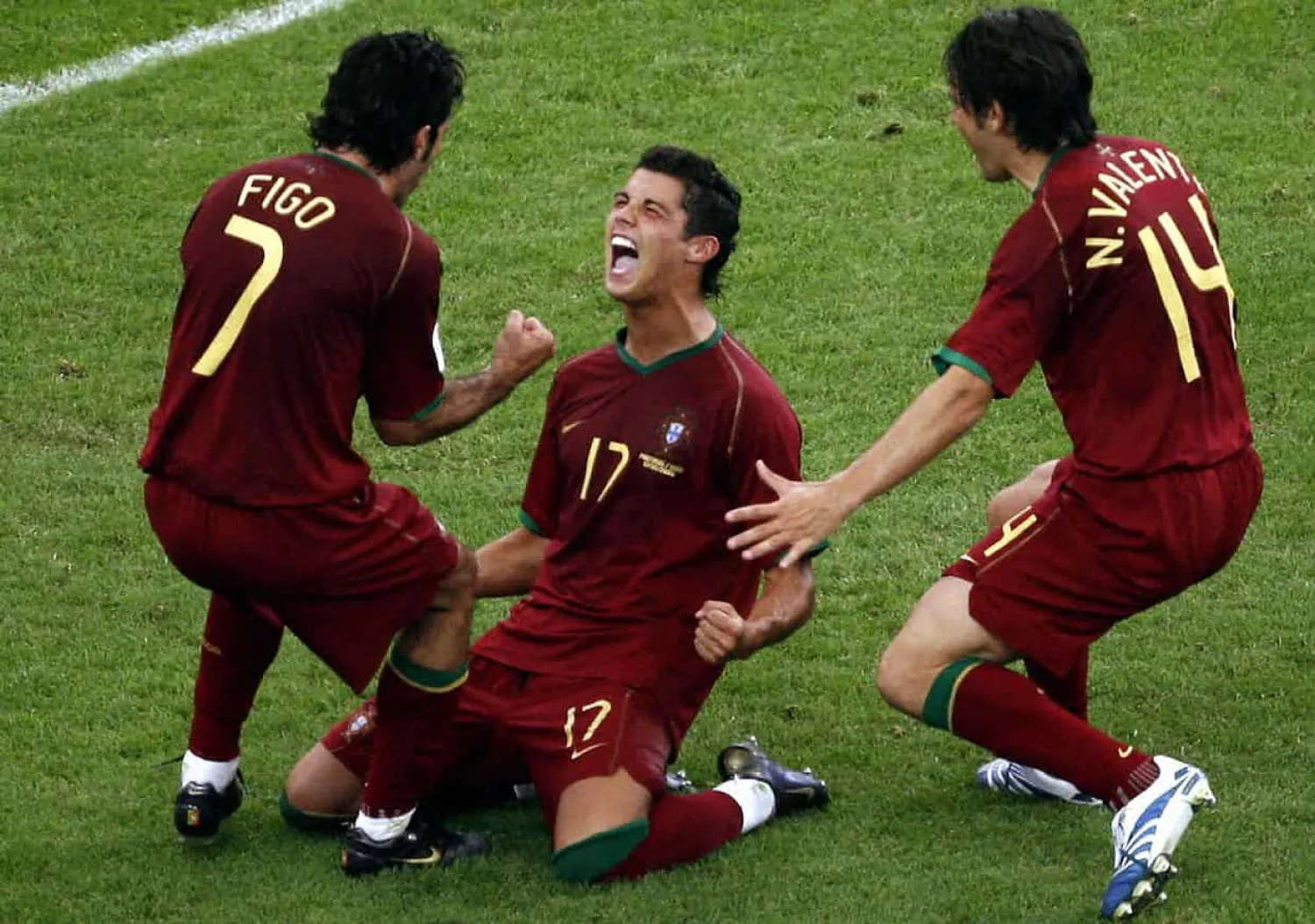

Inside the Sporting Lisbon Academy, where Ballon d'Or Winners are Made

Cristiano Ronaldo, Luís Figo and Nuno Valente all passed through the Sporting academy. (AFP)
TT

Inside the Sporting Lisbon Academy, where Ballon d'Or Winners are Made

Cristiano Ronaldo, Luís Figo and Nuno Valente all passed through the Sporting academy. (AFP)

“Effort, Dedication, Devotion, Glory.” Those are the first and last words the young hopefuls see as they enter and leave the Sporting Clube de Portugal academy. I had visited Benfica’s €15m complex the night before and was immediately struck by the contrasting values at this rural complex in Alcochete. Perhaps it was the €0.40 coffee served to me in the clubhouse by a bronzed pensioner who was wearing a permanent scowl. Without extravagances, this is a place for football.

As coaches gathered around a portable TV to watch Primeira Liga highlights and plan what the evening would have in store, I couldn’t help but daydream about the players who had walked these corridors and slept in the rooms next door, back when they owned nothing more than a pocketful of ambition. Sporting have produced Portugal’s two most capped players, Cristiano Ronaldo and Luís Figo, both of whom have won the Ballon d’Or, the Champions League and a shed-load of leagues and cups. There are signed pictures and murals of the pair plastered all around the facilities.

“Listen to me,” says Miguel Miranda, the goalkeeping coordinator at the academy. “Messi is a freak, a one-off and clearly the best ever, but what Cristiano has done to be anywhere near his levels speak volumes about the man. He came here from an island with nothing: a skinny boy with many bad habits who liked to run at defenders. Now he is a complete player: a beast. We use him as an example in every room here: from the gymnasium, to the psychology classrooms and the dressing rooms. He sacrificed himself to get everything he has now.”

While wandering around the six training pitches and talking to Miranda, I notice a theme: the ball is continuously zipped out to wingers who are encouraged to drive at isolated full-backs. “Cristiano, Figo, Nani, Quaresma – we’ve always specialized in wingers here,” he says. “Coaches limit touches for central players, who are encouraged to spread the ball wide into wingers, who have unlimited touches to create chances from wide.” Miranda says the country’s top wingers make their way to Alcochete as the academy has a history of producing “free-range players, not battery-caged ones”.

“Ten of our boys were in Portugal’s 23-man squad that won Euro 2016. Of the eight from here who started in the final, five are attackers. The other two came on as wingers! We like the boys to be free to express themselves on the pitch. We love creative kids.”

Sporting became the first Portuguese club to open an academy in 2002. Like both Benfica and Porto, a 4-3-3 template runs through the veins of the youth system. Yet, all of their coaches take “field trips” to different football cultures, such as Barcelona’s La Masia, Ajax’s De Toekomst and various hotbeds of youth talent in South America, to see how things are done elsewhere and absorb knowledge from other philosophies.

After witnessing an Under-16 player fail to control three 20-yard passes in a row just minutes after he had beaten three opponents and finished from 25 yards, I joke with Miranda that I cannot work out if he is the best or worst player I have ever seen. “He’s gone,” says Miranda with a cutting frown. “Look at his skin. Look at his legs. He’s finished. I’m serious. We do physical examinations on the boys every three months. This boy isn’t at the levels he needs to be and he’s finished maturing. We check players’ skin for acne, knees and other joints for growth.”

“If a player isn’t performing at the standard we require for their age and their body has stopped developing, then we will release them. We prefer skinny, awkward teens to the finished product at 15. Again, here, Cristiano is the perfect example. We don’t want them to be professional at 14. We want them to be professional at 20.”

Aurélio Pereira, the club’s long-serving director of youth recruitment, has overseen the discovery of Figo, Paulo Futre, Simão Sabrosa, João Moutinho, Cedric, Ricardo Quaresma and Nani, among others, but Ronaldo is the real darling for the club. The 70-year-old’s eyes light up when he reminisces about Ronaldo tying weights to his legs and racing past traffic in the streets outside the academy to gain strength and speed.

“As soon as we make contact with a player coming from far away, our objective is to bring them over to the Sporting Academy,” says Pereira. “We are responsible for a massive change in the lives of young players who could become greats one day. We find the strong and weak points of each individual and change their training to reflect that.”

Sporting insist they are interested in developing people, not just players. Eric Dier, who spent eight years with the club before signing for Tottenham, has testified to that. “They pride themselves on bringing you up as a polite and respectful person. They would never get angry with you if you missed a pass but they would do if you were disrespectful to someone. There was no shouting. A good player for them was someone who could understand when they made a mistake and correct it for themselves.

“When I first came to England to play I saw coaches having a go at players when they made mistakes. They would literally be talking them through the game. In Portugal, the coach would sit on the bench and not say a word. We’d just play. It was a matter of us making mistakes and learning from them by ourselves. You understand the game a lot better that way. For me, the sign of a bad player is someone who makes the same mistake twice.”

Miranda is adamant that making each player happy in his day-to-day life matters to the club. “Correct diets and sleeping patterns are of high importance here and having the correct lifestyle has an enormous effect on performance. When players perform well on the pitch, they find everything else easier, eventually becoming content with life’s challenges. The development of humans is of great importance.”

Ronaldo’s success tells its own story and so too does that of Figo, who has gone on to prosper in multiple avenues. He is fluent in five languages, runs bars and restaurants around Portugal, works for the Stop TB Partnership to serve people affected by tuberculosis, is on the board of a charity run by Internazionale, and even ran to be Fifa president.

As I said “boa noite” to the still scowling waiter at the end of the night and made my way out of the academy, I walked past a shirt signed by Ronaldo and the other youth graduates who helped Portugal win Euro 2016. The Ballon d’Or winners, European champions and professionals spread around the world are all a testament to the “effort, dedication, devotion, glory” motto that was instilled in them here.

The Guardian Sport


‘Don’t Jump in Them’: Olympic Athletes’ Medals Break During Celebrations

Gold medalists team USA celebrate during the medal ceremony after the Team Event Free Skating of the Figure Skating competitions at the Milano Cortina 2026 Winter Olympic Games, in Milan, Italy, 08 February 2026. (EPA)
TT

‘Don’t Jump in Them’: Olympic Athletes’ Medals Break During Celebrations

Gold medalists team USA celebrate during the medal ceremony after the Team Event Free Skating of the Figure Skating competitions at the Milano Cortina 2026 Winter Olympic Games, in Milan, Italy, 08 February 2026. (EPA)

Handle with care. That's the message from gold medalist Breezy Johnson at the Milan Cortina Winter Olympics after she and other athletes found their medals broke within hours.

Olympic organizers are investigating with "maximum attention" after a spate of medals have fallen off their ribbons during celebrations on the opening weekend of the Games.

"Don’t jump in them. I was jumping in excitement, and it broke," women's downhill ski gold medalist Johnson said after her win Sunday. "I’m sure somebody will fix it. It’s not crazy broken, but a little broken."

TV footage broadcast in Germany captured the moment biathlete Justus Strelow realized the mixed relay bronze he'd won Sunday had fallen off the ribbon around his neck and clattered to the floor as he danced along to a song with teammates.

His German teammates cheered as Strelow tried without success to reattach the medal before realizing a smaller piece, seemingly the clasp, had broken off and was still on the floor.

US figure skater Alysa Liu posted a clip on social media of her team event gold medal, detached from its official ribbon.

"My medal don’t need the ribbon," Liu wrote early Monday.

Andrea Francisi, the chief games operations officer for the Milan Cortina organizing committee, said it was working on a solution.

"We are aware of the situation, we have seen the images. Obviously we are trying to understand in detail if there is a problem," Francisi said Monday.

"But obviously we are paying maximum attention to this matter, as the medal is the dream of the athletes, so we want that obviously in the moment they are given it that everything is absolutely perfect, because we really consider it to be the most important moment. So we are working on it."

It isn't the first time the quality of Olympic medals has come under scrutiny.

Following the 2024 Summer Olympics in Paris, some medals had to be replaced after athletes complained they were starting to tarnish or corrode, giving them a mottled look likened to crocodile skin.


African Players in Europe: Ouattara Fires Another Winner for Bees

Football - Premier League - Newcastle United v Brentford - St James' Park, Newcastle, Britain - February 7, 2026 Brentford's Dango Ouattara celebrates scoring their third goal with Brentford's Rico Henry. (Reuters)
TT

African Players in Europe: Ouattara Fires Another Winner for Bees

Football - Premier League - Newcastle United v Brentford - St James' Park, Newcastle, Britain - February 7, 2026 Brentford's Dango Ouattara celebrates scoring their third goal with Brentford's Rico Henry. (Reuters)

Burkina Faso striker Dango Ouattara was the Brentford match-winner for the second straight weekend when they triumphed 3-2 at Newcastle United.

The 23-year-old struck in the 85th minute of a seesaw Premier League struggle in northeast England. The Bees trailed and led before securing three points to go seventh in the table.

Last weekend, Ouattara dented the title hopes of third-placed Aston Villa by scoring the only goal at Villa Park.

AFP Sport highlights African headline-makers in the major European leagues:

ENGLAND

DANGO OUATTARA (Brentford)

With the match at Newcastle locked at 2-2, the Burkinabe sealed victory for the visitors at St James' Park by driving a left-footed shot past Magpies goalkeeper Nick Pope to give the Bees a first win on Tyneside since 1934. Ouattara also provided the cross that led to Vitaly Janelt's headed equalizer after Brentford had fallen 1-0 behind.

BRYAN MBEUMO (Manchester Utd)

The Cameroon forward helped the Red Devils extend their perfect record under caretaker manager Michael Carrick to four games by scoring the opening goal in a 2-0 win over Tottenham after Spurs had been reduced to 10 men by captain Cristian Romero's red card.

ISMAILA SARR (Crystal Palace)

The Eagles ended their 12-match winless run with a 1-0 victory at bitter rivals Brighton thanks to Senegal international Sarr's 61st-minute goal when played in by substitute Evann Guessand, the Ivory Coast forward making an immediate impact on his Palace debut after joining on loan from Aston Villa during the January transfer window.

ITALY

LAMECK BANDA (Lecce)

Banda scored direct from a 90th-minute free-kick outside the area to give lowly Leece a precious 2-1 Serie A victory at home against mid-table Udinese. It was the third league goal this season for the 25-year-old Zambia winger. Leece lie 17th, one place and three points above the relegation zone.

GERMANY

SERHOU GUIRASSY (Borussia Dortmund)

Guirassy produced a moment of quality just when Dortmund needed it against Wolfsburg. Felix Nmecha's silky exchange with Fabio Silva allowed the Guinean to sweep in an 87th-minute winner for his ninth Bundesliga goal of the season. The 29-year-old has scored or assisted in four of his last five games.

RANSFORD KOENIGSDOERFFER (Hamburg)

A first-half thunderbolt from Ghana striker Koenigsdoerffer put Hamburg on track for a 2-0 victory at Heidenheim. It was their first away win of the season. Nigerian winger Philip Otele, making his Hamburg debut, split the defense with a clever pass to Koenigsdoerffer, who hit a shot low and hard to open the scoring in first-half stoppage time.

FRANCE

ISSA SOUMARE (Le Havre)

An opportunist goal by Soumare on 54 minutes gave Le Havre a 2-1 home win over Strasbourg in Ligue 1. The Senegalese received the ball just inside the area and stroked it into the far corner of the net as he fell.


Olympic Town Warms up as Climate Change Puts Winter Games on Thin Ice

 Milano Cortina 2026 Olympics - Alpine Skiing - Men's Team Combined Downhill - Stelvio Ski Centre, Bormio, Italy - February 09, 2026. Alexis Monney of Switzerland in action during the Men's Team Combined Downhill. (Reuters)
Milano Cortina 2026 Olympics - Alpine Skiing - Men's Team Combined Downhill - Stelvio Ski Centre, Bormio, Italy - February 09, 2026. Alexis Monney of Switzerland in action during the Men's Team Combined Downhill. (Reuters)
TT

Olympic Town Warms up as Climate Change Puts Winter Games on Thin Ice

 Milano Cortina 2026 Olympics - Alpine Skiing - Men's Team Combined Downhill - Stelvio Ski Centre, Bormio, Italy - February 09, 2026. Alexis Monney of Switzerland in action during the Men's Team Combined Downhill. (Reuters)
Milano Cortina 2026 Olympics - Alpine Skiing - Men's Team Combined Downhill - Stelvio Ski Centre, Bormio, Italy - February 09, 2026. Alexis Monney of Switzerland in action during the Men's Team Combined Downhill. (Reuters)

Olympic fans came to Cortina with heavy winter coats and gloves. Those coats were unzipped Sunday and gloves pocketed as snow melted from rooftops — signs of a warming world.

“I definitely thought we’d be wearing all the layers,” said Jay Tucker, who came from Virginia to cheer on Team USA and bought hand warmers and heated socks in preparation. “I don’t even have gloves on.”

The timing of winter, the amount of snowfall and temperatures are all less reliable and less predictable because Earth is warming at a record rate, said Shel Winkley, a Climate Central meteorologist. This poses a growing and significant challenge for organizers of winter sports; The International Olympic Committee said last week it could move up the start date for future Winter Games to January from February because of rising temperatures.

While the beginning of the 2026 Olympic Winter Games in Cortina truly had a wintry feel, as the town was blanketed in heavy snow, the temperature reached about 40 degrees Fahrenheit (4.5 degrees Celsius) Sunday afternoon. It felt hotter in the sun.

This type of February “warmth” for Cortina is made at least three times more likely due to climate change, Winkley said. In the 70 years since Cortina first held the Winter Games, February temperatures there have climbed 6.4 degrees Fahrenheit (3.6 degrees Celsius), he added.

For the Milan Cortina Games, there's an added layer of complexity. It’s the most spread-out Winter Games in history, so Olympic venues are in localities with very different weather conditions. Bormio and Livigno, for example, are less than an hour apart by car, but they are separated by a high mountain pass that can divide the two places climatically.

The organizing committee is working closely with four regional and provincial public weather agencies. It has positioned weather sensors at strategic points for the competitions, including close to the ski jumping ramps, along the Alpine skiing tracks and at the biathlon shooting range.

Where automatic stations cannot collect everything of interest, the committee has observers — “scientists of the snow”— from the agencies ready to collect data, according to Matteo Pasotti, a weather specialist for the organizing committee.

The hope? Clear skies, light winds and low temperatures on race days to ensure good visibility and preserve the snow layer.

The reality: “It’s actually pretty warm out. We expected it to be a lot colder,” said Karli Poliziani, an American who lives in Milan. Poliziani was in Cortina with her father, who considered going out Sunday in just a sweatshirt.

And forecasts indicate that more days with above-average temperatures lie ahead for the Olympic competitions, Pasotti said.

Weather plays a critical role in the smooth running and safety of winter sports competitions, according to Filippo Bazzanella, head of sport services and planning for the organizing committee. High temperatures can impact the snow layer on Alpine skiing courses and visibility is essential. Humidity and high temperatures can affect the quality of the ice at indoor arenas and sliding centers, too.

Visibility and wind are the two factors most likely to cause changes to the competition schedule, Bazzanella added. Wind can be a safety issue or a fairness one, such as in the biathlon where slight variations can disrupt the athletes' precise shooting.

American alpine skier Jackie Wiles said many races this year have been challenging because of the weather.

“I feel like we’re pretty good about keeping our heads in the game because a lot of people are going to get taken out by that immediately,” she said at a team press conference last week. “Having that mindset of: it’s going to be what it’s going to be, and we still have to go out there and fight like hell regardless.”
