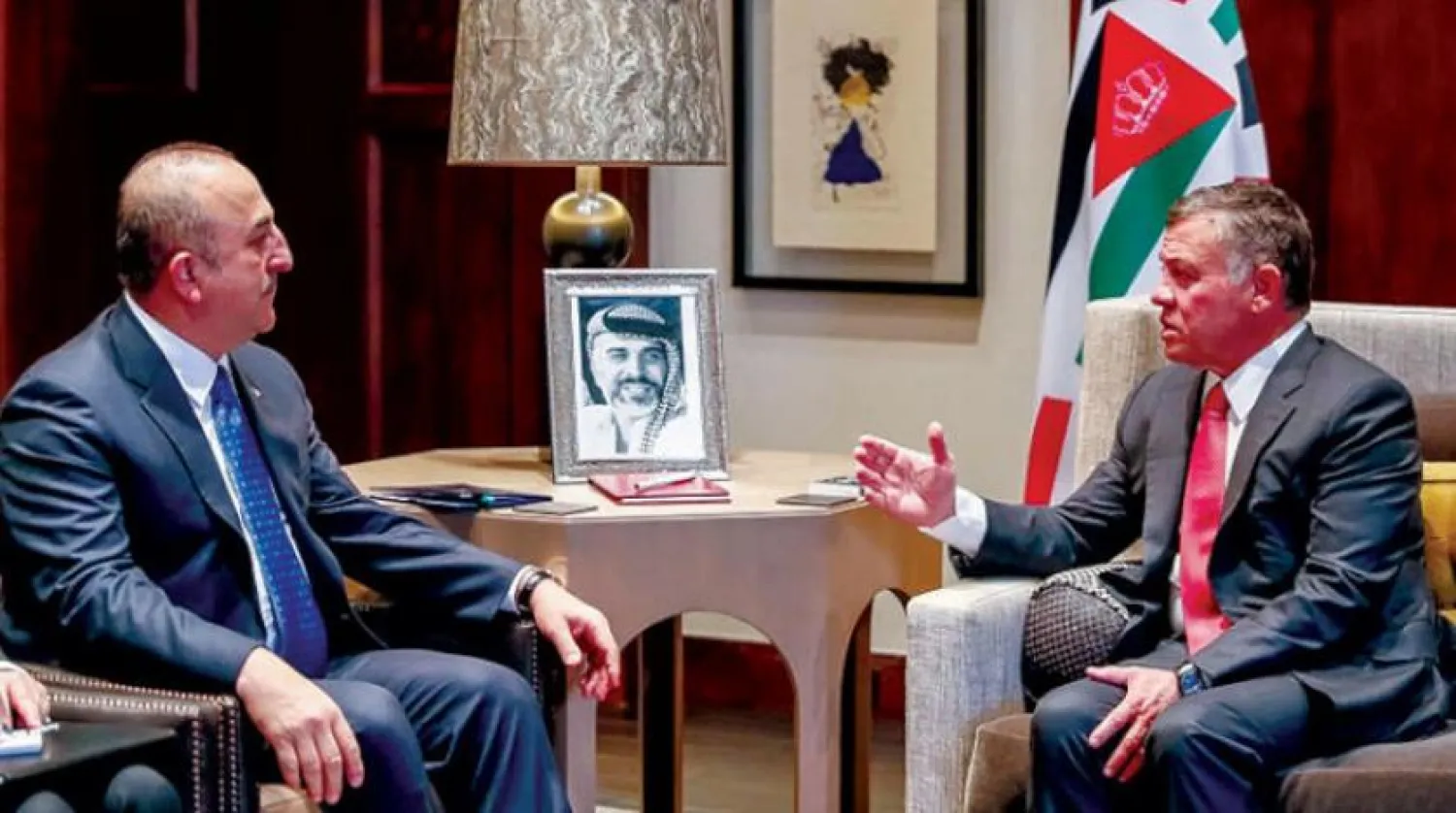
Jordanian King Abdullah II during his meeting with the Turkish Foreign Minister (Royal Court of Jordan)
Turkish Foreign Minister Mevlut Cavusoglu confirmed that Turkey has no hidden agendas concerning Syria, reaffirming that it only wishes the latter peace and stability.
Speaking at a press conference following his meeting with Jordanian counterpart Ayman Safadi in Amman on Monday, Cavusoglu said that Turkish operations were clear and aimed at terminating terrorists, pointing out that Turkey supports the territorial integrity of Syria and has full understanding in this regard.
He stressed that if Syrian regime forces enter Afrin to eliminate terrorism, Turkey welcomes it.
Speaking on Jordanian-Turkish relations, the top Turkish diplomat said that the two countries share positions on ruling out the United States decision on Jerusalem as wrong.
Cavusoglu also stressed that his country fully rejects US President Donald Trump’s decision on moving the US Embassy to Jerusalem and recognizing it as the official capital of Israel.
Both Jordan and Turkey have reached an understanding to establish a joint mechanism for cooperation between the two foreign ministries. Cavusoglu said that there is a common history between the Jordanian and Turkish communities, and there is a large number of Turkish students in Jordan studying Arabic, and some Turkish institutions are based in Jordan.
Cavusoglu revealed the increase in the number of Turkish flights to Jordan to support tourism, and that his country is working to visit the Turks to Jerusalem through Jordan.
A number Turkish official will be visiting Jordan, Cavusoglu added.
For his part, Jordanian Foreign Minister Ayman Safadi said that Cavusoglu’s visit came to reinforce Turkish-Jordanian agreements reached at three different summits, to enhance bilateral exchange and unite efforts in dealing with regional situation.
Safadi stressed during the press conference that the two countries share strong relations, pointing out that they are developing steadily and have entered year 71 with steady momentum and mutual interest.
He pointed out that challenges were discussed to develop economic relations and trade and cultural cooperation, indicating that it was agreed to sign the necessary agreements between the two countries, increase trade and investment exchange, and work to create nourishing conditions.
He added that Jordan and Turkey agree on the Palestinian issue being central and encourage primarily the two-state solution, which guarantees Palestinians their legitimate right to a state established, with East Jerusalem as its capital.
Macron Concludes in Qatar Gulf Tour Focused on Regional Securityhttps://english.aawsat.com/gulf/5331840-macron-concludes-qatar-gulf-tour-focused-regional-security
Macron Concludes in Qatar Gulf Tour Focused on Regional Security
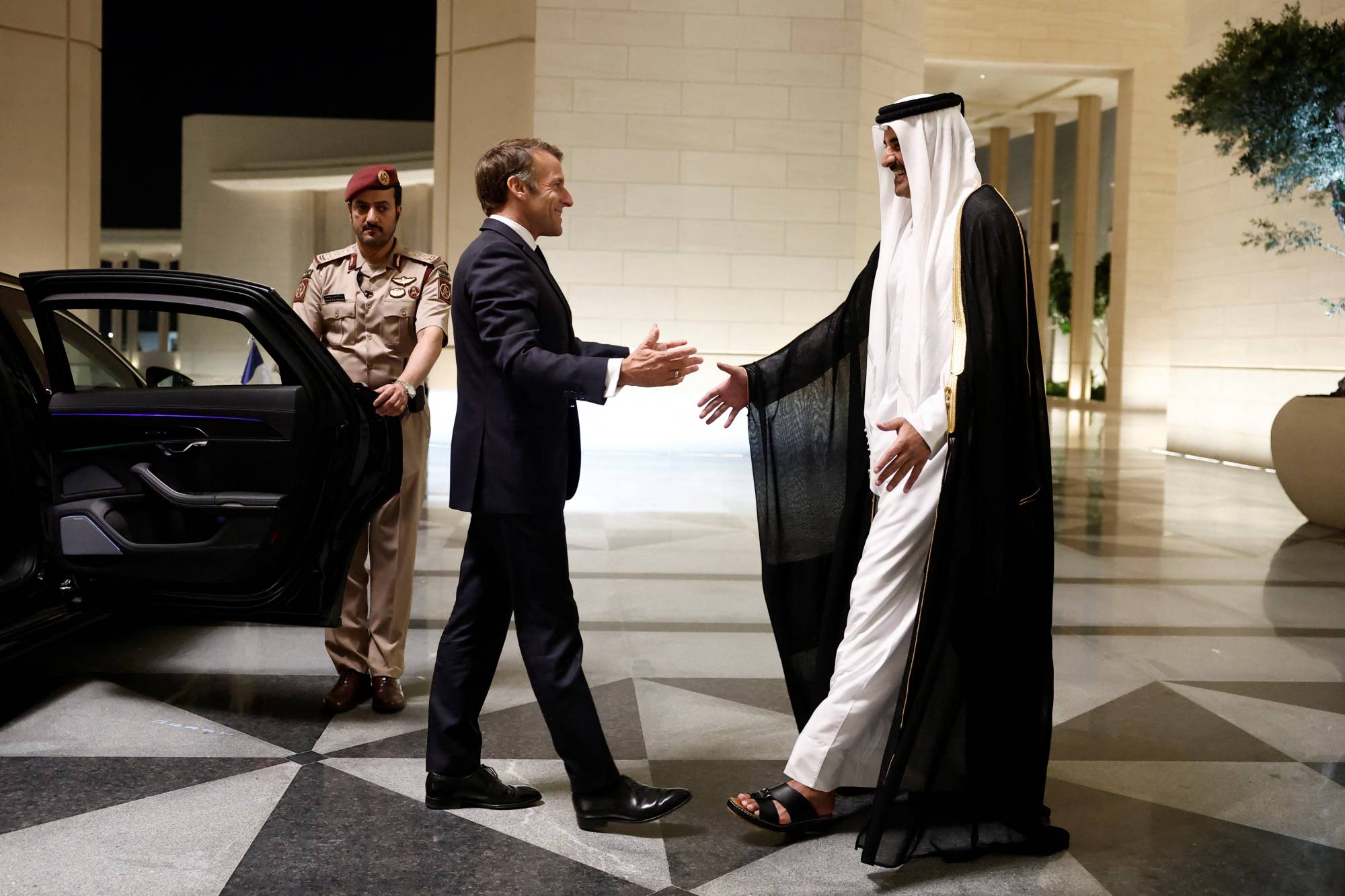
Emir of Qatar Sheikh Tamim bin Hamad Al Thani and French President Emmanuel Macron meet in Doha on Tuesday. (QNA)
French President Emmanuel Macron began a state visit to Doha on Tuesday, the final stop of his Gulf tour following visits to Kuwait, the United Arab Emirates, and Bahrain. The tour focused on regional security, energy supplies, and strengthening economic and defense partnerships.
Emir of Qatar Sheikh Tamim bin Hamad Al Thani received Macron at Lusail Palace on Tuesday, where an official reception ceremony was held to mark the first state visit by a French president to the country.
The leaders then held a bilateral meeting to review friendly relations and cooperation between both nations, as well as developments in the region.
They reviewed bilateral cooperation relations and the strategic partnership between the two countries, as well as ways to boost and develop them at various levels, particularly in the economic, investment, security, and defense sectors.
Sheikh Tamim expressed his deep pleasure with this historic visit and the profound depth of bilateral ties it reflects, looking forward to strengthening the solid strategic partnership and cooperation in various fields. For his part, Macron stressed his country's keenness to develop cooperative relations and push them toward broader horizons that meet the aspirations of both nations and their peoples.
Macron's Gulf tour came amid escalating regional tensions and threats facing maritime navigation and energy supplies, while Paris is seeking to enhance coordination with its Gulf partners in security of the Strait of Hormuz and the stability of energy markets.
Qatar's Ambassador to France Sheikh Ali bin Jassim Al Thani said the visit was an opportunity to expand cooperation in the fields of defense, security, energy, investment, technology, artificial intelligence, and cybersecurity, as well as to strengthen political coordination on regional and international crises.
Emir of Qatar Sheikh Tamim bin Hamad Al Thani (R) welcomes French President Emmanuel Macron (C) at the Lusail Palace in Lusail, north of Doha, Qatar, 20 October 2026. (EPA)
Boosting Bahraini-French cooperation
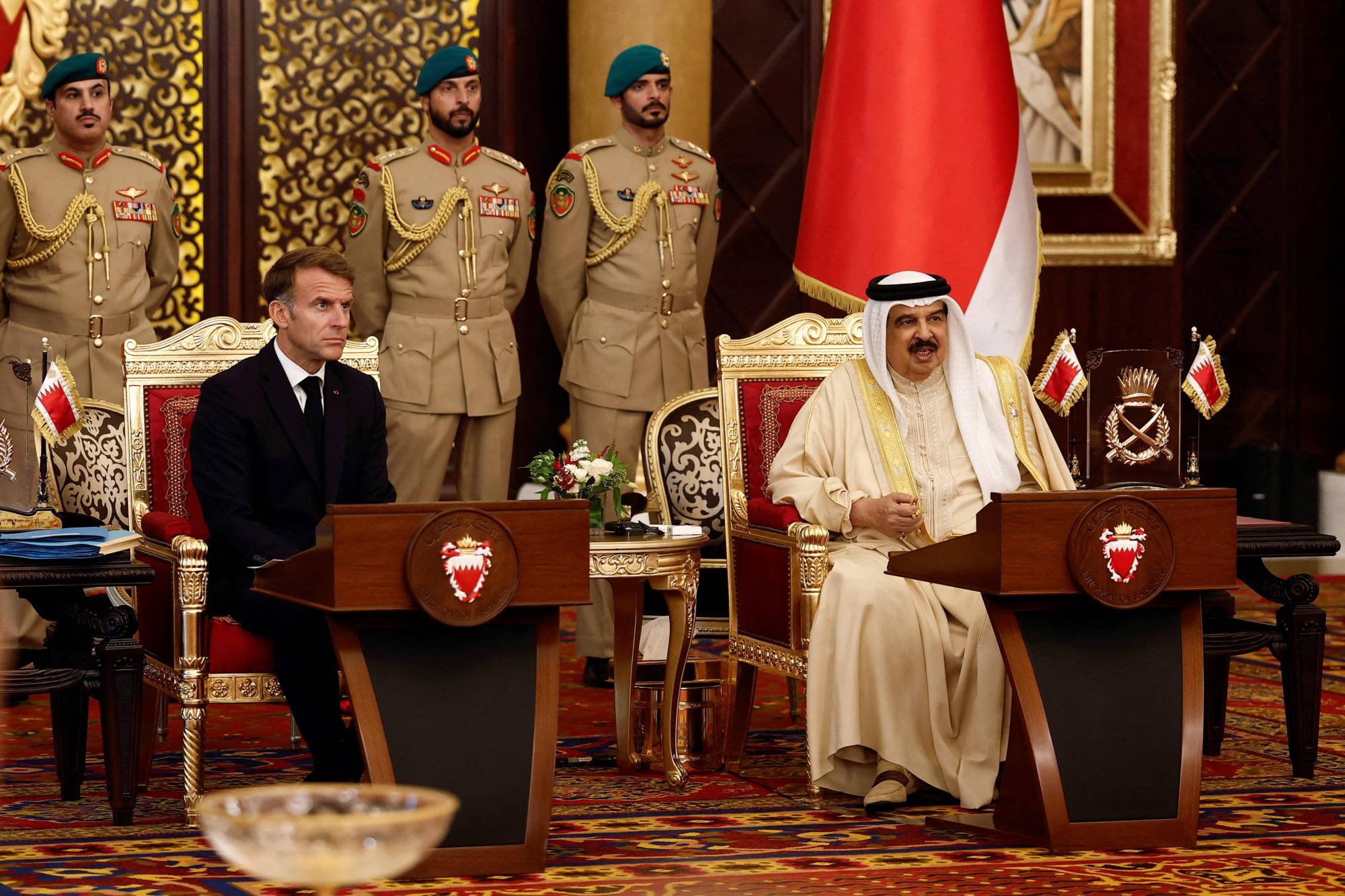
In Manama, Bahrain’s King Hamad bin Isa Al Khalifa and Macron discussed developments in the Middle East during official talks on Tuesday. They reviewed bolstering strategic cooperation between their countries, particularly in the fields of defense, security, economy, energy, and technology.
Macron underlined France's commitment to helping Bahrain protect its security and its readiness to provide support again in the event that it faces attacks, hoping to expand defense cooperation to include missile production and Manama's participation in manufacturing processes, alongside developing naval cooperation and drone systems.
King Hamad condemned the Houthi attacks on Saudi Arabia, stressing Manama's full solidarity with Riyadh and its support for measures to protect its security and sovereignty.
He underscored the importance of coordination with France in the UN Security Council regarding regional issues, including the Palestinian cause and the two-state solution.
Macron's visit to Manama witnessed the signing of a memorandum of understanding for cooperation in the peaceful uses of nuclear energy, aimed at developing the capabilities and skills necessary for a Bahraini civilian nuclear program through training and qualification programs.
King Hamad awarded Macron the Order of Sheikh Isa bin Salman Al Khalifa, First Class, in appreciation of his efforts to strengthen bilateral relations.
Bahrain's King Hamad bin Isa Al Khalifa (R) and French President Emmanuel Macron attend an agreement signing ceremony, at al-Sakhir Palace near Zallaq, on October 20, 2026. (AFP)
Emirati-French defense partnership
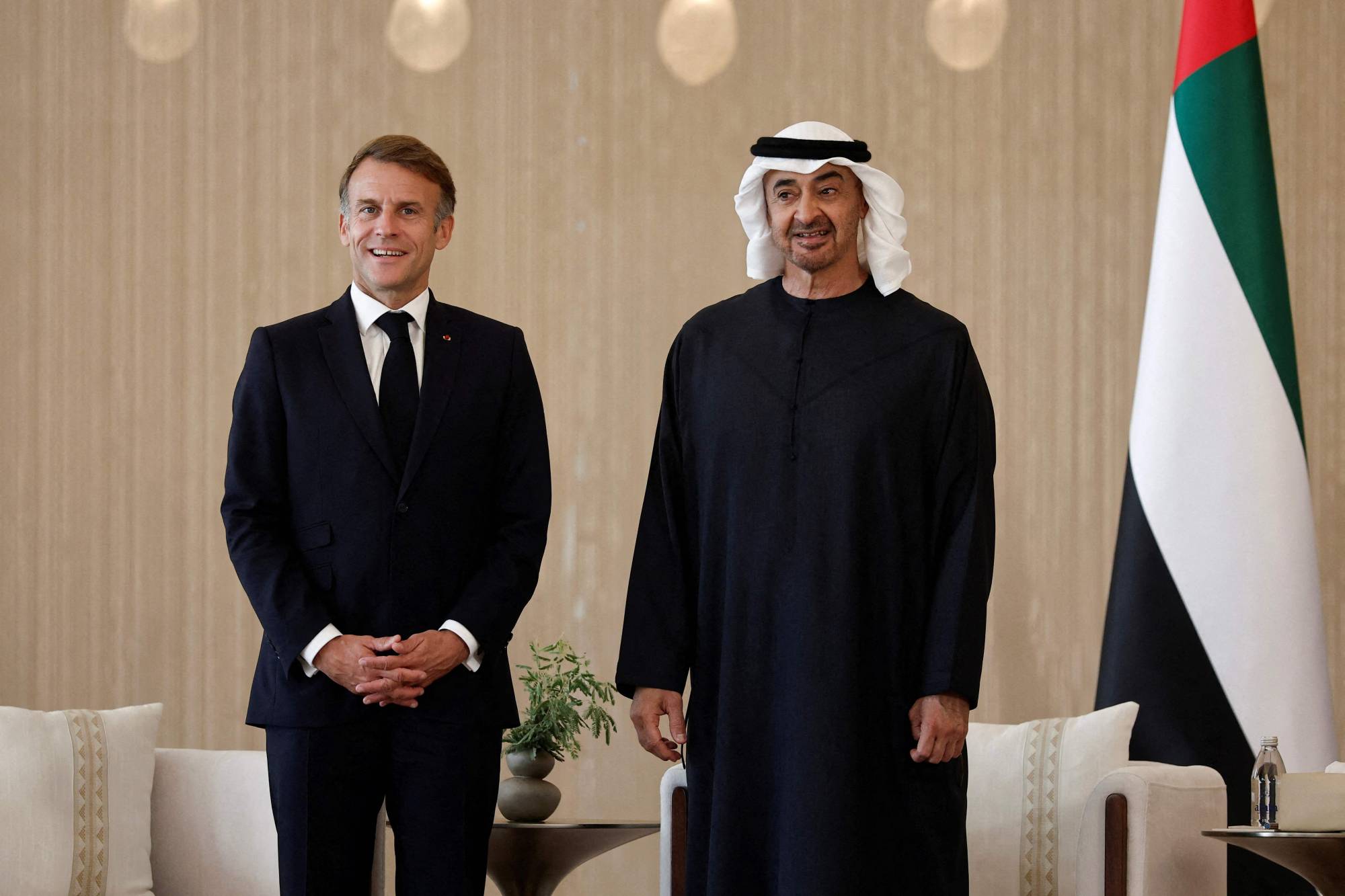
In Abu Dhabi, UAE President Sheikh Mohamed bin Zayed Al Nahyan and Macron witnessed on Tuesday the exchange of the strategic defense partnership framework between the two countries, as well as the executive arrangements regarding defense industries.
On Monday, the two leaders discussed ways to strengthen strategic relations between their countries and expand areas of economic and investment cooperation.
They underlined their commitment to further boosting cooperation in vital sectors and accelerating progress in executing joint projects, particularly in the fields of energy, advanced technologies, and artificial intelligence, which are major pillars in the strategic partnership between their nations.
On the regional level, the two presidents reviewed international issues and developments, foremost of which were the latest updates in the Middle East and efforts aimed at containing their repercussions, especially regarding the security of maritime corridors and the stability of energy supplies to global markets.
They stressed the importance of continued coordination and cooperation between Abu Dhabi and Paris to support regional security and stability, and to work toward bolstering opportunities for peace in a way that serves the interests of the region's countries and peoples.
France's President Emmanuel Macron (L) and UAE President Sheikh Mohamed bin Zayed Al Nahyan attend a signing ceremony for bilateral defense agreements at Zayed International Airport in Abu Dhabi on October 20, 2026. (AFP)
Macron secured the delivery of an additional 200,000 tons of diesel per month from the UAE and Bahrain during his Gulf tour, the French presidency said on Tuesday.
He obtained commitments for around 100,000 tons per month from the Emirates, while an additional 100,000 tons monthly will be secured during the stop in Bahrain, the Elysee Palace said.
With the addition of deliveries from Saudi Arabia, France has commitments for 295,000 tons per month, representing just over 10 percent of its consumption, the presidency added.
Kuwait has also given "very clear commitments" to deliver diesel and kerosene to the French overseas territories of Mayotte and Reunion in the Indian Ocean, the French presidency said.
Saudi Interior Minister Reviews Facilities Security Forces Operations in Riyadhhttps://english.aawsat.com/gulf/5331810-saudi-interior-minister-reviews-facilities-security-forces-operations-riyadh
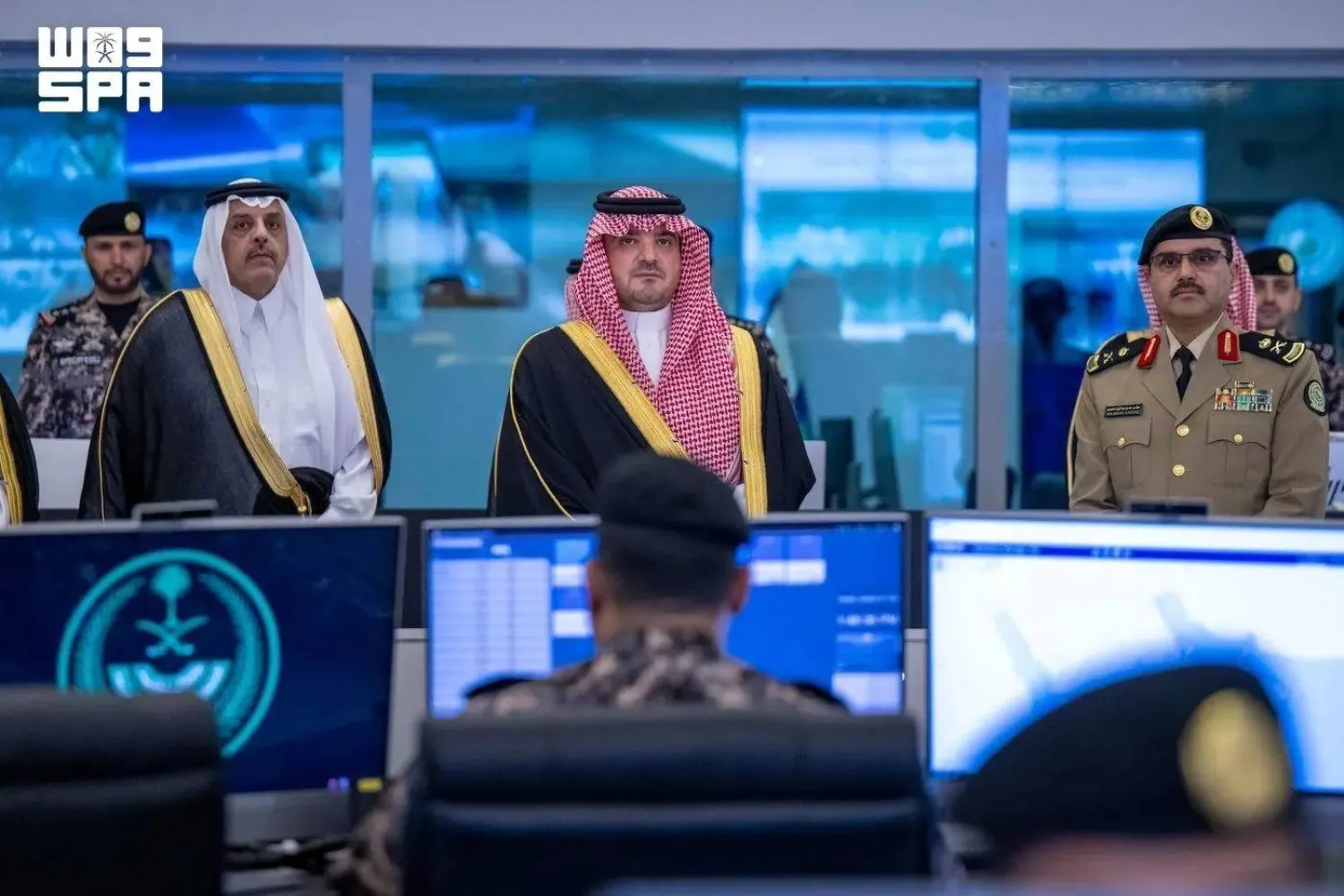
Saudi Minister of Interior Prince Abdulaziz bin Saud bin Naif bin Abdulaziz at the Facilities Security Forces Command in Riyadh on Tuesday. (SPA)
TT
TT
Saudi Interior Minister Reviews Facilities Security Forces Operations in Riyadh
Saudi Minister of Interior Prince Abdulaziz bin Saud bin Naif bin Abdulaziz at the Facilities Security Forces Command in Riyadh on Tuesday. (SPA)
Saudi Minister of Interior Prince Abdulaziz bin Saud bin Naif bin Abdulaziz reviewed on Tuesday operations at the Facilities Security Forces Command in Riyadh, inaugurating two centers for command and control and cybersecurity, as well as launching digital services for personnel.
The minister inaugurated the center for command and control and security UAV systems, which comprises seven specialized units and is linked to 13 command and control centers at the forces’ branches across Saudi Arabia.
The center uses an integrated system of advanced electronic systems and platforms to receive reports, manage and monitor field operations, and exchange security information, improving response times and security coordination in cooperation with the National Center for Security Operations.
The center also uses drones equipped with artificial intelligence technologies to support field surveillance and improve the efficiency of security operations within the forces’ areas of responsibility.
During the visit, the minister inaugurated the cybersecurity center, which is responsible for protecting data and information, securing networks and devices, monitoring systems to identify and address vulnerabilities, and detecting and countering cyber threats. These functions aim to protect technical infrastructure and support business continuity.
Prince Abdulaziz bin Saud also launched services for Facilities Security Forces personnel through the Absher Interior application. Developed in cooperation with the Ministry of Interior’s unified development center under its Technology Affairs sector, the services aim to simplify procedures and enable personnel to access services electronically.
The minister reviewed the forces’ upgraded digital services and electronic systems, including the integration of the Mawared system with the Absher platform and the National Unified Access platform (Nafath), as well as secure technical interfaces integrating related systems. These integrations aim to improve service efficiency and advance digital transformation.
Coalition: Drones Launched Toward Saudi Arabia Intercepted, Destroyed https://english.aawsat.com/gulf/5331807-coalition-drones-launched-toward-saudi-arabia-intercepted-destroyed
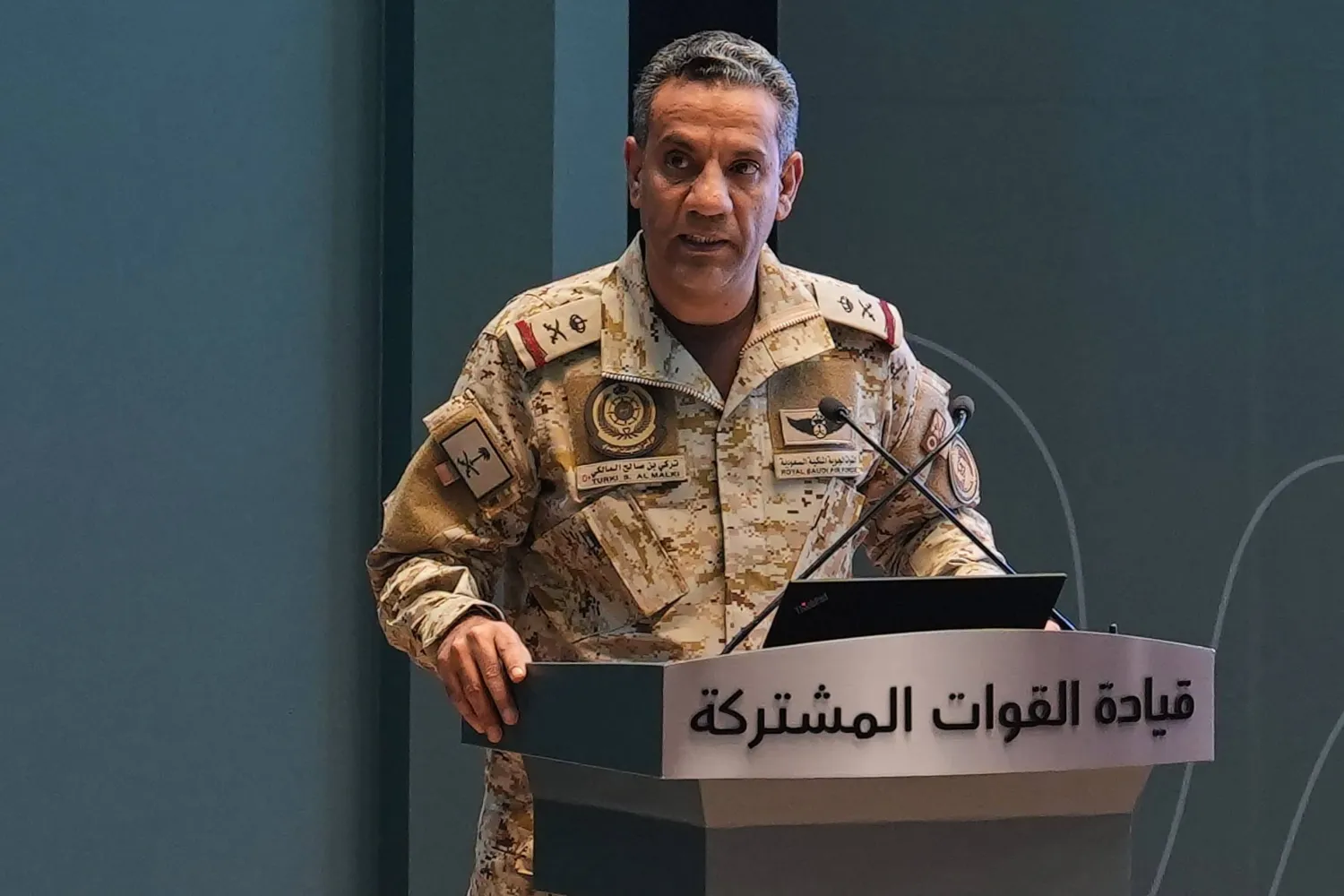
Coalition to Restore Legitimacy in Yemen Spokesman Major General Turki Al-Malki speaks during a press conference in Riyadh, Saudi Arabia, Thursday, Oct. 15, 2026. (AP)
TT
TT
Coalition: Drones Launched Toward Saudi Arabia Intercepted, Destroyed
Coalition to Restore Legitimacy in Yemen Spokesman Major General Turki Al-Malki speaks during a press conference in Riyadh, Saudi Arabia, Thursday, Oct. 15, 2026. (AP)
Official Spokesperson for the Coalition to Restore Legitimacy in Yemen Major General Turki Al-Malki said on Wednesday that four drones launched toward Saudi Arabia were intercepted and destroyed.
He added that a drone launched toward the Eastern Region was also intercepted and destroyed.
Earlier, the Coalition said the ballistic missile launcher used by the terrorist Houthi militia in an attack on Riyadh on Tuesday was destroyed.
Saudi forces had intercepted a ballistic missile aimed at the Kingdom's capital, the Coalition said.
The Kingdom "intercepted and destroyed a ballistic missile launched by the terrorist Houthi militia towards Riyadh,” Al-Malki announced in a post on X.
The Saudi civil defense had earlier issued a warning by the National Early Warning Platform in Riyadh City to alert for a potential danger.
لم تشترك بعد
انشئ حساباً خاصاً بك لتحصل على أخبار مخصصة لك ولتتمتع بخاصية حفظ المقالات وتتلقى نشراتنا البريدية المتنوعة