


From Faster Decisions to Less Panic: Five Ways VAR could be Improved

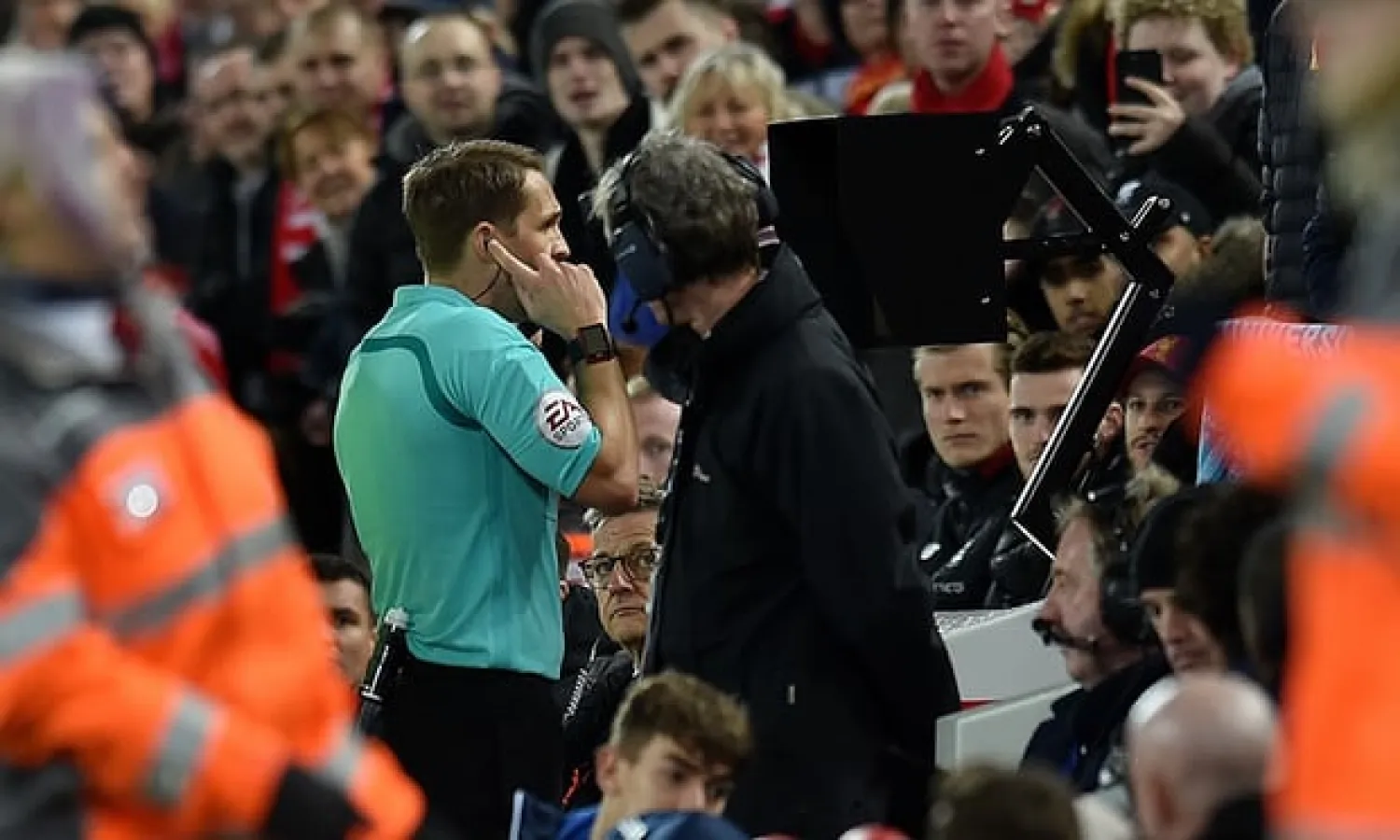
 Craig Pawson consults the VAR system during January’s FA Cup fourth round match between Liverpool and West Bromwich Albion at Anfield. Photograph: Andrew Powell/Liverpool FC via Getty Images
Craig Pawson consults the VAR system during January’s FA Cup fourth round match between Liverpool and West Bromwich Albion at Anfield. Photograph: Andrew Powell/Liverpool FC via Getty Images
TT

From Faster Decisions to Less Panic: Five Ways VAR could be Improved

 Craig Pawson consults the VAR system during January’s FA Cup fourth round match between Liverpool and West Bromwich Albion at Anfield. Photograph: Andrew Powell/Liverpool FC via Getty Images
Craig Pawson consults the VAR system during January’s FA Cup fourth round match between Liverpool and West Bromwich Albion at Anfield. Photograph: Andrew Powell/Liverpool FC via Getty Images

1) Speed the thing up

This is both the trickiest fix to effect and the most vital. On Wednesday night the Wembley crowd could have succumbed to hypothermia in the time it took Paul Tierney to resolve decisions. As Mauricio Pochettino pointed out, having to wait two minutes to know whether you can celebrate a goal is a bit of a buzzkill. VAR is supposed to check all “reviewable” decisions (goals, penalties, red cards, mistaken identity). Goals are particularly problematic because the game stops and cannot restart until a decision is confirmed. Quite simply, these confirmations need to be quicker. Greater experience may help but there is a feeling that some video assistant referees also need a sit down and a reminder of the rules.

2) Apply the bloody rules

Football is a simple game (regulations regarding feinting during a penalty run-up excepted). The rules of VAR are designed to match. “Mimimum interference – maximum benefit” is the motto. Any interjection by the video assistant is supposed to happen only in the case of a decision missed or a “clear” error having been made. At the Spurs-Rochdale match, Érik Lamela’s opening goal was ruled out by VAR. Yet no number of replay viewings reveals a clear and obvious error. A possible infringement? Yes. But not a clear error. There is perhaps a lesson here. If you cannot see an error at the first time of reviewing it, then it is not a clear error.

3) Tell people what is going on

We still do not know precisely which error caused the Lamela goal to be ruled out. This is because referees (never mind their video assistants) do not speak to the media after matches. It is also because there is an absence of communication from officials to fans in the ground. As it stands, nobody knows why VAR intercedes and on what grounds it is doing so. Half the time it is difficult to tell when VAR is being used at all. Again it is not as if there are no solutions to this: referees could wear microphones and relay information through the tannoy; screens inside the stadium could also pass on information. It does not even need to be a full explanation of the process. At this stage, any information at all would be nice.

4) Empower the referee

VAR is a two-way thing. If referees are worried about a decision they can ask the video assistant to check. If the assistant spots something the referee should be aware of, he or she can let them know. The dialogue is supposed to aid a referee, who will always have the final say. But at Wembley it did not feel as if Tierney was being empowered. There were several agonising periods during the game in which he was forced to stand still – finger in ear – as he waited for instructions that would allow him to carry on with his job. When the credibility of the referee is constantly being questioned such an experience is hardly reaffirming. Again, protecting the referee is a cornerstone of VAR in principle, but it needs to be worked out in practice.

5) Do not panic

Given that a single refereeing decision can spark a 24-hour media storm (traditional and social, by the way), a malfunctioning refereeing system is naturally proving catnip. The talk has now moved on from whether VAR would prove to be an omniscient panacea to whether it should be ditched for ever. The truth is that we remain in a trial period and, as of Wednesday, only half a dozen matches have taken part in it. At this stage some of the issues are glaring but technically solvable. Other issues to do with the culture of football (ie fans do not like breaks) may be more intractable but, again, are recognised in VAR’s own principles. The Premier League meets to vote on the technology next month. The clubs could approve or deny it but they could also seek to trial it further.

The Guardian Sport


Sunderland Worst Hit by Losing Players to African Cup of Nations 

14 December 2025, United Kingdom, London: Sunderland's Habib Diarra (L) and Leeds United's Gabriel Gudmundsson battle for the ball during the English Premier League soccer match between Brentford and Leeds United at the Gtech Community Stadium. (dpa)
TT

Sunderland Worst Hit by Losing Players to African Cup of Nations 

14 December 2025, United Kingdom, London: Sunderland's Habib Diarra (L) and Leeds United's Gabriel Gudmundsson battle for the ball during the English Premier League soccer match between Brentford and Leeds United at the Gtech Community Stadium. (dpa)

Premier League Sunderland will have to do without six players over the next few weeks and are the club worst hit as the Africa Cup of Nations takes its toll on European clubs competing over the holiday season.

Sunderland, eighth in the standings, had four of their African internationals in action when they beat Newcastle United on Sunday, but like 14 other English top-flight clubs will now lose those players to international duty.

The timing of the African championship, kicking off in Morocco on Sunday and running through to January 18, has long been an irritant for coaches, with leagues in Belgium, France, Germany, Italy, Netherlands, Portugal, and Spain also affected.

Hosting the tournament in the middle of the season impacts around 58% of the players at the Cup of Nations, though the Confederation of African Football did try to mitigate the impact by moving the start to before Christmas, so it is completed before the next round of Champions League matches.

The impact on European clubs was also lessened by allowing them to release players seven days, rather than the mandatory 14 days, before the tournament, meaning they could play for their clubs last weekend.

Sunderland's Congolese Arthur Masuaku and Noah Sadiki, plus full back Reinildo (Mozambique), midfielder Habib Diarra (Mali), and attackers Chemsdine Talbi (Morocco) and Bertrand Traore (Burkina Faso) have now departed for Morocco.

Ironically, Mohamed Salah’s absence from Liverpool to play for Egypt should lower the temperature at the club after his recent outburst against manager Arne Slot, but Manchester United will lose three players in Noussair Mazraoui, Bryan Mbeumo and Amad Diallo, who scored in Monday’s 4-4 draw with Bournemouth.

France is again the country with the most players heading to the Cup of Nations, and with 51 from Ligue 1 clubs. But their absence is much less impactful than previously as Ligue 1 broke after the weekend’s fixtures and does not resume until January 2, by which time the Cup of Nations will be into its knockout stage.

There are 21 players from Serie A clubs, 18 from the Bundesliga, and 15 from LaLiga teams among the 24 squads at the tournament in Morocco.


Rodgers Takes Charge of Saudi Team Al-Qadsiah After Departure from Celtic 

Then-Celtic head coach Brendan Rodgers greets supporters after a Europa League soccer match between Red Star and Celtic at Rajko Mitic Stadium in Belgrade, Serbia, Sept. 24, 2025. (AP)
TT

Rodgers Takes Charge of Saudi Team Al-Qadsiah After Departure from Celtic 

Then-Celtic head coach Brendan Rodgers greets supporters after a Europa League soccer match between Red Star and Celtic at Rajko Mitic Stadium in Belgrade, Serbia, Sept. 24, 2025. (AP)

Brendan Rodgers has returned to football as the coach of Saudi Arabian club Al-Qadsiah, six weeks after resigning from Scottish champion Celtic.

Al-Qadsiah, whose squad includes Italian striker Mateo Retegui and former Real Madrid defender Fernandez Nacho, is in fifth place in the Saudi Pro League in its first season after promotion.

Rodgers departed Celtic on Oct. 27 and has opted to continue his managerial career outside Britain for the first time, having previously coached Liverpool, Leicester and Swansea.

In its statement announcing the hiring of Rodgers on Tuesday, Al-Qadsiah described him as a “world-renowned coach” and said his arrival “reflects the club’s ambitious vision and its rapidly growing sporting project.”

Aramco, the state-owned Saudi oil giant, bought Al-Qadsiah in 2023 in a move that has helped to transform the club’s status.

“This is a landmark moment for the club,” Al-Qadsiah chief executive James Bisgrove said. “The caliber of his experience and track record of winning reflects our ambition and long-term vision to establish Al-Qadsiah as one of Asia’s leading clubs.”

Rodgers is coming off winning back-to-back Scottish league titles with Celtic, where he won 11 major trophies across his two spells. He also won the FA Cup with Leicester.

Al-Qadsiah's last two coaches were former Liverpool striker Robbie Fowler and former Spain midfielder Michel.


Portugal to Return to F1 Calendar in 2027 and 2028 

12 July 2025, United Arab Emirates, Abu Dhabi: Red Bull driver Max Verstappen leads into turn one during the Abu Dhabi Grand Prix at the Yas Marina Circuit, Abu Dhabi. (dpa)
TT

Portugal to Return to F1 Calendar in 2027 and 2028 

12 July 2025, United Arab Emirates, Abu Dhabi: Red Bull driver Max Verstappen leads into turn one during the Abu Dhabi Grand Prix at the Yas Marina Circuit, Abu Dhabi. (dpa)

Formula One will return to Portugal's Portimao circuit in 2027 and 2028 after the Dutch Grand Prix at Zandvoort drops off the calendar.

Formula One announced a two-year deal in a statement on Tuesday.

The 4.6-km Algarve International circuit in the country's south last hosted the Portuguese Grand Prix in 2020 and 2021, both seasons impacted by the COVID-19 pandemic with stand-in venues.

In 2020, seven-times world champion Lewis Hamilton took his 92nd career win at Portimao, breaking the record previously held by Michael Schumacher. Hamilton also won in 2021.

"The interest and demand to host a Formula One Grand Prix is the highest that it has ever been," said Formula One chief executive Stefano Domenicali, thanking the Portuguese government and local authorities.

The financial terms of the deal were not announced.

"Hosting the Grand Prix in the Algarve reinforces our regional development strategy, enhancing the value of the territories and creating opportunities for local economies," said Economy Minister Manuel Castro Almeida.

Portugal first hosted a grand prix in Porto in 1958, with subsequent races at Monsanto and Estoril near Lisbon. The late Brazilian great Ayrton Senna took his first grand prix pole and win at the latter circuit in 1985.

Formula One announced last year that Zandvoort, a home race for four-times world champion Max Verstappen, would drop off the calendar after 2026.

The championship already features a record 24 races and Domenicali has spoken of European rounds alternating to allow others to come in.

Belgium's race at Spa-Francorchamps is due to be dropped in 2028 and 2030 as part of a contract extension to 2031 announced last January.
