Saudi Crown Prince Visits Mojave Air and Space Port in Californiahttps://english.aawsat.com/home/article/1224706/saudi-crown-prince-visits-mojave-air-and-space-port-california
Saudi Crown Prince Visits Mojave Air and Space Port in California
Saudi Crown Prince Mohammed bin Salman visits the Virgin Galactic Company and Mojave Air and Space Port in California. (SPA)
Saudi Crown Prince Mohammed bin Salman, Deputy Prime Minister and Minister of Defense, paid a visit to Virgin Galactic Company and Mojave Air and Space Port in California, reported the Saudi Press Agency on Monday.
Upon his arrival, he was received by the founder of Virgin Group, Chairman of the Board of Directors of Virgin Galactic Richard Branson and the Chief Executive Officers of several Group's subsidiaries.
During the visit, Prince Mohammed was briefed on the progress achieved by Virgin Galactic and its plan to launch the first spacecraft to monitor Earth.
He also inspected latest advanced technologies in this regard.
Branson introduced the high-speed Hyperloop transportation system that connects cities and shortens distances, said SPA.
And for the first time, Virgin Galactic unveiled new and unique aircraft fuel compartments, in addition to a presentation on spacecraft that will enter commercial services.
The officials reviewed the areas of existing investment partnership, ways of developing them especially in space services, opportunities for deepening cooperation in modern technologies through research, manufacturing, and training Saudi youths, and transforming the Kingdom from a consumer to a producer of technology.
Prince Mohammed was accompanied on his visit by Prince Khalid bin Salman bin Abdulaziz, Saudi Ambassador in Washington, and members of the official delegation traveling with the Crown Prince on his official trip to the United States.
Prior to arriving in Los Angeles, Prince Mohammed had paid a visit to Seattle.
King Salman: We Thank God for Honoring Us With Serving the Two Holy Mosques and Caring for Pilgrimshttps://english.aawsat.com/gulf/5277768-king-salman-we-thank-god-honoring-us-serving-two-holy-mosques-and-caring-pilgrims
King Salman: We Thank God for Honoring Us With Serving the Two Holy Mosques and Caring for Pilgrims
Custodian of the Two Holy Mosques King Salman bin Abdulaziz (Asharq Al-Awsat)
Custodian of the Two Holy Mosques King Salman bin Abdulaziz on Wednesday expressed “gratitude to Almighty God for honoring us with the service of the Two Holy Mosques and the care of pilgrims to His Sacred House.”
King Salman prayed that God accept the pilgrims’ Hajj, rituals and acts of worship.
“With the advent of the blessed Eid al-Adha, we congratulate our people in this blessed homeland and our Islamic nation on this occasion, and pray to Him Almighty to make it an Eid of goodness, peace and stability for our nation and the entire world. May you all be well every year,” the king said.
Since dawn on the first day of Eid al-Adha, pilgrims have begun performing the stoning ritual at Mina, casting seven pebbles at the Grand Jamarat (Jamarat al-Aqaba), amid smooth crowd movement under the prepared dispatching plan.
About 1.7 million pilgrims departed to Muzdalifah after sunset on Tuesday following their standing at Arafat to perform the greatest pillar of Hajj, in safety and dressed in unified white garments.
Security and service teams were deployed across the holy sites to oversee pilgrims’ movement from Arafat to Muzdalifah, where they remained until dawn on Wednesday, the morning of Eid al-Adha, in preparation for proceeding to Mina to perform the stoning of Jamarat al-Aqaba, Tawaf al-Ifadah, the sacrificial offering, and the shaving or trimming of hair, before staying in Mina for the remainder of the Hajj rites.
Saudi Interior Minister Prince Abdulaziz bin Saud bin Naif said the level of security, organizational and service integration across the Hajj system, along with its advanced capabilities and preparations, reflects the scale of care provided to pilgrims and enhances the efficiency of implementing security and operational plans to ensure their safety and enable them to perform their rituals with ease and reassurance.
On Tuesday, the interior minister inspected the Special Security Forces of the Presidency of State Security participating in the Hajj security forces, praising the specialized efforts carried out by the units.
Pilgrims Perform Stoning Ritual at Jamrat Al-Aqaba in Minahttps://english.aawsat.com/gulf/5277644-pilgrims-perform-stoning-ritual-jamrat-al-aqaba-mina
Muslim pilgrims cast stones at a pillar symbolizing Satan, during the annual hajj pilgrimage in Mina, Saudi Arabia, May 27, 2026. REUTERS/Ibraheem Abu Mustafa
Pilgrims Perform Stoning Ritual at Jamrat Al-Aqaba in Mina
Muslim pilgrims cast stones at a pillar symbolizing Satan, during the annual hajj pilgrimage in Mina, Saudi Arabia, May 27, 2026. REUTERS/Ibraheem Abu Mustafa
Pilgrims arriving from Muzdalifah began at dawn Wednesday performing the stoning ritual at Jamrat Al-Aqaba in Mina on the first day of Eid Al-Adha, amid an integrated system of security, health, and organizational services provided by the relevant Saudi authorities to facilitate the performance of rituals.
The Jamarat facility witnessed smooth crowd movement supported by direct field monitoring and operational plans designed to regulate pedestrian flows and ensure safe mobility between the holy sites.
Authorities were on hand around the facility through the deployment of ambulance and medical teams, guidance and awareness services, and enhanced sanitation and cleaning operations to provide a safe and comfortable environment for pilgrims.
Meanwhile, shuttle buses and Al Mashaaer Al Mugaddassah Metro continued transporting pilgrims between the holy sites according to operational schedules aligned with traffic and crowd-management plans aimed at easing movement and reducing travel time.
Stoning of Jamrat Al-Aqaba marks one of the key Hajj rituals performed by pilgrims following their overnight stay in Muzdalifah, before continuing the remaining rites of the Day of Al-Nahr (Day of Sacrifice), including animal sacrifice, hair shaving or trimming, and Tawaf Al-Ifadah.
Hajj Pilgrims Head to Muzdalifah after Arafat, as Mina Prepares for Their Returnhttps://english.aawsat.com/gulf/5277513-hajj-pilgrims-head-muzdalifah-after-arafat-mina-prepares-their-return
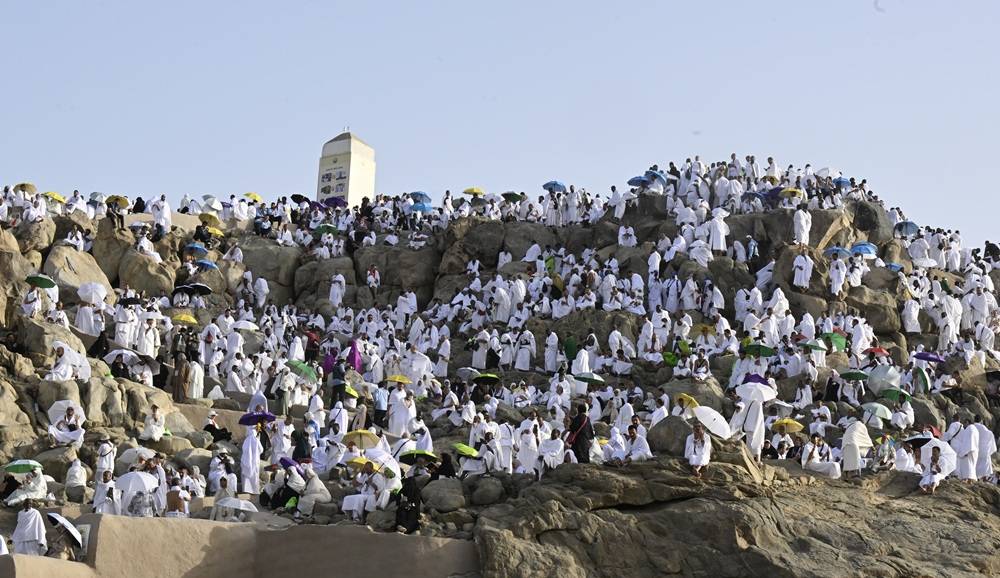
Muslim pilgrims pray on Saudi Arabia's Mount Arafat, also known as Jabal al-Rahma or Mount of Mercy, during the climax of the Hajj pilgrimage early on May 26, 2026. (AFP)
Hajj Pilgrims Head to Muzdalifah after Arafat, as Mina Prepares for Their Return
Muslim pilgrims pray on Saudi Arabia's Mount Arafat, also known as Jabal al-Rahma or Mount of Mercy, during the climax of the Hajj pilgrimage early on May 26, 2026. (AFP)
Hajj pilgrims began heading to Muzdalifah at sunset on Tuesday, the ninth day of Dhu al-Hijjah, to spend the night there after standing on the plain of Arafat and completing the greatest pillar of the Hajj.
The move came after pilgrims spent the Day of Tarwiyah in Mina, following the Sunnah of the Prophet Mohammed.
Saudi security and service teams were deployed across the holy sites to manage the movement from Arafat to Muzdalifah, where pilgrims will remain until dawn on Wednesday, the first day of Eid al-Adha.
They will then head to Mina to stone Jamarat al-Aqaba, sacrifice their animals, shave or shorten their hair, and stay there for the remaining days of the pilgrimage.
In a solemn scene, about 1.7 million pilgrims, according to the General Authority for Statistics, poured into Arafat from the early morning hours of the ninth day of Dhu al-Hijjah to perform Hajj’s central rite.
Dressed in white, they chanted the talbiyah and prayed for forgiveness and mercy on one of the most solemn days of the Hajj.
Muslim pilgrims gather at Jabal al-Rahmah (Mount of Mercy) in the Arafat region near Makkah, Saudi Arabia, 26 May 2026. (EPA)
Their hearts were united by one purpose, seeking pardon, forgiveness, and spiritual renewal. Their colors, nationalities, and languages differed, but their prayers rose as one, pleading for mercy and deliverance from hellfire.
The pilgrims performed the noon and afternoon prayers combined and shortened, with one call to prayer and two iqamahs, at Al-Namirah Mosque in Arafat, in keeping with the Sunnah of the Prophet.
They listened to the Arafat sermon, delivered this year by Sheikh Dr. Ali Al-Hudhaifi, imam and preacher.
Prince Saud bin Mishal bin Abdulaziz, deputy governor of the Makkah Region and deputy chairman of Saudi Arabia’s Permanent Committee for Hajj and Umrah, said at Arafat that the Kingdom’s leadership gives great attention to serving pilgrims and harnessing all technical and human resources so they can perform their rituals safely and smoothly from arrival to departure.
He said Saudi Arabia had been honored with the responsibility of serving the Grand Mosque and its visitors, and had made serving pilgrims a deeply rooted mission passed down through generations and supported by the care of its leadership.
Speaking on behalf of Custodian of the Two Holy Mosques King Salman bin Abdulaziz and Prince Mohammed bin Salman, Crown Prince and Prime Minister, Prince Saud welcomed the pilgrims and said the Day of Arafat embodies the highest meanings of unity and equality.
Saudi Arabia had mobilized all its capabilities and resources to develop projects, prepare facilities, deploy modern technologies, and harness national talent and human expertise to help pilgrims perform their rituals with ease, he stressed.
He said the Kingdom would continue developing the Hajj system and improving services for pilgrims, guided by its noble mission toward Islam and Muslims.
Prince Saud praised pilgrims for their cooperation and adherence to instructions, urging them to maintain awareness and discipline to help ensure the best services and complete their spiritual journey in comfort and calm.
He also commended workers from various sectors serving pilgrims, saying their sincere efforts reflect the noble values and humanitarian principles of Saudi citizens, as well as the honor of serving pilgrims in pursuit of divine reward.
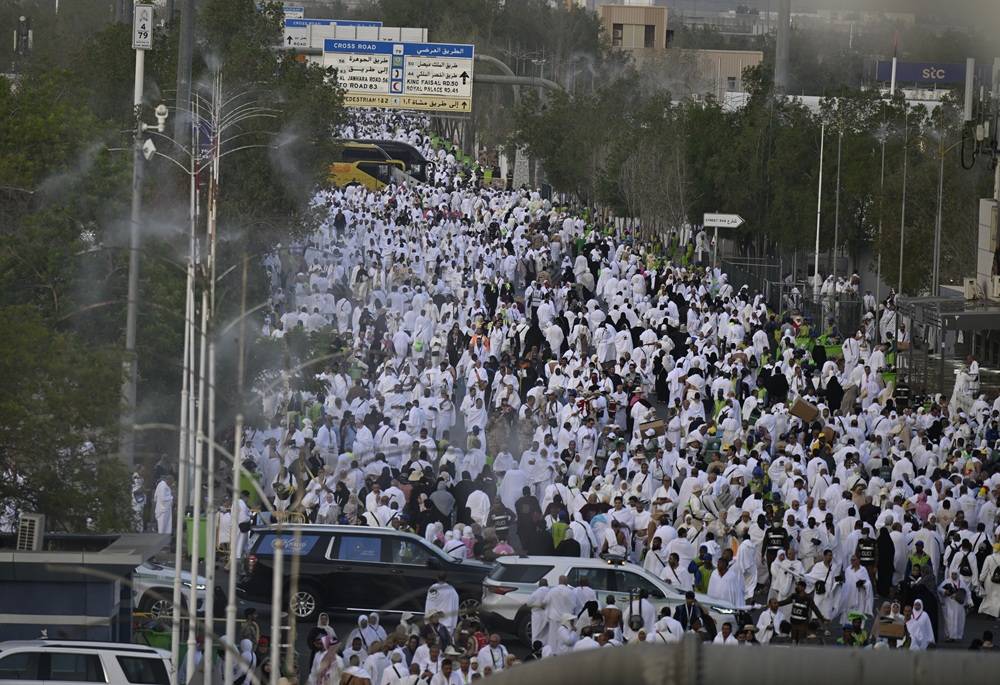
Muslim pilgrims make their way to Jabal al-Rahmah (Mount of Mercy) in the Arafat region near Makkah, Saudi Arabia, 26 May 2026. (EPA)
Carefully planned security operation
The movement of pilgrims from Arafat to Muzdalifah was smooth and flexible, with convoys monitored directly by security teams to organize them according to movement and grouping plans, guide them, and ensure their safety.
The security plan was designed to ease the flow of crowds through the Al-Mashaaer Al-Mugaddassah Metro line, buses, and pedestrian routes, as part of an integrated service system for pilgrims.
Saudi Arabia’s Interior Ministry is tracking pilgrim movements across the holy sites through an advanced digital system that has improved field decision-making, crowd management, service efficiency, and pilgrim safety.
The system uses advanced technologies and smart operating systems to monitor crowd density, pedestrian movement, and transport in key locations. It analyzes live operational indicators using artificial intelligence to improve movement and respond to field developments.
Security operations and control centers linked to the digital system strengthen coordination among security, service, and health agencies at the holy sites through real-time monitoring.
They also help improve performance, maintain services during the Hajj season, forecast crowd density, and manage pilgrim movement.
لم تشترك بعد
انشئ حساباً خاصاً بك لتحصل على أخبار مخصصة لك ولتتمتع بخاصية حفظ المقالات وتتلقى نشراتنا البريدية المتنوعة