What Next for Italy after their Failure to Qualify for the World Cup?

 Luigi Di Biagio will lead Italy against at Wembley. Photograph: Adam Davy/PA
Luigi Di Biagio will lead Italy against at Wembley. Photograph: Adam Davy/PA
TT

What Next for Italy after their Failure to Qualify for the World Cup?

 Luigi Di Biagio will lead Italy against at Wembley. Photograph: Adam Davy/PA
Luigi Di Biagio will lead Italy against at Wembley. Photograph: Adam Davy/PA

Neil Morris: The wrong coach was hired and everything after that was inevitable. This was about incompetence at the top and that’s where the rebuilding needs to start.

Luca Hodges-Ramon: Italy’s failure to qualify represented a nadir in what has been a pretty dismal decade. Barring performances at Euro 2012 and 2016 (the latter was in large part down to the brilliance of Antonio Conte), the era has been one of bad decision-making from the top down, which culminated in the hiring of Giampiero Ventura and the FIGC’s inertia when it was clear Ventura needed firing.

Blair Newman: This was a huge shock but, as bad as Italy were, they only lost out in a play-off to an extremely well-organised Sweden side. That defeat was the culmination of something that started while Conte was in charge. He did an excellent job, but he also ignored a huge amount of talent, particularly young and inexperienced players. His tactics at Euro 2016 papered over the cracks in an ageing and poor squad, which made the transition really hard for his successor, Ventura, to manage.

Emmet Gates: It’s a one-off. They failed to qualify for Euro 92 and came back to make it to the final of USA 94.

Giorgio Chiellini says the art of defending is being ruined. Is this a problem for Italy?

Emmet: As Chiellini himself noted, all defenders (and goalkeepers) are now expected to play the ball. When I see Caldara, Rugani, Romagnoli and so on, I don’t see a new Chiellini, a new Claudio Gentile, a new Ciro Ferrara. I see a lot of Alessandro Nestas, which is hardly a bad thing, but every smooth Nesta needs a Chiellini beside him.

Neil: This is part of a vicious circle. Because defenders such as Chiellini have perfected their art, others teams have been forced to adapt and play another way. As a result, the game has changed and the art of defending has become more intricate. It is now up to Italian defenders to embrace that challenge – thankfully the younger generation are doing so.

Blair: Because of the way tactics have changed, today’s defenders have to be good on the ball, drive forward and pick a pass. It’s surprising to hear Chiellini bemoaning this as he’s proficient in these skills. Young Italian defenders may not have his aggression, but that doesn’t mean Italy is losing its defensive nous. Alessio Romagnoli, Mattia Caldara, Daniele Rugani are all under 24 and they can fill the void when Chiellini and Leonardo Bonucci join Andrea Barzagli in international retirement.

Is Italy’s failure to reach the World Cup down to a decline in talent production?

Blair: Italy still produces top talent, but it’s irrelevant if their path to the national team is blocked by tacticians with rigid ideas. Hopefully their next manager will be more open-minded.

Emmet: Italy has stuttered in producing world-class players, especially in the No10 position. Where is the new Baggio or Totti? The country has some of the highest rising obesity levels in Europe, which suggests younger generations aren’t playing football as much as they did, say, 30 years ago. And the kids who do play are conditioned to get results rather than develop their creativity and innovation. Italy needs to overhaul its footballing ethos. Only in Italy could Rino Gattuso, as hard-working as he was, gain more caps than Roberto Baggio.

Neil: There was enough talent to qualify and they may have avoided Spain in the group had they taken their friendly schedule more seriously. There has been a dip in talent but there are reasons to be excited about the next generation coming through.

Luca: Italy’s youth teams (and current squad) have promising youngsters breaking through: Gianluigi Donnarumma, Lorenzo Pellegrini, Roberto Gagliardini, Bryan Cristante, Chiesa, Caldara, Rugani, Cutrone, Belotti and plenty of others. But at the same time, Italy’s talent pool has undeniably dwindled since their last Word Cup victory in 2006.

Are foreign players in Serie A hampering the development of Italian youngsters?

Luca: People looked for an easy explanation when Italy failed to qualify and, mirroring the current socio-political environment in the country, some impulsively decided to blame foreigners for blocking the path of Italian youngsters. There is a debate to be had here but I fear ignorance and intolerance cloud some people’s judgement. Quotas on foreign players is not the answer – although youth academies need much more investment as they are very underfunded when compared, for example, to their Spanish counterparts.

Emmet: If they were good enough, they’d play. Italy had a wealth of talent in the 1990s when Serie A housed the world’s greatest players, to such an extent that they left out Gianluca Vialli and Roberto Mancini for USA 94, Baggio and Beppe Signori for Euro 96, Gianfranco Zola and Fabrizio Ravanelli for France 98.

Neil: Last year 52% of players in Serie A were foreign. Compare that to 56.1% in Portugal (who won Euro 2016) and 53% in Germany (who won the 2014 World Cup) and you see the argument does not stack up. Foreign players make up 64% of the Premier League yet England qualified easily.

Is caretaker boss Luigi Di Biagio the best option going forward?

Luca: Carlo Ancelotti would not only bring a wealth of experience and tactical nous, but his quiet leadership style would help restore confidence and nurture Italy’s youngsters.

Blair: Di Biagio has experience working with the new generation but I wasn’t hugely convinced by his U21 side. Vincenzo Montella could be a good call. He’s not tied to his systems; he’s not dogmatic; and, as he showed at Milan, he’s willing to give young players a chance.

Emmet: Ancelotti. He has won the Champions League more times than any manager alive so has nothing to prove at club level. The international arena would suit him perfectly: he’s a cup specialist who can maximise players for short bursts of excellence and he would command respect from every Italian player, something Ventura did not have as he hadn’t won anything as a manager.

Which three players will be integral in leading Italy to Euro 2020?

Emmet: Marco Verratti, if he leaves the glass ceiling of PSG and develops his abilities; Belotti, who also needs to move on from Torino to grow; and Lorenzo Insigne.

Neil: Jorginho will pull the strings in the midfield for many years to come; Insigne is perhaps Italy’s most creative player; and Caldara will emerge, alongside Rugani, as a crucial part of what should be a new-look defence in 2020.

Luca: Jorginho can become Italy’s next great midfield conductor; Insigne is one of the few senior squad members with genuine flair; and Rugani will step into Chiellini’s role.

Blair: Jorginho is the beating heart of Napoli’s possession game so must start in the deep-lying midfield role; Verratti needs to step up; and Belotti can lead the line.

The Guardian Sport


MLS Announces Key 2027 'Sprint Season' Matches Ahead of Calendar Shift

Inter Miami's Argentine forward #10 Lionel Messi looks on during a Major League Soccer (MLS) regular season football match between Inter Miami CF and FC Cincinnati at Nu Stadium in Miami, Florida, on October 28, 2026. (Photo by Giorgio VIERA / AFP)
TT

MLS Announces Key 2027 'Sprint Season' Matches Ahead of Calendar Shift

Inter Miami's Argentine forward #10 Lionel Messi looks on during a Major League Soccer (MLS) regular season football match between Inter Miami CF and FC Cincinnati at Nu Stadium in Miami, Florida, on October 28, 2026. (Photo by Giorgio VIERA / AFP)

Lionel Messi's Inter Miami will kick off Major League Soccer's 2027 "Sprint Season" when they face Cincinnati on February 19, launching the league's transition to a traditional autumn-to-spring calendar.

The standalone match at Nu Stadium in Miami will begin a truncated 14-game regular season and playoff tournament designed to bridge the gap as MLS shifts away from its traditional summer schedule to align with Europe's top leagues.

The schedule, previewed on Apple TV's "MLS Countdown," emphasizes weekly rivalry ⁠matchups. Among the ⁠headline games announced, LA Galaxy will host Los Angeles FC on April 10 in the "El Trafico" derby.

The sprint season will conclude its regular-season slate on May 8 with "Decision Day," anchored by the Hudson River Derby between New York ⁠City FC and the New York Red Bulls, setting the stage for the May playoffs.

The four-month sprint serves as the prelude to the league's full operational shift. The first standard season under the new timetable will run from mid-to-late July 2027 through May 2028, featuring a midwinter break and no matches in January.

MLS Commissioner Don Garber previously called the calendar change "one of the ⁠most ⁠important decisions in our history,” Reuters reported.

The strategic overhaul was approved following a two-year review to synchronize the league's transfer activity with the global summer window, minimize scheduling conflicts with FIFA's international fixtures, and hold the MLS Cup playoffs in May when the North American sports calendar is less crowded.

US men's national team coach Mauricio Pochettino is among those who have endorsed the change, noting that calendar alignment with the global soccer landscape will benefit clubs, coaches, and player development.


Rybakina Clinches Year-end Top Ranking with Tokyo Second-round Win

Tennis - WTA 500 - Pan Pacific Open - Ariake Coliseum, Tokyo, Japan - October 29, 2026 Kazakhstan's Elena Rybakina celebrates after winning her round of 16 match against Kazakhstan's Yulia Putintseva REUTERS/Kim Kyung-Hoon
TT

Rybakina Clinches Year-end Top Ranking with Tokyo Second-round Win

Tennis - WTA 500 - Pan Pacific Open - Ariake Coliseum, Tokyo, Japan - October 29, 2026 Kazakhstan's Elena Rybakina celebrates after winning her round of 16 match against Kazakhstan's Yulia Putintseva REUTERS/Kim Kyung-Hoon

Elena Rybakina beat fellow Kazakh Yulia Putintseva 6-2 6-3 in the second round of the Pan Pacific Open in Tokyo on Thursday to secure the year-end world number one ranking for the first time, more than a week before the season-ending WTA Finals.

Rybakina received a bye into the last 16 of the WTA 500 event in Tokyo and arrived at the Ariake Coliseum after capturing her fourth ⁠title of the ⁠season and first as the top-ranked player at last week's Ningbo Open in China.

The 27-year-old, who rose to world number one for the first time en route to winning the US Open last month, ⁠needed only one more victory this year to ensure that world number two Aryna Sabalenka could not overtake her.

Rybakina is enjoying a marquee year with wins at the Australian Open and US Open to take her Grand Slam tally to three, after winning Wimbledon four years ago.

Rybakina next faces Leylah Fernandez in a rematch of their Ningbo final, ⁠after ⁠the Canadian beat Elise Mertens 6-2 7-6(8), Reuters reported.

Rybakina endured a brief dip after her US Open triumph, losing her opening match in Beijing and missing the Wuhan Open due to a leg injury, before defending her title in Ningbo.

She is targeting a 16th career title before heading to Indian Wells, California, for the WTA Finals, where the season's top eight players will compete from November 8-15.


Naomi Osaka Knocked Out of Tournament in Japan by 18-year-old Mia Pohankova

Tennis - WTA 500 - Pan Pacific Open - Ariake Coliseum, Tokyo, Japan - October 29, 2026 Slovakia's Mia Pohankova embraces Japan's Naomi Osaka after winning her round of 16 match REUTERS/Kim Kyung-Hoon
TT

Naomi Osaka Knocked Out of Tournament in Japan by 18-year-old Mia Pohankova

Tennis - WTA 500 - Pan Pacific Open - Ariake Coliseum, Tokyo, Japan - October 29, 2026 Slovakia's Mia Pohankova embraces Japan's Naomi Osaka after winning her round of 16 match REUTERS/Kim Kyung-Hoon

Naomi Osaka, seeded No. 7 and playing before home fans in Japan, was knocked out of the Pan Pacific Open on Thursday by Mia Pohankova of Slovakia.

Pohankova, who turned 18 a week ago and was a wildcard entry in Japan, upset Osaka 6-3, 7-5 to advance to the quarterfinals after a match that lasted 1 hour, 35 minutes.

Pohankova will face Alycia Parks in the quarterfinals. Pohankova was the 2025 junior singles champion at Wimbledon.

Osaka was coming off a win over Jasmine Paolini in the first round in Tokyo.

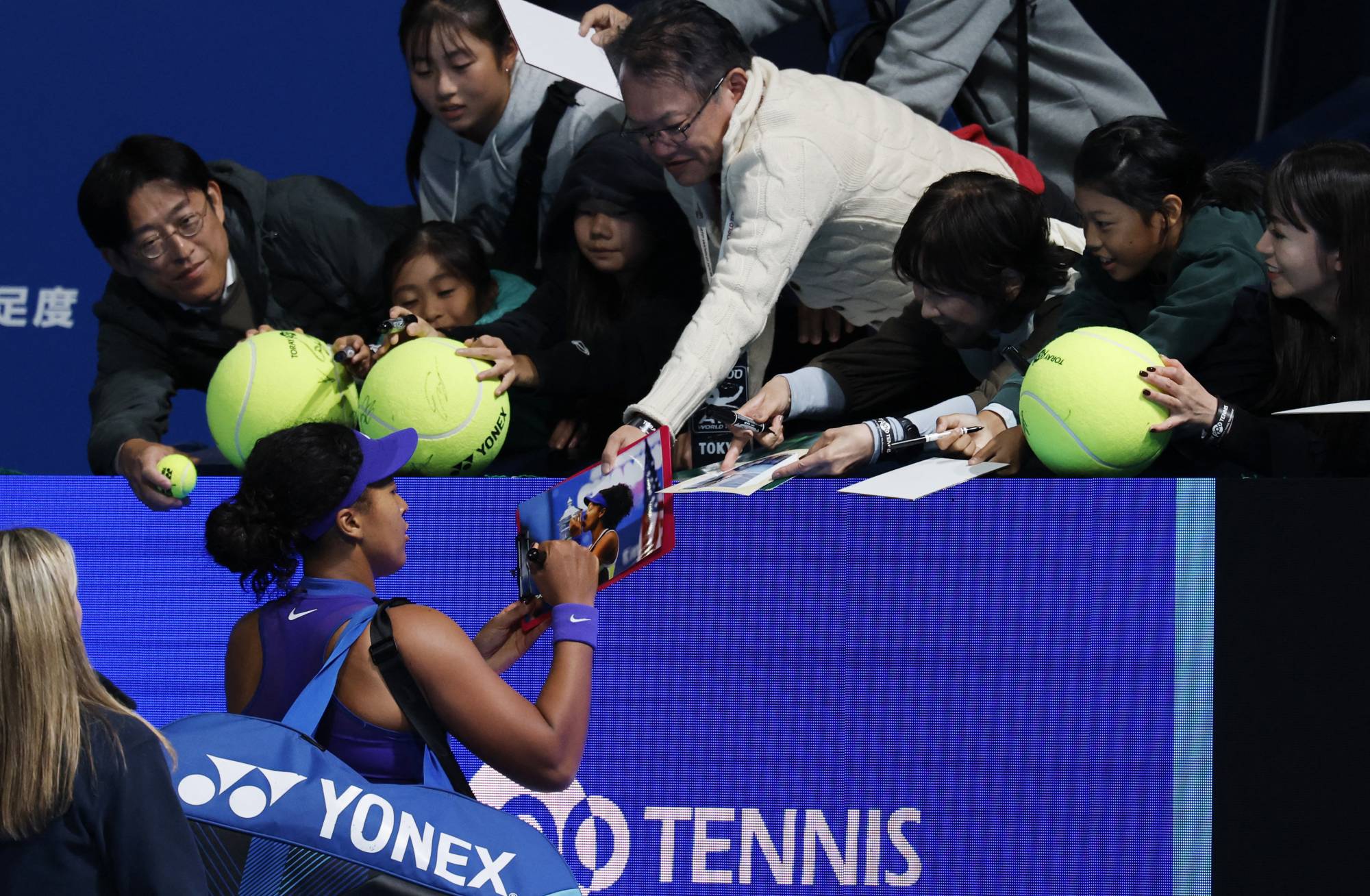
Tennis - WTA 500 - Pan Pacific Open - Ariake Coliseum, Tokyo, Japan - October 29, 2026 Japan's Naomi Osaka signs autographs after her round of 16 match against Slovakia's Mia Pohankova REUTERS/Kim Kyung-Hoon

In other round-of-16 matches on Thursday at the Pan Pacific Open, Parks defeated Kimberly Birrell 6-3, 6-1, and Leylah Fernandez defeated No. 5 Elise Mertens 6-2, 7-6 (8), The Associated Press reported.

In a late match, top-ranked Elena Rybakina faced Yulina Putintseva. Both were born in Russia but represent Kazakhstan.

Second-seeded Maja Chwalinska and No. 4 Belinda Bencic pulled out of the tournament earlier with injuries. Chwalinska has an injured left thigh and Bencic has a right-ankle injury.