

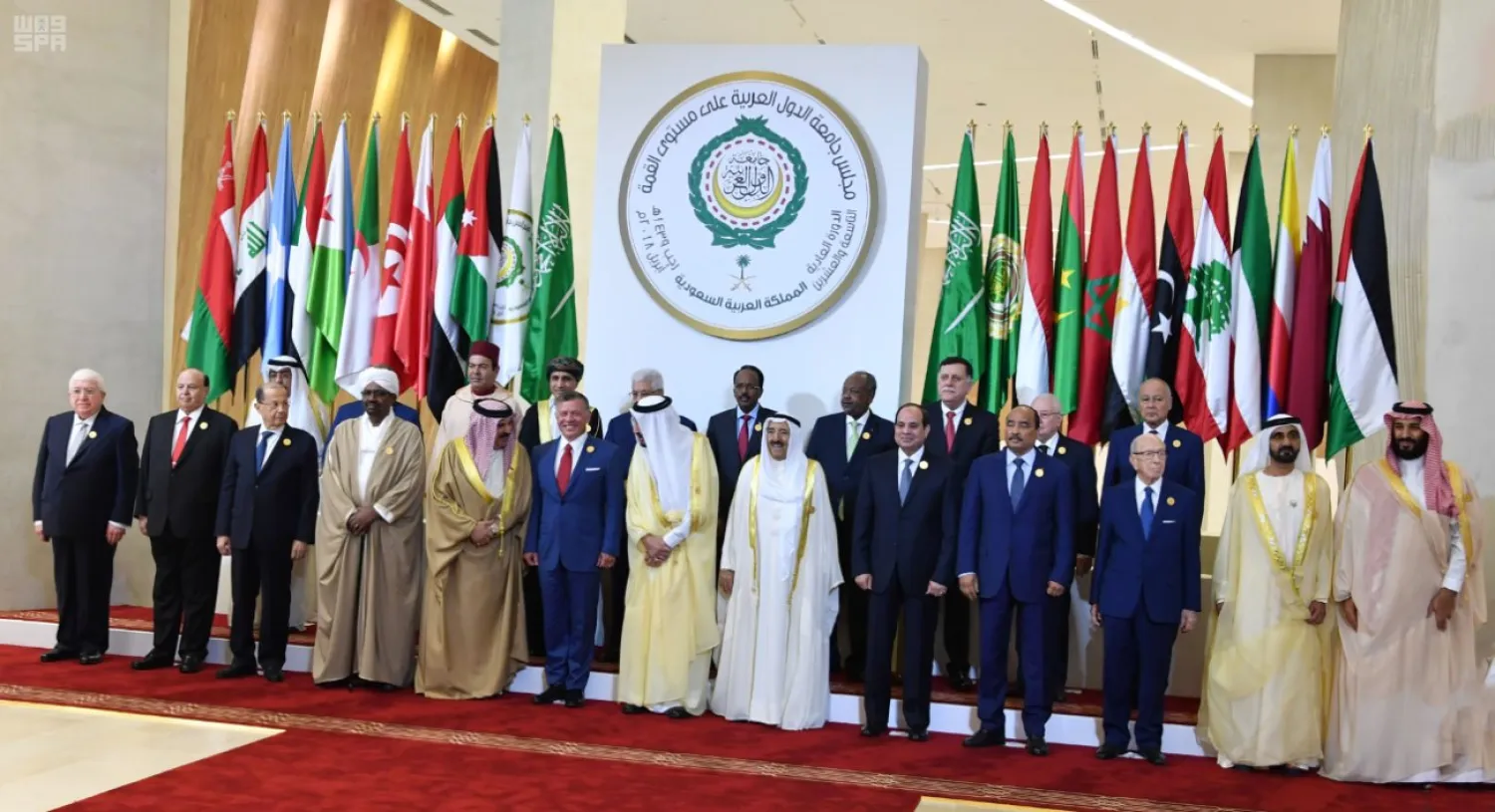

Arab Summit Underlines Palestinian Cause, Condemns Foreign Meddling

Arab leaders pose for a photo at the 29th Arab League summit in Dhahran. (SPA)
TT

Arab Summit Underlines Palestinian Cause, Condemns Foreign Meddling

Arab leaders pose for a photo at the 29th Arab League summit in Dhahran. (SPA)

The 29th Arab League summit concluded on Sunday with gatherers underlining the centrality of the Palestinian cause.

Held in the Saudi city of Dhahran, the summit’s closing statement also called on regional countries to respect the sovereignty of Arab nations. To that end, they urged support for strategies that bolster Arab national security.

In a statement to reporters at the end of the annual gathering, Saudi Foreign Minister Adel al-Jubeir said that the summit condemned the use of chemical weapons in Syria and demanded an international probe in the attack.

The Arab leaders also called for reaching a political solution to the crisis.

Jubeir added that Saudi Arabia remains a “firm and constant” supporter of the Palestinian cause.

The Arab summit also condemned Iran’s meddling in regional affairs and its Houthi proxies for targeting Saudi Arabia and the Yemeni people.

Saudi Custodian of the Two Holy King Salman bin Abdulaziz concluded the summit, which saw the attendance of kings, presidents and leaders of 17 Arab countries.

The 30th Arab summit will be held in Tunisia in 2019.

Earlier, leaders speaking at the opening of the 29th summit stressed the importance of ensuring the rights of the Palestinian people and cementing the national security of the entire Arab world.

Arab League Secretary General Ahmed Abul Gheit lamented the United States’ decision to relocate its embassy in Israel to Jerusalem, saying that the Arabs have managed to garner international condemnation for the move.

It is not enough however, he added, stressing that the Palestinians need more support to counter “attempts to defeat their cause and violate their rights.”

On Syria, he stated that the regime held the majority of the responsibility for the “collapse of the nation and displacement of the people.”

“I do not acquit regional and international players, each of whom are trying to achieve political and strategic goals over Syrian corpses and rubble of their dreams of a normal life,” continued Abul Gheit.

He said that the Syrian people’s dream of restoring their nation remains beyond their reach, hoping that the Arab leaders would be able to seize control of the situation and draft a joint strategy that would push forward the political solution based on the Geneva talks.

On the overall Arab scene, he said that regional meddling, spearheaded by Iran, has reached an unprecedented level.

Tehran, he said, does not harbor the Arabs any good intentions, as demonstrated by its destructive role in their countries, such as in Yemen.

He therefore called on the Arabs to take a united stand to speak out against this destructive aggression.

Secretary General of the Organization of Islamic Cooperation (OIC) Dr. Yousef bin Ahmed Al-Othaimeen highlighted the Palestinian cause, which has been at the heart of the organization’s concerns.

He stressed the need to adhere to Arab League statements related to the cause and its commitment to the two-state solution and 2002 Arab initiative. He also voiced concern over the developments in Syria, Yemen and Libya.

European Union High Representative for Foreign Affairs and Security Policy Federica Mogherini expressed her gratitude to Saudi Arabia for its efforts in serving Arab causes.

She emphasized the importance of developing solutions and dealing with the crises in many Arab regions so that people can live in peace and stability.

She condemned the Syrian regime for displacing its own people and attacking them with chemical weapons, saying that the “perpetrators should be held accountable.”

On Iraq, she praised the people’s determination and courage in defeating the ISIS terrorist organization.

With regard to the Palestinian cause, she announced the EU’s readiness to host the sixth meeting on Jerusalem in cooperation with the Arab League. She stressed that her organization will not stop cease its efforts to reach a two-state solution through negotiations with the United Nations, the United States and Russia, as well as all concerned parties and Arab countries.

Emir of Kuwait Sheikh Sabah al-Ahmed al-Jaber al-Sabah warned of the dangers threatening the Arab world, saying the leaders of region must double efforts to resolve their crises.

He stressed the need for establishing mechanisms for joint Arab work that would help confront challenges and overcome current difficulties.

On Syria, he condemned the April 7 regime chemical attack against Douma, saying that it stems from the international community’s failure to resolve the country’s crisis.

On Yemen, he condemned the repeated ballistic missile attacks by the Iran-backed Houthis against Saudi Arabia.

He hailed the Saudi-led Arab coalition aimed at restoring legitimacy in Yemen, highlighting its pioneering role in tackling the difficult humanitarian situation in the country.

The Emir voiced Kuwait’s concern over Washington’s decision to relocate its embassy to Jerusalem, hoping that it would reconsider it and resume its role as a sponsor for peace.

Egyptian President Abdul Fattah al-Sisi said that the Arab summit was being held at a time of unprecedented challenges facing the region, calling for solidarity in confronting threats to the Palestinian cause and meddling in Arab internal affairs.



Illegal Gold Mining Puts Egypt Investment at Risk

Egypt’s petroleum minister tours the Sukari gold mine. (Petroleum Ministry)
TT

Illegal Gold Mining Puts Egypt Investment at Risk

Egypt’s petroleum minister tours the Sukari gold mine. (Petroleum Ministry)

Illegal gold mining in Egypt threatens “investment opportunities and the ability to benefit from the country’s reserves,” as “clashes among illegal prospectors” continue to recur.

Businessman Naguib Sawiris said Egypt’s mineral wealth was being continuously wasted because of random and illegal mining by outlaws, adding that most mining companies suffer from illegal practices that can include threats with weapons.

Commenting on a report on global gold and silver reserves on his X account, Sawiris said such practices, carried out by people, some of whom are not Egyptian, deprive Egypt of becoming one of the countries with the largest gold reserves.

Sawiris is among the businessmen who have long been enthusiastic about investing in gold. In late April, he spoke of injecting about $400 million into the gold mining company in which he is a shareholder, and has bet on gold prices even during periods of price turbulence.

Rahab al-Ghoul, a member of parliament’s Energy and Environment Committee, told Asharq Al-Awsat that illegal mining for gold and minerals threatens investment opportunities, adding that there have been significant efforts recently to confront it. She said that in some desert and mountainous areas, there is cooperation between state agencies and citizens to confront those prospecting for gold.

She added that the state can exercise its sovereignty over any area where foreign companies want to explore, and that the Petroleum Ministry is already holding exploration tenders and cooperating with companies with experience in the field. She stressed the government’s keenness to encourage investment and resolve any obstacles facing investors.

Early last month, the Interior Ministry announced the arrest of a man accused of killing eight others after a fight among a number of people illegally prospecting for gold in the Red Sea governorate in southeastern Egypt.

The incident came one day after one person was killed in similar clashes in the mountainous al-Baramiya area in Aswan governorate in southern Egypt.

There are no official statistics on illegal mining operations, which usually involve selling minerals at prices below their real value.

Economist Karim al-Omda spoke of the difficulties facing investors in gold and silver exploration, including illegal mining operations, or the lack of agreement on attractive shares and incentives for foreign companies, which at times demand high percentages of exploration revenues.

Al-Omda told Asharq Al-Awsat that there is a clear absence of a government investment vision for this sector, unlike the clear vision, for example, in the gas and oil sector. He said random mining wastes existing wealth by depleting it.

Egyptian Minister of Petroleum and Mineral Resources Karim Badawi said during a meeting with leaders of three global mining companies last Wednesday that reforms had been implemented to develop the role of the Mineral Resources Authority so that it becomes an independent economic entity capable of supporting investors with data and technical services, in addition to activating the one-stop-shop mechanism to facilitate dealings with government bodies.

He said at the time that the modern airborne survey project represented an important step toward providing more accurate geological data on promising areas, helping investors make better investment decisions and increasing the likelihood of new discoveries, especially since Egypt has significant mining potential that has not yet been fully exploited.

The government is seeking to launch a major international gold exploration tender covering more than 210 areas in the Eastern Desert, aiming to attract $1 billion in investments by 2030 to increase production.

This comes as part of a plan to raise the mining sector’s contribution to gross domestic product from less than 1% to about 6% by 2030, according to local media reports.

Late last year, the government approved several incentives in the mining sector, including lowering licensing fees and granting tax and customs exemptions on exploration equipment, supplies, and related services, according to repeated statements by the Petroleum Ministry.

Al-Ghoul said these decisions reflect the state's current investment priority in mineral exploration, including gold, adding that some obstacles are being overcome gradually to achieve the maximum benefit.


Iraq’s PMF Declares ‘Complete Split’ from Parties, Factions

PMF chief Faleh al-Fayyadh. (INA)
TT

Iraq’s PMF Declares ‘Complete Split’ from Parties, Factions

PMF chief Faleh al-Fayyadh. (INA)

The head of Iraq’s Popular Mobilization Forces announced the start of implementation of a government order by Prime Minister Ali al-Zaidi, who is also commander-in-chief of the armed forces, to form a committee tasked with reorganizing the relationship with armed factions.

The move is officially being presented as part of a broader effort to place all weapons under state control.

PMF chief Faleh al-Fayyadh said in a television interview that the new committee had begun work on mechanisms for the “complete disengagement” of the PMF from any political, factional, or partisan frameworks.

The aim was to turn the PMF into an institution governed by a unified system and linked to the commander-in-chief of the armed forces, he added.

Fayyadh said the effort was based on the 2016 law governing the PMF and on successive government orders. But he said the war against ISIS had prevented full implementation over the past years.

In a related development, Sabah al-Numan, spokesman for the commander-in-chief of the armed forces, confirmed that a government order had been issued to form a “sovereign” committee that would set binding mechanisms to end the possession of weapons outside state control.

He warned against what he described as the continued “politicization of the military institution,” saying national security required control over weapons.

Fayyadh rejects calls to dissolve PMF

At the same time, Fayyadh rejected local and diplomatic calls to dissolve the PMF after the end of “major battles”, describing such demands as “unrealistic.”

He said the need for security forces, including the PMF, was “permanent” as long as security threats continued.

Fayyadh said those who believed the PMF’s role had ended had a “superficial view,” referring to criticism he sees as driven by political opposition to his forces.

In a more sensitive file, Fayyadh revealed special arrangements involving brigades affiliated with Saraya al-Salam, which is linked to the Sadrist movement, in Samarra.

He said the brigades would be integrated into the PMF structure under new professional arrangements.

The Saraya al-Salam had handed over their security responsibilities to the Iraqi army in Samarra city on Thursday.

Fayyadh said these formations would be “received as individuals and restructured or redeployed in the field as needed.”

He said the objective was to end the idea of “areas belonging to certain factions” in favor of unified military administration.

In a notable statement, he added that some sites would be placed under temporary transitional arrangements supervised by the Iraqi army before being finally redistributed within the PMF.

The developments come as the head of the Security Media Cell, Lieutenant General Saad Maan, announced the start of steps to implement the decision to place weapons under state control.

He said a number of factions, including Asaib Ahl al-Haq and Kataib al-Imam Ali, had begun legal procedures to hand over heavy and medium weapons ahead of integration into official institutions.

Other factions, including Kataib Hezbollah, the Nujaba movement, and Kataib Sayyid al-Shuhada, continue to reject handing over their weapons.

They said disarmament depends on achieving the “goals for which they were formed,” particularly those linked to the presence of foreign forces in Iraq.

The security spokesman for Kataib Hezbollah, Abu Mujahid al-Assaf, said some current initiatives “do not represent the factions of the Islamic Resistance.” The Nujaba said in a statement that weapons were a “red line.”

‘Unified standards’

Fayyadh said the current stage represented a “starting point” for applying unified standards to all formations.

He warned against any political or partisan links within the military structure and said implementation would include all brigades without exception.

Local press reports said leaders of the Coordination Framework have received signals that Washington will not accept symbolic disarmament.

The reports said Washington is instead pushing for the “dissolution of the PMF” and firmly rejects its integration into other security institutions.

Separately, Numan denied on Friday reports of changes in senior leadership positions in the military and security institutions.

He said current commanders were continuing to perform their duties and national responsibilities normally.


Sources to Asharq Al-Awsat: Palestinian Factions Link Gaza Talks Progress to Halt in Assassinations

A Palestinian woman stands at the site of an Israeli strike after residents were warned to evacuate their home in al-Zawaida, central Gaza Strip. (AFP)
TT

Sources to Asharq Al-Awsat: Palestinian Factions Link Gaza Talks Progress to Halt in Assassinations

A Palestinian woman stands at the site of an Israeli strike after residents were warned to evacuate their home in al-Zawaida, central Gaza Strip. (AFP)

Israel is stepping up assassinations of Hamas and Islamic Jihad members even as attention turns to Cairo on Saturday for the first meetings on proposals aimed at breaking the deadlock over the second phase of the Gaza ceasefire.

Asharq Al-Awsat learned from two Hamas sources and a third source from a Palestinian faction that the groups will meet among themselves on Saturday, before the Hamas delegation meets the mediators, to discuss the demands they see as essential to any progress in the talks.

The three sources said the factions will clearly demand an end to the assassinations, which have escalated since Israel killed Ezzeddine al-Haddad, commander of the Qassam Brigades, Hamas’s armed wing, on May 15.

His killing was followed by a series of assassinations targeting prominent figures. Similar operations had preceded it, targeting operatives who took part in a series of attacks, including the Oct. 7, 2023, attack.

“The assassinations and daily violations, in all their details, must stop to show goodwill by Israel and achieve real progress that reflects a positive Israeli acceptance of the mediators’ efforts,” the source said.

The two Hamas sources said halting the assassinations and violations would be a clear condition, and a demand backed unanimously by the factions, to ensure the negotiations succeed.

They said the Palestinian side would show significant flexibility in the current round of talks in a way that serves Palestinian demands.

Those demands will also include requiring Israel to implement its commitments under the first phase, including completing the withdrawal, expanding the operation of crossings, allowing aid into the enclave, and enabling the Gaza administrative committee to assume its duties in Gaza.

A factional source expected the current round to be difficult, citing Israel’s threats to escalate assassinations and carry out larger operations inside Gaza in the coming period if no agreement is reached.

The source said the factions would show flexibility, but not at the expense of their legitimate demands.

All the sources acknowledged that the assassinations had affected internal consultations and decision-making and had also had an operational impact inside the enclave.

The Gaza Health Ministry said 119 Palestinians were killed in May, the highest monthly toll recorded since the start of the year. Women, children, and the elderly made up 30% of the victims. The dead included 19 children, or 16%, and 10 women, or 8.5%.

According to Asharq Al-Awsat’s monitoring, Israel has assassinated more than 17 operatives since targeting Haddad, most of them from Hamas.

On Thursday and Friday, Israel assassinated four commanders and activists from the General Security apparatus and attempted to assassinate two others.