Jordan Postpones Trial of 32 ISIS Members

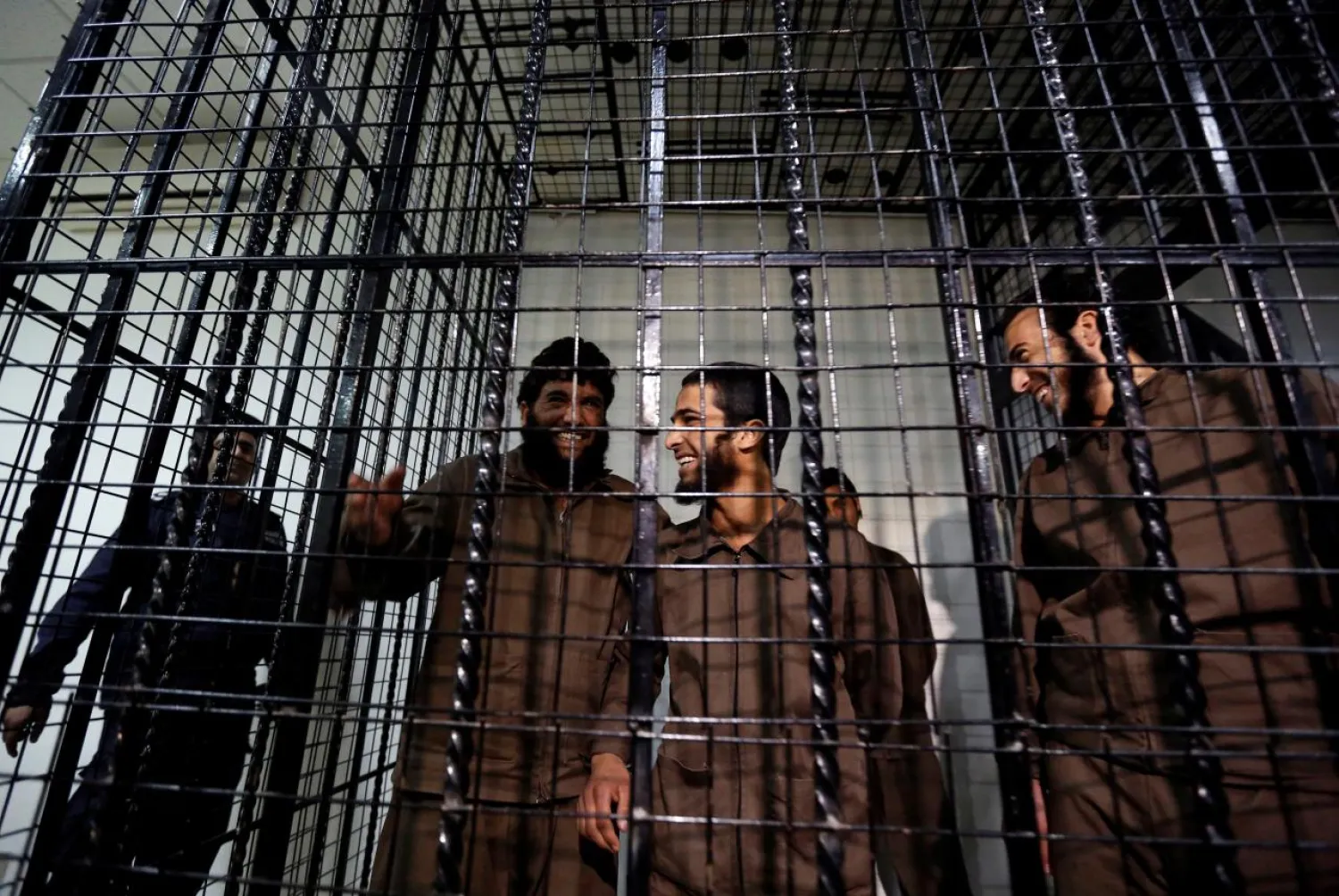
Five Syrians, accused of facilitating the Rukban bombings in June 2016, react during their trial at the State Security Court in Amman, Jordan December 4, 2017. Reuters/Muhammad Hamed
TT

Jordan Postpones Trial of 32 ISIS Members

Five Syrians, accused of facilitating the Rukban bombings in June 2016, react during their trial at the State Security Court in Amman, Jordan December 4, 2017. Reuters/Muhammad Hamed

Jordanian authorities released on Monday spokesman of the banned Tahrir Party Mamdouh Qutaishat, and member of the party's media office Mohammed Zalloum, after they were arrested in February following statements about the visit of US Secretary of State Rex Tillerson to Jordan.

Lawyer of extremist organizations, Mousa al-Abdallat, said the release was made on bail of $7,000 after authorities agreement.

In the same context, lawyer Abdallat told Asharq Al-Awsat that the Jordanian authorities arrested doctor Hisham al-Jayousi on the grounds of belonging to the party, as well as Sami Amir and Haroun Obaid, residents of Amman and have been detained by the governor of the capital for more than 100 days for being members of Tahrir party.

Notably, being member of Tahrir party is punishable by law in Jordan for belonging to an illegal association and the penalty ranges from one to three years in prison.

In a related development, Jordanian State Security Court postponed the trial of 32 defendants, according to Abdallat, who is also the lawyer of several defendants. He indicated the court did not inform his clients of the reason for the delay.

Earlier this month, the Court commenced the trial of 32 ISIS members who planned to carry out terrorist acts against military and security sites, commercial centers, media stations and moderate clerics.

The accused were charged with conspiracy to carry out terrorist acts, promote ideas of a terrorist group, engage in terrorist acts, sell weapons and ammunition to be used in terrorist acts, provide funds for terrorist acts, and possession of weapons for terrorist use as well as not reporting information related to terrorist activity.

In 2016, ISIS first appeared in Jordan, through a cell of the organization, where security forces then launched a preemptive attack on the cell stronghold in the northern city of Irbid. The attack, which turned into a clash lasted the whole night, and ended with the elimination of seven members of the cell and the killing of a member of the Jordanian force.

ISIS also adopted a car bomb in late 2016, inside a Jordanian center on the Syrian border near al-Rukban camp killing seven Jordanian soldiers and wounding 14 others.

The terrorist organization adopted the Karak operation in Jordan which resulted in the killing of the four attacking members, as well as ten others including seven of the security forces, two citizens, and a Canadian tourist.

The State Security Court has tightened the sentences imposed on ISIS members ranging from 3 to 15 years' imprisonment, depending on the actions of each accused.


Israel Military Issues Evacuation Warning for Area of South Lebanon

 Smoke rises following an explosion in southern Lebanon, near the Israel-Lebanon border, as seen from northern Israel, April 28, 2026. (Reuters)
Smoke rises following an explosion in southern Lebanon, near the Israel-Lebanon border, as seen from northern Israel, April 28, 2026. (Reuters)
TT

Israel Military Issues Evacuation Warning for Area of South Lebanon

 Smoke rises following an explosion in southern Lebanon, near the Israel-Lebanon border, as seen from northern Israel, April 28, 2026. (Reuters)
Smoke rises following an explosion in southern Lebanon, near the Israel-Lebanon border, as seen from northern Israel, April 28, 2026. (Reuters)

Israel's military on Tuesday warned residents of more than a dozen villages and towns in southern Lebanon to immediately evacuate and head northwards, saying it would respond to Hezbollah's "violation of the ceasefire" there.

The military "does not intend to harm you, and out of concern for your safety, you are required to evacuate your homes immediately and move away from the specified area towards the Sidon District", Arabic-language spokesman Avichay Adraee posted on X.

"Anyone present near Hezbollah elements, their facilities or their weapons is endangering their life," he added.

All the areas listed in the post appear to be outside or on the border of the so-called "Yellow Line" -- a strip of Lebanese territory around 10 kilometers (six miles) deep along the border within which Israeli troops are operating.

Israel and Iran-backed Hezbollah have traded blame over violations of the fragile ceasefire in Lebanon agreed earlier this month, and attacks by both sides have continued.

In two incidents on Tuesday morning, the Israeli military said an interceptor was launched "toward a suspicious aerial target that was identified in an area where Israeli forces are operating in southern Lebanon".

On both occasions, it said the target did not cross into Israeli territory.

The military also announced on Tuesday morning that one soldier had been severely injured and another lightly injured a day earlier "as a result of an explosive drone impact during operational activity in southern Lebanon".

"This incident constitutes a violation of the ceasefire understandings by the Hezbollah terrorist organization," it said.

Israeli Prime Minister Benjamin Netanyahu said Monday that Hezbollah's rockets and drones remained a key threat requiring action by the Israeli military, adding that Israel was continuing to carry out strikes.

Hezbollah drew Lebanon into the Middle East war on March 2 by firing rockets towards Israel to avenge the killing of Iranian supreme leader Ali Khamenei.


Dozens of Gaza Children Arrive in Jordan for Medical Care

A wounded Palestinian girl, evacuated from Gaza for medical treatment, arrives in an ambulance at the King Hussein Bridge in Jordan, April 27, 2026. (Reuters)
TT

Dozens of Gaza Children Arrive in Jordan for Medical Care

A wounded Palestinian girl, evacuated from Gaza for medical treatment, arrives in an ambulance at the King Hussein Bridge in Jordan, April 27, 2026. (Reuters)

A new group of wounded or ill Palestinian children from Gaza have arrived in Jordan to receive medical care, the kingdom's army said on Tuesday.

They are the 26th group of children transported to Jordan since the start of the war in Gaza in October 2023.

The 81 children, accompanied by 108 family members, arrived through the King Hussein, or Allenby, border crossing between the occupied West Bank and Jordan, the army said in a statement.

It is part of the "Jordanian medical corridor" initiative that King Abdullah II agreed to following a meeting with US President Donald Trump in February 2025.

Under the initiative, around 2,000 children will be transported to Jordan to receive medical care.

Since March last year, more than 716 children have been transferred in cooperation with the World Health Organization, the majority of them suffering from fractures, major wounds or cancer.

"The children will be treated in a number of Jordanian hospitals, as part of the kingdom's ongoing medical and humanitarian efforts to provide healthcare and medical support to our brothers and sisters in the Gaza Strip," the army said.

A ceasefire has largely held in Gaza since last October, but some violence has persisted.


Iraqi Leaders to Begin Thorny Talks on Forming Cabinet

 Iraqi Prime Minister Mohammed Shia al-Sudani meets with Ali al-Zaidi, the Coordination Framework’s nominee for prime minister, in Baghdad, Iraq, April 28, 2026. (Iraqi Prime Minister’s Media Office/Handout via Reuters)
Iraqi Prime Minister Mohammed Shia al-Sudani meets with Ali al-Zaidi, the Coordination Framework’s nominee for prime minister, in Baghdad, Iraq, April 28, 2026. (Iraqi Prime Minister’s Media Office/Handout via Reuters)
TT

Iraqi Leaders to Begin Thorny Talks on Forming Cabinet

 Iraqi Prime Minister Mohammed Shia al-Sudani meets with Ali al-Zaidi, the Coordination Framework’s nominee for prime minister, in Baghdad, Iraq, April 28, 2026. (Iraqi Prime Minister’s Media Office/Handout via Reuters)
Iraqi Prime Minister Mohammed Shia al-Sudani meets with Ali al-Zaidi, the Coordination Framework’s nominee for prime minister, in Baghdad, Iraq, April 28, 2026. (Iraqi Prime Minister’s Media Office/Handout via Reuters)

Iraqi leaders are expected to begin complex talks on Tuesday over forming a government and allocating cabinet portfolios under new prime minister-designate Ali al-Zaidi.

Five months on from elections, Iraq remains deadlocked in negotiations over a new administration, after US pressure scuppered the choice for prime minister of the majority bloc in parliament.

Two-time ex-premier Nouri al-Maliki, who has close ties to Iran, had been endorsed by the bloc but was forced to step back after an ultimatum from US President Donald Trump.

Since the 2003 invasion of Iraq led by the United States, the country has walked a tightrope between the competing influences of Washington and Tehran.

On Monday, Iraq's new President Nizar Amedi nominated businessman Zaidi as prime minister-designate, giving him the daunting task of putting a cabinet together in the next 30 days amid fierce political wrangling.

The Coordination Framework -- the majority bloc in parliament and an alliance of Shiite groups with varying ties to Iran, had backed Maliki but appears to have yielded to the US pressure.

The framework has now endorsed Zaidi and thanked Maliki, a key member of their alliance, for dropping out.

Iraq's state-run INA news agency quoted a framework official late Monday as saying the alliance would meet on Tuesday with Zaidi to discuss the cabinet.

Zaidi said he is determined to work "with all political forces", INA reported.

Seen as a compromise figure, Zaidi, 40, is little known in political circles, and has never held a government post.

A businessman and owner of a television channel, he once headed one of the many Iraqi banks that are banned from conducting dollar transactions under US anti-money laundering regulations.

If Zaidi succeeds in forming a government, he will replace Mohammed Shia al-Sudani, who until recently enjoyed smooth relations with the US.

Sudani's hopes for a second term as prime minister faded after he failed to stop Iran-backed groups from targeting US interests during the Middle East war.

A political source told AFP that the Coordination Framework endorsed Zaidi "after checking" with US representatives.

Victoria J. Taylor, director of the Iraq Initiative at the Atlantic Council think tank, said on X that "the framework would not have nominated him without some sense that the US would accept his nomination".

Trump's "public opposition to Maliki was deeply embarrassing and the framework doesn't want to go down that road again," added Taylor, who is a former US deputy assistant secretary for Iraq.

Zaidi's nomination also emerged 10 days after an Iranian commander visited Iraq and met with political leaders.