


Exclusive- Twelve Things You Need to Know About the Iran Nuclear ‘Deal’

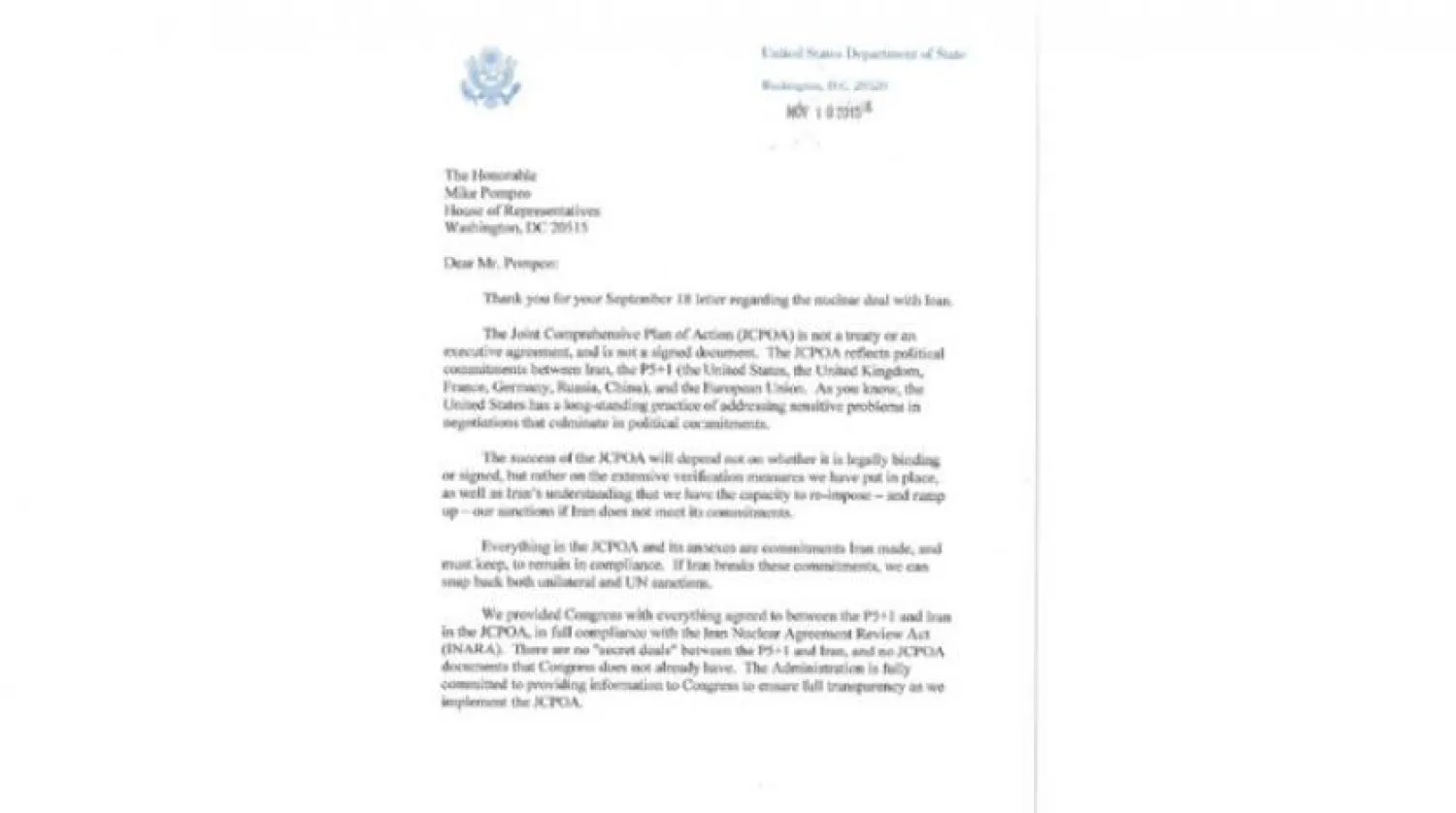
A copy of a letter sent by the State Department to Mike Pompeo on November 19 2015, stating that the nuclear "deal" with Iran is not a legal treaty
TT

Exclusive- Twelve Things You Need to Know About the Iran Nuclear ‘Deal’

A copy of a letter sent by the State Department to Mike Pompeo on November 19 2015, stating that the nuclear "deal" with Iran is not a legal treaty

Although it has been in the headlines, the so-called “Iran nuke deal” remains for almost three years a source of misinformation and mystification for many, including some political personalities who should know better.

A brief reminder of some aspects of the “deal” may be useful for those interested in an impartial and informed debate on the issue. Here are 12 things you need to know:

1- The “deal” is known as Comprehensive Joint Plan of Action (CJPOA) and represents a wish-list in which Iran and the Five Permanent members of the United Nations’ Security Council plus Germany hope action will be taken with regards to the illicit aspect of Iran’s nuclear program and the sanctions imposed on Iran as a result of it.

2- The CJPOA isn’t a treaty; nor could it be regarded as a formal international agreement. In fact, it has no legal basis as it was never presented to the parliaments of any of the countries involved submitted to a process of legislation.

3- The architect of the deal was former US President Barack Obama who insisted that CJPOA not be regarded as a treaty so that he won’t be obliged to submit to Congressional scrutiny where he claimed he would be unable to secure ratification because of opposition from the Republican Party.

4- In Iran President Hassan Rouhani’s Cabinet never officially discussed let alone ratify the CJPOA. The wish-list was submitted to the Islamic Consultative Majlis (Iran’s parliament) in two different versions one of which contained 72 differences with the published English text, and then withdrawn, by the US State Department. The parliament spent 15 minutes to pass a resolution making a reference to the CJPOA without expressly approving it. The first item on that resolution calls for destroying Israel’s nuclear arsenal.

5- No one has signed the CJPOA. Thus, all talk of “honoring our signature” by people like former US President Jimmy Carter and former European Union foreign policy spokesman Javier Solana is based on a misunderstanding. In any case, even if someone wanted to sign it, there is no universally recognized text of the CJPOA.

6- Theoretically, CJPOA was negotiated by a body, known as P5+1, which has no legal status, no mission statement and no mechanism for accountability to any authority. It was a group invented by Obama as a parallel Security Council.

7- CJPOA was negotiated outside the framework of the Nuclear Non-proliferation Treaty and bypassed seven UN Security Council resolutions. Thus it could be regarded as a blow to international law, something tailor-made to suit Obama.

8- CJPOA also by-passes the rules set by the International Atomic Energy Agency (IAEA) in dealing with cases in which NPT signatories violate its terms. In CJPOA, IAEA is assigned the task of inspecting Iran’s nuclear activities but not according to its own rules, set and used for decades, but through separate accords with Tehran. This is why CJPOA makes it clear that its methodology concerns only Iran and no other NPT signatory which might find itself in the same position.

9- Under CJPOA, the IAEA is tasked to periodically report on Iran’s compliance with the terms of the wish-list. However, there is no mechanism for reporting on compliance by the P5+1. Thus the fact that all 6, that is to say the US, Russia, China, Britain, Germany and France have not fully complied with CJPOA is not attested. Only a third of Iran’s frozen assets have been released, half of them through the United States, plus Japan and South Korea that are not involved in CJPOA. The Europeans still refuse to let Iran open bank accounts not to mention branches of its own banks. China is sitting on some $20 billion of frozen Iranian assets. Russia has suspended a credit line of $5 billion promised to Iran as sweetener for CPOA.

10- Iran’s non-compliance is camouflaged by terminology. For example, Iran has shipped only half of its enriched uranium to outside locations. But this is not reported by the IAEA as non-compliance because Iran says it is in the process of arranging for the shipment of the remainder. Iran also escapes censure by IAEA on the issue of centrifuges by reducing the number of machines but replacing half of them with new machines with much higher capacities.

11- Critics of trump’s move claim that ditching CJPOA is “wrong and dangerous” because there is no alternative. That’s disingenuous. The alternative is new round of negotiations based on the seven UN Security Council resolutions that Iran has rejected. Unlike CJPOA which lacks a fixed text and is both vague and confusing, the UNSC resolutions are precise and clear with internationally recognized methods of implementation.

12- Critics of Trump pretend that the only choice is to either surrender to the Islamic Republic or to go into an all-out war against it. That’s nonsense. A whole raft of other options remains available, provided someone has the courage to contemplate them. One current example is North Korea: it has been dragged to the negotiating table neither with surrender to its whims nor through full-scale invasion of its territory.



US Authorizes Iranian Oil Sales Amid Talks on Final Peace Deal

US Treasury Secretary Scott Bessent attends a bilateral meeting during the G7 Summit in Evian-les-Bains, France, June 17, 2026. (Reuters)
TT

US Authorizes Iranian Oil Sales Amid Talks on Final Peace Deal

US Treasury Secretary Scott Bessent attends a bilateral meeting during the G7 Summit in Evian-les-Bains, France, June 17, 2026. (Reuters)

The United States authorized Iranian oil sales on Monday, easing decades-old sanctions as it pushes toward a final peace deal with Tehran in return for commitments on nuclear inspections and free transit through the Strait of Hormuz.

The general license, announced by the Treasury Department, allows the sale of crude oil and petrochemical and petroleum products of Iranian origin through August 21.

The license says Iranian oil can be imported into the US when necessary to complete ‌its sale, delivery ‌or offloading. The US has not meaningfully imported Iranian ‌oil ⁠since Washington imposed measures ⁠after the 1979 revolution.

"In line with the ongoing productive talks in Switzerland, Iran has committed to free and open transit in the Strait of Hormuz and to permit International Atomic Energy Agency (IAEA) inspectors into their country," Treasury Secretary Scott Bessent wrote on X.

"As part of the framework, Treasury has issued a temporary 60-day general license authorizing the production, delivery and sale of Iranian oil."

Under a memorandum of ⁠understanding signed last week between Washington and Tehran, the US ‌agreed to issue waivers for the export ‌of Iranian crude oil, petroleum products and derivatives, and all associated services, including banking transactions, insurances ‌and transportation.

Payment of funds to Iran may be made in US dollar-denominated ‌funds, according to the license.

Cuba, North Korea and Crimea are among those excluded from the license.

Washington first sanctioned Iran in 1979 when revolutionary students seized the US embassy in Tehran, holding diplomats hostage. Numerous additional sanctions have been imposed since then over the ‌nuclear program and Iran's support for groups the US deems terrorist organizations.

Independent Chinese refiners have been the main buyers ⁠of sanctioned Iranian ⁠oil, taking advantage of deep discounts as others avoided such purchases. India, South Korea, Japan, Italy, Greece, Taiwan and Türkiye were also major buyers of Iranian crude before US sanctions were reimposed in 2018.

Mediators said on Monday that Washington and Tehran made "encouraging progress" at the first round of talks aimed at reaching a final peace deal. The talks began under the terms of the memorandum of understanding reached last week to extend a tenuous ceasefire from April for at least another 60 days.

Oil prices had risen sharply when Tehran started blockading the Strait of Hormuz, prompting a US blockade of Iranian ports, but after the interim deal, fell to their lowest since before the war began on February 28 with US-Israeli attacks on Iran.


Taiwan Begins 5-Day Military Drill with Tanks Patrolling Streets

This picture taken and released by Taiwan's Central News Agency (CNA) on June 22, 2026 shows a row of armored military vehicles driving along the highway in Taoyuan, Taiwan. (AFP photo / CNA Photo)
TT

Taiwan Begins 5-Day Military Drill with Tanks Patrolling Streets

This picture taken and released by Taiwan's Central News Agency (CNA) on June 22, 2026 shows a row of armored military vehicles driving along the highway in Taoyuan, Taiwan. (AFP photo / CNA Photo)

Taiwan kicked off a five-day set of military drills on Monday aimed at boosting the island's combat readiness in case of a Chinese military attack.

In the city of Taoyuan, home to the island's largest international airport, tanks drove down city streets and highways, videos and photos of the exercise showed, as armored vehicles from the Army’s 269th Infantry Brigade conducted combat readiness patrols morning.

The Immediate Combat Readiness Exercises are meant to test how rapidly military units can deploy, especially in the face of a possible sudden escalation of Chinese grey-zone warfare. Grey-zone tactics refer to a range of aggressive tactics that vary from navy ship patrols to drone flights, but fall short of direct combat.

The exercises, announced Sunday afternoon, are meant to be realistic, the Ministry of Defense said in a statement, with an emphasis on “real-time, live-fire and on-site."

These exercises are designed to simulate what would happen before enemy forces launched their ships, according to Taiwan's semi-official Central News Agency. The series of exercises could also include impromptu ones in the future, including real-time responses to Chinese military drills.

China's People's Liberation Army sent 23 aircraft towards Taiwan from Sunday into Monday morning, according to Taiwan's defense ministry. That was accompanied by seven navy ships and five other Chinese government ships. China sends war planes, drones and navy ships towards the island on a daily basis.

Taiwan regularly conducts combat readiness drills as it seeks to bolster its defense capabilities amid ongoing military pressure from China, which claims the self-governed island as its own territory and has not ruled out the use of force to bring it under its control. Earlier in June, Taiwan fired rockets in China's direction for the first time as part of a military exercise.


EU Chief Hails 'Statesman' Starmer after Resignation

European Commission President Ursula von der Leyen gives a press statement on sanctions against Russia at the EU headquarters in Brussels on June 9, 2026. (Photo by Nicolas TUCAT / AFP)
TT

EU Chief Hails 'Statesman' Starmer after Resignation

European Commission President Ursula von der Leyen gives a press statement on sanctions against Russia at the EU headquarters in Brussels on June 9, 2026. (Photo by Nicolas TUCAT / AFP)

EU chief Ursula von der Leyen on Monday praised British Prime Minister Keir Starmer for bolstering "European" security after he announced his resignation.

"It can take many leaders years to grow into the statesman you became in just two years. European and Ukrainian security is stronger because of you. Thank you, dear Keir," the European Commission president posted online.