
Steven Gerrard and How Predicting Which Players will be Good Managers is Pure Guesswork

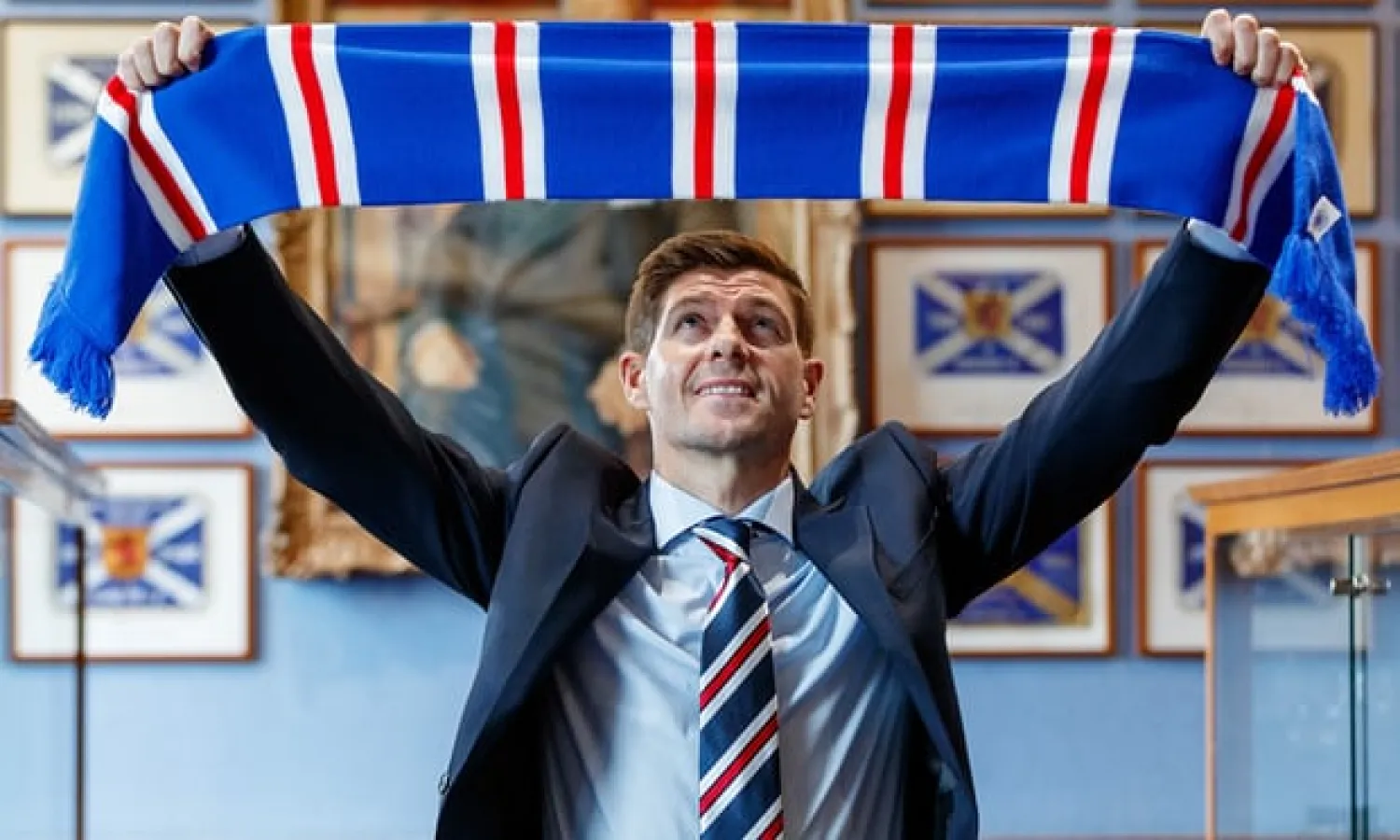
 Steven Gerrard has taken his first managerial job at Rangers after making a good impression with Liverpool’s youngsters. Photograph: BPI/Rex/Shutterstock
Steven Gerrard has taken his first managerial job at Rangers after making a good impression with Liverpool’s youngsters. Photograph: BPI/Rex/Shutterstock
TT

Steven Gerrard and How Predicting Which Players will be Good Managers is Pure Guesswork

 Steven Gerrard has taken his first managerial job at Rangers after making a good impression with Liverpool’s youngsters. Photograph: BPI/Rex/Shutterstock
Steven Gerrard has taken his first managerial job at Rangers after making a good impression with Liverpool’s youngsters. Photograph: BPI/Rex/Shutterstock

When Ross Wilkins stood up during his late father’s memorial service at St Luke’s Church in Chelsea last week to address a congregation that included many of the great names of the past 40 years of English football, he found the words to express a poignant truth. “Football found a way to live without Dad,” he said, “but the simple truth was that Dad could never live without football.”

After calling time on his long and distinguished playing career, Ray Wilkins stayed in the game, as so many do. The next 20 years were spent in a variety of dugouts, as the manager of Queens Park Rangers, Fulham and the national team of Jordan, as well as assistant manager of Chelsea, Watford, Millwall, Aston Villa and England’s Under-21s. None of those appointments, it could be said, ended well

Even a happy and fulfilling time as assistant to his friend Carlo Ancelotti at Stamford Bridge was abruptly and mysteriously terminated a few months after the pair had celebrated winning the club’s first league and Cup double. In October 2015, he left his last job, dismissed by Aston Villa along with the entire coaching staff. He reverted to his role as a popular pundit on Sky Sports, but it was not the same thing.

Intelligent, empathetic, articulate, steeped in football, a leader in the dressing room, Wilkins seemed to face no obstacles in the way of a management career to match his achievements as a player. But if there is one thing we can recognise, it is the impossibility of looking at a bunch of former players who have excelled at the game’s highest levels and guessing with any accuracy which of them will do equally well as managers. Or, for that matter, of predicting who will emerge from a thwarted or nondescript playing career to become a managerial immortal.

The mourners at Wilkins’s memorial service included some who could count themselves successes in management (Antonio Conte, Roy Hodgson, Kevin Keegan, Glenn Hoddle) and others who could not (Gianfranco Zola, John Hollins, Bryan Robson, Peter Reid). Anyone who could have looked at those eight as their playing careers drew to a close and sorted the prospective managerial wheat from chaff would have deserved a gold medal for clairvoyance.

Could it have been foreseen in 1974, when a former centre-forward named Alex Ferguson was pulling pints in his Glasgow pub while earning £40 a week as the part-time manager of East Stirlingshire, that he would devote a quarter of a century to rebuilding the biggest institution in English football? Or that Bobby Moore, playing his last game for West Ham that year, would be brought down by the lowest hurdles of management?

Steven Gerrard and Frank Lampard would impress any potential employer. Both won a century of England caps and most of the top honours on offer in club football. Each carries himself well, as Wilkins did. In their recent appearances as TV pundits, they have demonstrated insight and eloquence. Yet as these former international colleagues prepare for the first steps of a managerial career, riding a wave of support from those who admired their deeds on the pitch, only a fool would bet the house on which of them, if either, will survive the tests to come.

Gerrard, having made a good impression during a year spent coaching age‑group teams at Liverpool, has already made his move into the spotlight by accepting an offer to cross the border and manage Rangers. Lampard, in an interview with this newspaper last week, made it clear he intends to follow suit once he has completed his Uefa Pro Licence course and served an apprenticeship with Chelsea’s academy.

The portents are good and not so good. On the positive side, there were many who doubted that Zinedine Zidane, despite his great playing career at Real Madrid and several seasons coaching the club’s second string, would make a successful transition to the job of head coach at the Bernabéu. Now the man who presents such a seemingly taciturn and uncommunicative face to the outside world is just one step away from a third successive Champions League trophy, a feat that would carry him beyond José Villalonga, Miguel Muñoz and Vicente del Bosque to become the most successful manager in the club’s incomparable European Cup history.

On the other hand, as Lampard and Gerrard will be painfully aware, there is Gary Neville, perhaps the member of their own England generation who looked most naturally suited to the manager’s chair. Hodgson must have thought so when he invited him to become one of his England assistants in 2012. But three years later Neville accepted an invitation from his friend Peter Lim, the Singaporean businessman, to take over as head coach of Valencia, a fine club in temporary difficulties. He spoke no Spanish, had never worked in La Liga and could rely only on the owner and his brother, Phil, who had been installed there as assistant caretaker manager, to help him get the club out of trouble. To make that work would have required a miracle, and four disastrous months in Spain appear to have ended the ambitions that had led him to earn his Uefa qualifications.

Gerrard, it hardly needs saying, has never worked in Scottish football. At least, unlike Neville, he is going to a place where they speak a variant of his own native language. But expectations in Glasgow will be unrealistic and even minor mistakes will be held up to intense scrutiny. If he falls, it will be from a high place and the injuries could be severe. Lampard, for one, will be watching with interest.

The Guardian Sport


Chelsea Injuries up 44% After Club World Cup but Report Says Event Has Had ‘Minimal’ Impact

Chelsea's Reece James, center, lifts the trophy following the Club World Cup final soccer match between Chelsea and PSG at MetLife Stadium in East Rutherford, N.J., Sunday, July 13, 2025. (AP)
TT

Chelsea Injuries up 44% After Club World Cup but Report Says Event Has Had ‘Minimal’ Impact

Chelsea's Reece James, center, lifts the trophy following the Club World Cup final soccer match between Chelsea and PSG at MetLife Stadium in East Rutherford, N.J., Sunday, July 13, 2025. (AP)

Chelsea suffered a 44% spike in injuries after competing in the supersized Club World Cup this year, according to findings published on Tuesday.

But the newly expanded tournament has so far had a “minimal impact” on injuries overall, the latest edition of the Men’s European Football Injury Index found.

There was fierce opposition to FIFA's new flagship club event when it was confirmed in 2023 that it would increase from seven to 32 teams, with players' unions warning of physical and mental burnout of players due to an ever expanding match schedule. But FIFA pressed ahead and staged the tournament in the United States in June-July.

Chelsea went on to win the inaugural competition, receiving the trophy from US President Donald Trump at MetLife Stadium and taking home prize money of around $125 million. But, according to the Index, from June-October, Chelsea picked up more injuries — 23 — than any of the nine clubs from Europe's top leagues that participated in the Club World Cup.

They included star player Cole Palmer, and was a 44% increase on the same period last year.

While Chelsea, which played 64 games over the entire 2024-25 season, saw an increase in injuries, the Index, produced by global insurance firm Howden, found that overall there was a decrease.

“In principle you would expect this increased workload to lead to an increase in the number of injuries sustained, as a possible rise in overall injury severity,” the Index report said, but added: “The data would suggest a minimal impact on overall injury figures.”

Despite the figures, the authors of the report accept it was too early to assess the full impact of the Club World Cup, with the findings only going up to October.

“We would expect to see the impact to spike in that sort of November to February period,” said James Burrows, Head of Sport at Howden. “What we’ve seen previously is that’s where the impact is seen from summer tournaments."

Manchester City has sustained 22 since the tournament, which is the highest among the nine teams from Europe's top leagues — England, Spain, Italy, Germany and France.

Those teams have recorded 146 injuries from June-October, which is down on the previous year's figure of 174.

From August-October that number is 121, the lowest for that three-month period in the previous six years of the Index.


Sunderland Worst Hit by Losing Players to African Cup of Nations 

14 December 2025, United Kingdom, London: Sunderland's Habib Diarra (L) and Leeds United's Gabriel Gudmundsson battle for the ball during the English Premier League soccer match between Brentford and Leeds United at the Gtech Community Stadium. (dpa)
TT

Sunderland Worst Hit by Losing Players to African Cup of Nations 

14 December 2025, United Kingdom, London: Sunderland's Habib Diarra (L) and Leeds United's Gabriel Gudmundsson battle for the ball during the English Premier League soccer match between Brentford and Leeds United at the Gtech Community Stadium. (dpa)

Premier League Sunderland will have to do without six players over the next few weeks and are the club worst hit as the Africa Cup of Nations takes its toll on European clubs competing over the holiday season.

Sunderland, eighth in the standings, had four of their African internationals in action when they beat Newcastle United on Sunday, but like 14 other English top-flight clubs will now lose those players to international duty.

The timing of the African championship, kicking off in Morocco on Sunday and running through to January 18, has long been an irritant for coaches, with leagues in Belgium, France, Germany, Italy, Netherlands, Portugal, and Spain also affected.

Hosting the tournament in the middle of the season impacts around 58% of the players at the Cup of Nations, though the Confederation of African Football did try to mitigate the impact by moving the start to before Christmas, so it is completed before the next round of Champions League matches.

The impact on European clubs was also lessened by allowing them to release players seven days, rather than the mandatory 14 days, before the tournament, meaning they could play for their clubs last weekend.

Sunderland's Congolese Arthur Masuaku and Noah Sadiki, plus full back Reinildo (Mozambique), midfielder Habib Diarra (Mali), and attackers Chemsdine Talbi (Morocco) and Bertrand Traore (Burkina Faso) have now departed for Morocco.

Ironically, Mohamed Salah’s absence from Liverpool to play for Egypt should lower the temperature at the club after his recent outburst against manager Arne Slot, but Manchester United will lose three players in Noussair Mazraoui, Bryan Mbeumo and Amad Diallo, who scored in Monday’s 4-4 draw with Bournemouth.

France is again the country with the most players heading to the Cup of Nations, and with 51 from Ligue 1 clubs. But their absence is much less impactful than previously as Ligue 1 broke after the weekend’s fixtures and does not resume until January 2, by which time the Cup of Nations will be into its knockout stage.

There are 21 players from Serie A clubs, 18 from the Bundesliga, and 15 from LaLiga teams among the 24 squads at the tournament in Morocco.


Rodgers Takes Charge of Saudi Team Al-Qadsiah After Departure from Celtic 

Then-Celtic head coach Brendan Rodgers greets supporters after a Europa League soccer match between Red Star and Celtic at Rajko Mitic Stadium in Belgrade, Serbia, Sept. 24, 2025. (AP)
TT

Rodgers Takes Charge of Saudi Team Al-Qadsiah After Departure from Celtic 

Then-Celtic head coach Brendan Rodgers greets supporters after a Europa League soccer match between Red Star and Celtic at Rajko Mitic Stadium in Belgrade, Serbia, Sept. 24, 2025. (AP)

Brendan Rodgers has returned to football as the coach of Saudi Arabian club Al-Qadsiah, six weeks after resigning from Scottish champion Celtic.

Al-Qadsiah, whose squad includes Italian striker Mateo Retegui and former Real Madrid defender Fernandez Nacho, is in fifth place in the Saudi Pro League in its first season after promotion.

Rodgers departed Celtic on Oct. 27 and has opted to continue his managerial career outside Britain for the first time, having previously coached Liverpool, Leicester and Swansea.

In its statement announcing the hiring of Rodgers on Tuesday, Al-Qadsiah described him as a “world-renowned coach” and said his arrival “reflects the club’s ambitious vision and its rapidly growing sporting project.”

Aramco, the state-owned Saudi oil giant, bought Al-Qadsiah in 2023 in a move that has helped to transform the club’s status.

“This is a landmark moment for the club,” Al-Qadsiah chief executive James Bisgrove said. “The caliber of his experience and track record of winning reflects our ambition and long-term vision to establish Al-Qadsiah as one of Asia’s leading clubs.”

Rodgers is coming off winning back-to-back Scottish league titles with Celtic, where he won 11 major trophies across his two spells. He also won the FA Cup with Leicester.

Al-Qadsiah's last two coaches were former Liverpool striker Robbie Fowler and former Spain midfielder Michel.