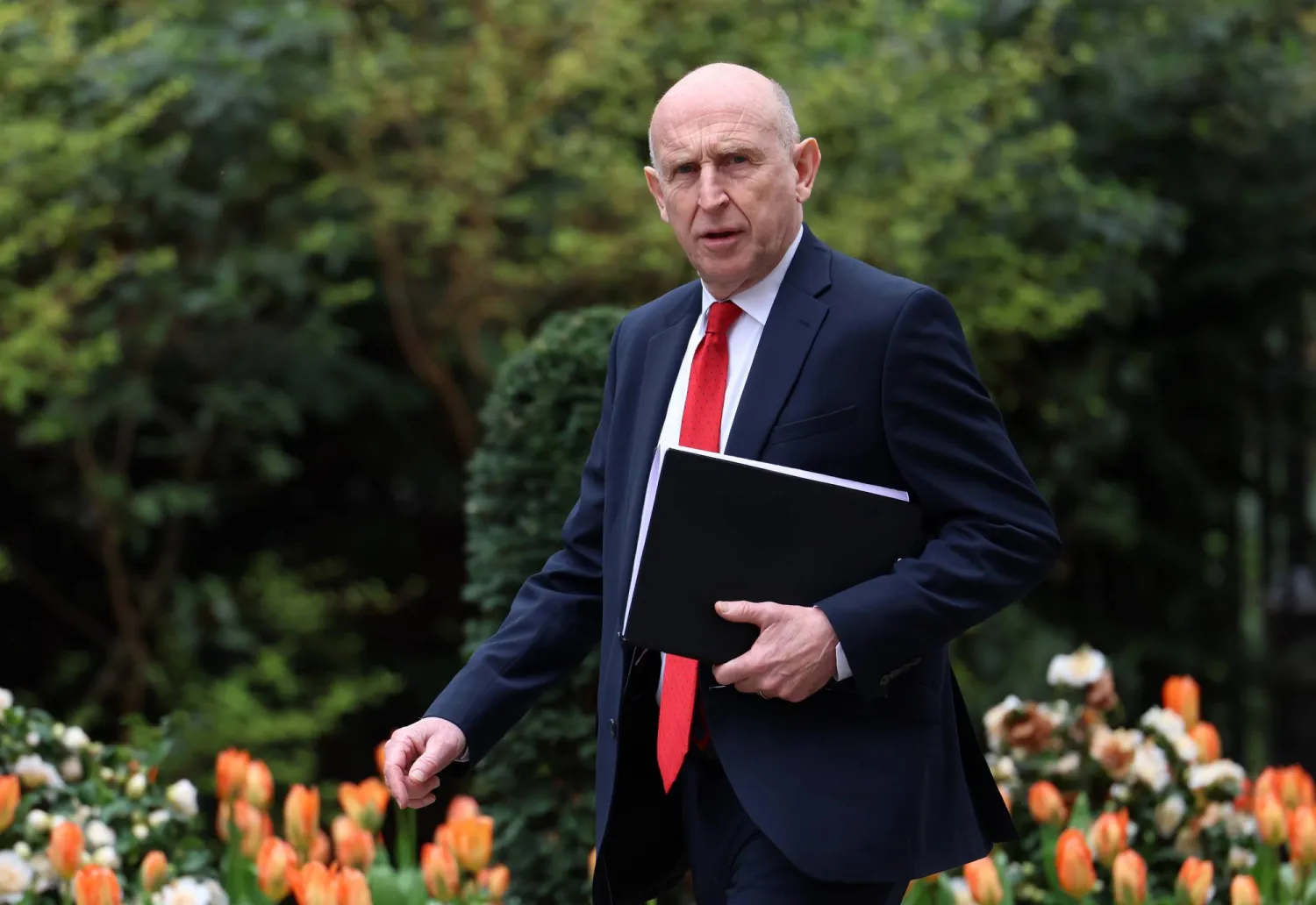
John Simpson: The More I Covered War the More I Hated it

A BBC journalist’s journey of 52 years… worldly interviews and crossfire

John Simpson: The More I Covered War the More I Hated it
TT

John Simpson: The More I Covered War the More I Hated it

John Simpson: The More I Covered War the More I Hated it

The waitress at London’s Landmark Hotel led me to his usual table in the corner, and there he was, an English, elegant man in his seventies. He was engrossed in an article on his MacBook. He greeted me with a warm smile. And after we exchanged pleasantries, he immediately assumed the role of the interviewer, forgetting that I was the one asking the questions. He soon realised and said, “I prefer asking the questions, as people’s stories and documenting the truth is my passion”.

To John Simpson, journalism is not a career, it is a calling. When he was only 15 years old he read George Orwell’s “1984”, and decided ever since to always be on the side of those who preserve memories rather than ones trying to erase them. He devoted his life to documenting history in public records.

Simpson’s name became linked to the BBC from day one. This partnership allowed for a journey of 52 years packed with adventures in over 120 countries, and 47 wars. Death brushed him ten times, and he lost one of his crew members in Iraq, a few metres away from where he was standing. As he grew older, his hatred for war grew with him. However, he refuses to allow those bad experiences to take control of his endless memories.

He told me about the time he snuck into Afghanistan in a Shadoor (Afghani Burqa), and how he discovered the Massacre of Sabra and Shatila in Lebanon. When he told me about his mock execution in the outskirts of Beirut, I felt I was there with him.

I asked him about his interviews with world leaders so he praised Mandela, told me he was charmed by King Hussein of Jordan, and expressed his annoyance with Khomeini. He even diagnosed Gaddafi with insanity.
One cannot summarize Simpson’s career in numbers and anecdotes, but interviewing him gave me an insider’s look at the world of journalism aimed at humanizing politics.

* You have covered tens of wars, and have become regarded as one of the most important British war correspondents. How do you feel about that?
I do not regard myself as a war reporter. I am really more of a diplomatic correspondent who strays into wars. I have covered around 47 wars all together, but it is not how I see myself. I see myself as somebody who is really interested in politics. Of course, wars are a nasty form of politics, so that is really why I have strayed into that. Also, not everyone likes to cover wars, but I do not mind. Like Martin Bell and the others, whatever happens I ought to report on it, and sometimes it is a war, sometimes it is a revolution..

* Claire Hollingworth late war reporter used to take socks and a toothbrush with her in a small rucksack to war. What do you take?
I am much less organized than her. I also take much more than Claire. I always carry some form of gadget for music whatever it may be, and I always carry one big book because you can get arrested or stuck somewhere and if you do not have anything to read that is absolutely dreadful. I am very forgetful. I often forget the toothbrush or the socks, but I never forget the music or the book.

* You have categorized wars in your last book as dirty wars, proxy wars, and so one. How is the notion of war changing today?
Back where Claire Hollingworth and Martha Gellhorn started, at the time of the Spanish Civil War, big powers were fighting. I think that is true for Syria and in other parts of the world where the big countries are moving in, paying people, supplying them with weapons and fighting out their ideological, religious or just purely political battles in other people’s territory. The idea of an all-out major war between powers, that seems to have vanished, the last example of that I believe was Saddam Hussein’s attack on Iran in 1980. I do not think we have had anything as straightforward ever since.

* In your Panorama special on the BBC in 2016, you predicted an isolationist America under Trump, and this year’s Munich Security Conference has come to a conclusion that diplomacy is dead. How do you perceive the scene now?
I think that is profoundly wrong about diplomacy, as I feel that it is all what we have got. It is a lifebelt that saves us from disaster. However, there are times where diplomacy goes silent, but it can never go away. I must say having covered 47 wars in 52 years, wars make me profoundly angry and as I have got older and have become a father again quite late in life, it has made me all the more angry. I have a hatred of war, that I suppose I previously did not have.

* How many times did you have a near death experience?
I have it written out actually. In 2016, pure chance, I had kidney failure and I lay there in hospital and was lucky to survive. I had nothing else to do on my hospital bed, and so I recalled all the times.. the Kidney failure was the 10th. Death has brushed me. It was not just the bullet that is fired here and there, it is the bullet what hits the wall right beside you. It has been bombs more than bullets for me, and knives and physical attack by groups and so forth in Northern Ireland, Iran, Lebanon (three times), and others. I know very well now what it feels like to be on the point of death and I have to say, it is not that disturbing.

* Would you count losing members of your crew more upsetting them?
That is far worse. When my translator was killed in 2003 during the invasion of Iraq, I could not see any reason to be still alive while he was dead. He was standing quite close to me and he had his legs cut off by a piece of shrapnel, and I just had a piece of shrapnel in my leg. It just seemed to me to be unfair that he died and I lived.

* Do you suffer from PTSD?
No. I do not believe in it. I have got friends who had suffered from it, so I know it does actually exist. I am not denying it, but it has not affected me. I am not saying that I go through those experiences and they do not matter, and that they do not have an effect on me. However, I do not believe in letting it affect me, and it has not. I do get little flashbacks of these things, but I do not feel of damaging flashbacks, they are more like memories. I will never forget the business of the mock execution I once had just outside Beirut during the civil war in the 80s. I knew the gun was not loaded, but it felt like a near death experience. I was made to kneel down. The guy put the gun behind my neck, I remember it with the greatest clarity, looking down at the sandy earth filled with cigarette ends, feeling that it was the last scene I would see, and then he pulled the trigger with no bullet and everybody laughed. I do have these memories, and I do think it is important to, but they are not my master, they do not control me.

* Do you prefer interviewing or being interviewed?
I much prefer interviewing. I do not like being interviewed.

* Is it because you would rather hear someone’s story rather than tell yours?
Yes. I am not very keen on talking. When I am with somebody who is talkative, I prefer getting them to talk.

* You say journalism is more of a calling than a profession, why did you become a journalist?
It is. It is not organized enough to be a profession. I became a journalist for rather noble reasons in a way, although I find it quite amusing to think of nobility and journalism in the same sentence. When I was about 15, I read George Orwell’s 1985 and it was wonderful. That idea that you could destroy the reality of the past by destroying documents, newspapers and memories, was such a concept to me. So I thought, whatever I do I will be on the side of the memories, not on the side of people trying to stop them. I still think that if you can get things out on the public record that is what counts. To tell people the truth has a serious effect on the way these events are seen. An example of that, the Chinese government for decades tried to make out that there was no massacre in Tiananmen square. I was there, I saw it. Every time I talk to a government official in
China I manage to get a reference to Tiananmen, and I always use the world massacre, and it causes upset and embarrasses people. We must not allow ourselves to forget what really, really, happened.

* You mention in your book that the kindest person you interviewed was Nelson Mandela. What was it like to interview him?
It is a big cliché and I know that, but he was the greatest person I ever interviewed. What made him the greatest was simply his normality and naturalness. You really could ask him anything and he would not have been offended by it. I asked him about corruption in South Africa for instance, which is a very sensitive subject, and he just talked through it. He was so honest and accepted that some of his ministers were corrupt. That is something you do not often see.

* You also note that some of the people you interviewed were impressive, some were not at all. Can you give examples?
I have interviewed a lot of people, many we impressive and a lot were not over the years. To me, it is their relationship to truth that makes them a serious interviewee or just another politician defending him or herself. I used to interview Margaret Thatcher quite a lot and she was terribly difficult to interview because she was so sharp and well informed and if you made any slightest little mistake she would be on you and she would correct you. I did not really like her very much as a person, but I did admire her. I have interviewed various Arab leaders over the years, amongst them was Bashar Al Assad.

* What did you think of him?
This was long before the war began. It was in 2006, and at that stage he seemed to me to be more like a North London Ophthalmologist than a Syrian president. I asked him quite a lot of difficult questions and he answered them all. I remember my producer was with me and he was very worried when I asked Assad about who was in charge in Syria, was it him or his brother or his uncle, and I heard my producer gasping, and he answered honestly. Now if you interviewed Assad you would sadly be talking about the most appalling violations of the rules of war and some of the worst examples of attacks on civilians in modern history, and he is responsible. He carries the burden of guilt for that.

* Which other interviews with Arab leaders resonated with you?
I interviewed Colonel Gaddafi several times, and I thought probably he was insane, he was just a weirdo. I am never still to this day, even after talking to several people who worked for him or knew him, quite been able to understand how he managed to survive because he was really off the wall and a very nasty character, and now we know the details. To me he seemed eccentric to the point of craziness. I also interviewed the late king of Saudi Arabia, King Abdullah bin Abdel Aziz. He was very charming, and very sharp. He was absolutely delightful, and walking away from the interview I felt much better to having met this person. Not many politicians give you that feeling. He was a very thoughtful man. Another interview I remember was with King Abdullah of Jordan. Delightful. My favorite really in many ways was the late King Hussein of Jordan. He was such a charmer and his sons got those same qualities. I just think that Abdullah has done extraordinarily well.
The list also includes various prime ministers of Lebanon but they do come and go a little bit more. I have also specialized in Iran even before the revolution. Now, sadly Tehran is so terrified by the BBC Persian service they have placed a total block on anybody from the BBC going there. I would like to go back to Iran on holiday. I tried to also learn Farsi. I interviewed Ayatollah Khomeini.

*What did you think of Al Khomeini?
He was absolutely firmly lodged in the past. All his concerns were related to the Shah’s father and to the Shah himself and to the role the Western countries played in helping the Shah and all of that kind of stuff. He was also concerned about fighting Saddam Hussein, and I do not think it was anything more in his life except that. He was very withdrawn and did not want to have any kind of relationship with his interviewer. Rafsanjani who took over from him was a lot funnier and more charming. He was more interesting and far more plugged into the realities of the real world.

*What about American Presidents?
Historically, I was not very involved in reporting from America, as the BBC has a big bureau there. There was rarely a need for me to go there. I have however met and got to know many of the American Presidents like Bill Clinton and George Bush Sr. I also met Obama, and felt he was light weight even though he is intelligent. He wanted to be liked too much. I was from the start a little less enthusiastic about his presidency than a lot of people were. Decent man no question, but not very good as a president.

*You mention in your book that a scoop should be sacrificed for the sake of checking and verifying the news before broadcasting it. The BBC does not tend to break news to the public. What do you think of that?
They never did. They are uncomfortable with stories that only one of their correspondents has got. You can feel the sense of their relief when other newspapers and outlets pick the news up. An example from a long time ago is the massacre in Sabra and Shalita in 1982. It was something which together with another BBC correspondent we were the first people to come across. Even when we broadcast the pictures of the piles of bodies I could see that the BBC was uncomfortable about it. Fortunately quite soon, it got picked up by Reuters and everybody relaxed. For the BBC the most important thing is to get it right not to get it fast. I believe in that, but it is sometimes very frustrating. I did some reporting in Iraq about abnormalities in children being born, and clearly there was something very wrong in this town, the doctors all said it. It was difficult to get to because ISIS was taking hold of the town then. It was dangerous to get to, and we got lots and lots of pictures with children with dreadful abnormalities, and proof of why it might have happened and seemed to be something to do with the weapons that the Americans had used when they stormed the town, but the BBC was terribly nervous about it. We used it in the end, but the editors were scared.

* You have done things that were not very safe, like in Afghanistan. Can you tell me more about that?
I have done a lot of crazy things in Afghanistan without necessarily setting out to do that. in 1989 when the Russian troops were just withdrawing a cameraman and I were smuggled in to Kabul by one of the fighter groups. We did not realise how dangerous it was. we were betrayed to the secret police and there was a shootout. We kind of got out stepping over the bodies of secret policemen who were attacking the house where we had been hiding. I have near thought it was something to be terribly proud of, as it sparked a fight with casualties, but it was a major story at the time, and the story was how deeply the fighters had infiltrated the government structure in Kabul. It was exciting and alarming. After 9/11, the Taliban closed of Afghanistan completely, and said that any journalists found there will be dealt with. I do not like people telling i cannot do things, so i got a group of smugglers in Pakistan who smuggled goods into Afghanistan, to agree to take me and they said the only they would do it if you and your cameraman wear a Burka and we did that.

*How did you feel wearing a Burka?
Horrible. You feel so powerless. You just have that little panel with lace on it. It is amazing how quickly you start obeying other people's instructions just like Afghan women tend to do that. it was not sensible, but i am too old to be sensible.

*Did you feel that you had to fight to be sent by the BBC everywhere?
Quite often I did, In a big organization like that, there are so many competing groups. it is a very competitive environment. I had to pull out all the stops, from bullying to contacts. It does not make me popular with my colleagues, which is sad, but there are more important things than popularity.

*You were the first BBC correspondent to use the Online Service for reporting. Tell me more?
Yes I think I was. What I really was genuinely the first person in the world to do, in Afghanistan in 2001 I was able to broadcast from there live from a battle. things going off all around us.

*You are very caught up with technological advances; you have a verified twitter account. why is that so?
You have got to keep up. A fellow BBC journalist friend of mine still uses a typewriter. I think if you step out of the line as it is moving forward, you just end up being completely forgotten about. I now rather enjoy Twitter and I am still not very good at Facebook. The technology is terribly important particular in television and you have got to keep up. When you get to my age its quite easy to stop, but I feel the need to keep on pushing myself.

*What is the most essential advice you can give to young journalists?
We are living in a different kind of world, where newspapers and television and radio news are much less popular than they were. People do not want to know about things. They want to just be in their little echo chamber where they just hear the views that they like to hear which is disturbing. I just feel that young journalists in particular have to be aware of that and have to fight against it. It is the death of real journalism if we just simply write and broadcast about things that will please people. You have to challenge the other peopple’s views of things, and keep on forcing it through. It is more difficult now because institutional journalism is on the way down. We need good young journalists more than any other stage. It is not a profession that makes money. You do not get rich by being a journalist, and you should not ever want to. You absolutely have to be true to the kind of voice inside you and not be somebody else’s employee.

*What is your next project?
I have decided to turn to fiction and am currently writing a novel about Russia. More important to me is my television work. 25 years ago, I went to Brazil to the farthest reaches of the amazon and I met a tribe there that never had any contact with the outside world. They were lovely. Now I want to go back and see what has happened to them, and I am scared that they would all be wearing Manchester United t-shirts.
Microsoft Saudi Head Affirms Kingdom Entering AI Execution Phase

Saudi Arabia shifts from AI pilots to live deployment in key sectors (Shutterstock)
TT

Microsoft Saudi Head Affirms Kingdom Entering AI Execution Phase

Saudi Arabia shifts from AI pilots to live deployment in key sectors (Shutterstock)

Riyadh’s hosting of the Microsoft AI Tour this week delivered a headline with concrete weight: customers will be able to run cloud workloads from a local Azure data center region starting in the fourth quarter of 2026.

The announcement was more than a technical update. It marked a shift in posture. Saudi Arabia is no longer testing artificial intelligence at the margins. It is moving decisively into execution, where infrastructure, governance, skills development, and enterprise adoption align in a single direction.

For Turki Badhris, president of Microsoft Saudi Arabia, the timing reflects years of groundwork rather than a sudden push.

“Confirming that customers will be able to run cloud workloads from the Azure data center region in the fourth quarter of 2026 gives organizations clarity and confidence as they plan their digital and AI journeys,” Badhris told Asharq Al-Awsat on the sidelines of the event.

“Clarity and confidence” may sound procedural, but they are strategic variables. Government entities and large corporations do not scale AI based solely on pilot projects.

They move when they are assured that local infrastructure is available, regulatory requirements are aligned, and long-term operational continuity is secured. The announcement of the new Azure region signals that the infrastructure layer is no longer a plan, but a scheduled commitment nearing implementation.

From pilots to production

Saudi Arabia’s AI story has unfolded in phases. The first focused on expanding digital infrastructure, developing regulatory frameworks, and strengthening cloud readiness. That phase built capacity. The current phase centers on activation and use.

Badhris said the conversation has already shifted. “We are working closely across the Kingdom with government entities, enterprises, and partners to support readiness, from data modernization and governance to skills development so that customers can move from experimentation to production with confidence.”

The distinction is fundamental. Pilots test potential. Production environments reshape workflows.

Companies such as Qiddiya Investment Company and ACWA Power illustrate that transition. Rather than treating AI as isolated pilot initiatives, these organizations are embedding it into daily operations.

ACWA Power is using Azure AI services and the Intelligent Data Platform to optimize energy and water operations globally, with a strong focus on sustainability and resource efficiency through predictive maintenance and AI-driven optimization.

Qiddiya has expanded its use of Microsoft 365 Copilot to enable employees to summarize communications, analyze data, and interact with dashboards across hundreds of assets and contractors.

AI is no longer operating at the margins of the enterprise. It is becoming part of the operating core, a sign of institutional maturity. The technology is shifting from showcase tool to productivity engine.

Infrastructure as strategic signal

The Azure data center region in eastern Saudi Arabia offers advantages that go beyond lower latency. It strengthens data residency, supports compliance requirements, and reinforces digital sovereignty frameworks.

In highly regulated sectors such as finance, health care, energy, and government services, alignment with regulatory requirements is not optional; it is essential.

Badhris described the milestone as part of a long-term commitment. “This achievement represents an important milestone in our long-term commitment to enable real and scalable impact for the public and private sectors in the Kingdom,” he said.

The emphasis on scalable impact reflects a more profound understanding: infrastructure does not create value on its own, but enables the conditions for value creation. Saudi Arabia is treating AI as core economic infrastructure, comparable to energy or transport networks, and is using it to form the foundation for productivity gains.

Governance as accelerator

Globally, AI regulation is often seen as a constraint. In the Saudi case, governance appears embedded in the acceleration strategy. Adoption in sensitive sectors requires clear trust frameworks. Compliance cannot be an afterthought; it must be built into design.

Aligning cloud services with national digital sovereignty requirements reduces friction at scale. When organizations trust that compliance is integrated into the platform itself, expansion decisions move faster. In that sense, governance becomes an enabler.

The invisible constraint

While generative AI dominates headlines, the larger institutional challenge often lies in data architecture. Fragmented systems, organizational silos, and the absence of unified governance can hinder scaling.

Saudi Arabia's strategy focuses on data modernization as a foundation. A structured and integrated data environment is a prerequisite for effective AI use. Without it, AI remains superficial.

Another global challenge is the skills gap. Saudi Arabia has committed to training three million people by 2030. The focus extends beyond awareness to practical application. Transformation cannot succeed without human capital capable of integrating AI into workflows.

Badhris underscored that skills development is part of a broader readiness ecosystem. Competitiveness in the AI era, he said, is measured not only by model capability but by the workforce’s ability to deploy it.

Sector transformation as economic strategy

The Riyadh AI Tour highlighted sector use cases in energy, giga projects, and government services. These are not peripheral applications but pillars of Vision 2030. AI’s role in optimizing energy management supports sustainability. In major projects, it enhances execution efficiency. In government services, it improves the citizen experience.

AI here is not a standalone industry but a horizontal productivity driver.

Positioning in the global landscape

Global AI leadership is typically measured across four pillars: compute capacity, governance, ecosystem integration, and skills readiness. Saudi Arabia is moving to align these elements simultaneously.

The new Azure region provides computing. Regulatory frameworks strengthen trust. Partnerships support ecosystem integration. Training programs raise skills readiness.

Saudi Arabia is entering a decisive stage in its AI trajectory. Infrastructure is confirmed. Enterprise use cases are expanding. Governance is embedded. Skills are advancing.

Badhris said the announcement gives institutions “clarity and confidence” to plan their journey. That clarity may mark the difference between ambition and execution. In that sense, the Microsoft tour in Riyadh signaled that infrastructure is no longer the objective, but the platform on which transformation is built.


Italian Defense Minister to Asharq Al-Awsat: Relations with Saudi Arabia at an Unprecedented Strategic Strength

Guido Crosetto said Rome and Riyadh are working to support the success of the ongoing negotiations between Washington and Tehran (Italian Ministry of Defense).
TT

Italian Defense Minister to Asharq Al-Awsat: Relations with Saudi Arabia at an Unprecedented Strategic Strength

Guido Crosetto said Rome and Riyadh are working to support the success of the ongoing negotiations between Washington and Tehran (Italian Ministry of Defense).

Italian Defense Minister Guido Crosetto said relations between Rome and Riyadh have reached an unprecedented level of strategic strength, noting that the two countries are working to build genuine partnerships based on joint development, integrated supply chains, skills transfer, and the development of local capabilities.

In an interview with Asharq Al-Awsat, Crosetto stressed that cooperation between Italy and Saudi Arabia has become essential for strengthening peace and stability in the Middle East, adding that both countries are working together to support the ongoing negotiations between the United States and Iran in order to prevent regional escalation.

Speaking on the sidelines of the World Defense Show in Riyadh, the minister described the Saudi economic environment as highly attractive, noting that the event reflects the Kingdom’s growing pivotal role in technological and industrial innovation and provides a platform for discussing future scenarios and emerging technologies.

Strategic Strength

Crosetto said relations between Saudi Arabia and Italy are “excellent” and “at an unprecedented stage of strategic strength.”

He noted: “Political understanding between our leaders has established a framework of trust that translates into tangible and structured cooperation in the defense sector, both militarily and industrially. Our countries share fundamental principles: reliable partnerships, honoring commitments, the importance of diplomacy, and adherence to international law. This makes our cooperation stable, predictable, and oriented toward the long term.”

The Italian minister said the Saudi economic environment is highly attractive (Asharq Al-Awsat)

Dialogue Between the Armed Forces

Crosetto noted that dialogue between the armed forces of the two countries is ongoing and includes the exchange of operational expertise, doctrines, strategic analyses, and regional scenario assessments, adding that this “enhances interoperability and mutual understanding.”

He stressed that the Red Sea and the Arabian Gulf are two closely interconnected strategic regions, and their security represents a shared interest for Italy and Saudi Arabia.

"In this context, cooperation between Rome and Riyadh is essential to strengthening peace and stability in the Middle East, with particular attention to supporting political solutions in Lebanon, Gaza, and Syria, as well as advancing the ongoing negotiations between the United States and Iran, which are a critical element in preventing regional escalation.”

According to the minister, “this political commitment is complemented by a practical commitment,” noting that Italy is among the most active Western countries in providing healthcare to Palestinian civilians through medical evacuations, the transport of humanitarian aid, and the deployment of naval medical capabilities. He described this as “a concrete example of how military tools can serve humanitarian and stabilization objectives.”

Meeting Between the Crown Prince and Meloni

The Italian defense minister said the meeting between Prime Minister Giorgia Meloni and Saudi Crown Prince and Prime Minister Mohammed bin Salman gave strong momentum to bilateral relations.

“At the military level, cooperation is expanding in training, logistics, military doctrine, technological innovation, maritime security, and the protection of critical infrastructure. There is also growing interest in emerging domains, including cyberspace, outer space, and advanced systems.”

Saudi Crown Prince Mohammed bin Salman meets with Italian Prime Minister Giorgia Meloni in AlUla, January 2025 (SPA).

He continued: “At the industrial level, we are moving beyond the traditional client-supplier relationship and seeking to build real partnerships based on joint development, integrated supply chains, skills transfer, and the development of local capabilities.”

Saudi Arabia a Key Partner for Italy’s Energy Security

Crosetto emphasized that cooperation between Italian companies and their Saudi counterparts in defense capabilities, technology transfer, aviation projects, and shipbuilding is fully aligned with Saudi Vision 2030, which aims to strengthen the Kingdom’s industrial, technological, and human capital base.

“Italian companies’ contributions are not limited to providing platforms; they also include expertise, training, and engineering support. This approach extends beyond the defense sector to infrastructure, technology, tourism, and major projects such as NEOM, highlighting the complementarity between our economies.”

He continued: “Cooperation also includes the energy sector and the energy transition, as Saudi Arabia is a key partner for Italy’s energy security, with growing collaboration in hydrogen and renewable energy. In addition, there is an emerging strategic focus on critical and strategic raw materials, a sector in which the Kingdom is investing heavily and which could see significant growth in both industrial and technological cooperation.”

Saudi Economic Environment Highly Attractive

Crosetto said the recent Italian 'Industry Days' forum held in Riyadh, organized in cooperation between the two countries’ defense ministries, sent a very strong signal of expanding bilateral cooperation, attracting both small and medium-sized enterprises and major industrial groups and leading to the creation of tangible operational links.

“The Saudi economic environment is highly attractive, featuring major public investments, a streamlined tax system, incentives for materials and equipment, and double-taxation avoidance agreements, making the Kingdom a strategic industrial partner.”

He added: “Trade exchange is not limited to the defense sector. Italian products are in strong demand in other sectors such as machinery, fashion, design, and pharmaceuticals. Bilateral agreements exceeding €10 billion include major companies such as 'Leonardo' and 'Fincantieri'.”

Visit of Prince Khalid bin Salman

The Italian defense minister said the visit of his Saudi counterpart Prince Khalid bin Salman, to Rome, strengthened dialogue between the two countries, noting that discussions “covered diverse sectors, from space to naval domains, and from aviation to helicopters, with a primary focus on military cooperation, training, and the exchange of joint strategic analyses.”

Prince Khalid bin Salman during his meeting with Italian industrial companies in Rome, October 2024 (SPA).

World Defense Show in Riyadh

Crosetto said Saudi Arabia’s hosting of the third edition of the World Defense Show reflects the Kingdom’s growing central role in technological and industrial innovation and provides a platform for discussing future scenarios, emerging technologies, and cooperation models.

“I believe it is important for a country with promising investment prospects such as Saudi Arabia to host an international event that enables direct dialogue with the world’s leading companies in a continuously expanding sector.”

Italian Defense Minister Guido Crosetto (Italian Ministry of Defense).

He concluded: “In this context, I am confident that the model of cooperation between Italy and the Kingdom - based on dialogue, mutual trust, and a long-term vision - represents an example of how to combine strategic interests, innovation, and responsibility.

"On this basis, we will continue working side by side to strengthen a partnership that goes beyond the present, contributes to regional stability, and creates tangible opportunities for our two countries and for the international community as a whole.”


Bin Habrish to Asharq Al-Awsat: Hadhramaut on Threshold of New Era

Sheikh Amr bin Habrish, First Deputy Governor of Hadhramaut (Asharq Al-Awsat)
TT

Bin Habrish to Asharq Al-Awsat: Hadhramaut on Threshold of New Era

Sheikh Amr bin Habrish, First Deputy Governor of Hadhramaut (Asharq Al-Awsat)

After nearly 500 days spent in the mountains and highlands, Sheikh Amr bin Habrish, First Deputy Governor of Hadhramaut and commander of the Hadhramaut Protection Forces, has returned to the provincial capital, Mukalla, declaring what he described as the beginning of a “new phase” that will shape a different future for Yemen’s largest eastern governorate.

In an interview with Asharq Al-Awsat from his residence overlooking the Arabian Sea, Bin Habrish said Hadhramaut is currently experiencing “a state of stability and reassurance,” which he attributed to the steadfastness of its people and to Saudi support and intervention that came “at the right time.”

He said the current ambition is to build a state based on institutions under which all citizens are united, while preserving Hadhramaut’s distinct character. Bin Habrish also affirmed his commitment to integrating the Hadhramaut Protection Forces into “fair” state institutions.

Addressing security concerns, he described terrorism as “manufactured” and said it has no social base in Hadhramaut. He accused external powers and local actors of exploiting it for their own agendas, while stressing readiness to confront terrorism in all its forms.

Bin Habrish offered his account of the recent handover of military camps led by the Nation’s Shield Forces, saying the achievements were made possible by the resistance of Hadhramaut’s people on their own land, and by Saudi support and what he called the Kingdom’s “honest and decisive” stance at a critical moment.

He said this outcome would not have been possible without the “genuine bond” between Hadhramaut’s society and Saudi Arabia, adding that this relationship has helped restore security and stability to Mukalla after what he described as unnecessary turmoil.

“We were not satisfied with the arrival of forces and the internal conflict and fighting that followed,” he said, adding that some parties felt emboldened and left no room for dialogue.

He accused the Southern Transitional Council of deploying its forces and “fully occupying the governorate,” stressing that Hadhramaut belongs to its people and that any mistake should have been addressed locally, not imposed by force. “We were compelled to resist,” he said, citing home raids and pursuits as “wrong and unjustified.”

Open Channels with Saudi Arabia

Bin Habrish credited Saudi Arabia’s leadership — King Salman bin Abdulaziz, Crown Prince Mohammed bin Salman, Defense Minister Prince Khalid bin Salman, along with the Special Committee and the Joint Forces Command — for Hadhramaut’s current stability.

He said coordination with the Kingdom takes place “at the highest levels,” with open channels and no barriers, praising Saudi intentions and expressing deep appreciation for its support.

A New Era

Bin Habrish said Hadhramaut is entering a new era rooted in its traditions of peace, wisdom, and culture. He reiterated calls for self-rule based on historical grounds, describing it as the minimum requirement for enabling Hadhramaut to build its institutions and deliver services.

He urged unity, mutual compromise, and prioritizing the governorate’s interests, saying: “We forgive and open a new page. We are not seeking revenge. What matters is that Hadhramaut remains at the center of decision-making. Without it, there can be no development.”