



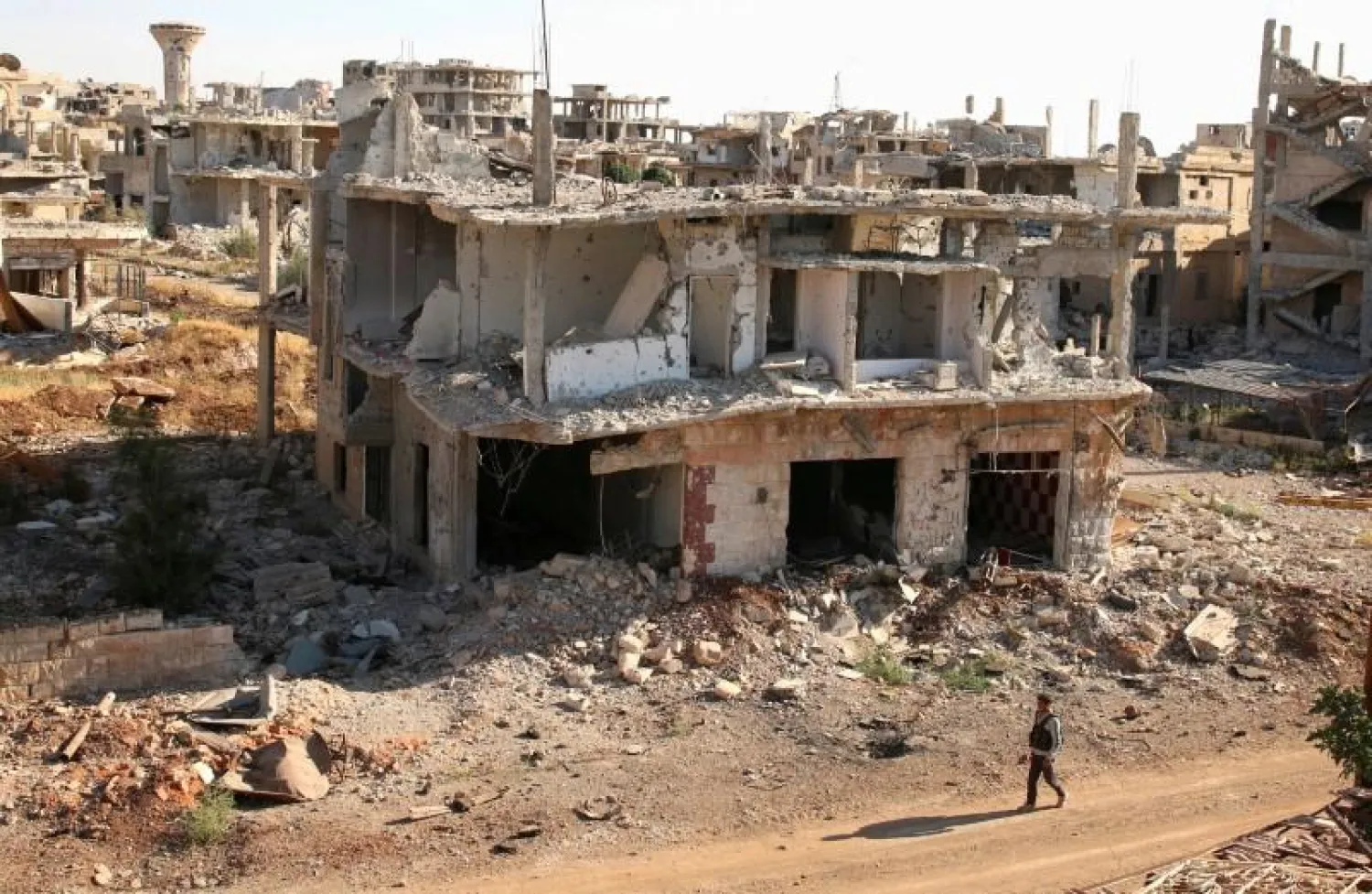

The United states is trying to push Russia to comply with the "de-escalation" agreement in southern Syria and prevent regime forces and Iran-backed organizations from advancing to it, as well as to implement the terms of the agreement, which state that Hezbollah and other Tehran-affiliated Syrian and foreign groups must be about 25 kilometers from the Jordanian border.
Parts of the provinces of Daraa, Quneitra and Suwayda south of Syria are one of the areas to reduce the escalation according to US-Russian-Jordanian agreement in July. After Ghouta and Homs, it is clear that Damascus has settled its choice to push its forces and organizations backed by Iran to the south.
On Saturday, Washington asked Moscow to honor its obligations under Presidents Donald Trump and Russia President Vladimir Putin's statement last year.
After Ghouta and Homs, it is clear that Damascus has decided to push its forces and organizations supported by Iran to the south, including the forces of Brig. Suhail al-Hassan, known as the "tiger" and the fourth division, "al-Quds Brigade" of the Popular Front-General Command led by Ahmed Jibril.
On Friday, Syrian aircraft dropped leaflets on Daraa, urging fighters to lay down their weapons or face an offensive. One of the leaflets included a picture showing lined up bodies of anti-regime fighters, with the caption warning that this is the “inevitable fate of anyone who insists on carrying arms.” Another leaflet announced the arrival of the Syrian Arab army’s soldiers.
Opposition factions control 70 percent of Daraa and parts of the district center, while regime forces retain control over the majority of the north.
In May 2017, negotiations were launched between Washington, Moscow and Amman to establish a de-escalation zone in the south, which led to the agreement between Trump and Putin on the sidelines of Hamburg summit. It was later re-established at the Asia-Pacific Economic Cooperation (APEC) summit in Vietnam, in November.
At the time, then US Secretary of State Rex Tillerson and Russian Sergei Lavrov reached an agreement that included de-escalation in the south as a "temporary step" to maintain a ceasefire and ultimate elimination of presence of foreign forces and fighters from the region to ensure a more sustainable peace.
For Moscow, the plan, which guaranteed Russian-US cooperation, meant the total elimination of the al-Nusra Front and ISIS-affiliate Khalid Army. At that time, the Trump administration made a concession that it had frozen the secret program to support opposition factions. At the end of last year, military and financial support for 35,000 opposition fighters on the southern front was effectively halted.
During the battles of Ghouta, opponents tried to mobilize for "Najda al-Ghouta", however, the US Embassy in Amman sent a letter to the leaders of the southern front factions of Free Syrian Army, saying that Russian or Syrian air strikes do not mean in any way the termination of the de-escalation agreement between the United States, Russia and Jordan.
As reinforcements approached Daraa and Iranian militias were re-deployed, opposition allies began to consider their options.
Sources told Asharq Al-Awsat that over the past week, Deputy Assistant Secretary of State David Satterfield was working on formulating a proposal which included the withdrawal of all Syrian and non-Syrian militias to 20-25 kilometers from the Jordanian border, the transfer of opposition fighters and their families to Idlib in northern Syria, the reopening of the crossing point between Syria and Jordan, in addition to the formation of a US-Russian mechanism to control the implementation of the agreement.
Satterfield also wants to discuss the possibility of dismantling US Tanf camp at the Syrian-Jordanian-Iraqi border, which has been publicly criticized by Moscow.
Jordanian officials also tried to get in touch with the Russians to obtain "guarantees" to secure the borders and not to bring new refugees to Jordan. They also want to open the way for the return of Syrian refugees to their country.
Satterfield is likely to leave office and possibly become an ambassador to Ankara.
The State Department announced on Saturday that it would take “firm and appropriate measures in response to Assad regime violations”, saying it was concerned by reports of an impending Assad regime operation in southwest Syria within the boundaries of the de-escalation zone negotiated between the United States, Jordan, and Russia.
“As a guarantor of this de-escalation area with Russia and Jordan, the United States will take firm and appropriate measures in response to Assad regime violations,” State Department spokeswoman Heather Nauert said in a statement late on Friday.
“It is time for Russia to acknowledge its role in the shooting down of MH17 and to cease its callous disinformation campaign,” added the spokeswoman.
The resumption of talk about the withdrawal of Iranian-backed militias from southern Syria and the pressure to abide by the "southern truce" coincided with two elements: first, the ongoing Israeli raids on Iranian and Hezbollah sites in Syria, and Putin’s statement after meeting with Assad.
A Western official noted that the Israeli raids on Iranian sites in Syria coincided with the visit of Israeli Prime Minister Benjamin Netanyahu to Moscow, "which means a Russian political and field approval because the Russian army did not operate the defense system of S-400 missiles located in western Syria."
The official explained that it was remarkable that after the raid, Russia did not take any diplomatic measure nor did it criticize them, like it did after the US-British-French tripartite raids on regime sites in April in response to a chemical attack on Douma.
Putin said after meeting with Assad that foreign armed forces will be withdrawn from the territory of the Syrian Arab Republic.
A day later, Putin’s envoy for Syria, Alexander Lavrentiev clarified that Putin’s comment was aimed at the US and Turkey along with Iran and Hezbollah.
“This statement involves all foreign troops in Syria including the Turkish, American, Iranian and Hezbollah,” he said, but added that Putin’s comments should be viewed as a “political statement” rather than as the beginning of a withdrawal process.
Later, Iran’s Foreign Ministry spokesperson Bahram Qasemi responded by saying that as long as terrorism exists and the Syrian government wants, Iran will be present in Syria.
“Those who have entered Syria without the consent of the Syrian government should leave,” indicated Qasemi.
Syria’s Deputy Foreign Minister Faisal Mekdad responded by hailing Iran’s assistance to his country, stressing that the pullout of the Iranian military advisers from the Arab country was not up for discussion.
Diplomats considered it a sign of additional disagreement between Russia and Iran. They believe Damascus is trying to balance between the two allies. However, it is becoming increasingly difficult as the battles approach areas where Moscow has come to terms with foreign countries.
“Damascus seems to be closer to the Iranian option in terms of the southern battle,” they indicated.
One diplomat indicated that the past few days had witnessed a "re-deployment" of Iranian forces, which are now, according to him, few kilometers away from the Jordanian border, but stayed closer to Golan Heights.
Syria sent a proposal through mediators to regional states that included: the withdrawal of Hezbollah and Iranian militias 25 kilometers away from the disengagement area from the occupied Golan Heights, in accordance with arrangements allowing the presence of local councils in Beit Jann and villages in the liberated Golan Heights as well as considering the possibility of reviving the agreement on disengagement between Syria and Israel of 1974.
At the same time, backed by Iran, Damascus continues to reinforce its troops and vehicles to the south. Scenarios similar to Ghouta are proposed for the Damascus region, and before that east of Aleppo, where the forces advance from Daraa to the Naseeb crossing with Jordan. East of de-escalation area will be separated from the west and several strategic hills will become under control. At the same time, troops will increase the raids taking control of areas one after the other.
In practice, this means pushing the opposition to choose between three options: the "Douma model", “Hammouriya model" in Ghouta, which came under the "scorched earth" approach, and the "Sakba model" which is between the first two approaches.
Damascus is trying to put it under the pretense of fighting "al-Nusra Front" or "Khalid army" of ISIS, although the tripartite agreement to reduce the escalation stipulated that it is the responsibility of the guarantors of the agreement, namely US and Russia, which was confirmed by Washington in its Department of State statement.


