

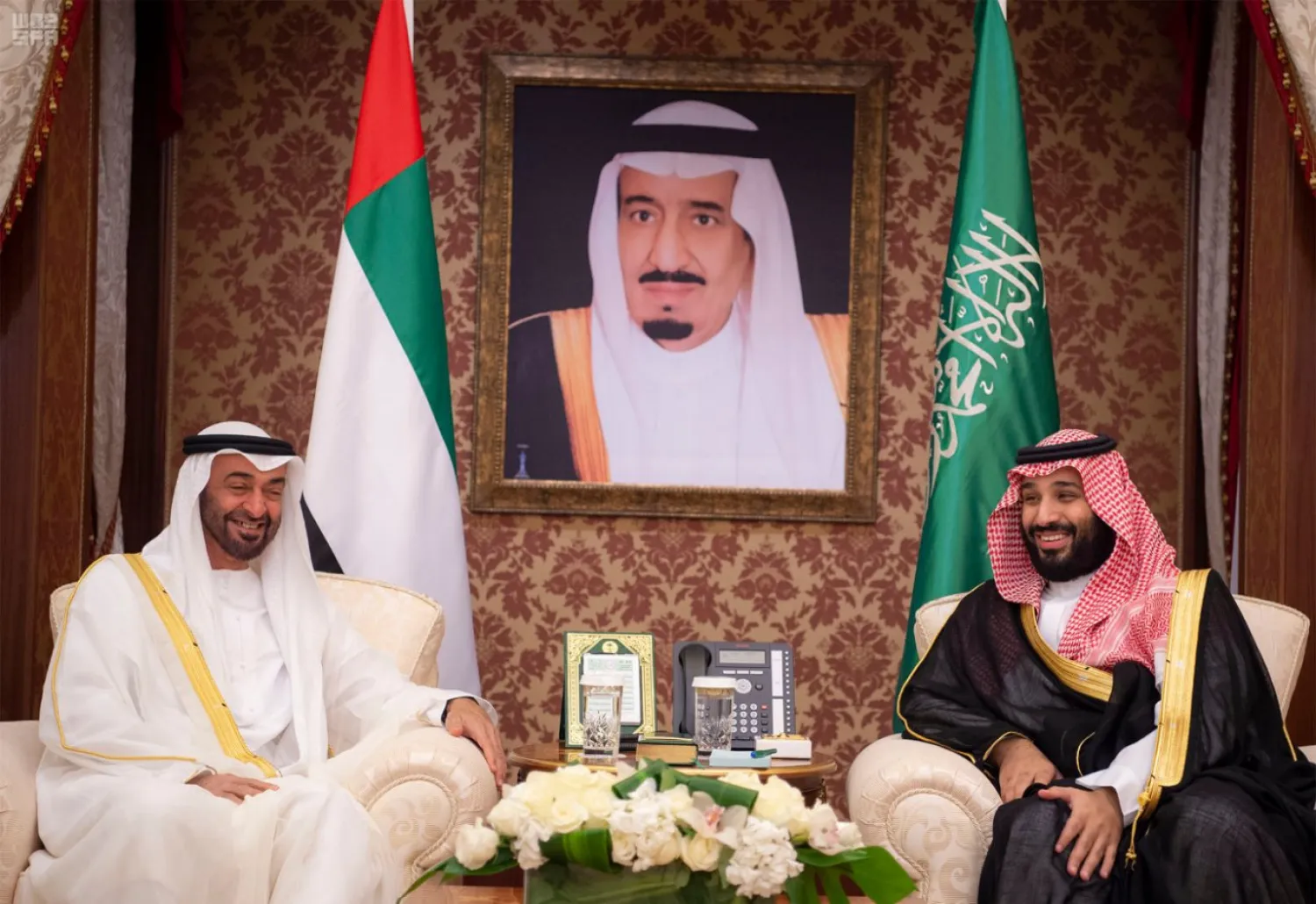

20 MoUs Signed in First Meeting of Saudi-Emirati Coordination Council

Crown Prince and Deputy Prime Minister and Minister of Defense, Prince Mohammed bin Salman, and Abu Dhabi Crown Prince and Deputy Supreme Commander of the UAE Armed Forces Sheikh Mohammed bin Zayed Al Nahyan (SPA)
TT

20 MoUs Signed in First Meeting of Saudi-Emirati Coordination Council

Crown Prince and Deputy Prime Minister and Minister of Defense, Prince Mohammed bin Salman, and Abu Dhabi Crown Prince and Deputy Supreme Commander of the UAE Armed Forces Sheikh Mohammed bin Zayed Al Nahyan (SPA)

Saudi-Emirati Coordination Council held its first meeting in Jeddah on Wednesday, under the chairmanship of Saudi Crown Prince and Deputy Prime Minister and Minister of Defense, Prince Mohammed bin Salman, and Abu Dhabi Crown Prince and Deputy Supreme Commander of the UAE Armed Forces Sheikh Mohammed bin Zayed Al Nahyan.

During the meeting, the Saudi-Emirati Coordination Council’s Organisational Structure was declared with the objective of enhancing joint co-operation on the implementation of targeted projects and programmes. The Council will bring the friendly ties between the two nations to new heights, especially their cooperation in all military, political, economic, trade and cultural fields, as well as in other areas.

The Saudi-Saudi Coordination Council stands as a role model for cooperation between world countries and consolidates joint action between Gulf Cooperation Council (GCC) states.

It was established under an agreement between the two countries reached in May 2016 under the directives of President Sheikh Khalifa Bin Zayed Al Nahyan and King Salman Bin Abdul Aziz.

The council is expected to coordinate the implementation of joint initiatives conducive to providing job opportunities, boosting GDP and accelerating bilateral investments.

The council seeks to develop a joint vision to deepen bilateral relations in line with the objectives set by the GCC in order to strengthen economic integration between the sides and develop innovative solutions for the optimum utilization of resources while building up an efficient and integrated education system premised on grooming qualified national generations.

On Tuesday, the two countries announced a joint vision for economic, developmental and military integration through 44 joint strategic projects as part of "Strategy of Resolve" which was developed over 12 months by 350 government officials from different fields. The strategy outlines three main axes: the economic axis, the human and knowledge axis, and the political, security and military axis.

Both leaders set a time frame of 60 months to implement the strategic projects aimed at building an exceptional model between UAE and Saudi Arabia which supports the works of the GCC. The strategy also "protects the interests of both countries and creates new opportunities for the brotherly people."

The Strategy also includes a plan to establish an agricultural investment company as a joint venture fund for renewable energy and a third investment fund for small and medium enterprises. It will also facilitate the flow of traffic in ports, build a unified industrial database, empower the banking sector in both countries, harmonize economic procedures and legislation and create a joint council to coordinate foreign investments.

The areas of cooperation identified by the Strategy of Resolve also include security and military cooperation and integration, coordination of foreign military assistance and standardization in the military industry sector.

During the coming period, the two sides will work on activating the joint manufacturing industries, implementing the electric linkage project, launching joint housing and financing services and solutions, establishing a joint center for the development of desalination technologies, cooperation in the management of infrastructure projects, and cooperate in the development of modern financial technology techniques.

The first meeting of the Joint Coordination Council witnessed the signing of 20 memorandums of understanding to enhance Saudi-UAE cooperation in various fields. A number of strategic projects were launched, and the structure of the Council was announced.

During the meeting, Sheikh Mohammed bin Zayed asserted that UAE and Saudi Arabia have strategic relations based on solid foundations of unity, joint vision, objectives and cooperation under the blessings of Sheikh Khalifa Bin Zayed Al Nahyan and the Custodian of the Two Holy Mosques King Salman bin Abdul Aziz.

“Our meeting today is a continuation of our brotherly and strong relations," he indicated.

Sheikh Mohammad also added that Saudi-Emirati Coordination Council supports the objectives of the GCC under the leadership of Saudi Arabia.

“We have a historic opportunity to create an exceptional Arab model of cooperation. Our solidarity and unity protect our interest, strengthen our economies and build a better future for our peoples,” bin Zayed said.
Abu Dhabi Crown Prince indicated that both UAE and KSA have the two largest Arab economies, forming the two most modern armed forces.

The economies of Saudi Arabia and the UAE, he went on to say, represent a gross domestic product of one trillion dollars, and joint exports rank fourth globally and amount to $750 billion, plus Dh150 billion annually invested in infrastructure projects, which generates huge opportunities for bilateral cooperation.

The council includes 16 ministers from prioritised sectors from both countries as follows; from Saudi Arabia: Minister of Interior Prince Abdul Aziz bin Saud bin Nayef, Minister of Culture Prince Badr bin Abdullah bin Farhan, Minister of Economy and Planning Mohammed al-Tuwaijri, Minister of Commerce and Investment Majid al-Qasabi, Minister of Foreign Affairs Adel al-Jubair, Minister of Energy, Industry and Mineral Resources Khalid al-Falih, Board Chairman of the General Entertainment Authority Ahmad Bin Aqeel Al Khatib, Minister of Finance Mohammad al- Jadaan, and CEO of Board at Public Investment Fund Yasir al-Rumayyan.

From the UAE, the council includes the following members: Deputy Prime Minister and Minister of Presidential Affairs Sheikh Mansour Bin Zayed Al Nahyan, Minister of Economy Sultan al-Mansouri, Minister of State for Foreign Affairs Anwar Gargash, Minister of State for Financial Affairs Obaid Bin al-Tayer, Minister of Education Hussain al-Hammadi, Minister of State Sultan al-Jaber, and Deputy Secretary-General of the Supreme National Security Council Ali al-Shamsi.

In order to ensure the best utilization of co-operation and partnership prospects, an executive committee has been formed under the chairmanship of Sheikh Mansour and Minister Mohammad al-Tuwaijri to accelerate co-operation between the two sides on prioritized areas and following up the progress of work.

Crown Prince of Abu Dhabi Sheikh Mohammed bin Zayed Al Nahyan arrived in Jeddah on Monday and was received at the King Abdul Aziz International Airport by Crown Prince Mohammed bin and a number of Saudi officials.



Saudi, Swedish FMs Stress Importance of Intensifying Int’l Efforts to End Regional Escalation

Saudi Minister of Foreign Affairs Prince Faisal bin Farhan bin Abdullah and his Swedish counterpart Maria Malmer Stenergard meet in Riyadh on Tuesday. (SPA)
TT

Saudi, Swedish FMs Stress Importance of Intensifying Int’l Efforts to End Regional Escalation

Saudi Minister of Foreign Affairs Prince Faisal bin Farhan bin Abdullah and his Swedish counterpart Maria Malmer Stenergard meet in Riyadh on Tuesday. (SPA)

Saudi Minister of Foreign Affairs Prince Faisal bin Farhan bin Abdullah received in Riyadh on Tuesday his Swedish counterpart Maria Malmer Stenergard for talks on regional developments.

They underlined the importance of intensifying international efforts to de-escalate tensions to preserve regional peace and stability.

They FMs also tackled the bilateral relations between their countries and ways to bolster them in various fields.

Stenergard stressed Sweden’s condemnation of the Iranian attacks in the region, expressing its solidarity with the affected countries and the need for navigation to return to normal in the Strait of Hormuz.

The ministers also reviewed the humanitarian situation in Gaza and the Israeli attacks on Lebanon.

Also on Tuesday, Prince Faisal received a telephone call from his Egyptian counterpart Badr Abdelatty to discuss regional developments.

They underscored the importance of intensifying efforts to de-escalate tensions in a manner that preserves regional peace and security.


Swedish FM to Asharq Al-Awsat: We Stand in Full Solidarity with Saudi amid these Difficult Times

Swedish Foreign Minister Maria Malmer Stenergard. (Turky Al-Agili)
TT

Swedish FM to Asharq Al-Awsat: We Stand in Full Solidarity with Saudi amid these Difficult Times

Swedish Foreign Minister Maria Malmer Stenergard. (Turky Al-Agili)

Swedish Foreign Minister Maria Malmer Stenergard stressed her country’s full solidarity with Saudi Arabia amid the difficult conditions in the region, adding that the Kingdom was a “highly valued partner and interlocutor on regional and global issues”.

In an interview to Asharq Al-Awsat, she said: “I have long planned to visit Saudi Arabia and I am very pleased to finally be here. It is important for me to be able to personally convey my government’s sincere support and solidarity with Saudi Arabia in current difficult times.”

“We commend the Kingdom’s resilience and commitment to support dialogue and peaceful solutions. Sweden and Saudi Arabia share a joint interest in global peace and stability within a rules-based international order. During my discussion with Foreign Minister Prince Faisal bin Farhan bin Abdullah, I have also been able to outline Sweden’s approach to major international conflicts, including our strong support to Ukraine,” she added.

“I also wanted to meet with additional representatives in the very diverse group of Swedish or ‘Swede-tech’ companies present in Saudi Arabia, such as Envac, Getinge, TetraPak and Hitachi Energy. I wanted to express my sincere gratitude for their contribution to the impressive development of Saudi Arabia and for being excellent ambassadors of Sweden’s spirit of innovation and building a better future,” she continued.

On Saudi-Swedish relations and aspects of cooperation, Stenergard said: “Swedish- Saudi relations are excellent and ever-expanding. Saudi Arabia has for a long time been one of Sweden’s largest trading partners in the MENA region. Swedish companies, like Ericsson and ABB, have been present in the Saudi market since the 1950’s and 60’s and continue to bring jobs to Saudis across the Kingdom.”

US-Israel war on Iran

On the US-Israel war on Iran, she said: “Sweden views the situation with great concern. Sweden’s position is clear: we urge all parties to continue talks and pursue a diplomatic solution.”

“There is a strong global urge and interest that these efforts, as soon as possible, lead to sustainable peace. Any final arrangement must address key concerns, such free navigation in the Strait of Hormuz, ensuring that Iran does not acquire nuclear weapons and that Iran does not pose a threat to regional and international security,” she stated.

On whether Sweden would be involved in ensuring freedom of navigation in the Strait of Hormuz, the Red Sea and the Bab el-Mandeb strait, she replied: “Sweden is engaged in efforts to uphold freedom of navigation in the region, such as the French British initiative, together with Saudi Arabia.”

“We continue to assess how Sweden can best contribute. As a member of the European Union, Sweden contributes to the EU led Operation Aspides in the Red Sea, which aims to safeguard maritime security and ensure continued freedom of navigation through key waterways such as the Red Sea and the Bab el-Mandeb strait,” Stenergard went on to say.

NATO summit

Asked about the outcomes of the recent NATO summit in Sweden, she told Asharq Al-Awsat: “Sweden is happy to have hosted a productive meeting of the NATO Ministers of Foreign Affairs in Helsingborg. The meeting was an important milestone on the road to the NATO Summit in Ankara.”

“We are pleased that Sweden could facilitate a meeting that allowed for open and constructive discussions. Hosting our first NATO meeting at ministerial level is an expression of Sweden’s ambition to be an active and constructive NATO ally,” she added.

Lebanon-Israel negotiations

Turning to the future of the Israeli and Lebanese negotiations, she stressed that she was “deeply concerned about the situation on the ground, including the large-scale demolition of villages in southern Lebanon, and the very large number of internally displaced people.”

“The Swedish position is clear: the ceasefire must be respected and talks on a long-term solution need to continue. Israel must withdraw from Lebanese territory and respect Lebanon’s sovereignty and territorial integrity,” she demanded.

“At the same time, a sustainable peace requires the disarmament of Hezbollah, in line with UN Security Council resolutions and decisions by the Lebanese government. There can only be a diplomatic solution to this conflict,” she said.


Oman, Kuwait Support Stability, Dialogue to Tackle Regional Challenges

Omani Foreign Minister Badr bin Hamad Al Busaidi and his Kuwaiti counterpart Sheikh Jarrah Jaber Al Ahmad Al Sabah sign the MoU during their meeting on Monday. (ONA)
TT

Oman, Kuwait Support Stability, Dialogue to Tackle Regional Challenges

Omani Foreign Minister Badr bin Hamad Al Busaidi and his Kuwaiti counterpart Sheikh Jarrah Jaber Al Ahmad Al Sabah sign the MoU during their meeting on Monday. (ONA)

Oman and Kuwait stressed on Monday the importance of maintaining coordination and consultations, bolstering security and stability, and supporting dialogue and diplomacy to tackle challenges in the region.

The countries held the 11th session of the Oman-Kuwait Joint Committee in Al Jabal Al Akhdar in Oman. It was chaired by Omani Foreign Minister Badr bin Hamad Al Busaidi and his Kuwaiti counterpart Sheikh Jarrah Jaber Al Ahmad Al Sabah.

The meeting addressed the deep-rooted fraternal relations between their countries. The officials discussed ways to boost bilateral cooperation in a number of fields to serve common interests, in translation of the aspirations of the wise leaderships of Oman’s Sultan Haitham bin Tarik and Kuwait’s Emir Sheikh Mishal Al Ahmad Al Jaber Al Sabah, reported Oman’s state news agency ONA.

Al Busaidi said that the meeting was held in implementation of the supreme directives of the leaderships of the two countries, calling for deepening bilateral cooperation, particularly in the economic, commercial, cultural, and scientific fields, and exchanging expertise to achieve greater integration and partnership between Oman and Kuwait.

He pointed out that the regular convening of the joint committee reflects the attention and care it receives from the leaderships of both countries, and embodies the joint commitment to strengthening its role as an effective institutional framework to propel cooperative relations toward more advanced and comprehensive levels.

For his part, Sheikh Jarrah stressed that the two countries' celebration this year of the 55th anniversary of their diplomatic relations reflects the development and growth of their ties.

The FMs said that Omani-Kuwaiti relations are a model of sincere fraternal bonds among the countries of the Gulf Cooperation Council.

They signed a memorandum of understanding in the field of cybersecurity, and an executive program in the field of standardization.