

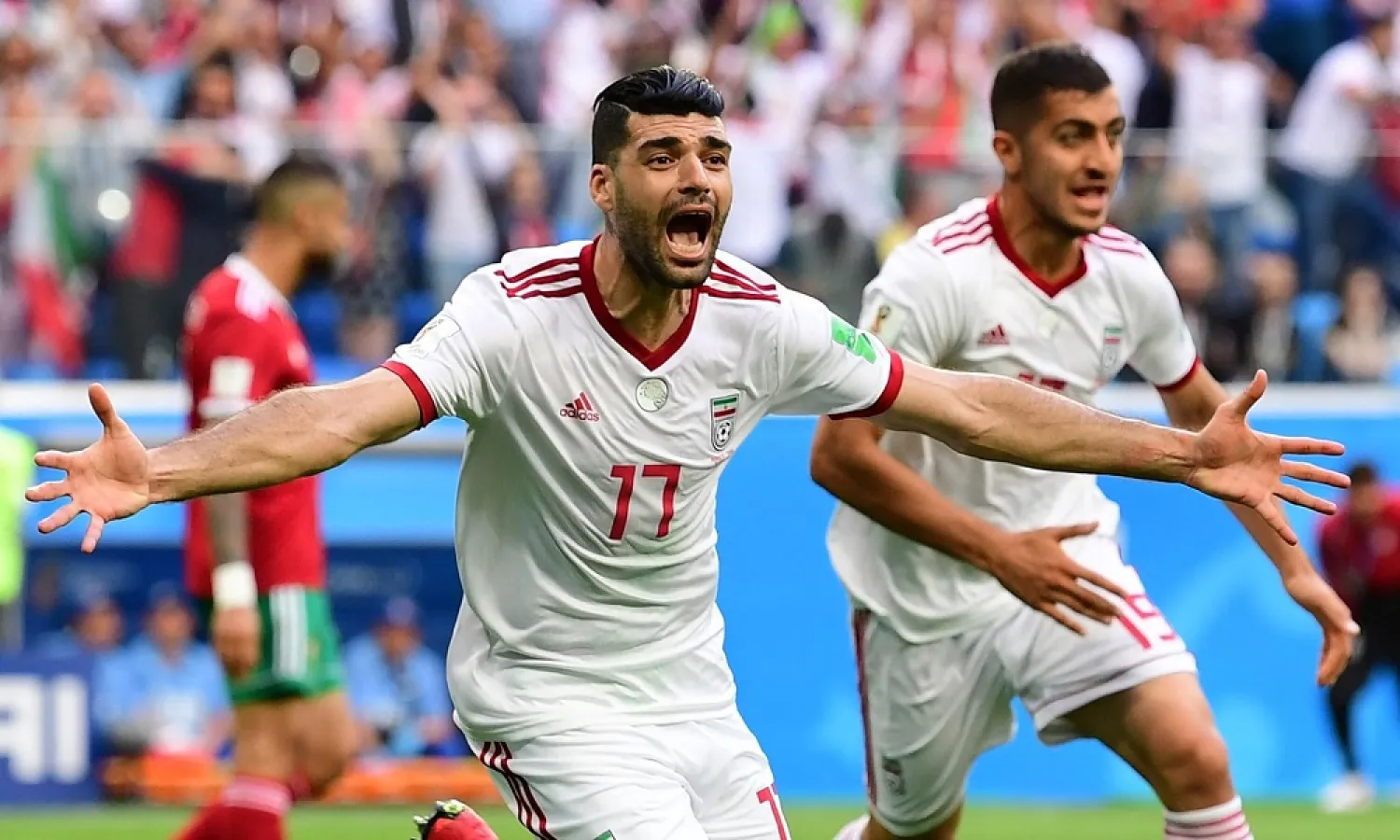

Morocco Own Goal Hands Iran Victory in Group B

Iran’s Mehdi Taremi reacts after Morocco scored a late own goal. (AFP)
TT

Morocco Own Goal Hands Iran Victory in Group B

Iran’s Mehdi Taremi reacts after Morocco scored a late own goal. (AFP)

A late own goal by Morocco handed Iran on Friday victory in their opening match at the FIFA World Cup.

Aziz Bouhaddouz gifted Iran a dramatic 1-0 victory, sending euphoric Iranian players on to the pitch.

It was Iran's second win in 13 matches at the World Cup, and Asia's first since the 2010 tournament in South Africa.

Wasteful finishing looked to have consigned this compelling contest at the Saint Petersburg Stadium to a goalless draw but Bouhaddouz's mistake in injury-time means Iran emerge as the early challengers to Spain and Portugal in Group B.

Morocco was most dangerous on the wings, through Hakim Ziyech on the right and Amine Harit on the left, during its strong start to the game.

Iran coach Carlos Queiroz, once of Real Madrid and Manchester United, insisted the chaos that has engulfed Spain this week offered no boost to these teams' chances, but this victory certainly cranks the pressure up a notch.

When Bouhaddouz nodded in at the near post, Iran's substitutes could not resist rushing onto the field and when the final whistle blew moments later they were sprinting over again in delight.

Morocco should at least take heart from a blistering first half an hour, during which their zip and zest deemed them virtually unplayable. But Ziyach, Ayoub El Kaabi and Mehdi Benatia all failed to capitalize.

Morocco's fans, at a World Cup for the first time in 20 years, belted out their own national anthem and then applauded Iran's, the 67,000-seater arena a sea of red and white, and buzzing with the hum of vuvuzelas in a throwback to the 2010 World Cup in South Africa.

The only shame was the large number of empty seats at kick-off, with many supporters still queueing to get through security 15 minutes before kick-off.

Morocco started brilliantly, hounding Iran's every touch and swarming forward with such ferocity that on the line, Queiroz spent most of the opening 20 minutes urging his players to pause and take a breath.

The only surprise was Morocco were not ahead as Ziyach kicked the air from a well-worked corner, El Kaabi sliced wide and a penalty-box scramble saw shots from Younes Belhanda and Benatia blocked.

The onslaught finally eased after half an hour and by the interval Iran had not only survived but finished the stronger, Sardar Azmoun, the 'Iranian Messi', spurning a one-on-one after a scintillating break.

Perhaps tired from the first period or, more likely, reminded of their defensive duties during the interval, both teams were cagier after the restart.

They each made substitutions as the game drifted past the hour and the closest it had come to a winner was when a fizzing Ziyach drive had to be tipped around the post by Ali Beiranvand.

Queiroz and his opposite number Herve Renard were involved in a touchline scuffle, that was quickly resolved, before the real drama arrived moments later.

Bouhaddouz could not see what was behind him when a whipped free-kick came in from the left and he panicked, diving to the ball and heading it inside his own near post.



A Bird Leaves Nothing Behind: The Lesson Behind Japan’s World Cup Stadium Cleanups

Japan supporters clean the stands at the end of the World Cup group E football match between Germany and Japan, at the Khalifa International Stadium in Doha, Qatar, Wednesday, Nov. 23, 2022. (AP)
TT

A Bird Leaves Nothing Behind: The Lesson Behind Japan’s World Cup Stadium Cleanups

Japan supporters clean the stands at the end of the World Cup group E football match between Germany and Japan, at the Khalifa International Stadium in Doha, Qatar, Wednesday, Nov. 23, 2022. (AP)

If there's one country guaranteed to clean up at the World Cup, it's Japan.

Literally.

Scenes of Japanese football fans sweeping stadiums and picking up trash after a match first drew public attention in France in 1998 — Japan's first appearance in the World Cup.

The tradition has continued every four years. It happened at the World Cup in Qatar in 2022, and it's certain to continue when Japan opens play in June with group games in Arlington, Texas, and Monterrey, Mexico.

The cleanup astonishes non-Japanese who might be accustomed to leaving stadiums and stepping over half-eaten food, shredded paper wrappers, and cups — empty or with liquid dribbling out.

At the World Cup in Russia in 2018, Japanese players famously cleaned the dressing room after a loss and left a thank-you note in Russian. In 2022, fans left thank-you notes on rubbish bags written in Arabic, English and Japanese.

Why do Japanese behave this way? It's not that complicated. Beginning in elementary school, students are socialized to behave this way — in the classroom, in the school yard or on a playing field.

“Japanese sports fans at world events who clean up the stadium are behaving much the same way they did when they learned how to enjoy sports as school boys and girls,” Koichi Nakano, who teaches politics and history at Sophia University, told The Associated Press.

There is a phrase in Japanese that explains it.

“Tatsu tori ato wo nigosazu.”

The literal translation is: “A bird leaves nothing behind.”

Rendered in English the message is: “Return it the way you found it.”

Many Japanese elementary schools don’t have janitors, so the clean-up work is left to students. Office workers often dedicate time to sprucing up their areas.

Also, there are relatively few trash containers in public spaces in Japan, so people take their waste home with them. This keeps the sidewalks cleaner, saves the cost of emptying trash cans, and keeps away vermin.

“The way most ordinary soccer fans experience soccer at school is no different from other sports, and the emphasis is not just on physical education but also on moral education as well,” Nakano added.

Collective vs. the individual

Raised in Germany, Barbara Holthus is the deputy director of the German Institute for Japanese Studies in Tokyo. A sociologist, she agrees it's prudent not to put Japanese on a pedestal. Japan, like any country, has its own challenges and shortcomings.

“An academically sound explanation is that people in Japan just happen to be socialized different,” she told The AP. “If you grew up with a certain way of how things are being done, you apply that to even cleaning up a stadium afterwards.”

At work here is also the Japanese concept of “meiwaku,” which implies not causing trouble or annoying others. From the Japanese point of view, leaving rubbish piled up in a stadium would be a bother to others.

Japan is a relatively crowded place, and greater Tokyo alone has about 35 million people, almost the population of the entire state of California. People need to get along.

“Japanese learn early on that you don't want to inconvenience other people,” Holthus said.

She said the focus is often on the collective, compared with the West where the emphasis is on the individual and individual rights.

“You don’t want to bother people. It goes to all areas of life in Japan,” Holthus added. “We are raised (in the West) that we don’t have to clean up after ourselves in public spaces because there is going to be some kind of public service doing that.”

And because Japanese people have received widespread praise for the clean-up, the behavior has been reinforced.

“Now that the media has latched onto the story and lavished praise on Japanese fans, they have made it a point of pride to display those values and norms,” Jeff Kingston, who teaches history at Temple University in Japan, wrote in an email.

A Japanese tradition

The clean-up tradition is not limited to football’s marquee tournament. The same thing happened last year at the Under-20 World Cup in Chile as Japanese fans cleaned up after a match. And even more recently last month at Wembley Stadium in London where Japan defeated England 1-0 in an international friendly.

“It’s one of our traditions,” said Toshi Yoshizawa, who was leading the cleanup in Chile. “We grew up with the teaching that we should leave a place cleaner than when we arrived.”

William Kelly, an emeritus professor of anthropology at Yale University and a specialist on Japan, said the tradition is linked to football more than other sports. He speculated it's tied to the establishment of Japan's professional football league more than 30 years ago.

“It (the J-League) was trying to distinguish itself from baseball by emphasizing teams’ community embeddedness and commitment,” Kelly wrote in an email. “Soccer fans felt, and feel, more a part of the club and its stadium.”


Riyadh to Host Joshua vs. Prenga Showdown in July

Boxing - Jake Paul v Anthony Joshua - Kaseya Center, Miami, Florida, US - December 19, 2025 Anthony Joshua after winning his fight against Jake Paul. (Reuters)
TT

Riyadh to Host Joshua vs. Prenga Showdown in July

Boxing - Jake Paul v Anthony Joshua - Kaseya Center, Miami, Florida, US - December 19, 2025 Anthony Joshua after winning his fight against Jake Paul. (Reuters)

Chairman of the Board of Directors of Saudi Arabia’s General Entertainment Authority Turki Alalshikh announced the return of British boxer Anthony Joshua to the ring in “The Comeback,” scheduled for July 25 in Riyadh.

The 36-year-old Joshua will fight Kristian Prenga, an Albanian with 20 victories and one loss.

Joshua’s last fight was a knockout victory over YouTuber Jake Paul on Dec. 19. Ten days later, he was injured in a car crash in Nigeria that killed two of his friends.

“It’s no secret I’ve taken some time to consolidate and rebuild to be ready for stepping back into the ring,” Joshua said in a Matchroom statement, “and today is the next step on that journey.”

In the statement, Joshua said the fight with Prenga is the first in a “multi-fight deal."

The event forms part of the Kingdom’s continued hosting of major international boxing matches, further cementing Riyadh’s status as a premier destination for global sports and entertainment.

The bout will be broadcast live worldwide on DAZN.


Man Utd Close in on Champions League Spot but Still Work to Do, Carrick Says

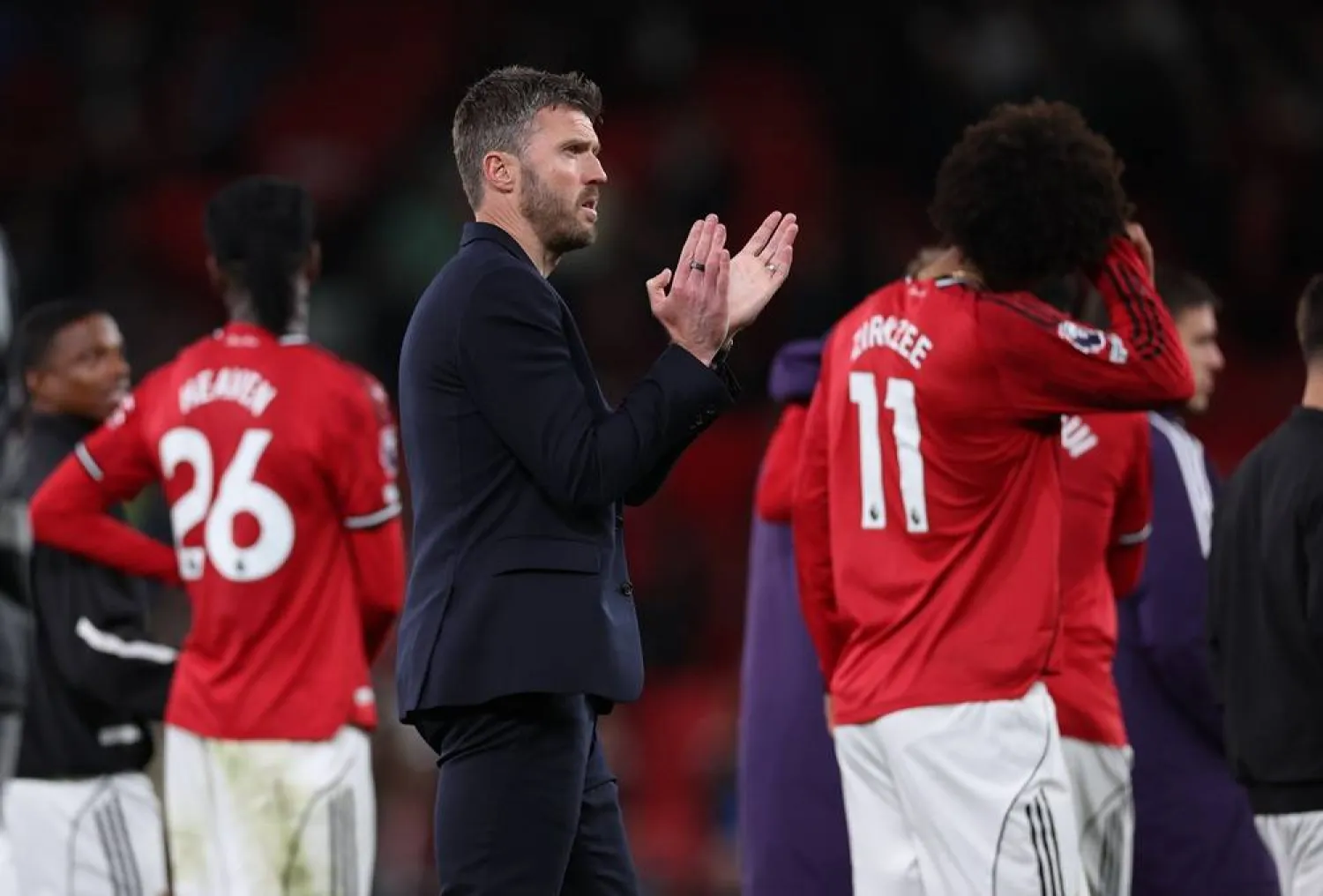
Manchester United interim manager Michael Carrick reacts after the English Premier League match between Manchester United and Brentford FC, in Manchester, Britain, 27 April 2026. (EPA)
TT

Man Utd Close in on Champions League Spot but Still Work to Do, Carrick Says

Manchester United interim manager Michael Carrick reacts after the English Premier League match between Manchester United and Brentford FC, in Manchester, Britain, 27 April 2026. (EPA)

Manchester United's 2-1 win ‌over Brentford on Monday put them on the brink of Champions League qualification but interim manager Michael Carrick said they must keep pushing to finish as high up the Premier League table as possible.

The victory lifted United to third place on 61 points, 11 clear of sixth-placed Brighton & Hove Albion, with four games remaining.

With the top five qualifying for the Champions ‌League next season, ‌United need two more points ‌to ⁠seal their return ⁠to Europe's elite competition after a two-year absence.

"The Champions League is one thing, but it's not something that we should be over-celebrating either," former United midfielder Carrick told reporters.

"We want to be finishing high up the league really, ⁠and we want to be challenging ‌high up in the ‌league and trying to get more points so our ‌season doesn't get to a close when ‌that happens.

"We have put ourselves in good position, but there's still more work to be done," added Carrick, who took charge in January with United in ‌sixth spot after Ruben Amorim's dismissal.

Casemiro was on the scoresheet on Monday ⁠and ⁠while supporters have called on the club to keep him for another year, Carrick said the midfielder's situation was clear.

"From both sides it's pretty clear. Probably the situation and the clarity of it has helped everything," he added.

"It means a lot to him and credit to him because of the situation that it is, he's given absolutely everything as well and had some big moments for us."

United next face fourth-placed Liverpool on Sunday.