



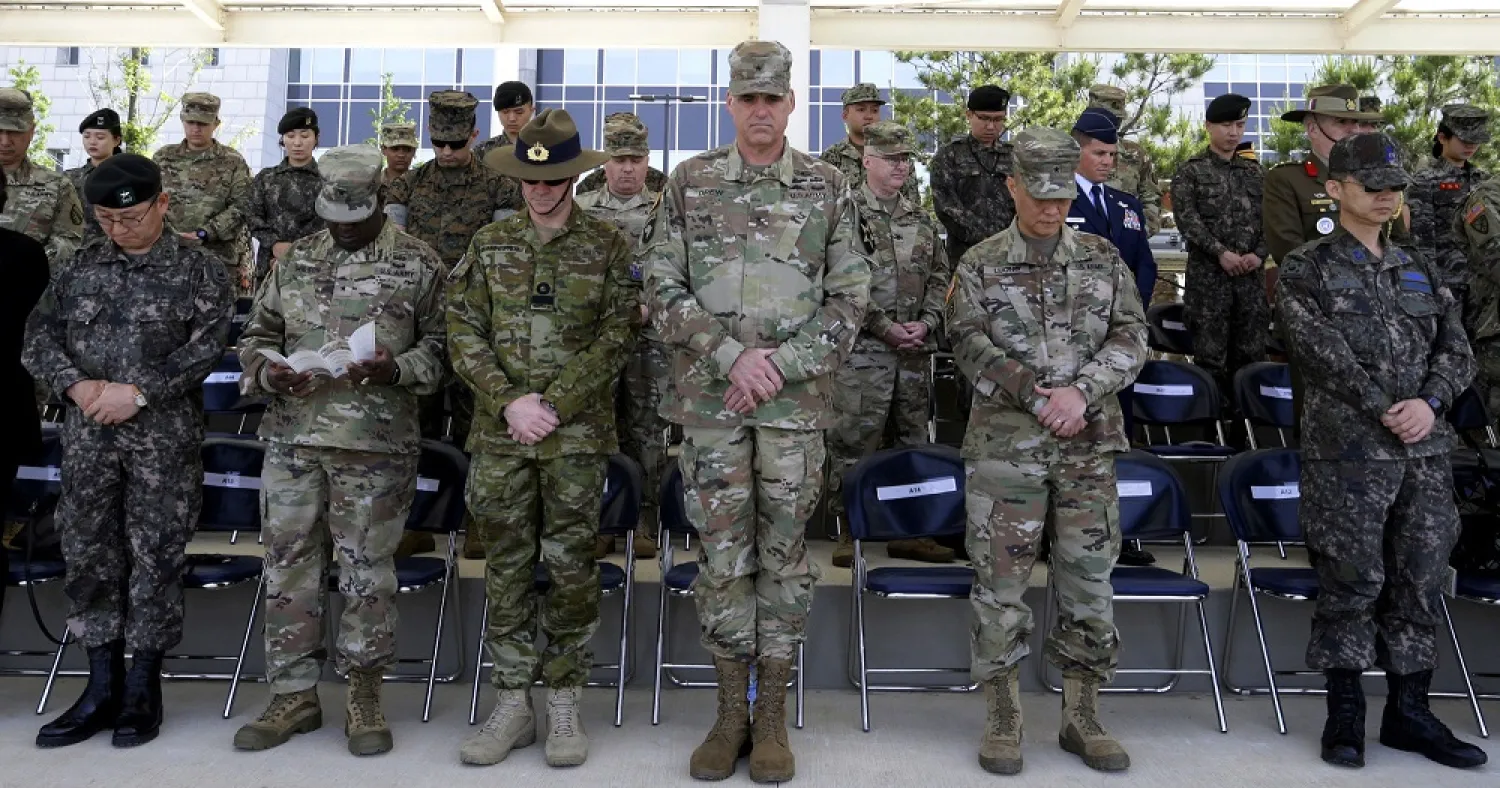

The United States formally ended on Friday its military presence in the South Korean capital Seoul ahead of relocating to a new headquarters in the western port city of Pyeongtaek.
The US military had been headquartered in Seoul's central Yongsan neighborhood since American troops first arrived at the end of World War II.
The two allies agreed as long ago as 1990 to relocate the headquarters to Camp Humphreys, an existing base in Pyeongtaek, around 60 kilometers (38 miles) south of the capital. But the project was delayed for years by resident protests, financial issues and extensive construction work.
It was not until 2013 that the first unit transferred across to Camp Humphreys, named after a pilot who died in a helicopter accident.
The command’s move comes amid a fledgling detente on the Korean Peninsula. Most troops have already transferred to the new location, and the US says the remaining ones will move by the end of this year.
Located in the western port city of Pyeongtaek and close to a US air field, the new 3,510-acre (1,420-hectare) command cost $11 billion to build and is the largest overseas US base.
A ceremony was held to mark the relocation.
A message by South Korean President Moon Jae-in said that the headquarters is the cornerstone of the US-South Korea alliance.
"In opening a new era of the US forces headquarters in Pyeongtaek, I hope that the US-South Korea alliance will develop beyond a 'military alliance' and a 'comprehensive alliance' and become a 'great alliance,'" he said in the statement.
The relocation is part of a broad US plan to realign its 28,500 troops and their bases in South Korea into two major hubs: one in Pyeongtaek and the other in the southeastern city of Daegu. US officials say they want to move out of highly populated areas and improve efficiency and military readiness.
"Modern warfare is all about concentrating and deploying forces quickly, and Pyeongtaek in these terms has many advantages because it can really function as an outlet, unlike Yongsan, which was stuck in the middle of a population center," said Yun Jiwon, a security professor at Pyeongtaek University.
It also moved US forces away from the hundreds of North Korean artillery guns targeting the Seoul metropolitan area, although Camp Humphreys is still within reach of newer weapons, such as the 300 mm guns North Korea revealed in 2015.
The land used by the Yongsan Garrison will be handed over to South Korea, which hopes to turn the site into a Seoul's "Central Park."
Camp Humphreys incorporates a total of 513 buildings including schools, shops and banks spread over 14.7 million square meters, and will accommodate 43,000 people including soldiers and their family members by the end of 2022.
The Yongsan area has been occupied by foreign forces since the late 19th century. Chinese troops used the site as their base when they came to help suppress a revolt in 1882. The Imperial Japanese Army took it over during Japan's colonization of the peninsula from 1910 to 1945.
The US military arrived to disarm Japan following its World War II defeat. Most US troops were withdrawn in 1949 but they returned the next year to fight alongside South Korea in the three-year Korean War. In 1957, the US military command in South Korea was formally launched in Yongsan.
The US has 28,500 troops stationed in the South to defend it from the nuclear-armed North, and the move comes only weeks after Trump and Pyongyang's leader Kim Jong Un had an unprecedented summit in Singapore.


