

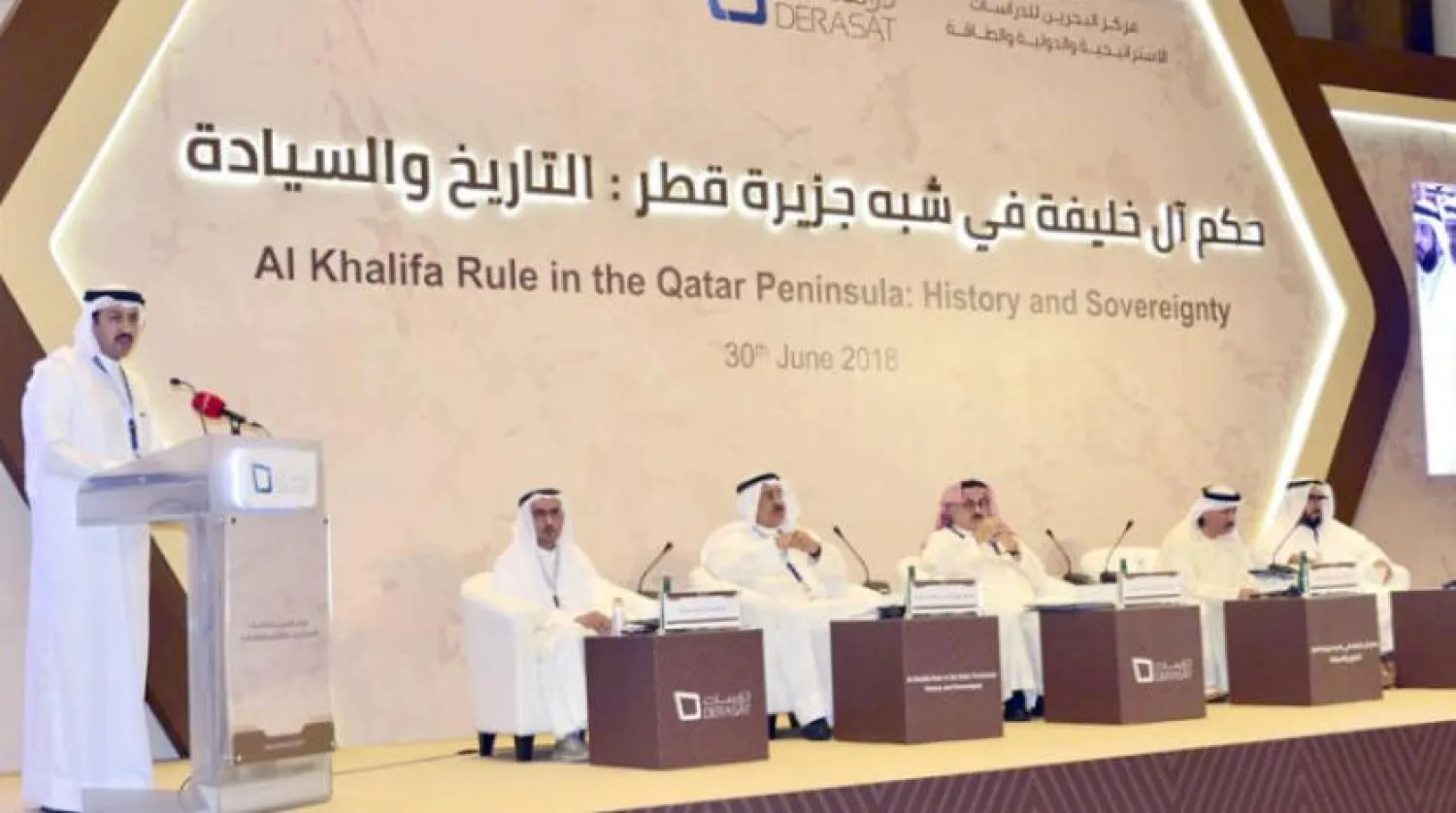

Bahraini Documents Reveal Historic Al-Khalifa Rule of Qatar Peninsula

A Manama conference highlighted the Al-Khalifa family’s historic rule of the Qatari Peninsula. (Asharq Al-Awsat)
TT

Bahraini Documents Reveal Historic Al-Khalifa Rule of Qatar Peninsula

A Manama conference highlighted the Al-Khalifa family’s historic rule of the Qatari Peninsula. (Asharq Al-Awsat)

Documents revealed for the first time on Saturday detailed the rule of the Al-Khalifa family of the Qatari Peninsula throughout history.

This history was traced during a conference, entitled “Al-Khalifa’s Rule in the Qatari Peninsula … History and Sovereignty.” The event was organized by the Bahrain Institute for Strategic, International and Energy Studies (DERASAT) and held in the Bahraini capital Manama.

The conference focused on Al-Zubarah, capital of Al-Khalifa in the Qatari Peninsula and the islands of Bahrain, the rebellion against the Al-Khalifa’s legitimate rule of the peninsula and the Qatari invasion of the al-Dibal in 1986.

The conference highlighted the significant historical period of the Al-Khalifa’s rule and sovereignty on the peninsula since the establishment of the Al-Khalifa State in the Al-Zubarah in 1762, reported the Bahrain News Agency (BNA).

“The Al-Khalifa State, with Al-Zubarah as its capital, fulfilled crucial internal and international duties and made history whose echoes still reverberate now and will always be present”, said DERASAT board of trustees’ chairman Dr. Sheikh Abdullah bin Ahmed Al-Khalifa.

Al-Khalifa’s emergence in 1762 was a changing point in the modern history of the region. They presented an exemplary model of trade, marine navigation, rule of law and security.

They also respected international treaties on the Qatari Peninsula and Bahrain islands.

As a result of Al-Khalifa’s just rule, Al-Zubarah was transformed into a prosperous political and trade hub.

Al-Zubarah’s rule by Al-Khalifa represented the unity of the peninsula and Bahrain islands.

This was underlined by Bahrain King Hamad bin Issa Al-Khalifa when he declared: “The people of Qatar are our own and they were part of us before the Al-Thani’s rule.”

Sheikh Abdullah stressed that Bahrain never abandoned Al-Zubarah and it and other Bahraini regions, have long been at the heart of demands at the International Criminal Court.

The current borders were drawn up by foreign powers to reap energy resources, he explained.

Bahrain has also been a victim of a series of conspiracies, he added.

The Al-Thani rule, on the other hand, has long been a symbol of rebellion and conspiracies, he continued.

He accused it of stoking strife and division to achieve expansionist goals through all illegitimate means, including resorting to force and forced displacement as demonstrated in the military invasion of Al-Zubarah in 1937.

The same scenario was repeated in 1986 with the invasion of al-Dibal.

Qatar’s hostile acts have continued, with its meddling in Bahrain’s internal affairs through its support of terrorist groups and fueling of media incitement, said Sheikh Abdullah.

The conference presented before the gatherers documents on Al-Zubarah’s history and the Al-Khalifa’s ties to the region.

They explain the demographics that existed at the time, as well as the political and historical geography of the Gulf region.
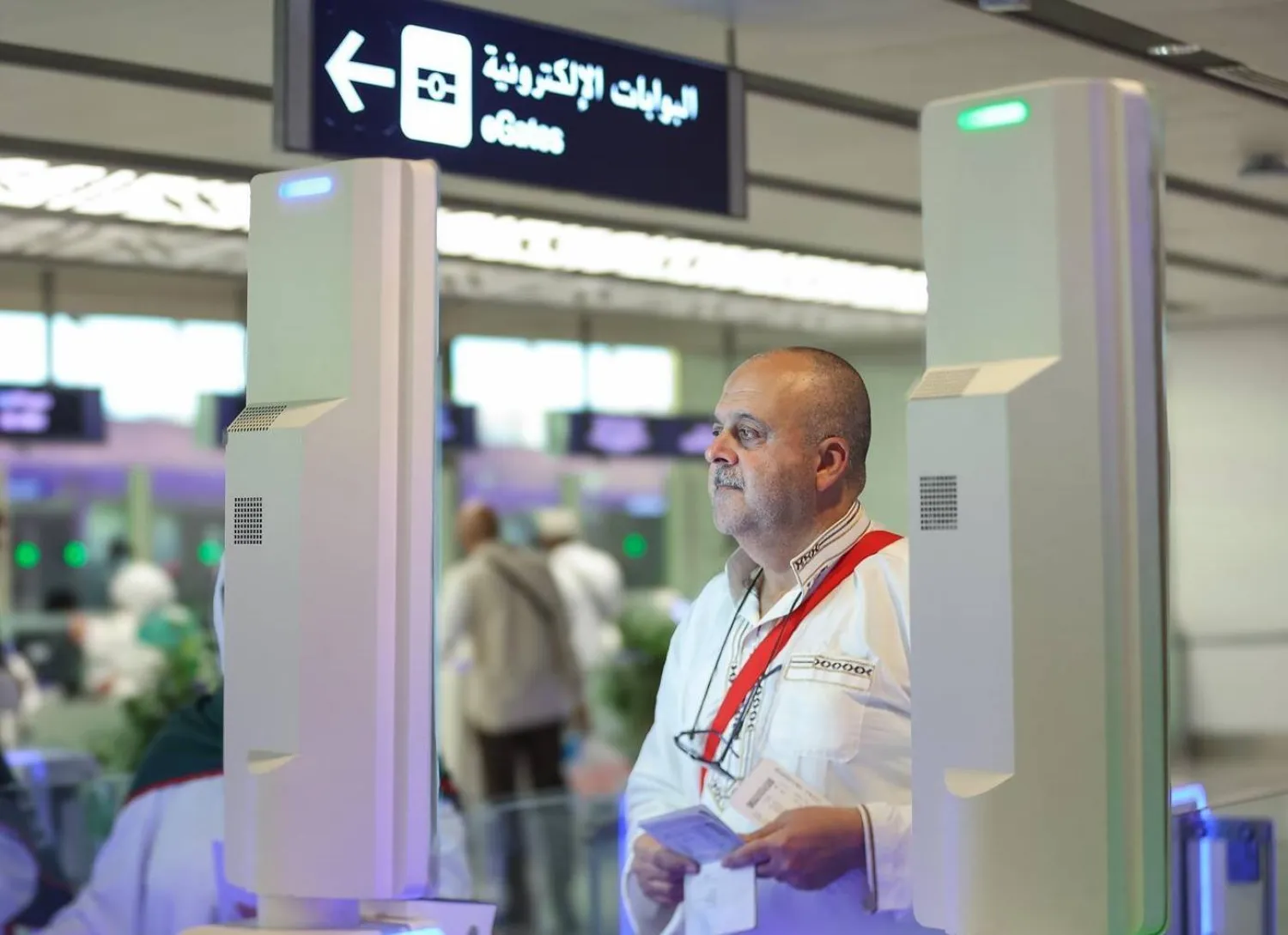



Saudi Passports Directorate Utilizes Airport E-Gates to Speed Up Hajj Pilgrim Departures

Automated E-gates allow departing pilgrims to complete passport control steps independently in a matter of seconds. (SPA)
TT

Saudi Passports Directorate Utilizes Airport E-Gates to Speed Up Hajj Pilgrim Departures

Automated E-gates allow departing pilgrims to complete passport control steps independently in a matter of seconds. (SPA)

Saudi Arabia’s General Directorate of Passports is utilizing modern technologies, including self-service E-gates at international airports, to streamline departure procedures for post-Hajj pilgrims across all border ports.

By instantly matching biometric data, these automated E-gates allow departing pilgrims to complete passport control steps independently in a matter of seconds.

The initiative, by the Ministry of Interior, significantly enhances passenger flow, reduces waiting times, and ensures a smoother, more efficient exit journey for travelers.

Saudi Arabia had announced the exceptional success of this year’s Hajj season that was backed by an integrated system of security, organization, and services, allowing pilgrims to perform their rituals with ease and tranquility.

The 2026 Hajj saw 1,707,301 pilgrims perform the rituals, with 1,485,729 pilgrims arriving via air ports, 54,429 by land, and 6,497 by sea.

Spokesperson of the General Directorate of Passports Major Nasser Al-Otaibi stressed on Sunday that the directorate continues to implement its operational plan for the departure of pilgrims through all international air, land, and sea ports.


Saudi Arabia to Host 39th Arab Inter-Parliamentary Union Conference this Week

The Speaker of the Saudi Shura Council said Joint Arab action represents a fundamental pillar for addressing current challenges (Arab Parliament)
TT

Saudi Arabia to Host 39th Arab Inter-Parliamentary Union Conference this Week

The Speaker of the Saudi Shura Council said Joint Arab action represents a fundamental pillar for addressing current challenges (Arab Parliament)

Saudi Arabia will host the 39th Conference of the Arab Inter-Parliamentary Union (AIPU) on Thursday via videoconference under the patronage of Custodian of the Two Holy Mosques King Salman bin Abdulaziz Al Saud.

The conference, organized by the Shura Council and AIPU, will bring together speakers of Arab parliaments and legislative councils, as well as delegates from several organizations.

Speaker of the Shura Council Sheikh Dr. Abdullah bin Mohammed Al Al-Sheikh expressed his appreciation for the Custodian of the Two Holy Mosques' patronage of the conference. He said the support reflects the commitment of the Custodian of the Two Holy Mosques and Prince Mohammed bin Salman bin Abdulaziz Al Saud, Saudi Crown Prince and Prime Minister, to strengthening joint Arab cooperation and highlighting the role of Arab solidarity in supporting regional security and stability.

He also underscored the Kingdom's commitment to advancing development and prosperity across the Arab world.

"Joint Arab action represents a fundamental pillar for addressing current challenges and an important basis for unifying positions and coordinating parliamentary efforts," Al Al-Sheikh said.

He added that such efforts contribute to enhancing stability, protecting shared Arab interests, promoting the role of parliaments in supporting development efforts, and consolidating the values of dialogue and integration among Arab states.

Al Al-Sheikh said the Shura Council looks forward to welcoming participants to the conference and expressed hope that its outcomes will support joint Arab parliamentary action and strengthen parliamentary diplomacy as an effective tool for advancing Arab causes in the region and the world.


Saudi, Qatari FMs Discuss Efforts to Support Regional Security

Prince Faisal bin Farhan and Sheikh Mohammed bin Abdulrahman (Asharq Al-Awsat)
TT

Saudi, Qatari FMs Discuss Efforts to Support Regional Security

Prince Faisal bin Farhan and Sheikh Mohammed bin Abdulrahman (Asharq Al-Awsat)

Saudi Minister of Foreign Affairs Prince Faisal bin Farhan bin Abdullah has made a phone call to Qatari Prime Minister and Minister of Foreign Affairs Sheikh Mohammed bin Abdulrahman bin Jassim Al Thani.

During the call on Sunday, the two ministers reviewed the latest developments and their implications for the region, as well as the two countries’ efforts to support security and stability.