


There is a Cloud Hanging over this World Cup and FIFA Must not Ignore it

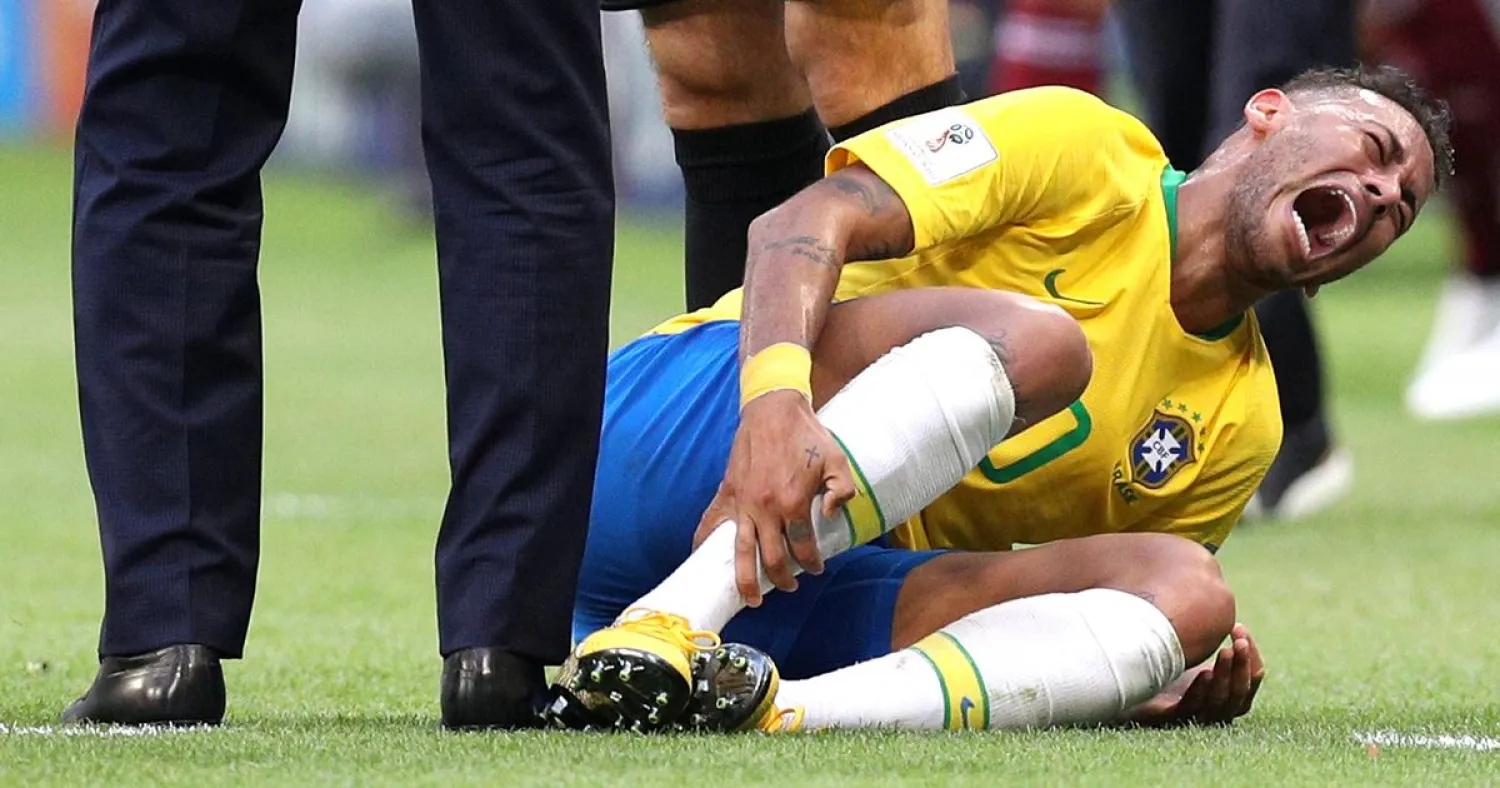
Brazil’s Neymar reacts after being fouled during his team’s match against Mexico in the World Cup round of 16. (Getty Images)
TT

There is a Cloud Hanging over this World Cup and FIFA Must not Ignore it

Brazil’s Neymar reacts after being fouled during his team’s match against Mexico in the World Cup round of 16. (Getty Images)

There was a time when we used to sneer at the antics deployed by South American nations, or the histrionics on show in La Liga, wondering how supporters put up with all the play-acting, but everyone’s at it now, including – and let’s not kid ourselves – England players. Cheating, sadly, is the one cloud that hangs over an otherwise brilliant World Cup in Russia.

Plenty of people will have come across comical clips of Neymar on social media, showing him rolling down motorways and mountains and along country lanes, following that series of exaggerated tumbles against Serbia. Yet the Brazilian is far from alone when it comes to feigning injury and trying to deceive officials.

Play-acting has been commonplace at this World Cup. It’s become a cancer in the game, not just a stain on it, and FIFA needs to find a cure. Either football’s world body confronts it head on, by introducing tougher penalties and urging referees to adopt a zero tolerance approach, or we hand over control to the players and resign ourselves to the fact that cheating is now “part and parcel of the game”. What a depressing thought.

What is clear right now is that the players, not the officials, are in charge. It was a free-for-all at times in the ugly spectacle that passed as a World Cup knockout game between England and Colombia, in particular the ridiculous amount of time – getting on for four minutes – between Mark Geiger, the referee, penalizing Carlos Sánchez for what was a stonewall penalty and Harry Kane, showing nerves of steel, converting from the spot.

Half a dozen Colombia players surrounded Geiger, much like the way that bullies pick on the vulnerable kid at school. There was zero respect for the referee, and bear in mind that Sánchez, grappling with Kane in the area with the ball nowhere near him, had been caught bang to rights. Perhaps Geiger should have been stronger and booked that posse of Colombia players, one after another. “Don’t understand why referees put up with in-your-face abuse,” Gary Lineker wrote on Twitter. “Give them yellow cards and stop the nonsense.”

Why can’t referees do that? If players know a caution is the mandatory response to any haranguing of officials, then the unacceptable scenes played out in Moscow on Tuesday night, or at the end of the Portugal vs. Uruguay last-16 tie on Saturday, when Ricardo Quaresma was nose-to-nose with the Mexican referee and Cristiano Ronaldo was screaming in his face, will surely disappear. If they don’t, some of the players are bigger birdbrains than we thought.

As for play-acting, it should be right at the top of FIFA’s agenda. Simulation is nothing new – picture Rivaldo clutching his face in 2002 after the ball hit him on the leg, or Jurgen Klinsmann throwing himself into the air in the 1990 World Cup final. Yet, sadly, it feels as though we have plumbed new depths in Russia.

We can all shake our heads at Pepe when he shamelessly falls to the floor after Morocco’s Mehdi Benatia taps him on the shoulder, but the reality is that the Portugal international is just one clown in a much bigger circus. Colombia, for sure, were a disgrace at times against England, unrecognizable from the team that illuminated the World Cup four years ago.

But take off your three lions shirt for a moment and watch the game again and England’s players were no angels. Jordan Henderson and Harry Maguire (and, yes, the Leicester defender did at least hold up his hands after he took a tumble) were among those exaggerating or feigning contact.

Gareth Southgate was asked about England’s conduct afterwards by a Russian journalist, who suggested to him that the current generation of players, unlike the team that the manager had been part of in the 90s, “falls down every time the wind blows”. Southgate, a dignified man working in an undignified game, replied: “Maybe we’re getting a bit smarter. Maybe we’re now playing by the rules the rest of the world are playing by. I thought there were many, many fouls in the game and I don’t think we conceded anywhere near the number of our opponents. If we went down, it’s because we were fouled.”

Leaving aside the last comment, which Southgate has to say in the circumstances, the England manager was being brutally honest. This is a game where anything goes now, where perfecting the darker arts is as much of a skill as executing a lovely one-two, and where cheating is passed off as being streetwise. As Southgate succinctly put it: “We’re now playing by the rules the rest of the world are playing by.”

Truth be told, it descends into a lawless game of skulduggery at times. And, quite frankly, who can blame England for getting their hands dirty and taking the view that the next round is a better place to be than the moral high ground. If you can’t beat ’em, join ’em.

What is also increasingly clear now is that there are many players – Pepe, Sergio Ramos and Neymar spring to mind immediately – who do not care a jot that their cheating is watched by hundreds of millions of people throughout the world, analyzed in television studios by former internationals, and highlighted and ridiculed on social media.

To be clear, it’s not about those players being role models – that’s more of a job for parents, not footballers. But do these players take no personal pride, or see any shame, in how they conduct themselves on the pitch?

That same footage – and more – is also being viewed by 13 officials who have access to 33 cameras in a control room in Moscow, where they perform the roles of video assistant referees – and you can probably see where this line of thought is going. Does there not come a point when the only way to iron out blatant cheating is to extend the remit of video technology to stray beyond correcting “clear and obvious errors” in “game-changing situations” and intervene in cases of play-acting, too?

The difficulty, of course, is that interpreting some of the incidents – whether at the time or even retrospectively the following day – can be highly subjective and there are occasions when only the player knows whether they are feigning.

Either way, something has to be done. FIFA, at the very least, needs to show a determination to tackle the disease. Officials have to be stronger. And here’s a revolutionary thought: how about the players take a bit of responsibility for their actions, too.

The Guardian Sport


Hospital: Vonn Had Surgery on Broken Leg from Olympics Crash

This handout video grab from IOC/OBS shows US Lindsey Vonn crashing during the women's downhill event at the Milano Cortina 2026 Winter Olympic Games on February 8, 2026. (Photo by Handout / various sources / AFP)
TT

Hospital: Vonn Had Surgery on Broken Leg from Olympics Crash

This handout video grab from IOC/OBS shows US Lindsey Vonn crashing during the women's downhill event at the Milano Cortina 2026 Winter Olympic Games on February 8, 2026. (Photo by Handout / various sources / AFP)

Lindsey Vonn had surgery on a fracture of her left leg following the American's heavy fall in the Winter Olympics downhill, the hospital said in a statement given to Italian media on Sunday.

"In the afternoon, (Vonn) underwent orthopedic surgery to stabilize a fracture of the left leg," the Ca' Foncello hospital in Treviso said.

Vonn, 41, was flown to Treviso after she was strapped into a medical stretcher and winched off the sunlit Olimpia delle Tofane piste in Cortina d'Ampezzo.

Vonn, whose battle to reach the start line despite the serious injury to her left knee dominated the opening days of the Milano Cortina Olympics, saw her unlikely quest halted in screaming agony on the snow.

Wearing bib number 13 and with a brace on the left knee she ⁠injured in a crash at Crans Montana on January 30, Vonn looked pumped up at the start gate.

She tapped her ski poles before setting off in typically aggressive fashion down one of her favorite pistes on a mountain that has rewarded her in the past.

The 2010 gold medalist, the second most successful female World Cup skier of all time with 84 wins, appeared to clip the fourth gate with her shoulder, losing control and being launched into the air.

She then barreled off the course at high speed before coming to rest in a crumpled heap.

Vonn could be heard screaming on television coverage as fans and teammates gasped in horror before a shocked hush fell on the packed finish area.

She was quickly surrounded by several medics and officials before a yellow Falco 2 ⁠Alpine rescue helicopter arrived and winched her away on an orange stretcher.


Meloni Condemns 'Enemies of Italy' after Clashes in Olympics Host City Milan

Demonstrators hold smoke flares during a protest against the environmental, economic and social impact of the Milano-Cortina 2026 Winter Olympics in Milan, Italy, February 7, 2026. REUTERS/Kevin Coombs
TT

Meloni Condemns 'Enemies of Italy' after Clashes in Olympics Host City Milan

Demonstrators hold smoke flares during a protest against the environmental, economic and social impact of the Milano-Cortina 2026 Winter Olympics in Milan, Italy, February 7, 2026. REUTERS/Kevin Coombs

Italian Prime Minister Giorgia Meloni has condemned anti-Olympics protesters as "enemies of Italy" after violence on the fringes of a demonstration in Milan on Saturday night and sabotage attacks on the national rail network.

The incidents happened on the first full day of competition in the Winter Games that Milan, Italy's financial capital, is hosting with the Alpine town of Cortina d'Ampezzo.

Meloni praised the thousands of Italians who she said were working to make the Games run smoothly and present a positive face of Italy.

"Then ⁠there are those who are enemies of Italy and Italians, demonstrating 'against the Olympics' and ensuring that these images are broadcast on television screens around the world. After others cut the railway cables to prevent trains from departing," she wrote on Instagram on Sunday.

A group of around 100 protesters ⁠threw firecrackers, smoke bombs and bottles at police after breaking away from the main body of a demonstration in Milan.

An estimated 10,000 people had taken to the city's streets in a protest over housing costs and environmental concerns linked to the Games.

Police used water cannon to restore order and detained six people.

Also on Saturday, authorities said saboteurs had damaged rail infrastructure near the northern Italian city of Bologna, disrupting train journeys.

Police reported three separate ⁠incidents at different locations, which caused delays of up to 2-1/2 hours for high-speed, Intercity and regional services.

No one has claimed responsibility for the damage.

"Once again, solidarity with the police, the city of Milan, and all those who will see their work undermined by these gangs of criminals," added Meloni, who heads a right-wing coalition.

The Italian police have been given new arrest powers after violence last weekend at a protest by the hard-left in the city of Turin, in which more than 100 police officers were injured.


Liverpool New Signing Jacquet Suffers 'Serious' Injury

Soccer Football - Ligue 1 - RC Lens v Stade Rennes - Stade Bollaert-Delelis, Lens, France - February 7, 2026  Stade Rennes' Jeremy Jacquet in action REUTERS/Benoit Tessier
Soccer Football - Ligue 1 - RC Lens v Stade Rennes - Stade Bollaert-Delelis, Lens, France - February 7, 2026 Stade Rennes' Jeremy Jacquet in action REUTERS/Benoit Tessier
TT

Liverpool New Signing Jacquet Suffers 'Serious' Injury

Soccer Football - Ligue 1 - RC Lens v Stade Rennes - Stade Bollaert-Delelis, Lens, France - February 7, 2026  Stade Rennes' Jeremy Jacquet in action REUTERS/Benoit Tessier
Soccer Football - Ligue 1 - RC Lens v Stade Rennes - Stade Bollaert-Delelis, Lens, France - February 7, 2026 Stade Rennes' Jeremy Jacquet in action REUTERS/Benoit Tessier

Liverpool's new signing Jeremy Jacquet suffered a "serious" shoulder injury while playing for Rennes in their 3-1 Ligue 1 defeat at RC Lens on Saturday, casting doubt over the defender’s availability ahead of his summer move to Anfield.

Jacquet fell awkwardly in the second half of the ⁠French league match and appeared in agony as he left the pitch.

"For Jeremy, it's his shoulder, and for Abdelhamid (Ait Boudlal, another Rennes player injured in the ⁠same match) it's muscular," Rennes head coach Habib Beye told reporters after the match.

"We'll have time to see, but it's definitely quite serious for both of them."
Liverpool agreed a 60-million-pound ($80-million) deal for Jacquet on Monday, but the 20-year-old defender will stay with ⁠the French club until the end of the season.

Liverpool, provisionally sixth in the Premier League table, will face Manchester City on Sunday with four defenders - Giovanni Leoni, Joe Gomez, Jeremie Frimpong and Conor Bradley - sidelined due to injuries.
