


Fear Motivates Pep Guardiola in His Quest for a City that Never Sleeps

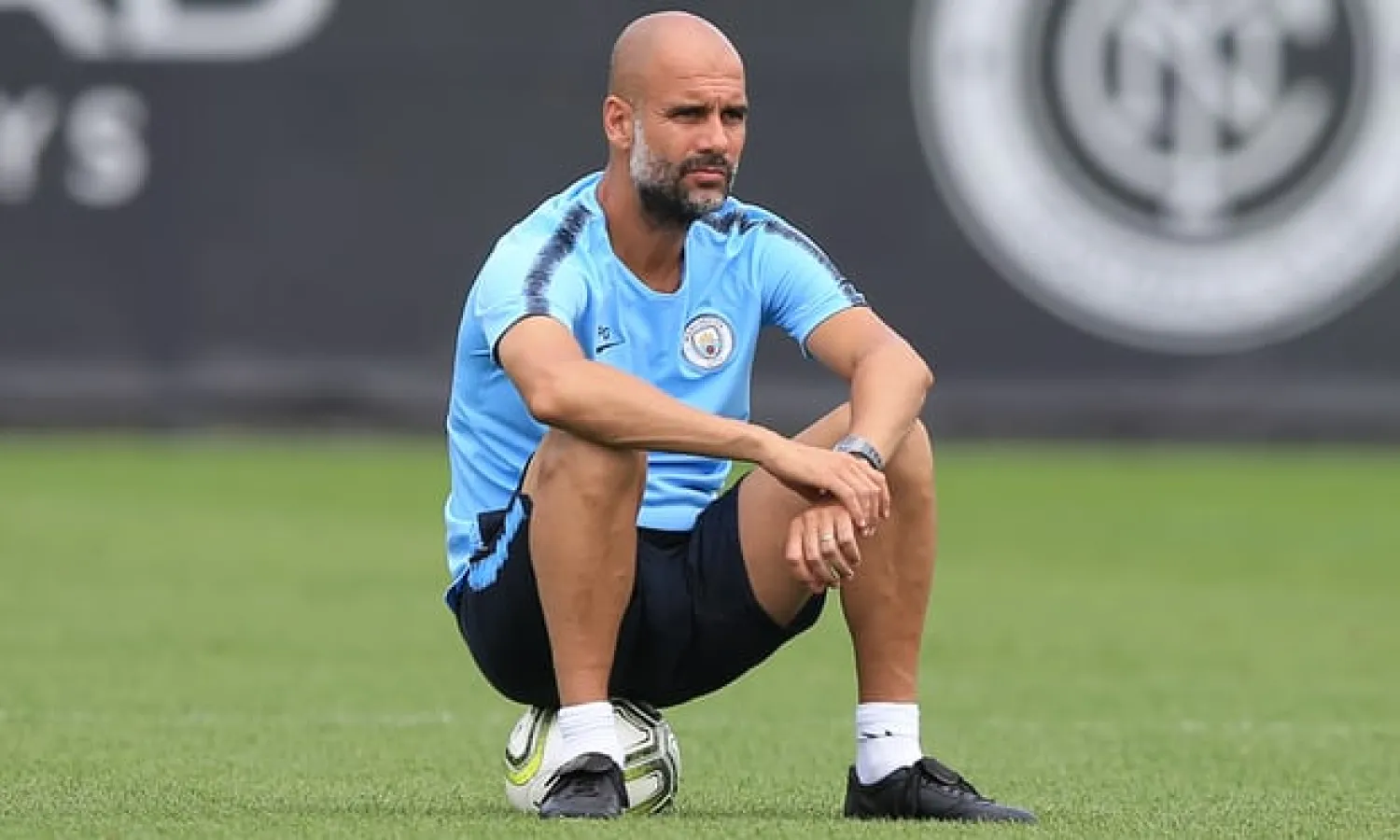
 Manchester City’s Pep Guardiola during training at New York City FC’ in July. Photograph: Matt McNulty - Manchester City/Man City via Getty Images
Manchester City’s Pep Guardiola during training at New York City FC’ in July. Photograph: Matt McNulty - Manchester City/Man City via Getty Images
TT

Fear Motivates Pep Guardiola in His Quest for a City that Never Sleeps

 Manchester City’s Pep Guardiola during training at New York City FC’ in July. Photograph: Matt McNulty - Manchester City/Man City via Getty Images
Manchester City’s Pep Guardiola during training at New York City FC’ in July. Photograph: Matt McNulty - Manchester City/Man City via Getty Images

The question of who motivates the motivator is often posed. In Pep Guardiola’s case, it may be the wrong one. It is not who, but what. The Manchester City manager is his own psychologist. His record of retaining titles shows he is sufficiently driven to avoid complacency. “The players don’t have to be worried,” he said as he contemplated Sunday’s Community Shield and the defence of City’s Premier League crown. “I am ready to fight again.” The reason felt counterintuitive. While the orchestrator of England’s only 100-point top-flight campaign can be a stranger to setbacks, he is galvanised by a fear of them.

He is not sated by success. Instead, Guardiola is haunted by the prospect of defeat’s damaging properties. They stretch far beyond the pitch, exerting a destructive impact on both his family and professional lives, and on a man who is so consumed by nerves that he cannot eat on match days. “The fear of losing games makes me starving and hungry again. I don’t like the feeling of losing games. All managers try to avoid that feeling: you feel guilty, you feel bad, your private life is not good, your relationship with the players is not good. Just that simple fear to lose a game makes you hungry.”

Fear may have spurred City on last season. They suffered five meaningful defeats: to Wigan in the FA Cup, Liverpool and Manchester United in the Premier League and two more to Liverpool in the Champions League. Opponents had more reasons to be afraid in a campaign that produced far more records than losses.

Glory may have been underpinned by fear and loathing in Manchester. The trailer for the Amazon documentary of City’s season includes Guardiola telling his team: “Some of you play better when you are angry with me, so if you hate me, hate me, guys.” An eloquent enthusiast can be charming, but it was a glimpse into Guardiola’s toughness. His players produce public paeans of praise to their manager. He suggested another picture could emerge when they are no longer beholden to him.

“When they are together [they say] he is an exceptional manager,” he said. “But after that they read books, they write books and make statements. They don’t have the courage to tell [me] face to face. It is normally the ones who don’t play. Normally, they are so sweet. When they are here, they say how good the manager is and how much he is a genius.”

Such superlatives have tended to come from Guardiola’s tactical and coaching prowess. He offered an insight into his man-management. “Sometimes you say some things in the heat of the dressing room,” he said. “Sometimes when you are sat here cold, you can analyse it in a different way. Some players need to be hugged for their best performance. Sometimes when you don’t speak to them is when they play better.”

City’s results last season were so impressive as to indicate Guardiola took a vow of silence. But now a purist sounded very pragmatic as he spoke of his priorities. “The Premier League is the main target,” he said. It felt the sort of logic Sir Alex Ferguson would long deploy, demoralising rivals with relentless consistency. “Every day, being there,” he said. “The Premier League shows you how you are as a team, if you are a stable system. In the Champions League, it is more unpredictable, so one bad moment, bad decisions, a bad half-time can break all the work of the whole season.”

The Community Shield will not, though it is notable that the past four champions have lost at Wembley. With City set to field a weakened and semi-fit side, that could become five. If Chelsea have an advantage, it is because City’s exploits came at a cost. They had 16 players at the World Cup, seven involved in the final week. Two, Kevin De Bruyne and Raheem Sterling, are yet to return to training. The England winger has been elusive in another respect, yet to commit to a new contract as he enters the final two years of his current deal.

While Gabriel Jesus signed up until 2023 on Friday, Sterling’s future is shrouded in more mystery. “I don’t know what is going to happen but I assure you 100% that the manager, the sporting director and all the players want him at the club,” Guardiola said.

Sterling delivered a career-best 23 goals last season but his situation is complicated by the arrival of a rival. Riyad Mahrez’s exploits on Leicester’s right flank secured him the PFA Player of the Year award in 2015-16’s title-winning campaign. Guardiola cited the versatility of both attackers to argue they can coexist and vowed that Sterling’s contractual impasse will not be a factor in selection, but the £60m addition will be granted the first chance to stake a claim for a place when he makes his debut on Sunday.Another winger represents the anomaly in an overworked group. Leroy Sané was the lone footballer to make 10 league starts for City last season who did not go to Russia. The PFA Young Player of the Year was a surprise omission from Germany’s World Cup squad. Guardiola challenged the 22-year‑old to force Joachim Löw to select him.

“Life is not easy,” he said. “Sometimes there are ups and downs and sometimes bad moments. It is how you react in those moments that will make you stronger. If he is able to overcome that, he will be a better player. Leroy made an amazing season but it is just one. You have to do another one and another one because the top, top players, every season they are there. His target is to be consistent. If that happens, he will be back in the national team and sooner or later he is going to play a European Championship and a World Cup.”

If Sané is like his manager, the fear of another summer on the sidelines will serve as motivation enough to excel.

The Guardian Sport


Pressure Builds on Milano Cortina Organizers Amid Climate Concerns and Funding Issues

A general view shows the Olympic rings on the Cortina Curling Olympic Stadium, which will host the curling, wheelchair curling, and Paralympic closing ceremony during the Milano Cortina Winter Olympic Games 2026, in Cortina, Italy, January 25, 2025. (Reuters)
TT

Pressure Builds on Milano Cortina Organizers Amid Climate Concerns and Funding Issues

A general view shows the Olympic rings on the Cortina Curling Olympic Stadium, which will host the curling, wheelchair curling, and Paralympic closing ceremony during the Milano Cortina Winter Olympic Games 2026, in Cortina, Italy, January 25, 2025. (Reuters)

Pressure is mounting on Italian authorities to accelerate preparations for the Milano Cortina Olympics amid funding gaps and unusually warm temperatures, even as the head of world skiing openly advocates a fundamental overhaul of how future Winter Games are hosted.

With the Games due to start in February, International Ski and Snowboard Federation (FIS) president Johan Eliasch said Italy’s challenges were symptomatic of deeper structural issues facing winter sport, as rising costs, climate pressure and under-used infrastructure fuel calls for a rotating model of permanent Olympic hosts.

Growing concern over climate pressure, escalating costs and the waste of Olympic infrastructure after the Games is strengthening support within international sport for a rotation system, under which a small pool of established venues would host the Winter Olympics on a recurring basis.

Proponents argue that such a model would allow long-term planning, reduce spending and ensure consistent conditions for athletes and spectators, rather than forcing hosts to build or upgrade facilities that are rarely used once the Games end.

Eliasch said several Olympic venues were facing technical difficulties not because of shortcomings by local organizers, but because of funding issues at government level.

Games ‌organizers have said the ‌venues will be ready on time.

"We see here that there are some venues that have ‌technical ⁠difficulties. It’s not the ‌organizing committees. It’s just simply a lack of funding from the Italian government," he told Reuters in an interview.

"It’s really important that every effort is now made to make sure that everything is ready on time."

Eliasch warned that readiness alone was not enough.

"We know that we will get everything somehow ready on time," he said. "But the question is, of course, what? And that what needs to meet a certain quality threshold and also experience threshold for the spectators, the fans, the athletes, first and foremost, to make this a success."

He warned that funding constraints could push preparations beyond critical tipping points.

SNOWMAKING CONCERNS

"We shouldn’t be penny wise and pound foolish," Eliasch said. "And there are certain tipping points here in the process beyond which there is no return."

"So from a quality perspective, for ⁠what we’re trying to do here, it’s really important that funding doesn’t become an impediment to delivering the best of the best for those two and a half weeks in February," he added.

Snowmaking has emerged as a key concern as organizers prepare venues across northern Italy, and ‍Eliasch noted that parts of the downhill course in Bormio had ‍no snow on them.

"We know right now that the snowmaking equipment is working, but we have an additional problem, and that is that ‍the temperatures are very warm," Eliasch said. "Which means we can only produce snow during the night, not during the daytime because it’s too warm."

"So the theoretical capacity simply can’t be met," he added.

Alessandro Morelli, Italian Undersecretary of the Presidency of the Council of Ministers, said he was happy with the situation.

"In Livigno, 53 additional snow cannons are in operation, ensuring the production of the snow needed for the smooth running of the competitions, ahead of the Olympics," he told Italian news agency ANSA.

"The situation satisfies us, and we are confident that we can achieve an even better result than we had imagined."

Eliasch contrasted the situation with regular international competitions.

"If this was a World Cup race or a World Championship race, it would be easy," Eliasch ⁠said. "We’d know exactly what plan B, plan C, plan D is. We wouldn't start making snow this late. We would have plans to bring in snow from other areas, track it in. We would have all sorts of contingency planning."

Olympic events are far more complex, making financial certainty essential.

"Without clarity on and transparency for the organizing committee that we’re trying to support in every possible way — and they are doing their best, they’re working incredibly hard — but without resources, no one is going to step forward and deliver without knowing that they will get paid," Eliasch, an International Olympic Committee (IOC) member, said.

IOC HAT ON

"It is a very logical step to take," Eliasch said of a rotation model. "And I have advocated for it with my IOC hat on. Without long-term planning, people are not going to invest. And the Games are getting more and more expensive."

"Huge investments, billions of dollars, are being invested in infrastructure," Eliasch added. "Which becomes wasted after the Olympic Games have been held."

"For Olympic Winter Games, to pull all that together, they need at least five- or six-years’ notice," Eliasch said.

"I think we’re looking at maybe six to eight venues to start with," Eliasch said.

Climate pressure is accelerating the debate.

"Climate change could become an ‌existential threat," Eliasch said. "The only logical way to bring costs down to reasonable levels is to have a rotation scheme."

The stakes extend far beyond winter sport.

"We are competing with Formula One, NFL, NBA, football — we have to be at the forefront," he said. "The five rings are magical. And that’s something we must protect at ‌all costs."


Jackson at the Double as Senegal Defeat Botswana 3-0

 Senegal's Nicolas Jackson celebrates after scoring during the Africa Cup of Nations group D soccer match between Senegal and Botswana in Tangier, Morocco, Tuesday, Dec. 23, 2025. (AP)
Senegal's Nicolas Jackson celebrates after scoring during the Africa Cup of Nations group D soccer match between Senegal and Botswana in Tangier, Morocco, Tuesday, Dec. 23, 2025. (AP)
TT

Jackson at the Double as Senegal Defeat Botswana 3-0

 Senegal's Nicolas Jackson celebrates after scoring during the Africa Cup of Nations group D soccer match between Senegal and Botswana in Tangier, Morocco, Tuesday, Dec. 23, 2025. (AP)
Senegal's Nicolas Jackson celebrates after scoring during the Africa Cup of Nations group D soccer match between Senegal and Botswana in Tangier, Morocco, Tuesday, Dec. 23, 2025. (AP)

Striker Nicolas Jackson scored twice as Senegal got their 2025 Africa Cup of Nations campaign off to a winning start with a comfortable 3-0 Group D victory over Botswana in Tangier on Tuesday.

Jackson ‌converted Ismail ‌Jakobs’ low ‌cross ⁠to give ‌his side the lead after 40 minutes as they broke the resistance of a stubborn Botswana, before showing quick feet from Ismaila ⁠Sarr’s pass to finish from ‌close range just before ‍the hour-mark.

Senegal, ‍who won the Cup ‍of Nations title in 2021 and are among the favorites again, overwhelmed their opponents with waves of attacks and added a third late ⁠on from Cherif Ndiaye, one of 28 efforts on the Botswana goal.

Senegal head Group D on goal difference from the Democratic Republic of Congo after the opening round of games. The latter defeated ‌Benin 1-0 on Tuesday.


Real Madrid’s Endrick Joins Lyon on Loan

Real Madrid’s 19-year-old Brazilian forward Endrick gestures during a match at Santiago Bernabeu Stadium in Madrid, Spain. (AFP)
TT

Real Madrid’s Endrick Joins Lyon on Loan

Real Madrid’s 19-year-old Brazilian forward Endrick gestures during a match at Santiago Bernabeu Stadium in Madrid, Spain. (AFP)

Real Madrid's Brazilian starlet Endrick has joined Lyon on loan, the Ligue 1 club announced on Tuesday.

The 19-year-old joined the Spanish giants to much fanfare in summer 2024, arriving from Palmeiras where he had led the side to back-to-back Brazilian league titles.

Endrick has scored seven goals in 40 appearances for Real Madrid but has seen his playing time at the Bernabeu limited this season under new coach Xabi Alonso.

In 14 appearances with the Brazil national team, the left-footed attacker has netted three times but his last strike for the Selecao came in June last year and he has only earned one cap in 2025.

Endrick joins French side Lyon on loan until the end of the season, with a fee agreed between the clubs of one million euros ($1.2 million).
