

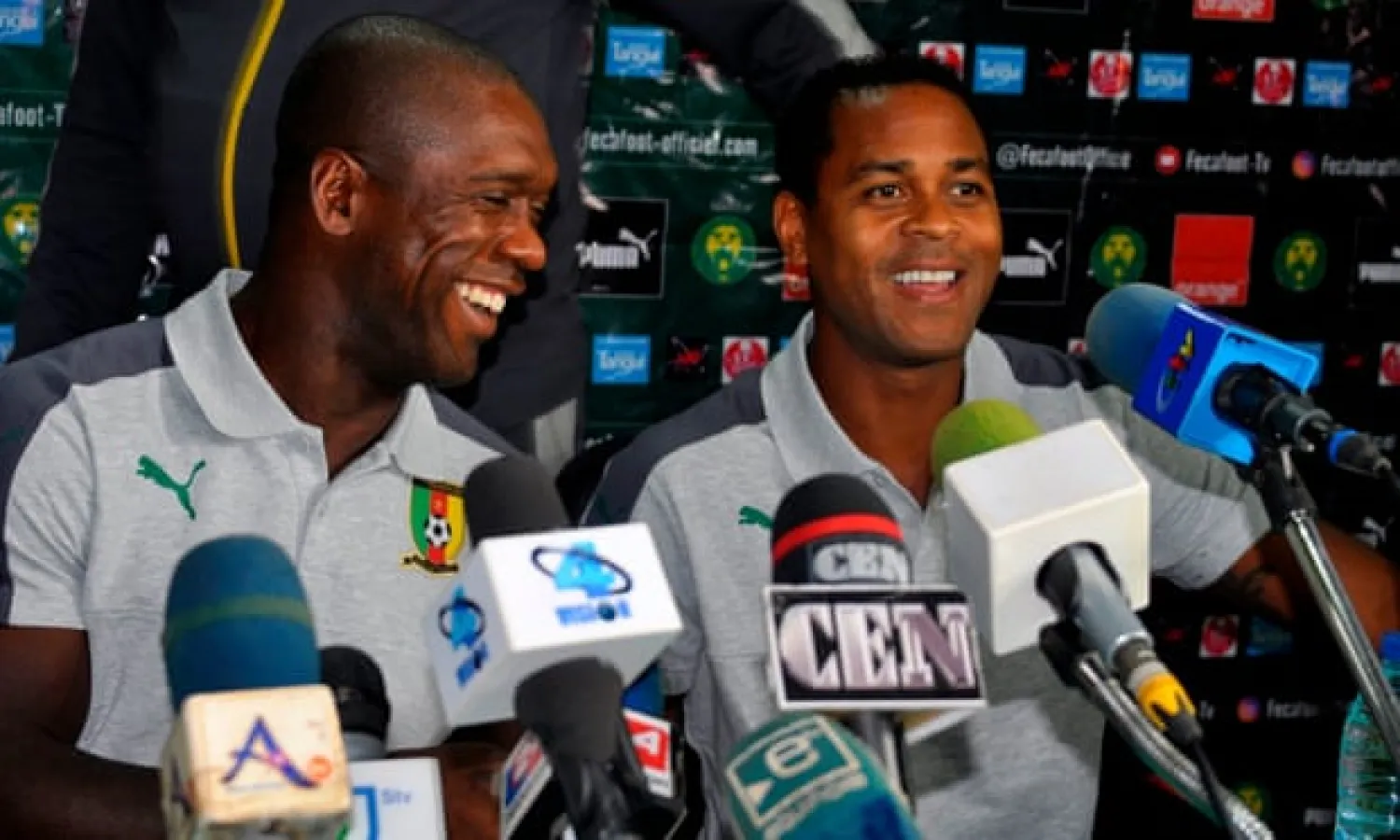

Seedorf, Kluivert Aim to Prove Doubters Wrong With Cameroon

 Clarence Seedorf and his assistant, Patrick Kluivert, are unveiled as Cameroon’s new management team in August. Photograph: Reinnier Kaze/AFP/Getty Images
Clarence Seedorf and his assistant, Patrick Kluivert, are unveiled as Cameroon’s new management team in August. Photograph: Reinnier Kaze/AFP/Getty Images
TT

Seedorf, Kluivert Aim to Prove Doubters Wrong With Cameroon

 Clarence Seedorf and his assistant, Patrick Kluivert, are unveiled as Cameroon’s new management team in August. Photograph: Reinnier Kaze/AFP/Getty Images
Clarence Seedorf and his assistant, Patrick Kluivert, are unveiled as Cameroon’s new management team in August. Photograph: Reinnier Kaze/AFP/Getty Images

Located at the tip of Grande Comore island in the Indian Ocean and surrounded by elegant palm trees that seem to look down on it like leafy floodlights, the Said Mohamed Cheikh Stadium is one of international football’s most picturesque venues. But when Comoros, ranked 149th in the world, host the champions of Africa on Saturday, all eyes will be on the visiting dugout, where Clarence Seedorf and his assistant manager, Patrick Kluivert, will oversee Cameroon for the first time.

Cameroon’s appointment of the Dutch duo last month, after negotiations with Sven-Göran Eriksson broke down, was hailed as a masterful coup by the officials who did the appointing but was more sceptically greeted by many other Cameroonians. The former national-team striker Patrick Mboma summed up the concerns when he said: “Seedorf has scant experience as a coach. He has never stayed on the bench of any team for more than six months, whether at Milan, Shenzhen or at Deportivo La Coruña, whom he was unable to save from relegation. And Kluivert … briefly managed Curaçao, which I do not think is enough to handle a big team like Cameroon.

“We are not disputing their fine careers as players but I’m surprised that with less than a year to the Afcon [the Africa Cup of Nations] that Cameroon is hosting we name two guys who have never worked in Africa and know nothing about African football.”

Aside from overlooking Kluivert’s role as the Netherlands’ assistant manager when they reached the 2014 World Cup semi-finals, Mboma’s summary sounded fair. And there was merit also in the suggestion – made by Cameroonians impressed by Aliou Cissé’s Senegal at the World Cup – that if leaps of faith were to be taken on people with little experience of successful management at the highest level, then why not give a Cameroonian coach an opportunity? But confronted with the fait accompli, Mboma said of the Dutch duo: “We have to give them a chance to prove what they can do.”

The pair’s lack of pedigree will certainly be raised again if Cameroon do not perform well on Saturday and beyond. Beating Comoros is considered to be a formality, even if the tiny island nation secured the greatest result of their short footballing history by holding Ghana to a 0-0 draw at home in 2015.

Seedorf and Kluivert have not shied away from contentious decisions. For their first squad they omitted two of the country’s most popular players, Benjamin Moukandjo and Christian Bassogog, both of whom were instrumental in last year’s continental triumph. That success earned them lucrative transfers to China, which have cost them their place under Seedorf. “Good young players don’t compete in China or in Asia,” he said, intimating he would give priority to Europe-based players. That was immediately criticised as an arrogant dogma that could not be sustained at a time when more and more Asian clubs are making irresistible offers for African players. Seedorf has a decent pool of players from which to select but not so deep that he can afford to discount players such as Moukandjo and Bassogog as a matter of policy. He seemed to relent a little in an interview on Cameroonian television, saying the pair were left out because there was no need for them to make such a long trip when their qualities were already well known. “We will definitely be engaging with them in the future.”

Seedorf could have pointed out that Moukandjo and Bassogog were also part of the squad that failed to reach the World Cup and that the previous manager, Hugo Broos, also dropped Bassogog, a thrilling winger on his day, after the victorious Afcon on the grounds that “he has to change his way of playing; it’s very predictable. If I were 40 years younger he would never go past me with the ball because everyone knows what he’s going to do. He emerged at the Afcon because teams did not know Bassogog but now they do.” Then again, for Seedorf to cite Broos might not have been shrewd given that the Belgian was sacked, 10 months after winning the Afcon, for falling out with several players as well as the ministry of sport.

In the credit column for Seedorf is the fact that Paul-Georges Ntep could make his debut on Saturday after accepting a call-up following several refusals. He made two appearances for France in friendlies before Euro 2016 but the forward has decided to pledge his international future to the country of his birth.

Seedorf has also given first call‑ups to the defenders Adrien Tameze of Nice and Jérôme Onguéné of Red Bull Salzburg. His squad also includes Carlos Kameni, Allan Nyom, Eric Maxim Choupo-Moting and André Onana, all of whom had declined selections in recent years because of differences with Broos or concerns about the mysterious workings of the Cameroon Football Federation (Fecafoot) and the ministry of sport.

Those two bodies’ feuding led last year to Fifa appointing a “normalisation committee” to oversee fresh elections of officials. That committee is still in place but football elections will not be held at least until after the country’s presidential election on 7 October, when the 85-year-old Paul Biya, ruler since 1982, will seek to extend his reign.

In the week before that election, as it happens, the Confederation of African Football is expected to give its verdict on the progress of preparations for the Afcon, having previously aired the possibility of stripping Cameroon of hosting rights if sufficient infrastructure improvement was not made. As hosts, Cameroon qualify automatically; if the tournament is assigned to somewhere else, then perhaps their group matches will count for more than fine-tuning, in which case the game against Comoros could turn out to be even more significant.

The coaching abilities of Kluivert and Seedorf are by no means the only factors of uncertainty affecting Cameroonian football right now.

The Guardian Sport


Hospital: Vonn Had Surgery on Broken Leg from Olympics Crash

This handout video grab from IOC/OBS shows US Lindsey Vonn crashing during the women's downhill event at the Milano Cortina 2026 Winter Olympic Games on February 8, 2026. (Photo by Handout / various sources / AFP)
TT

Hospital: Vonn Had Surgery on Broken Leg from Olympics Crash

This handout video grab from IOC/OBS shows US Lindsey Vonn crashing during the women's downhill event at the Milano Cortina 2026 Winter Olympic Games on February 8, 2026. (Photo by Handout / various sources / AFP)

Lindsey Vonn had surgery on a fracture of her left leg following the American's heavy fall in the Winter Olympics downhill, the hospital said in a statement given to Italian media on Sunday.

"In the afternoon, (Vonn) underwent orthopedic surgery to stabilize a fracture of the left leg," the Ca' Foncello hospital in Treviso said.

Vonn, 41, was flown to Treviso after she was strapped into a medical stretcher and winched off the sunlit Olimpia delle Tofane piste in Cortina d'Ampezzo.

Vonn, whose battle to reach the start line despite the serious injury to her left knee dominated the opening days of the Milano Cortina Olympics, saw her unlikely quest halted in screaming agony on the snow.

Wearing bib number 13 and with a brace on the left knee she ⁠injured in a crash at Crans Montana on January 30, Vonn looked pumped up at the start gate.

She tapped her ski poles before setting off in typically aggressive fashion down one of her favorite pistes on a mountain that has rewarded her in the past.

The 2010 gold medalist, the second most successful female World Cup skier of all time with 84 wins, appeared to clip the fourth gate with her shoulder, losing control and being launched into the air.

She then barreled off the course at high speed before coming to rest in a crumpled heap.

Vonn could be heard screaming on television coverage as fans and teammates gasped in horror before a shocked hush fell on the packed finish area.

She was quickly surrounded by several medics and officials before a yellow Falco 2 ⁠Alpine rescue helicopter arrived and winched her away on an orange stretcher.


Meloni Condemns 'Enemies of Italy' after Clashes in Olympics Host City Milan

Demonstrators hold smoke flares during a protest against the environmental, economic and social impact of the Milano-Cortina 2026 Winter Olympics in Milan, Italy, February 7, 2026. REUTERS/Kevin Coombs
TT

Meloni Condemns 'Enemies of Italy' after Clashes in Olympics Host City Milan

Demonstrators hold smoke flares during a protest against the environmental, economic and social impact of the Milano-Cortina 2026 Winter Olympics in Milan, Italy, February 7, 2026. REUTERS/Kevin Coombs

Italian Prime Minister Giorgia Meloni has condemned anti-Olympics protesters as "enemies of Italy" after violence on the fringes of a demonstration in Milan on Saturday night and sabotage attacks on the national rail network.

The incidents happened on the first full day of competition in the Winter Games that Milan, Italy's financial capital, is hosting with the Alpine town of Cortina d'Ampezzo.

Meloni praised the thousands of Italians who she said were working to make the Games run smoothly and present a positive face of Italy.

"Then ⁠there are those who are enemies of Italy and Italians, demonstrating 'against the Olympics' and ensuring that these images are broadcast on television screens around the world. After others cut the railway cables to prevent trains from departing," she wrote on Instagram on Sunday.

A group of around 100 protesters ⁠threw firecrackers, smoke bombs and bottles at police after breaking away from the main body of a demonstration in Milan.

An estimated 10,000 people had taken to the city's streets in a protest over housing costs and environmental concerns linked to the Games.

Police used water cannon to restore order and detained six people.

Also on Saturday, authorities said saboteurs had damaged rail infrastructure near the northern Italian city of Bologna, disrupting train journeys.

Police reported three separate ⁠incidents at different locations, which caused delays of up to 2-1/2 hours for high-speed, Intercity and regional services.

No one has claimed responsibility for the damage.

"Once again, solidarity with the police, the city of Milan, and all those who will see their work undermined by these gangs of criminals," added Meloni, who heads a right-wing coalition.

The Italian police have been given new arrest powers after violence last weekend at a protest by the hard-left in the city of Turin, in which more than 100 police officers were injured.


Liverpool New Signing Jacquet Suffers 'Serious' Injury

Soccer Football - Ligue 1 - RC Lens v Stade Rennes - Stade Bollaert-Delelis, Lens, France - February 7, 2026  Stade Rennes' Jeremy Jacquet in action REUTERS/Benoit Tessier
Soccer Football - Ligue 1 - RC Lens v Stade Rennes - Stade Bollaert-Delelis, Lens, France - February 7, 2026 Stade Rennes' Jeremy Jacquet in action REUTERS/Benoit Tessier
TT

Liverpool New Signing Jacquet Suffers 'Serious' Injury

Soccer Football - Ligue 1 - RC Lens v Stade Rennes - Stade Bollaert-Delelis, Lens, France - February 7, 2026  Stade Rennes' Jeremy Jacquet in action REUTERS/Benoit Tessier
Soccer Football - Ligue 1 - RC Lens v Stade Rennes - Stade Bollaert-Delelis, Lens, France - February 7, 2026 Stade Rennes' Jeremy Jacquet in action REUTERS/Benoit Tessier

Liverpool's new signing Jeremy Jacquet suffered a "serious" shoulder injury while playing for Rennes in their 3-1 Ligue 1 defeat at RC Lens on Saturday, casting doubt over the defender’s availability ahead of his summer move to Anfield.

Jacquet fell awkwardly in the second half of the ⁠French league match and appeared in agony as he left the pitch.

"For Jeremy, it's his shoulder, and for Abdelhamid (Ait Boudlal, another Rennes player injured in the ⁠same match) it's muscular," Rennes head coach Habib Beye told reporters after the match.

"We'll have time to see, but it's definitely quite serious for both of them."
Liverpool agreed a 60-million-pound ($80-million) deal for Jacquet on Monday, but the 20-year-old defender will stay with ⁠the French club until the end of the season.

Liverpool, provisionally sixth in the Premier League table, will face Manchester City on Sunday with four defenders - Giovanni Leoni, Joe Gomez, Jeremie Frimpong and Conor Bradley - sidelined due to injuries.
