



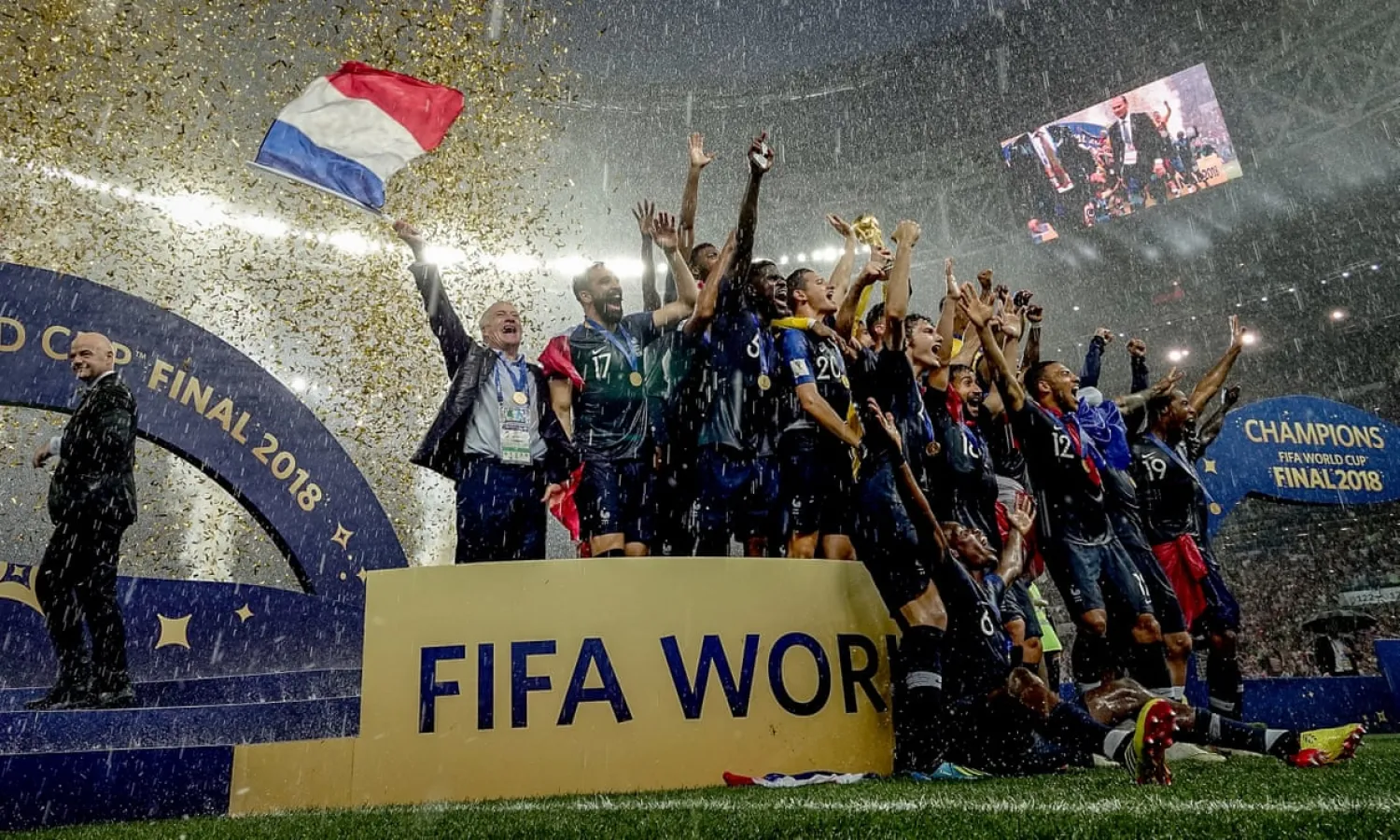

The crescendo for a team that finds itself growing as it hurdles the different stages of a tournament usually hits a high note at which everything suddenly seems incandescent with possibility. For France at the World Cup that came 57 minutes into their last-16 match in Kazan. Until that moment, Les Bleus had felt – perhaps even to themselves – like a work in progress. They had been effective but uninspiring in the group stage, their progress accompanied by rumblings from the media and public about how the team could eke more out of their talent. Then Benjamin Pavard set himself and struck a piercing volley to equalize against Argentina. He careered into a group embrace with his teammates in a state of euphoric disbelief. Everything felt instantly transformed.
Didier Deschamps did not need even a millisecond to settle on that moment as the catalyst, his team’s critical click. “It was the only moment at this World Cup where for nine minutes the French were about to be eliminated,” he says. “At that point, in the knockout round of the World Cup, to do that against Argentina, with their superior experience, gave our team so much conviction and determination. When you come out of a game like that there is nothing better.”
All these weeks later Deschamps pauses, exhales deeply, as if taking in the effect of it all once again. “The truth is, it gave us wind in our sails. From that moment our belief that we could go on changed.”
It is the nature of sports analysis to look for turning points, examine finer details, detect psychological nuances that can make the difference in the life of a team. Pavard’s goal was a significant moment, although nothing feels quite as important for Deschamps as the day he settled on the group he would take to Russia.
“The biggest decision I made was not during the World Cup but before, when I had to decide on my squad of 23,” he explains. “When you make your final list for the World Cup or European Championship you don’t take the 23 best players, that is for sure. But what I did was choose the best group that could go as far as possible together. I must say playing football is not the only consideration. Of course, they are brilliant players but there are other criteria – their character, their disposition to live together with other people and get on with their teammates. It is 24 hours a day for several long weeks. The environment that they live and work in is key.”
The prioritizing of the group dynamic is at the heart of his approach to tournament football. As France captain in what he calls “his first life” as a player he was a driving force in the team that won the World Cup in 1998 and European Championship in 2000. What happened next to that team is something that has stayed with him, taught him a lesson about the fragility of success, and emphasized how and when things need refreshing even from a position of supremacy.
France went to the World Cup in South Korea and were humiliated. “We arrived at the 2002 World Cup with two titles, very calm, well organized, maybe missing a bit of concentration. But the only truth is on the pitch. The dangers are there. The biggest victories can lead to the greatest foolishness. If you think: ‘We are here, we are winners‚’ no. France went as big favorites, had the best goalscorers from major leagues in the squad – France, England and Italy – and didn’t score a single goal! Football is not an exact science. It just shows how incredibly difficult it is to maintain the highest level.”
That dismal experience began a curious trend for defending champions to unravel and exit the following World Cup early. What happened to France in 2002 then happened to Italy in 2010, Spain in 2014 and Germany in 2018. Deschamps ponders what awaits for his current winners and cracks a joke about asking him again in four years’ time – if he is still in the job.
But there is a serious point about the psychological challenge of staying at the top, and Deschamps is not afraid to tackle it. “There is such a euphoric atmosphere and everyone is on such a high you don’t automatically pay as much attention as you should to maintaining that standard. You always have to remember – how and why did we manage to win this title? You mustn’t lose that. If you go in thinking you have proved yourself so don’t have to try so hard, that’s not going to work. It is in the moments of great victory that you make the most stupid mistakes.
“People always want the same thing: to carry on winning. But there are only two titles to be won every four years and you need so many favorable circumstances to go your way. There is an anticipation, a lot of emotion. I understand that. People think that because you are world champion you should win every game. It’s not like that. That would be too easy. There is the quality of your team but also what about those of your opponent?
“The impact of winning depends upon the generation. For those between 20 and 25 it is a booster, it gives them more confidence and determination to chase for more. For those in their 30s it is different as although they have so much experience they don’t have that feeling of having improvement in front of them. They know they are near the end. The biggest difficulty in sport is when you think you can’t do better. For the older ones, they are world champions and even if it is subconscious there is naturally a feeling of relaxation. That’s the danger. That’s where you have to say: this has to change.”
That is one of the reasons why Deschamps shook up his squad for the World Cup, even though two years before his team reached the final of the European Championship (an opportunity he regrets deeply that France did not seize). “At the Euros, we had quite a few players over 30 and I took the option in this World Cup to take 14 players who had never played in a big international tournament.”
He credits the mid‑20s gang, players such as Paul Pogba and Raphaël Varane, for being particularly influential. They were able to connect with both ends of the age scale and help bring the group together. Pogba was a notable leader in the camp. “He is someone in the middle – representing something for the younger generation because he has had success and knows what you need to get there, and he is respected by the older players because he was with them for the past five years.”
Respect within the team, or the wider public, is not a guarantee in international football. Deschamps considered the scenario that prompted Mesut Özil to withdraw from representing Germany, and the subsequent debate about nationality concerning players with mixed roots. Deschamps, as a part of the iconic black-blanc-beur collective of 1998 and manager of their equally multicultural contemporaries, has strong views about what it means to be French. “I start from the principle that any player who is French or has become French is selection-worthy. Some players have dual nationality and I am not going to take that away from them, they have freedom to choose, no problem.
“I give absolutely no consideration to a player’s identity, their race, their religion. In fact, it is good for any team to have diversity in it. But they have to agree that what they are representing is France. And like England, like Germany, like many other countries, France is a multicultural society.
“It was an idea that took off in 1998 but it was also something that was taken on by politicians because football has such media presence. They made out it was the representation of an ideal France. We are represented by sportsmen of different colors, different cultures, different religions, different origins, but that’s France. Quite apart from what they do on the pitch, it is a representation of our social reality. It’s a good vehicle for integration. There is a set of basic values that come across which can be transmitted – respect for your teammates, your opponents, the referee. This educational role is essential for young people.”
Deschamps was in London last week to pick up his award as Fifa coach of the year. He made a telling observation about the issues for young prospects in England to make inroads in international football compared with those in France. “The Premier League has a specific characteristic because they have economic resources nobody else has. A lot of foreigners come over to play,” he says. “In France a young talent who is 17 plays in Ligue 1. I’ve seen that in England it is more complicated. It takes longer. So it takes longer to get to international standard. But it seems there are a young generation of players who have particular quality, winning international titles at youth levels. They have the potential to improve and do something amazing.” The advice is transparent enough: get them playing.
Not everybody is suited for the life of international coaching. The rhythms contrast so much with the frenetic relentlessness of club football with its match day routines every three or four days. Long stretches without a game, gatherings which never feel long enough to get enough deep work done – these factors can be frustrating but Deschamps also values them enormously. Why? “I have a family life, tranquillity, freedom,” he says. “I have my life as a coach, and my life as a man with my wife and my son.”
Maintaining that normality and privacy is invaluable to him, as is emphasized by his answer to the question of where he lives: “France.” He smiles. No more details necessary. “I had a life before the World Cup and I will have a life afterwards. In my personal life nothing really changes. But in my professional life, there is nothing more incredible than to win the World Cup.”
So now his mind is focused on doing his utmost to ensure the standard does not drop. If the team needs to evolve, to be refreshed, so be it. “Everyone wants things to go on forever. But in football after a while either you have to change the coach or the players and in general it is easier to change the coach! What is really important is to constantly renew. If you end up doing and saying the same things the players fall asleep. That’s important to me – always come up with surprises. There is always more.”
(The Guardian)


